Pages

Showing posts with label Mary Skrenes. Show all posts

Mar 8, 2020

The 40 Years of Comics Project - Day 1838: Hard Time Season 2 #7, August 2006

https://www.comics.org/issue/297179/

First and foremost, this comic felt the most like a Steve Gerber comic of any issue in the series. There were splash pages, and big chunks of text, and weird technology. Gerber's earlier work, when it was at its best, pushed at the edges of the medium. In fact, I got into Howard the Duck after tracking down Mr. Gerber's illustrated prose ramblings in issue #16 of that series, having recently read his Vertigo offering Nevada. I get a similar feeling from Mr. Gerber's stories as I do from the music of Rush. In the documentary All the World's a Stage, the band are asked about their intellectual lyrics, and note that they figured if they could figure out these heady concepts, so could their audience. Steve Gerber's stories don't attempt to speak down to their audience. They assume that with a small bit of effort invested, concepts that might seem difficult can actually be easily understood and enjoyed.

I think it may be time to start seriously tracking down more of Gerber's work. I've got a fairly substantial collection of his writings, but there's definitely some holes, not suprisingly in his earlier works. And if he's a writer with whom you're unfamiliar, I highly recommend giving him a go. But be prepared for the weird.

More to follow.

Mar 7, 2020

The 40 Years of Comics Project - Day 1837: Hard Time Season 2 #6, July 2006

https://www.comics.org/issue/290967/

Cutter cuts loose! (Sorry, I had to.)

The confrontation between Ethan and Cutter comes to a head in the infirmary and Ethan manages to regain control of his spirit form in time to save the day. Cutter isn't dead, and appears to have some kind of understanding that Ethan is operating on another plane.

And that's it. The series ends. There's a coda issue tomorrow, but that's really all we have of what could have been a really great series. And I feel like so many things written about Mr. Gerber's writing echo that sentiment. His wonderful stories had this propensity to get cut short. I still contend that it's because he writes stories that are well ahead of their time. Give this one another 14 years, and we'll start looking at it the way we look at Howard and Man-Thing, brilliant prescient works.

One last visit with Ethan tomorrow. More to follow.

Mar 6, 2020

The 40 Years of Comics Project - Day 1836: Hard Time Season 2 #5, June 2006

https://www.comics.org/issue/278704/

Dealing with a backlog now - got some wrist pain with the cold weather.

Duane Cutter lies on an operating table and Ethan's spirit form is disarrayed by the circumstances. Meanwhile, the story of Cindy's journey to prison is concluded, and the efforts toward Ethan's emancipation progress.

A bit of a hodge podge of an issue, which isn't necessarily a bad thing. In extended stories like this you're always going to have an issue or two that can't focus on only one of the storylines because there are so many going on that are equally interesting and important. Were this published as one long graphic novel, we likely wouldn't blink at the sudden shifts between scenes - indeed, such a thing would heighten the tension of the scenes. But that atmosphere isn't really created in a serialized medium like this one. I recently read that Kurt Busiek is moving Astro City to a graphic novel-centered publishing model, so that the team can tell longer stories and take advantage of the "novel" aspect of the format. Busiek's wonderful superhero series is no stranger to long delays in the middle of 6 or 7 issue stories, and it certainly hurts the momentum of a piece when the last time you were immersed in the story was 7 months ago. Would Hard Time have been better served as a series of graphic novels, moving toward a European publishing model? Is the reason that the superhero thrives in the serial medium that they are infinite stories, whereas Ethan's story, a finite one, can't sustain a publishing format suited to infinite stories? Interesting.

Things finish up tomorrow. Sort of.

More to follow.

Mar 5, 2020

The 40 Years of Comics Project - Day 1835: Hard Time Season 2 #4, May 2006

https://www.comics.org/issue/278703/

Cindy's back story! She is such a fascinating character, occupying a very central yet liminal space in the jail. Her story is unsurprising in a lot of ways, being the story of so, so many queer kids. A mother that cannot accept her child's difference, the people at school cannot accept her difference, and it really is only in the prison that Cindy is allowed to be who she is. There's still cruelty, but in a microcosm of broken and damaged people, Cindy's particular difference is benign. As it should really have been on the outside too.

The Cutter story appears to be ramping up, and will hopefully have a satisfying(ish) ending in the next 2 issues. The final issue bears the label "49 Years Later," mocked up to look like the "1 Year Later" label that followed Infinite Crisis, which was occurring in the DCU at the same time as Hard Time, so I imagine any hanging threads of the current story will have to be dealt with before that final issue. I hope that any hanging threads of the current story will be dealt with. I'm still convinced that there are some of the ideas of Omega being dealt with in this series, though the setting skews things a bit.

My brain is not processing things properly today, I don't think. It's taking me ages to type this, and I'm not really saying anything.

More to follow.

Mar 4, 2020

The 40 Years of Comics Project - Day 1834: Hard Time Season 2 #3, April 2006

https://www.comics.org/issue/278702/

Things are getting more and more weird in the state Pen. With the arrival of Cutter, a serial killer covered in scars, we seem to be getting an opposite number to Ethan's psychic force, one that revolves around evil rather than good. And Ethan is, for all his 16 year old angst and attitude, a good person. Most bullied kids actually are, though the reaction to the bullying can often set them on a path toward repeating their abuse.

Ethan's psychic emanation reacts very poorly to Cutter's presence, and as Fruitcake Mullins suggests, it is because Cutter actually is evil. He puts forth that most of the inmates don't fall into that classification, in that they're cruel and mean, perhaps, but ultimately still possess some level of humanity within them. Mullins does not think the same of Cutter, and Ethan's reaction to him seems to bear this out. Which makes the final few pages of this comic much more disturbing, as Cutter performs what we could almost read as an initiation ceremony on Cindy, bringing her and another inmate, Hardin, into his orbit. Some of the language that Cutter uses hearkens back to ritual magic and practice - I feel like he might have linked somehow to Ethan's ancient lineage, had the series continued.

And who knows? Maybe he still will, but it'll have to happen over the course of the next 4 issues.

More to follow.

Mar 3, 2020

The 40 Years of Comics Project - Day 1833: Hard Time Season 2 #2, March 2006

https://www.comics.org/issue/278701/

Today's issue was much more prison drama than metaphysical action adventure. Ethan learns the hard way (which seems to be the norm for him) that even if you follow the rules of the penitentiary, you can sometimes lose.

The story, as with yesterday's, seemed much more about the establishment of the setting and situation than it was about furthering the plot. Much is made of the arrival of Cutter, a "celebrity" serial killer, who only shows up on the last page, and appears to portend trouble for our superpowered stalwart. Again, I'm sure that much of what we're being told was meant to play out over the course of much more than 7 issues, so I'm trying to read the series as if I didn't know it was cancelled prematurely.

Not so easy.

More to follow.

Mar 2, 2020

The 40 Years of Comics Project - Day 1832: Hard Time Season 2 #1, February 2006

https://www.comics.org/issue/278700/

Okay, I lied. I was really pumped to see what happens next, despite the surprisingly good Spider-Man comic I read yesterday.

It's hard to say how long is meant to have passed between the end of the previous series and the beginning of this one. Not too long, as Ethan is still 16, but I get the sense that a bit more time has passed, in that Ethan now seems to be much more in control of his spiritual body than we've seen previously.

This issue was basically a retelling of the first issue of the first series, in order, I have to imagine, to get new readers up to speed. This is a weird choice, in some ways, as we live in a world of trade paperback collections and ample back issue bins - and as the series is subtitled "Season 2," you'd think those interested might do a bit of research. That said, TPBs and back issues aren't always economically available to everyone, so perhaps the recap is necessary. Of course, because Mr. Gerber and Ms. Skrenes are very capable writers, the recap actually gives us some information that we previously had not seen. I'll admit, it was kind of a difficult comic to read. It's a pretty stark depiction of middle to high school bullying.

I was bullied as a kid. It might be a tough thing to wrap one's head around nowadays, as I'm a 6'2" white male, and I'm pretty large and imposing. And, to be fair, I've always been one of the tall kids. But I've also always been one of the sensitive and intellectual kids, and those kids are easy prey for bullies. Add to the horrific mixture of high school an extremely homophobic societal atmosphere, and a young person trying to figure out their sexual identity, and it's a pretty good recipe for bullying. I still deal with it, even today, though I like to think I've made some progress over the last few years. I can't stand bullies. I know we're supposed to pity them, that they're likely getting mistreated themselves in some aspect of their lives. But I've seen bullying ruin lives, up close, and I'm shocked that it's still so prevalent in pubescent culture. We can do better - we simply have to be willing to tell boys no every now and again. And girls, I suppose. All teenagers can be cruel.

I am excited/saddened to read the next six issues. I think Ethan's story could have been epic if it had been given the life span it deserved.

More to follow.

Feb 29, 2020

The 40 Years of Comics Project - Day 1830: Hard Time #12, March 2005

Well, that doesn't bode well for Year 6. A busy week at work. Apologies.

https://www.comics.org/issue/226575/

Ethan's birthday is rife with portent. If Fruitcake Mullins is to be believed, the tone of the series has dramatically shifted. Ethan has asserted some control over the force, stepping into a story much bigger than his own. The difficulty now lies in the fact that the second series only runs 7 issues, and Mr. Gerber has since passed away. Hopefully he gets a chance to tell Ethan's story in a relatively satisfying manner, though not nearly so satisfying as a longer run might have been.

I begin to wonder if Hard Time might be playing with some of the ideas that Gerber and his writing partner Mary Skrenes (who co-wrote this series too) had with regard to Omega the Unknown. There's an interesting parallel to be called between Omega and James-Michael, and Ethan and the Red Force. Both young men are mature for their age, precocious, and sense a strange affinity for a semi-voiceless super-powered force. Could it be that in Omega, James-Michael may have come to realize that he was controlling Omega? Or perhaps Omega and James-Michael's stories would have reached back into ancient Earth history, and shown them to be products of an ancient technological culture? Given Ms. Skrenes' involvement, I don't think it's that big a leap. Now I'll have to go back and read Omega and see if there's any indicators.

Taking a short break from Hard Time, just a few days, and then back to Ethan's story.

More to follow.

Jul 5, 2017

The 40 Years of Comics Project - Day 861: Omega the Unknown #10, October 1977

https://www.comics.org/issue/31556/

There's an argument to be made that this would actually be a great place for us to leave the story of Omega and James-Michael. I'm kind of reminded of the Milligan/Fegredo series Enigma, in which the main characters simply walk off screen at the end and we stop following their story, even though some of the plot points aren't quite cleared up. The end of today's comic would make an interesting ending, though leaving us hanging over the revelation of new versions of James-Michael's parents would be a bit cruel. But Omega's end in this issue? It could totally work.

One of the letters in today's comic articulates my own reaction to Omega, and strengthens that Lynchian vibe (especially after Twin Peaks episode 8 - what the hell was all that?!): I have no idea what's going on in this comic. It offers hints of a narrative that we just don't have enough information to fully comprehend quite yet. Why does the caped man want to make lots of money in Las Vegas? What's the deal with the weird secret-compound-like state of James-Michael's old home? And the fact that we can't comprehend it is just fine. Not everything we hear, or experience, is comprehensible. Why, then, should our stories be?

I had mentioned that this was only sort-of the end of Omega. Though the comic promises that the story will be finished somehow in the pages of The Defenders, Steve Gerber and Marvel acrimoniously parted ways not long after this comic was published, and the finale of Omega was handed to Steve Grant. So there is a final chapter to this story in The Defenders (and I'm in the process of tracking it down), but it won't be the ending that the story was heading toward, or deserves.

Glad to have read this - it cements my thinking that Steve Gerber was just too far ahead of his time to garner the kind of success he deserved. Had he been one of those up and coming writers during the British invasion of the late 80s, I think he might have rivaled Moore, Gaiman, or Morrison in terms of fame and popularity.

On to something different tomorrow. See you then.

Jul 4, 2017

The 40 Years of Comics Project - Day 860: Omega the Unknown #9, July 1977

https://www.comics.org/issue/31242/

Gerber and Skrenes return for the last couple of issues of Omega, and as yet there's no indication, either narratively or from the editorial pages, that the title is in danger. One potential indicator is the divided response from readers on the letters page. Some are so very into the style of storytelling that Omega is beautifully demonstrating, and some see it as nothing more than wordiness and meandering that has not place in a superhero comic. I think this demonstrates a fundamental way (or two, really) of understanding superhero comics, and one that leads into that old saw of the genre being little more than adolescent power fantasies. Omega eschews that description by actually placing an adolescent in the story who is completely atypical for that demographic, and by utilizing a heroic figure who does not buy into the rigidity of superheroic practice that one might glean from other Marvel comics of the time.

One thing I'd like to note is the way that the regular writing team re-enters the comic with little or no hiccup over the fill-in teams. This is one of the advantages of the Marvel method of comic creation that was at its apotheosis in the Seventies. Both Scott Edelman and Roger Stern would likely have worked from a synopsis supplied by Skrenes and Gerber, in that Richard Rory shows up (which was intimated before the fill-in issues), as does the Fookkiller. Both of these are characters from Gerber's tenure on Man-Thing, and it's unlikely that they would have simply appeared in the story if there wasn't already a precedent in the plotting. So while the issues were definitely not on the same level as those written by the regular team, they still contribute to the overall plot (what little we have) set out by that team.

I think.

As with many of Gerber's other works, the character for whom the title is named is in many ways a secondary character, and it's the characters who are more of the secondary mold that move into the limelight. Omega himself is interesting, but not nearly so much as the little tribe that is forming in the Hell's Kitchen apartment with James-Michael. Though, that said, their story would likely not be quite as alluring if there wasn't the intimation of connection with Omega. It's so sad that tomorrow's issue is the last one. Sort of...but we'll talk about that tomorrow.

To be continued.

Jul 1, 2017

The 40 Years of Comics Project - Day 857: Omega the Unknown #6, January 1977

https://www.comics.org/issue/30681/

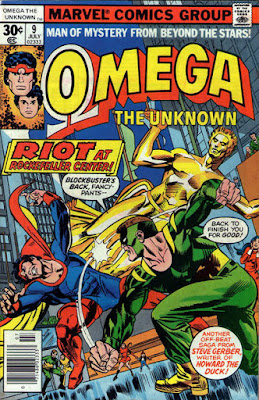
Though Omega stands head and shoulders above much of the mainstream superhero output of the Big Two in the 70s, it doesn't always manage to avoid the annoying cliches of the medium of its origin. Today's cover is so thoroughly misleading. Let's look just past the fact that the antagonist is actually a blonde man in the comic itself (strange that that could be missed in the colouring. I wonder if the same person does the colour guides for the cover and the interior?). The large man in the overalls also appears to be specifically targeting Omega, and to be villain monologuing at the same time, neither of which is actually the case in the comic. Instead, we have a mentally-unbalanced man hearing voices and having a large amount of pain in his head lashing out at all and sundry in an effort to make the pain stop. What Gerber, Skrenes, and Mooney are obviously doing in the comic is portraying a very seriously disturbed man who is little in control of himself. What the cover depicts is a "bad guy."

There's conversations to be had about a number of things here. First we can think about this in terms of judging books by covers. That's what much of the comics industry relies on, really. A catchy, well-designed cover will draw the eye, and tempt one into looking within. And if that cover also features some awesome-looking action starring our hero, so much the better. It's not that cover is completely lying about what happens in the issue. Omega is attacked by a large man with a wrench (though it's the bullet between the eyes that ultimately takes him down !!?!), it's just there isn't the actual intent behind it that seems to be being portrayed here. Second, and this might be a stretch, portraying this man as villainous on the cover but troubled in the interior problematically stigmatizes mental illness. It's quite obvious from the interior captioning that we're supposed to have some sympathy for this man struggling with what seems like an insurmountable psychic problem. So to see him as villainous on the cover implicitly links dealing with serious mental illness to villainy. That's worrying.

Did I mention that Omega gets shot in the head right in front of James-Michael in this issue?

The next two issues of the series are guest-written. My thinking is that this is when Gerber started really being in conflict with Marvel over HTD, which perhaps necessitated some fill-ins. I wasn't going to read them, but I think I actually will. One is written by Roger Stern, who's a writer I really like, so that'll be cool.

To be continued.

Jun 30, 2017

The 40 Years of Comics Project - Day 856: Omega the Unknown #5, November 1976

https://www.comics.org/issue/30434/

Omega (who's only been called that in the press, and never refers to himself by that name) has that most 70s of superhero experiences in today's issue: the mystical experience.

A fair number of comics writers and artists in the 70s started thinking about the superhuman as vehicle for the kind of experience usually relegated to psychedelic entheogen trips. I posted an example in a review of a Jim Starlin Warlock comic a while back, and as I note there, it's pretty typical of the superhero transcending consciousness.

Omega is attacked by two ghostly cats, servitors of El Gato, villain du jour, who push him from his dimension into astral realms. A strange reaction between Omega's powers and the dimension he's in actually disintegrates his body...and when next we see him, he's sitting in an alley outside the shop he's been staying at all this time. Though we do get a bit of the psychedelic weirdness of the other dimensions, it's interesting that there appears to be an entire portion of Omega's experience that we're not privy to - that which comes after his discorporation. We could assume that he wakes up immediately in the alley, but there's narrative that takes place between those events, which gives the impression of time passing after his body vanishes. Unlike many of the mystical odysseys superheroes went on in this era, we're not told nor shown all of the revelations Omega might have had. Either they're indescribable, in which case why try (let's ask H.P. Lovecraft that!), or Omega himself doesn't really understand or remember what happened. Either way, we're focalized through the character of Omega through omission rather than through inclusion, which I think is an interesting way to approach focalization.

Omega does bring down El Gato in this issue, with a little help from his friends. And James-Michael endures some of his own rather violent adventures at school.

To be continued.

Jun 29, 2017

The 40 Years of Comics Project - Day 855: Omega the Unknown #4, September 1976

https://www.comics.org/issue/30224/

There's a fairly large distinction between something intended for serial publication and something intended to be published as a standalone story in a single volume. It's unfortunate that in the 70s, Marvel, and most other publishers, were not quite as receptive to superhero graphic novels as they are now. Omega the Unknown is, almost undeniably, a single story, one that needs, or needed, to be told in its completion, rather than serially. While the story is, as the effusive praise of the letters page testifies, maintaining a lovely mystery around the two main characters, it's not really doing the sorts of things that serially-intended tales need to do. Each issue is building on the previous one more like chapters of a novel. The difference between a chapter ending and a serial publication ending is one that I talk about when I'm teaching comics, especially when I'm teaching collections of comics originally published on a monthly/bimonthly basis. Such stories will, generally, have some kind of cliffhanger at the end in order to bring the reader back to the series the following month. I am, of course, speaking in vast generalities here, but by and large if you're telling a story that you want to make sure your reader is willing to remember and come back to, you need to have a hook of some kind.

Omega, while it has subtle hooks, doesn't have the momentous, climactic moment at the end of each issue that entices the reader back. It's more an impending sense of revelation than the revelation itself.

Which, of course, is what will keep me coming back over the next few days to finish the series, but is also probably ultimately what contributed to the low sales of the series. As critics of Lost are wont to point out, you can only go so far without revealing some details of your primary mystery, and my sense is that not much of it is revealed in the 10 extant issues of Omega. But this likely has to do with the fact that the climax of the story is meant to be the revelation of the mystery, and once revealed, the story is done.

To be continued.

Jun 28, 2017

The 40 Years of Comics Project - Day 854: Omega the Unknown #3, July 1976

https://www.comics.org/issue/30029/

Omega is entering slow-burn territory, and I don't have a whole lot to say about this issue. Our hero, well one of them, does manage to escape from Electro and disable the strange robot that seems to have followed him from wherever he came from. Meanwhile, James-Michael starts school, is antagonized by a bully, and makes friends with some other kids.

And that's it.

This is not to say that the comic wasn't enjoyable, just that not much happened in it. Maybe tomorrow will be a bit more eventful.

To be continued.

Jun 27, 2017

The 40 Years of Comics Project - Day 853: Omega the Unknown #2, May 1976

https://www.comics.org/issue/29847/

The second issue of Omega continues to be mysterious and strange, and more and more as I read it it reminds me of a 90s Vertigo superhero comic, albeit with the very, very Seventies use of the second-person caption box (i.e., the narrative voice speaking directly to the character using the pronoun "you").

Both the Hulk and Electro show up in today's comic. In the initial issue, there was no real mention of any of the other Marvel U characters, and part of me thinks that the story might have benefited from not actually being a part of the Earth-616 continuity. It seems to be telling a very different kind of superhero story from the mainstream. On the other hand, the inclusion of Omega in the Marvel U allows us to hold the character and situation up in contrast to something like the X-Men or Avengers in terms of how it is treating the superhero and its relationship with both individuals and with the society it inhabits.

That said, the Hulk is not necessarily the best comparison in this case. Where Omega appears to be fulfilling a traditional superheroic role, the Hulk is quite far from that, at least in the incarnation that appears in this issue. I think a far better comparison might have been, in this era, the Defenders, whom Gerber was scripting at the time, or even someone like Captain America, whose history up to this point very often involved younger sidekicks. Part of the story, as confirmed in the text piece by Gerber in the first issue, is considering the relationship these sidekick characters have with the heroes they assist, and how the relationship might be envisioned when the hero is not completely, or at all, human. Not that James-Michael is a "normal" young man, but, as far as we know, he's still human, whereas Omega is...something else.

If I want to speculate a bit, I'm thinking that Omega is actually from the future, and James-Michael is either him as a young boy, or a template from which Omega will be created. Though, as I noted yesterday, the answer to this question, or the Gerber/Skrenes answer to this question, will likely never be told.

To be continued.

Jun 26, 2017

The 40 Years of Comics Project - Day 852: Omega the Unknown #1, March 1976

https://www.comics.org/issue/29661/

Today we begin one of the great mysteries of Marvel Comics. Well, it's sort of a mystery. Omega the Unknown was cancelled after 10 issues, leaving numerous plot elements dangling and a promise from writer Steve Gerber that he'd finish the story one of these days. Unfortunately, Gerber and Marvel acrimoniously parted ways before that could happen, and Gerber never revealed how the story was meant to finish. Steven Grant wrote a conclusion to the series in The Defenders, but the Gerber/Skrenes/Mooney version sadly never saw the light of day.

Today's issue offers a nice, if very strange, set up for the series. It might be all the Twin Peaks I've been watching over the last little while, but this comic has a very Lynchian vibe. I'm not surprised, though. Gerber and Lynch have very similar sensibilities when it comes to utilizing the ridiculous to communicate a point. The stories of Omega and James-Michael are told in parallel, only coming together at the end of the issue. In fact, much of the Omega storyline is communicated to James-Michael as a dream, so right up until the end of the issue we're wondering if the superheroic action of the story is actually all dream.

Of course, then there's the problem of James-Michael's parents, whose bizarre fate lets us know that while he may be dreaming about strangely-costumed heroes, James-Michael is inhabiting a very strange story all his own. There's a wonderful ambiguity to all of the events that occur in this comic, and just enough hinting that there's a bigger picture we just can't see to bring us back for another issue.

To be continued.

Apr 5, 2015

Live-Post: Reorganizing my comic collection, Sunday, April 5, 2015 @ 17:47

I was just filing Jonathan Lethem's re-imagining of  Omega the Unknown. I just picked up a hardcover collection of it at my local Chapters for 8 bucks. It pays homage to Steve Gerber's bizarre little 70s project, one of the great mysteries of superhero comics. Gerber fell out with Marvel well before the original series ended, and he, to his dying day, never (at least to my knowledge) revealed how the story was supposed to end. I think Marvel had someone finish it up in Defenders some time later, but Gerber (and co-writer Mary Skrenes) never revealed what was meant to happen.

At this point, I think whatever we've imagined is going to be better that what was. But then again, it was Gerber, and he's never disappointing.