Pages

Showing posts with label Thor. Show all posts

Jun 25, 2019

The 40 Years of Comics Project - Day 1582: Thor #373, November 1986


Earlier on in my reading of this crossover, I noted that there were issues that were not necessary for enjoyment of the story. I'm going to revise this statement. As I read through, I've noticed that each issue is telling an important part of this tale, with one or two possible exceptions. Today's issue, much like yesterday's tells an integral part of the Massacre storyline, specifically its impact on X-Factor and on Angel. This issue has got to mark one of the very last appearances, at least for a few decades, of the traditional Warren Worthington III as Angel. Shortly after the events of the crossover, Angel is "recruited" by Apocalypse and becomes Archangel, a look and character revision that sticks around for quite some time, and heralds the beginnings of Marvel's attempt to become grittier in the late 80s and early 90s.

I've been very much enjoying the Thor comics I've been reading over the last little while. I've heard fabulous things about Walt Simonson's run on the title, though I only have a few issues of it. I'm sure it's been reprinted, so perhaps I'll have to save up my pennies.

Thor's involvement in this crossover speaks to his commitment to Earth and its people, including the disenfranchised beneath the streets of New York. Thor is often compared to Superman, favourably, in comparisons of the various heroes and teams in their respective universes. Though much of this has to do with Thor's extremely high power levels, it also has to do with his desire to connect with humanity, and to serve them as best he can. I've written extensively about this relationship between humanity and divinity from the Superman perspective. I'm curious how Thor's relationships and narratives speak to this idea, considering that rather than being an original hero, these stories are meant to be continuations of a much longer mythic history. Fodder for the next degree, perhaps?

"I think my old friend Puddlegulp has recognized me even though I...I was not wearing a beard when last we met."

Mar 10, 2017

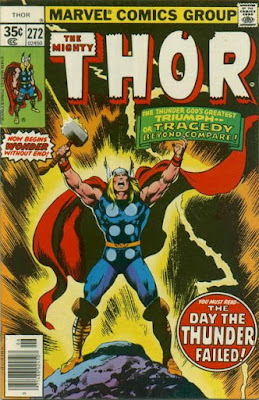
The 40 Years of Comics Project - Day 744: Thor #272, June 1978

https://www.comics.org/issue/32351/

A bit more sword and sorcery, though the first words in this comic are "Portrait of a super-hero." Thor has always been a tricky one for me. I think it's that attempt at faux-Shakespearean dialogue that puts me off. Even people in Shakespeare's time didn't speak like that. It's poetry, not conversation.

Today's comic fits into a neat little subgenre that I might have to start tracking: the text of mettle. Thus far I can think of only one other example in my collection, though I imagine there's others. The basics of the genre are thus: a hero wanders into a situation in which they are faced with having to perform a certain number of tasks or they'll be imprisoned/killed. The tasks seem easy enough (i.e., in this issue, Thor is tasked with lifting a house cat), but, for some reason, are virtually impossible. Once the tasks are all failed, the hero thoroughly confused about said failure, the antagonist reveals themselves to have been testing the hero's fortitude, and that the challenges were actually remarkable feats (the aforementioned cat, for example, was actually the Midgard Serpent, which Thor managed, impressively, to lift slightly), and that the hero has proven themselves worthy. There's a Supreme back-up story in one of Alan Moore's Supreme issues with a very, very similar tale. And I'm sure that both of these stories draw inspiration from older pieces. I'm curious to see if such stories appear every now and again in a superhero's myth, at moments where, either narratively or ontologically, it makes sense to test and reaffirm the fortitude of hero. I'll think some more on this.

To be continued.

Sep 28, 2016

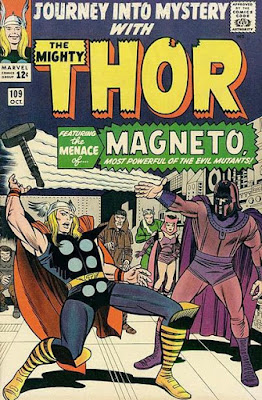
The 40 Years of Comics Project - Day 581: Journey Into Mystery #109, October 1964

http://www.comics.org/issue/18695/

My understanding is that this is one of the very first times that a villain from one Marvel property crosses over into another. While I'm not always a fan of Stan Lee's writing (as much of it as is his, anyway), this story is interesting as Thor really stumbles into the middle of an X-Men adventure, and, by the end of the story, admits that he's not really sure what just went on. The X-Men themselves appear off-panel, an optic blast here, a freak blizzard there. One of the most intriguing parts of the story is the single line we are given by The Scarlet Witch, in which she laments having to work for someone so evil as Magneto. I'm not sure how long after this she and her brother join the Avengers, but it really does look like a story line that may have been in the works for some time.

I'm not overly familiar with Thor's body of writings, so I was quite surprised to see Jane Foster as his nurse in the Donald Blake secret identity. Though Marvel has gone through numerous reality-shifts since this story was published, can it be that this is the same woman who now bears the mantel of Thor? She's not quite the physicist we've come to know from Natalie Portman's portrayal in the MCU, but I could see her desire to take care of the sickly Donald Blake translating nicely into a desire to take care of a sickly world in her superheroic guise.

Where will we go tomorrow? Suggestions?

Onward.

May 25, 2016

The 40 Years of Comics Project - The Weekly Graphic Novel: Week 8 - Ultimate Comics Thor, 2011

http://www.comics.org/series/52654/

As much as I would consider myself a rabid fan of Jonathan Hickman's writing, there's a substantial chunk of it that I haven't read as yet. His work in Marvel's "Ultimate Universe" makes up a significant portion of that chunk, and this is mainly due to having heard that, in contrast to his Earth-616 Marvel work, it's not that good.

But let me back up a moment.

The other thing keeping me from exploring this series, and others in the Ultimate U that Hickman has written, is my lack of knowledge about, and my dislike for, this particular version of the Marvel Universe. I've railed on about the grittiness of the current crop of DC films, and Marvel's Ultimate U, though it's genesis in Ultimate Spider-Man was less so, emblematizes this proclivity for gritty superheroes. And, honestly, I thought we'd had enough of that in the 90s. I've never really understood why realism seems to have to equal darkness. And that's how I've long perceived the Ultimate U. I'm happy to be proven wrong, but I'm pretty sure I'm hitting the target dead center here.

That said, Ultimate Thor is actually pretty good. It's still dark, it's still bloody, but it also tells an interesting tale spanning millennia, establishing the place of Asgard and the Norse mythos in the Ultimate U, and, in a nice twist, linking Ragnarok with the Second World War. I especially enjoyed the notion of gods being reborn as mortals, and having to deal with losing the power they once understood as intrinsic. Carlos Pacheco's art in this book is lovely, and in the sections near the end where we're seeing a different perspective on the events of the first run of The Ultimates, his style nicely apes/meshes with the Hitch/Neary widescreen action of that series. But there's where I have to become a bit critical. I'm not sure how much the end of this series would have made sense had I not read The Ultimates all those years ago when it came out. The supposed impetus for the Ultimate Universe was to allow readers who had not followed 35-40 years of continuity to enjoy the stories of the Marvel characters they were beginning to see in the movies. I distinctly recall the rhetoric surrounding the project, claiming that someone with no knowledge of any of the Marvel characters could pick up an Ultimate comic and not feel lost.

I can't imagine that this would be the case with the Thor series. But that's a small thing, really, especially considering that this series came out about a decade after the inception of the Ultimate universe. And a fictional universe with a decade-long history is going to have to have some expectations of continuity.

In the end, though, it's true: this series is not nearly as good as Hickman's work in the regular Marvel universe. It seems to lack the grandeur that, I have to say, is present in pretty much all of his other work that I've read. And seeing as how this is a story about gods, it should be pretty grand.