Pages

Showing posts with label Glenn Fabry. Show all posts

May 12, 2017

The 40 Years of Comics Project - Day 807: Greatest Hits #2, December 2008

https://www.comics.org/issue/542862/

This comic continues to be entertaining, and I think it's likely I'll be tracking down the remaining issues. My concerns over some of the more inflammatory bits yesterday were, I think, unfounded. Our narrator, Nick, is kind of an ass, so his use of derogatory language toward trans people is in keeping with the character. As, I think, is the behaviour of The Mates in Newark. Mr. Tischmann and Mr. Fabry are going for accuracy through a historical lens, rather than a contemporary one, which adds to the authenticity of the piece, and also has us question the often misplaced nostalgia for the bygone era of the Summer of Love.

But I'm feeling crappy again, so I don't have much more to say.

To be continued.

May 11, 2017

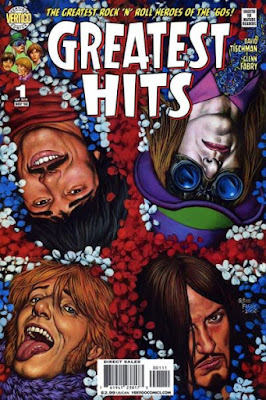
The 40 Years of Comics Project - Day 806: Greatest Hits #1, November 2008

https://www.comics.org/issue/542861/

What if the Beatles had been superheroes?

That's the driving question behind today's comic, and it certainly is an intriguing one. And the fact that it's drawn by Glenn Fabry doesn't hurt either. Known, in large part, for his wonderful covers for the Preacher series, his interior work is quite different, but no less compelling.

I wanted to like this series. It really seemed to be meshing a couple of things I really loved, but there's some problems with the story. The opening splash of superteam "The Mates" (that's them up on the cover) quelling unrest in a predominantly black neighbourhood in Newark seems a bit...off. The heroes appear to be joining the police in beating down the rioters which, from a particular point of view, puts the squarely on the wrong side of history.

And then later in the comic there's some derogatory language used in reference to a transsexual prostitute. Now, I'm willing to go with the notion that it might all be for a reason, that the use of this kind of language is a way of establishing the prejudices of the narrator, or that the Mates' involvement in a race riot is being used to depict poor choices they've made, but there isn't much indication of that in the comic itself. I'll give the second issue a go tomorrow (which is all the issues I actually have), and then we'll see.

Sorry - a brief and not too insightful post. I'm tired.

To be continued.

Mar 2, 2016

The 40 Years of Comics Project - Day 372: A1 #3, 1990


Our last little look, for now, at the short comics writing of Grant Morrison ends with quite a long book. A1 features some really, truly wonderful, weird, and generally excellent stories. It's a who's who of luminaries in the comics industry of the early 90s, with Morrison's presence being accentuated by Alan Moore, Brian Bolland (who writes and draws a story, in poetry, as well as providing that amazing cover), Philip Bond, Steve Parkhouse, Glenn Fabry, John Bolton, and Moebius. The stories are all weird (except Bond's, which is just kind of lovely), so Morrison's "The House of Heart's Desire" is in good company. I always get this story mixed up with his prose piece "The Room Where Love Lived," but that's only because they're works I'm less familiar with.

What more can I say? The real importance of this story comes in one panel, midway through the piece. The protagonist, with a door strapped to his back, has just come through a stinking forest, and is making his way toward a city of ghosts. The sign that points the way has a single word upon it: Barbelith. I'll point out that this comic is from about four years before Morrison's The Invisibles saw the light of day, and made the word Barbelith so very important for those of us who delved into the Supercontext.

Back to random craziness from the collection tomorrow. See you then!