Pages

Showing posts with label Frazer Irving. Show all posts

Mar 24, 2017

The 40 Years of Comics Project - Day 758: Fort - Prophet of the Unexplained #4, September 2002

https://www.comics.org/issue/713341/

And so things wrap up for Charles and Yhir. Actually, they wrap up pretty darned quickly, like within the first 5 or 6 pages. The feeling I get is that the Fort series really is more properly a graphic novel, or rather a complete work rather than a periodical publication. Or it should have been. Much of this final issue is aftermath and epilogue, though there is, in true horror movie fashion, a return of the baddie in the final pages. What we see, though, and this is significant for those who know of Fort's work, is his rededication to his work of chronicling "the Damned," the occurrences and people that simply cannot be explained by science.

This was a good series. I almost see it as a prequel to Irving and Rennie's Necronauts (did I already say that? Having deja vu). The young Mr. Lovecraft, Fort's child sidekick so to speak, begins writing after the confrontation with the alien virus, and I could see him growing up to become the same character that takes part in the Necronauts' adventure.

I think that was my first series for this year. What next?

To be continued.

Mar 23, 2017

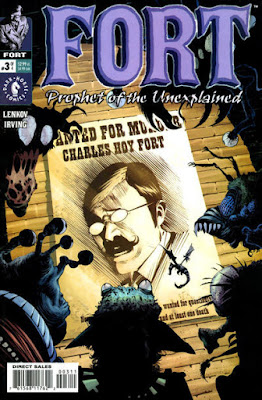
The 40 Years of Comics Project - Day 757: Fort - Prophet of the Unexplained #3, August 2002

https://www.comics.org/issue/713340/

Charles Fort is a study in contradictions in this issue. Though he makes his way around New York on a horse-drawn bookmobile, he also manages to go full-on action hero in this issue, actually engaging in a controlled slide down the Statue of Liberty, then chasing a giant alien virus into a sewer with a flashlight taped to a rifle. It's a wonderful reconception (I'm assuming this. Perhaps the real Fort actually was an adventurer) of a historical character. I'm going to be talking with my class about this next week, the notion of taking real people or places and fitting them into a fiction. My argument at the end of class today was that history is more often made up of events than of people. Even when we do recognize people as historically significant, it's because they are somehow attached to an event of historical significance. What the kind of fictionalization that Fort traffics in does is remind us that the people involved in those historical events, be they the fundamental figures or simply faces in the crowd, are, or were, each individuals with their own personalities, ideas, and dreams. As I teach Natalie Asplund's Redcoat West, and then teach factual accounts of the Northwest Mounted Police, I ask my students to notice what fiction is doing for us. It humanizes the historical. Biography and autobiography can also serve the same purpose, as long as we recognize that these, too, are forms of fiction. There's no such thing as an objective record of human experience, as far as I can tell.

Of course, some fictionalizations are more...real...than others. The one in Fort leaps over the cliff of the real and into complete fantasy, but it still reminds us that the real Charles Fort, the one who compiled the wonderful books that serve as his legacy, was a human being, perhaps even an adventurous one. And wouldn't it be just lovely if he actually did save New York from an alien virus from the back of a horse-drawn bookmobile?

To be continued.

Mar 22, 2017

The 40 Years of Comics Project - Day 756: Fort - Prophet of the Unexplained #2, July 2002

https://www.comics.org/issue/713339/

Fort and Yhir, his alien comrade, track an exo-virus through the nighttime streets of New York. I like to live my life believing that this sort of thing was happening all the time in the late 19th and early 20th centuries. There's just something about that early Industrial Revolution setting that lends itself to the strange and weird crawling from their hiding places in the fog and smoke-shrouded streets. And if this is how Fort collected his data for his strange books, so much the better.

It's interesting to see Frazer Irving's artwork on this piece and to compare it to something like Annihilator, which I read a few weeks back. His style is quite different without the digital colouring and someone else inking him. He's also playing with shadow a lot more, or it's a lot more noticeable here, though that makes sense in the context of the story. I enjoy this kind of versatility in an artist, every bit as much as I appreciate it in a writer. There's something to be said for consistency in art style, knowing what it is you're going to be seeing when you buy a work by a particular artist, but there's also something to be said for being surprised, pleasantly so, each time. Thus far, Irving's work has had that affect on me.

To be continued.

Mar 21, 2017

The 40 Years of Comics Project - Day 755: Fort - Prophet of the Unexplained #1, June 2002

https://www.comics.org/issue/713338/

You have to love Charles Fort. I'll admit that I enjoy delving into the irrational side of the world every now and again, but this guy made a life out of it. His catalogues of the weird read somewhere between scholarly treatise and science fiction. His dedication to chronicling the things we can't understand is inspiring. It obviously was for Mr. Lenkov and Mr. Irving.

This comic reads like a Lovecraft story. Really, that's one of the primary reasons I bought it in the first place. Irving was the artist on Necronauts, another comic that uses historical figures associated with the weird as main characters. I like to think that Fort exists in a similar, if not the same, universe. Though his little sidekick H.P. might mess with that theory.

Today's issue is very much set up, as the openings of all good limited series ought to be. Businessmen are going missing, strange lights have been seen in the sky, and librarian Charles Fort thinks there's a connection. Actually, let's call him an "action librarian." Which, really, is kind of amazing. How does one go about getting that job?

To be continued.

Jan 23, 2017

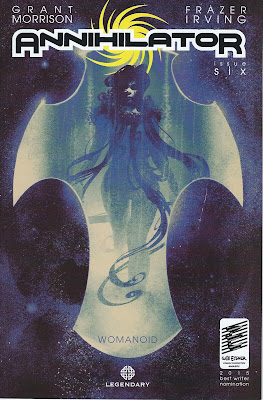
The 40 Years of Comics Project - Day 698: Annihilator #6, June 2015

http://www.comics.org/issue/1430495/

I know that I haven't spent much time on Frazer Irving's art, or not as much time as I've spent on Morrison's story. I mean, they're intrinsically linked, right? That's what we have to, have to, recognize about comics. So, let me just say that Olympia, Max Nomax's undead gynoid (or "Womanoid") is one of the loveliest women I've ever seen in comics. There's something timelessly beautiful and achingly vulnerable about the character. And, yes, *sigh*, that is coming from my completely subjective point of view, and not making any objective claims about the nature of beauty, nor is it intended to intimate that anyone not resembling this piece of art is not beautiful.

I feel, sometimes, like I need a disclaimer on my writing that says "Any opinions I express don't automatically mean that that is the only way I feel. It is simply one facet of my perception of the universe."

I'm still struggling to understand exactly what won out in this comic. I'd say it was love, except I'm not sure that it was. Obsession, maybe? Hope? Yeah, maybe that. Hope that in a world that seems like it is constantly falling into a supermassive black hole, we might still create meaning under the crushing pressure of oblivion.

Oof. Heavy stuff (*wink*). Onward.

(P.S. I really hope there is a sequel to this series, as is sort of teased. Max Nomax is the villain you love to hate)

Jan 22, 2017

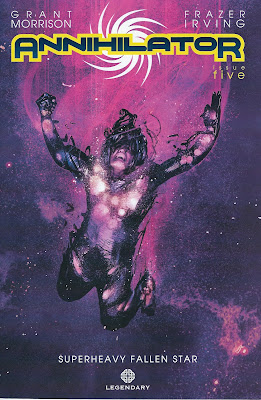
The 40 Years of Comics Project - Day 697: Annihilator #5, February 2015

http://www.comics.org/issue/1316746/

Max's plan comes into focus, as much as we can focus on this plan, considering that "our world" is a failed attempt by the antiprotagonist to create a universe. It's a comic about the characters in a universe that has been created for the sake of art. Typical Morrisonian metametatext.

I think one of the things that I love the most about this series, from that metatextual perspective, is that it's quite blatantly demonstrating that the relationship we have with our fictions, especially those that we create, is reciprocal. Max needs his creations, the inhabitants of Ray's universe, to tell him his story, to point out the significance of his own life. I wonder how many authors look at their works from this point of view, not only from how their fictions might affect others, but what they reveal about they themselves? And would it even be possible for an author to look at a work and see it from that perspective, or is that why we have people who are literary critics? We're the people who reveal not only what the text is saying about the culture, but what the text is saying about the person/function (thank you, Foucault!) that transmitted it to us.

Neat. Onward tomorrow to the final issue!

Jan 21, 2017

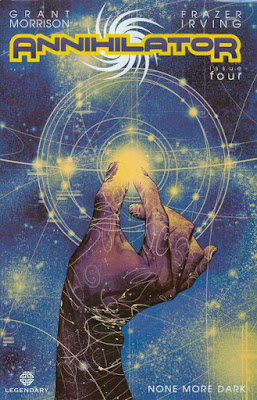
The 40 Years of Comics Project - Day 696: Annihilator #4, December 2014

http://www.comics.org/issue/1294535/

I've got people coming over for dinner tonight, and a fair bit to do, so it'll be a short one today.

I have no idea who, in this comic, I'm supposed to be identifying with. Everyone, except for Luna who is introduced this issue, seems to be a terrible human being/alien, though each of them appears to have one or two laudable traits. I remember reading a novel by Robert Rodi called What They Did to Princess Paragon, and by the end I felt I was slogging through a swamp because absolutely none of the characters were decent people. It's a strange thing to try to read, or experience, a piece of fiction in which none of the characters draw you to them. I like Max the most, I think, but only for his art above all else ethos. He's still pretty much a jerk, though.

Ah well. Can't like 'em all, I guess. I think I've come to the point in the series where the next couple of issues I've never read before, so that's cool. I have no idea how the story ends, or, really, where it's going. I'll find out tomorrow and Monday, I guess.

Onward.

Jan 20, 2017

The 40 Years of Comics Project - Day 695: Annihilator #3, November 2014

http://www.comics.org/issue/1281217/

It's cliche, I know, but things are getting mighty strange in this comic. Which, of course, is what I expect from a Grant Morrison comic that doesn't feature corporately-owned characters (though his corporately-owned work is just really strange too). We get an interesting literary history of Max Nomax in this issue, and start questioning Max's assertion that he's real. While he claims that the early stories are echoes of his future works resonating back through time, and Ray starts thinking that perhaps he's actually a science fiction devil, I'm more of the opinion that Ray is somehow conjuring into reality these characters from his screenplay, perhaps through a heretofore unknown ability stimulated by the pressure of the tumour in his brain.

There's a good chance that none of these theories are correct, however, which is what I utterly, utterly love about a Grant Morrison comic.

Let's talk about the covers for a moment. Frazer Irving did the art for Morrison's Seven Soldiers: Klarion series, and it was a wonderful, twisted, dark tale of underground Puritans and faeries from the future consuming the present. And while his art was quite glorious there, it was still cut from a superhero mold, in colour and design, perhaps. But here, with these covers, the twisted surreality of the story, the strange visions in Ray's head, come glorious and hideously to life. I'm of a mind to consider that these are what the visions Ray sees when he seizes look like: distorted faces, prison bars, immeasurable distances, and tiny, creepy teddy bears.

Oh. Hadn't I mentioned the tiny creepy teddy bear that keeps Nomax company on Dis, the prison that orbits the Great Annihilator? Maybe I need to add a bit of summary to these posts.

Onward.

Jan 19, 2017

The 40 Years of Comics Project - Day 694: Annihilator #2, October 2014

http://www.comics.org/issue/1261895/

I think that, perhaps, one of the things that kept me from being fully enthusiastic about Annihilator as it was coming out is that it is a very thinly-veiled retread of many of the issues that Morrison dealt with 20 years prior in Flex Mentallo. Max Nomax fires his story as a "data bullet" into Ray Spass' mind, and the story must be told, the fiction made real, in order that a universe-destroying threat be neutralized. It's not identical, but it's pretty close. Now, this is not necessarily a bad thing. Morrison's career in comics has been a long consideration of the boundaries between the "real" and the fictional, a consideration I take up myself in daily life. We construct ourselves as narratives in the world, even as we are constructed as narratives by others. It's often the inability of a person to fulfill the roles we're cast in that pushes some into states of depression. That said, I think that Flex, which I'll get to reading eventually, is a much purer distillation of this concept, and it might well be because it's dressed up in gaudy superhero finery, rather than the leather and insect costume of Max Nomax. If we're going to meld or fuse with our fictions, it'd be nice to do it with the ones that are a little flashier, perhaps a little more optimistic, than our reality.

Moving away from the story itself, let me just note that Frazer Irving's art is, in a word, incredible. It is rare that you'll see such nuanced facial expressions in a comic book. Ray's feelings about his inoperable tumour, about his bizarre new buddy-cop life with Max Nomax, about his interactions with corporate Hollywood, are written plainly on his face. All the way back to Scott McCloud, we've talked about the erasure of detail in the faces in comics, a process that allows us to connect on a more fundamental level with the characters. This works well most of the time, but occasionally you will end up reading a story that you cannot, or do not, place yourself inside, and then you need defined people, people who look different from you, to tell you the story. What's kind of fascinating about this particular use of the detailed face is that it's in a story that's about meshing with our stories. So if we can't place ourselves into the remarkably individualized characters in Annihilator, what is that saying about the experience of placing ourselves into our fictions?

Onward.

Jan 18, 2017

The 40 Years of Comics Project - Day 693: Annihilator #1, September 2014

http://www.comics.org/issue/1256097/

What's that you say? There's not enough Grant Morrison on this blog. Well, okay. I'll capitulate.

I have a couple of Morrison-penned mini-series sitting on my table that, for reasons unknown, I've simply not gotten around to finishing. Reading, that is. I'll admit that I'm less-enthusiastic about his later work than I am about his earlier stuff, but that likely has more to do with my propensity for superheroes than it does Morrison's craft. He still makes stories that are, in most cases literally, out of this world.

Annihilator is an interesting one. It fits into that metagenre of writers writing about being writers. Actually, perhaps that's a metametagenre. In Morrison's case, though, he acknowledges in critiquing the process of writing fiction that it is a fantastical pursuit, and so injects the fantastical into his story. There are, by my count thus far, three black holes in this story, and all of them are metaphors. We have the Great Annihilator, the supermassive black hole at the center of the galaxy. We have the mysterious sinkhole on the property that Ray Spass (pronounced "space," as in outer). And we have the dark hole on Spass' brain scan, an inoperable tumour. They're all the same thing, really: that spot of darkness from which springs forth creativity.

Though maybe I'm getting ahead of myself.

This series also does something that Morrison is well-known for: it blurs the lines between reality and fiction, introducing, at the issue's end, ultimate interstellar supervillain Max Nomax to his ostensible creator, Ray Spass. Nomax is the main character in Ray's new screenplay. As Warren Ellis has said, we have a strange relationship with our fiction, and only through fiction can we have conversations with it. Well, that and literary criticism, though oftentimes I find that criticism isn't actually having a conversation with fiction, but shouting over it and telling everyone what it means.

I might be a bit bitter, though.

Onward!

Aug 4, 2016

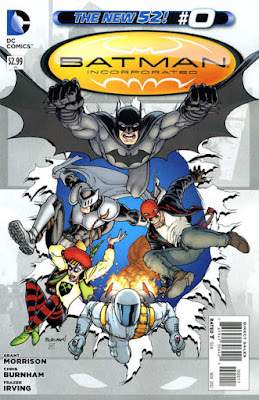
The 40 Years of Comics Project - Day 526: Batman Incorporated #0, November 2012

http://www.comics.org/issue/1010724/

The cynic in me would say that 1 year later, DC decided to do these zero issues to try to fix some of the clusterfuck of continuity errors and questions that came out of the New 52, or that they'd planned only a year in advance, and had no idea what to do next.

But let's put the cynic away for today. Batman Incorporated #0 is really cool. The characters who have been introduced in this global undertaking over the last few years are great characters. I'd read an El Gaucho comic all day. And I've already waxed lyrical about Knight and Squire (and Beryl's hologramatic appearance in this issue is great). I'm desperately curious about France's Nightrunner, enough so that I'm going to have to track down the Batman Incorporated special that I avoided at the time because it wasn't Morrison-penned, and because it was part of the New 52.

Last night I was fortunate enough to find a copy of the Chris Burnham-penned BI #11, and I really enjoyed the story about the Batman of Japan. Burnham plots today's comic, with dialogue by Morrison, and art by Frazer Irving, so it's a really great example of the collaborative nature of comics. We get a wonderful look at how Bruce went about recruiting, who was willing right off the bat and who took some convincing. We also get our first (and only?) look, at least in this title, at the Batman of Russia who, predictably, looks like a cross between a robot, a bat, and a bear. Let's see some more of him in the future please. Although this issue was published during the second volume of the series, it fits nicely just before Batman: The Return, and Bruce's public unveiling of the brand. Maybe next time through, that's where I'll put it.

(Next time through? Let's wait a decade or so, shall we?)

Anyway, a nice break, a nice reminder of the optimism that accompanies the founding of Batman Incorporated, before Talia's plans come to light, before the darkness that we're about to witness. These are four year old comics. You know what's coming, right?

Oh. You don't. Uh-oh.

Onward.

Jul 13, 2016

The 40 Years of Comics Project - Day 505: Batman and Robin #16, January 2011

http://www.comics.org/issue/784364/

Though they all seem to be unflappable homicidal maniacs, the villains in this issue have to take at least a slight pause when faced with two Batmen and a Robin. Even the hardest of villains would have to take just a moment to consider the life choices that led them into the path of two Batmen.

Which is to say, there's two Batmen in this issue. Yes, Bruce has returned, stepping from the shadows of time and the Omega Effect to stand next to Dick and Damian and face the immortal and mad Thomas Wayne/Dr. Hurt one more time. Oh, and The Joker is, sort of, working with them. I think once the smoke has cleared, Dick and Damian have some explaining to do to the elder Bat.

The problem of the two Bats is handled rather nicely by artist Cameron Stewart, whose depiction of Bruce and Dick are different enough, given that they're wearing identical costumes, that one never becomes lost trying to suss out who's fighting who. Aside from more obvious devices like Dick's batons, Stewart gives them different chins and very different builds. It's nice to see this kind of detail paid attention to. One of the mainstays of the secret identity is the idea that it could be anyone under the cowl, but this ignores the obvious fact that everyone has a different body and will wear clothing, form-fitting spandex or not, differently. Dick is a more slight Batman, whereas Bruce is more barrel-chested.

One last little taste of Morrison's Bat-universe tomorrow in The Return, and then I'll have to take a break from the Bat. But it'll only be a short one, and then we'll jump back into the grand experiment that is Batman Incorporated. Onward!

Jul 12, 2016

The 40 Years of Comics Project - Day 504: Batman and Robin #15, December 2010

http://www.comics.org/issue/782682/

I think it's getting on to time I took a break from Batman. Though the series is still utterly, utterly fantastic and weird, and the end of this issue, with the incarnation of the "Bat-God" (guess who?) was just great, but I'm running out of things to say about it. I feel like I've been repeating myself a good deal over the last few weeks. So I think we'll finish off the "Return" storyline, with Batman and Robin #16 and Batman: The Return, and then take a bit of a break before jumping headlong into Batman Incorporated.

But before we do that, can we just take a moment to appreciate Frazer Irving? How does one think about his art? At first I was quite taken by the painted quality of the artwork, a quality that can sometimes, thanks to the influence of Alex Ross, be equated with a photo-realistic sense. But Irving's art reminds me more and more of early Morrison collaborator Chas Truog, with simplistic representations and, occasionally, very cartoon-y depictions, though still parsed through this painted medium (I don't know if Irving does paint these comics, or if it's another technique of some kind. But it's beautiful, nonetheless). Truog's Animal Man is a study in contradictions, an early and dark proto-Vertigo title illustrated in a deceptively simple manner. There's much discussion of the kind of iconic abstraction that goes on in comics, the removal of detail in order to increase the ability of the reader to identify oneself with the focal character, and Truog's work on Animal Man is a wonderful example of this kind of thing. That said, the comic is also capable of great detail and nuance, and it's in this way that Irving's work reminds me of that much earlier title. As I say, the resemblance to painted canvases hearkens to that Rossian influence on comics, but occasionally we'll get a close-up of a character or a sequence that is drawn in the simplest of lines, and given the sheen of the painted by the colour process (I think. This is not quite my expertise). It's a really wonderful trick the comic is playing on its readers, placing us into the oil paint world. There's a sensuality to it, like moving through something thick, which makes the rapid-fire action sequences all the more impressive. They seem to move blindingly fast and in slow motion all at the same time. I'll get around to reading Irving's other works, many in collaboration with Morrison, eventually, but this quality of his art is worth paying attention to. Of all the senses to evoke in comics art, I think that tactile sense of bodily immersion is the most difficult, perhaps because we're not really aware of the constant touch of the air on our skins, all day, every day (having typed that, I can now feel every inch of exposed skin in the air, and my clothes on all the rest). Irving's art manages to approximate that tactility.

Onward.

Jul 8, 2016

The 40 Years of Comics Project - Day 500: Batman and Robin #14, October 2010

http://www.comics.org/issue/776240/

I have to admit, I found this comic a bit confusing. But I suppose that's because, with his return to Gotham, Doctor Hurt strikes and strikes hard, in order to avoid the previous outcome of his bid for control of the city. So things happen very fast in this issue. The Joker wants Hurt. Hurt wants Gotham. Batman and Robin, really, just want to get on with finding Bruce, but with a war between two insane criminals not just brewing, but exploding, the search for the Bat has to be put on hold. Wouldn't it be nice if someone returned to Gotham, just in time to save everyone?

I've written, repeatedly, over the last few weeks about how much I enjoy this series, and the Dick Grayson/Damian Wayne team. I'd love to have seen them get a bit more time as the Dynamic Duo, but this comic brings home the fact that their story is part of something much bigger, that they, as characters, are merely playing their parts in a story that is moving along on levels that they're not really aware of. The same could be said of Hurt and the Joker. Their interaction seems to be happening on a higher level. I'm not entirely certain what this is saying to us, though. With the revelation that Sexton is the Joker, that El Penitente is Doctor Hurt, the impression is given that their game has been playing out in the background the whole time, and that Batman and Robin have simply been moving around like chess pieces. It's not the role one usually imagines for superhero characters, and I feel like it's slightly disrespectful to them. That said, Dick has been thoroughly preoccupied with trying to find Bruce, so perhaps the shock and awe of the Joker/Hurt showdown is a result of his failure to see the smaller picture, so to speak. One can pay attention to the large-scale problems (i.e., the rescue of a comrade from the depths of time), but sadly cannot see the smaller problems brewing within that large scale. It's all about maintaining multiple perspectives.

But the big news: today marks 500 straight days of comics. Those who know me will evince no surprise at my having read comics for 500 days, but writing about them is a different matter. As I noted in my 1 year post, this is the longest sustained amount of writing I've ever done. Some days I did not want to write anything, and some days I had far more to say than I posted, but I'm quite proud of myself to have stuck with it this long. And I'm grateful to those of you who've stuck around for a bit. I'm hoping to get to a bit of a retrospective later today, pulling out some of the best and some of the worst of the last 500 comics I've read. I think the thing that really hits home at a moment like this is how little I've read, though it seems like a lot, and how much I've yet to read, which is slightly inconceivable.

Onward.


Jul 5, 2016

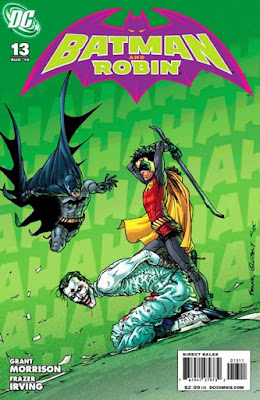
The 40 Years of Comics Project - Day 497: Batman and Robin #13, August 2010

http://www.comics.org/issue/766910/

I read things out of order. Thank goodness this is a time travel story. But it's interesting, isn't it? Ostensibly, I should be able to read things completely out of order, as stories are simultaneously happening in the past, present, and future, but because of the way in which the over-arching narrative is composed, there is an actual reading order - time, fictional time and probably real time too, function holistically, rather than through a cause and effect standing. Maybe a rhizomatic reading of fictional time in the DCU?

We're offered a fascinating, if unlikely, look at the Joker in this issue. The argument has often been made that Batman creates his own villains, that by cranking up the dial on heroics, the inverse happens with villainy. So what happens to Batman's nemesis when Batman dies? And, somehow, the Joker knows that his Batman is dead. I suppose he's known Dick Grayson a long time, and can recognize the difference. The Joker's claim of wanting to help, of some sanity returning to him, of feeling bad for the things he's done are dubious at best, but with a character like the Joker, and with a writer like Morrison, you have to acknowledge at least the outside possibility that it's the truth. This is what happens when a mythic figure is removed from the continuum of its existence - things start to fall apart. With the return of Dr. Hurt, masquerading as Thomas Wayne, this entire portion of the shared DCU seems to be falling apart, or shifting into something unhinged, while the one, true Batman struggles back across time, sowing the seeds of his own mythology. In this, we come to realize myth as a stabilizing force in fictional continuums, and in our own, too, I suppose.

Tomorrow we'll pop back into the Batman title for the second part of "R.I.P. - The Missing Chapter," which I actually read while going through Final Crisis, but it definitely belongs here instead. Onward.

Jul 4, 2016

The 40 Years of Comics Project - Day 496: Batman: The Return of Bruce Wayne #2, July 2010

http://www.comics.org/issue/758087/

Can't think of much to say about this comic - Frazer Irving's art is, as always, beautiful, and Morrison's writing is Morrison's writing. I feel like I might be hitting my Batman saturation (Baturation?) point, as the prospect of reading through the rest of the return story is not a welcome one at the moment. Or maybe it's just this morning. Or I wish Bruce wouldn't return, so Dick Grayson can be Batman forever.

(See what I did there?)

Okay, so this issue is a cool treatment of colonial-era America, rife with buckled hats and accusations of Devil worship. While I'm sure that these things happened at the time, I find it interesting that, through such works as The Scarlet Letter, this kind of behaviour is what's become emblematic of that period. And, honestly, having read a fair bit of literary output from the era, it's really pretty indicative. The other nice part of this issue was getting to see Bruce flex his detective muscles, rather than his combat muscles like in the previous issue. There are some skills that are relevant, and important, no matter what time period you've been displaced to.

Onward.