Pages

Showing posts with label Batman and Robin. Show all posts

Jul 13, 2016

The 40 Years of Comics Project - Day 505: Batman and Robin #16, January 2011

http://www.comics.org/issue/784364/

Though they all seem to be unflappable homicidal maniacs, the villains in this issue have to take at least a slight pause when faced with two Batmen and a Robin. Even the hardest of villains would have to take just a moment to consider the life choices that led them into the path of two Batmen.

Which is to say, there's two Batmen in this issue. Yes, Bruce has returned, stepping from the shadows of time and the Omega Effect to stand next to Dick and Damian and face the immortal and mad Thomas Wayne/Dr. Hurt one more time. Oh, and The Joker is, sort of, working with them. I think once the smoke has cleared, Dick and Damian have some explaining to do to the elder Bat.

The problem of the two Bats is handled rather nicely by artist Cameron Stewart, whose depiction of Bruce and Dick are different enough, given that they're wearing identical costumes, that one never becomes lost trying to suss out who's fighting who. Aside from more obvious devices like Dick's batons, Stewart gives them different chins and very different builds. It's nice to see this kind of detail paid attention to. One of the mainstays of the secret identity is the idea that it could be anyone under the cowl, but this ignores the obvious fact that everyone has a different body and will wear clothing, form-fitting spandex or not, differently. Dick is a more slight Batman, whereas Bruce is more barrel-chested.

One last little taste of Morrison's Bat-universe tomorrow in The Return, and then I'll have to take a break from the Bat. But it'll only be a short one, and then we'll jump back into the grand experiment that is Batman Incorporated. Onward!

Jul 12, 2016

The 40 Years of Comics Project - Day 504: Batman and Robin #15, December 2010

http://www.comics.org/issue/782682/

I think it's getting on to time I took a break from Batman. Though the series is still utterly, utterly fantastic and weird, and the end of this issue, with the incarnation of the "Bat-God" (guess who?) was just great, but I'm running out of things to say about it. I feel like I've been repeating myself a good deal over the last few weeks. So I think we'll finish off the "Return" storyline, with Batman and Robin #16 and Batman: The Return, and then take a bit of a break before jumping headlong into Batman Incorporated.

But before we do that, can we just take a moment to appreciate Frazer Irving? How does one think about his art? At first I was quite taken by the painted quality of the artwork, a quality that can sometimes, thanks to the influence of Alex Ross, be equated with a photo-realistic sense. But Irving's art reminds me more and more of early Morrison collaborator Chas Truog, with simplistic representations and, occasionally, very cartoon-y depictions, though still parsed through this painted medium (I don't know if Irving does paint these comics, or if it's another technique of some kind. But it's beautiful, nonetheless). Truog's Animal Man is a study in contradictions, an early and dark proto-Vertigo title illustrated in a deceptively simple manner. There's much discussion of the kind of iconic abstraction that goes on in comics, the removal of detail in order to increase the ability of the reader to identify oneself with the focal character, and Truog's work on Animal Man is a wonderful example of this kind of thing. That said, the comic is also capable of great detail and nuance, and it's in this way that Irving's work reminds me of that much earlier title. As I say, the resemblance to painted canvases hearkens to that Rossian influence on comics, but occasionally we'll get a close-up of a character or a sequence that is drawn in the simplest of lines, and given the sheen of the painted by the colour process (I think. This is not quite my expertise). It's a really wonderful trick the comic is playing on its readers, placing us into the oil paint world. There's a sensuality to it, like moving through something thick, which makes the rapid-fire action sequences all the more impressive. They seem to move blindingly fast and in slow motion all at the same time. I'll get around to reading Irving's other works, many in collaboration with Morrison, eventually, but this quality of his art is worth paying attention to. Of all the senses to evoke in comics art, I think that tactile sense of bodily immersion is the most difficult, perhaps because we're not really aware of the constant touch of the air on our skins, all day, every day (having typed that, I can now feel every inch of exposed skin in the air, and my clothes on all the rest). Irving's art manages to approximate that tactility.

Onward.

Jul 8, 2016

The 40 Years of Comics Project - Day 500: Batman and Robin #14, October 2010

http://www.comics.org/issue/776240/

I have to admit, I found this comic a bit confusing. But I suppose that's because, with his return to Gotham, Doctor Hurt strikes and strikes hard, in order to avoid the previous outcome of his bid for control of the city. So things happen very fast in this issue. The Joker wants Hurt. Hurt wants Gotham. Batman and Robin, really, just want to get on with finding Bruce, but with a war between two insane criminals not just brewing, but exploding, the search for the Bat has to be put on hold. Wouldn't it be nice if someone returned to Gotham, just in time to save everyone?

I've written, repeatedly, over the last few weeks about how much I enjoy this series, and the Dick Grayson/Damian Wayne team. I'd love to have seen them get a bit more time as the Dynamic Duo, but this comic brings home the fact that their story is part of something much bigger, that they, as characters, are merely playing their parts in a story that is moving along on levels that they're not really aware of. The same could be said of Hurt and the Joker. Their interaction seems to be happening on a higher level. I'm not entirely certain what this is saying to us, though. With the revelation that Sexton is the Joker, that El Penitente is Doctor Hurt, the impression is given that their game has been playing out in the background the whole time, and that Batman and Robin have simply been moving around like chess pieces. It's not the role one usually imagines for superhero characters, and I feel like it's slightly disrespectful to them. That said, Dick has been thoroughly preoccupied with trying to find Bruce, so perhaps the shock and awe of the Joker/Hurt showdown is a result of his failure to see the smaller picture, so to speak. One can pay attention to the large-scale problems (i.e., the rescue of a comrade from the depths of time), but sadly cannot see the smaller problems brewing within that large scale. It's all about maintaining multiple perspectives.

But the big news: today marks 500 straight days of comics. Those who know me will evince no surprise at my having read comics for 500 days, but writing about them is a different matter. As I noted in my 1 year post, this is the longest sustained amount of writing I've ever done. Some days I did not want to write anything, and some days I had far more to say than I posted, but I'm quite proud of myself to have stuck with it this long. And I'm grateful to those of you who've stuck around for a bit. I'm hoping to get to a bit of a retrospective later today, pulling out some of the best and some of the worst of the last 500 comics I've read. I think the thing that really hits home at a moment like this is how little I've read, though it seems like a lot, and how much I've yet to read, which is slightly inconceivable.

Onward.


Jul 5, 2016

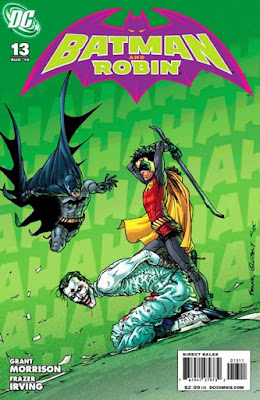
The 40 Years of Comics Project - Day 497: Batman and Robin #13, August 2010

http://www.comics.org/issue/766910/

I read things out of order. Thank goodness this is a time travel story. But it's interesting, isn't it? Ostensibly, I should be able to read things completely out of order, as stories are simultaneously happening in the past, present, and future, but because of the way in which the over-arching narrative is composed, there is an actual reading order - time, fictional time and probably real time too, function holistically, rather than through a cause and effect standing. Maybe a rhizomatic reading of fictional time in the DCU?

We're offered a fascinating, if unlikely, look at the Joker in this issue. The argument has often been made that Batman creates his own villains, that by cranking up the dial on heroics, the inverse happens with villainy. So what happens to Batman's nemesis when Batman dies? And, somehow, the Joker knows that his Batman is dead. I suppose he's known Dick Grayson a long time, and can recognize the difference. The Joker's claim of wanting to help, of some sanity returning to him, of feeling bad for the things he's done are dubious at best, but with a character like the Joker, and with a writer like Morrison, you have to acknowledge at least the outside possibility that it's the truth. This is what happens when a mythic figure is removed from the continuum of its existence - things start to fall apart. With the return of Dr. Hurt, masquerading as Thomas Wayne, this entire portion of the shared DCU seems to be falling apart, or shifting into something unhinged, while the one, true Batman struggles back across time, sowing the seeds of his own mythology. In this, we come to realize myth as a stabilizing force in fictional continuums, and in our own, too, I suppose.

Tomorrow we'll pop back into the Batman title for the second part of "R.I.P. - The Missing Chapter," which I actually read while going through Final Crisis, but it definitely belongs here instead. Onward.

Jul 1, 2016

The 40 Years of Comics Project - Day 493: Batman and Robin #12, July 2010

http://www.comics.org/issue/752938/

If I were a properly patriotic Canadian, I'd have reviewed a Captain Canuck or Alpha Flight comic today. But I find patriotism to be a far too slippery slope (and I love me some tobogganing!), as is evidenced by the state of the UK and US these days. Besides, I've been having a hard enough time reading these comics one day at a time. If I had to leave a gap, I might lose what little is left of my mind.

The wave begins to crest: "Thomas Wayne, Barbatos, Devil worship and the Underground Railroad." To which Damian replies "This is insane." "This is life in the Batcave" says Dick. Doctor Hurt is returning, slipping off his disguise as crimelord El Penitente and slipping on his Black Glove again. Oberon Sexton is revealed to be not Bruce Wayne, but his opposite - The Joker. And Alfred finds that the grounds of stately Wayne Manor are planned to function as a Bat Signal through time. I love this. This is what comics do.

Speaking of Alfred. Each time I finish writing up a comic, I copy this text into the "Notes" section for each issue in my database. When I first inputted everything into the database, it was skeleton data, so now when I go back and blog a comic, I fill all that in. One of the fields is major characters that appear in each issue. Though the comic is called Batman and Robin, Alfred has been in literally every issue - if we think back to what Bruce says about remembering Batman after he's gone, he makes reference to the people that kept him alive all this time. And that's Alfred, the hidden hero of the Bat-titles. Not that I'm arguing that he should have his own title or adventures. What Alfred reminds us of is that Batman functions best not as an individual, but as part of a team. That's what Batman Incorporated is really about, bringing that team out of the shadows of the Batcave and into the world. But we'll have to wait to see how all that turns out.

Back, briefly, to the main Batman series tomorrow. Onward!

Jun 30, 2016

The 40 Years of Comics Project - Day 492: Batman and Robin #11, June 2010

http://www.comics.org/issue/743422/

I begin to see Morrison's tenure on the Bat-titles through the lens of a Sine wave metaphor. The bits between the crests and the troughs are the "normal" stories, the ones that, while well drawn and written, are fairly recognizable as Batman superhero stories. And then we have things like "R.I.P.," where the line has delved into the trough, and things are all underworld and insane. But the bits I like most are the crests, where the hallucinatory quality is every bit as intense as the troughs, but we're moving into a higher reality style of story. That's where things are heading now. Though Dick makes his way through a series of caves below Wayne Manor, there's an inverse narrative journey upward happening. He moves from a place of capital and material to a place of spirits and gods, emerging from a grave at the end of the issue, foreshadowing if I've ever seen any. It's been long enough since I've read this run of Batman that I don't remember how Batman Inc. follows this wave, but I'm excited to find out. Even within the Batman and Robin series, I think we see this wave, heading down from the 60s-inspired opening to a dark and bloody chapter, and then back up through a story of Lazarus Pits, very much a mainstay of Bat-stories, but dealing with resurrection as well, so ascending, and then continuing to move upward through the current story arc that burst open at the apex in the "Return of Bruce Wayne" crossover.

Speaking of which, here's a reading order for the crossover that I'll be following, sans issues I've either read already or that I do not own. From what I can tell, Tim Drake undertakes a search that in many ways sets up the Return storyline, and I've never really read any of his solo stuff. Maybe it's time to delve into it.

Onward.

Jun 29, 2016

The 40 Years of Comics Project - Day 491: Batman and Robin #10, May 2010

http://www.comics.org/issue/732940/

Sorry for the blip yesterday. Occasionally (but only occasionally) something distracts me from thinking about comics.

We're entering a phase of Morrison's run that I both love and hate. I love it because it's a great mystery story, one told across time and space, like all good Morrison stories, and it really crystallizes the Dick Grayson/Damian Wayne relationship very nicely. I hate it because it also spells the end of that partnership, and of Grayson's time as Batman. One of my Flash posts (the delays to which are, believe me, becoming increasingly embarrassing) deals in part with the idea of characters being haunted by their predecessors, and I make the argument that some superheroes are far more affecting to their universes in death than they were in life. I don't think we can make that argument for Bruce Wayne, but there's something to be said for the vitality injected into the Bat-franchise by putting someone new in the costume. The entire opening arc of this series was about reconciling Dick Grayson to the fact that it's the symbol, not the person inside it, that matters. I'm not sure why, though it's perhaps because they often evince a more convincingly mythic human personality, but I've always seemed to favour the inheritors of the ancient superhero titles. Wally West as Flash. Kyle Rayner as Green Lantern. Connor Hawke as Green Arrow. And now Dick Grayson as Batman. Actually, it may not even be the personality, but the fact that this movement of inhabitants of the identity really demonstrates nicely the mythic nature of the superheroic archetypes. They ride their disciples like Loa. To me, it seems silly to define an archetype by a single individual.

The other great part of this arc is Oberon Sexton, the Gravedigger - a novelist and detective who assists Batman and Robin in their search for the time-displaced Bruce Wayne. Batman notes that there's something familiar about him. Hmmmm.....

Onward.

Jun 28, 2016

The 40 Years of Comics Project - Day 490: Batman and Robin #9, April 2010

http://www.comics.org/issue/728284/

Sorry. Got nothing to say this morning. Found out yesterday that the contract position I have that ends at the end of this week is not being renewed, and I'm freaking out about not having a job.

In brief, Batwoman proves what a badass she is, Dick is the best Batman ever, and I really have to track down the Knight and Squire mini-series, because I think I love them.

I'll try to be more on the ball tomorrow.

Onward.

Jun 27, 2016

The 40 Years of Comics Project - Day 489: Batman and Robin #8, April 2010

http://www.comics.org/issue/715092/

I have to wonder if there's something a bit snarky going on in this story line. Morrison is using the title and premise of a current DCU crossover, while certainly not contributing explicitly to that crossover, as an epilogue of sorts to his Final Crisis series, which wasn't given, IMHO, the crossover treatment it could have had. This in response to the fact that the crossovers that both preceded and followed FC were written by Geoff Johns. Who is one of the architects of DC's horrendous slide into mediocrity and irrelevance, along with Jim Lee and whoever the hell their Editor-in-Chief is these days.

That aside, a follow-up story to Final Crisis is great, mainly because there very rarely seems to be fallout from such crossovers in the continuing series that constitute their parts. In fact, Morrison's first major DC work in Animal Man was an attempt at dealing with the fallout of Crisis on Infinite Earths, and remains one of the best pieces of superhero fiction I've ever read. In terms of dealing with the ripples such cosmic events can cause, I'd have to say Marvel is better at dealing with it in their universes, but only because their heroes operate on a more grounded, political level than the DC heroes, and as such their crises operate on a similar level. There is always the consideration of law, human law, in the Marvel crossovers (with the exception, perhaps, of the recent Secret Wars), but with DC, it is very often reality itself that is threatened, a concern that supersedes human law.

There's something interesting there. That'll need more thought.

Did I mention how much I love the fact that Batwoman is in this arc? Yeah, I did. You should go and read the Rucka/Williams III run of Detective Comics. It'll blow your mind.

Onward. 

Jun 26, 2016

The 40 Years of Comics Project - Day 488: Batman and Robin #7, March 2010

http://www.comics.org/issue/705481/

I have opinions on Geoff Johns. First and foremost, I think he's one of the people responsible for the utter lack of innovation and backslide that DC Comics has taken over the last few years. The New 52 was probably one of the most ill-considered moves in comics, and the current back-pedalling "Rebirth" has all the hallmarks of yet another disaster. That said, his work on Green Lantern in the early 2000s is really amongst the best stories of that character that I've had the pleasure to read. I was dubious about the return of Hal Jordan, but Johns has a love for that character that shines through in his writing. One of the highest points of his run was the "Blackest Night" crossover, a comic that managed at the same time to reach the heights of superheroic storytelling that I love while simultaneously delving into the grimmest depths of the genre - a bit like Bendis' Age of Ultron.

Anyway, all this is prologue to the storyline upon which we embark today, "Blackest Knight." In the wake of the resurrections around the planet, the world is, as DC Earth does, moving on. But Dick Grayson has discovered a lost Lazarus Pit, and intends to resurrect Bruce Wayne. And things will go smoothly, of course.

One of the absolute, 100% best things about this issue is the background information that is casually dropped in the dialogue. The DCU is ridiculously North American, and really U.S., -centric, but Morrison, in just two or three speech bubbles, provides us with the notion that the United Kingdom (not so united anymore) has its own rich and varied superheroic history. I've already noted my appreciation for Knight and Squire, but the villains sound amazing: The Morris Men (as someone who's attended a few Morris Dancing festivals, I'd looooove to see them as super-baddies), The Radio Ghost, and even a nod to Brit Simon Furman and his acclaimed run on the U.S. and U.K. Transformers titles, the "Metalek Xenoformer," looking much like a steam shovel when we encounter it. And all this information provided in the voice of a super-Beefeater in the U.K.'s super-prison, Basement 101.

This is something that Morrison appreciates in a way that I don't see in a lot of other writers. Warren Ellis is perhaps one of the few others to realize that there's this insane disparity between the richness of imaginary U.S. superhero culture and that of the rest of the world. And, of course, we're not going to see all of these hole filled in. Popular audiences are, understandably, skewed toward stories that reflect their own experiences somehow, and despite a shared language, there's a lot of differences between North American and Europea....oops, sorry, English culture. However, such small acknowledgments as we see in this one little descriptive passage fill in not only names and locations, but also story potentials. One of McCloud's notions is the idea of "closure," that we fill in the gaps between the panels in a comic. From a narrative perspective, situated in a shared narrative universe, the bits and pieces we receive of other countries' super-histories allows us to perform a similar function with those histories. Knight and Squire, legacy heroes in the U.K., a super-prison guarded by a super-Beefeater, a slew of colourful villains. Enough information to demonstrate difference and commonality of fictional history.

Oh, the other 100% absolute best thing about this comic is that it co-stars the amazing Kate Kane, Batwoman. The more I'm reading her these days, the more I want to go and track down all of her appearances, even the New 52 stuff. *sigh* I told myself I wasn't going to do this...

Onward.

Jun 25, 2016

The 40 Years of Comics Project - Day 487: Batman and Robin #6, January 2010

http://www.comics.org/issue/676604/

I'm not a fan of Philip Tan's art, I'm afraid. This is not to say that he's not a good artist. He's certainly a far better artist than I'll ever be. But over the last three issues, I've found myself having to go back and re-read bits of the comics to try and figure out what was happening in each panel, and how one moves into the other. While the story, as I suggested yesterday, is taking a considered look at the grim Batman of the 1980s, Tan's art seems to be calling back to the early 90s, and the rapid-fire and not always coherent art of the Image founders. Now, to be fair, a lot of this issue (which consists pretty much of one long fight sequence) takes place at night, so of course it's going to be dark. But that shouldn't necessarily make what's happening unclear, just a bit shadowed. I'm sure I've seen his art elsewhere, but I can't off the top of my head think of a particular example, and maybe it was just this comic. Certain artists and writers work well together, and certain artists and writers are better suited to particular types of stories. I'm not sure this story was suited to Tan's particular talents.

I'm glad to see the end of this story. I've been pretty effusive with my praise of this extended Batman run, but this story leaves me cold. While I can see the various stories as meditations on the history of the character, I'm inclined to think that these meditations work best when they are utilizing new elements, rather than retreading older ones from the very eras they're considering. The first story arc, looking to the bombasticness of 60s Batman, used characters resonant of that era, but not from that era. This arc, considering the darkness of 80s Batman, could have told the same story without resorting to the use of Jason Todd. There's a difference between retreading history and repeating it.

Tomorrow we'll start on the "Blackest Knight" arc, which features one of my absolute favourite creations from this era of the DCU, Kate Kane, the Batwoman. While Dick and Damian were featured in Batman and Robin, Kate was briefly given the starring role in Detective Comics, and it's a really beautiful run. I'm sure I'll get to it one of these days.

Onward.

Jun 24, 2016

The 40 Years of Comics Project - Day 486: Batman and Robin #5, December 2009

http://www.comics.org/issue/676603/

Can I make a confession?

This particular story arc is not my favourite of the Morrison-era Batman. As I noted yesterday, it's calling back to the Grim'n'Gritty(TM) era of the DCU, and it's an era that I really don't have a lot of patience for. I give the same look to people who try to put some reality into superheroes as I do to people who try to put reality in Shakespeare's plays, or into Biblical narratives. The point of the characters is not reality - at least, not our lived reality. They belong to the Platonic world of forms, the archetypal reality, the place where everything is bigger and louder and better and faster. They need to function in a place of myth.

I know. I'm starting to sound like a broken record. But if there's one thing that Morrison accomplishes in this run, a thing that sadly seems to have been forgotten after his run, it's that Batman deserves his place in the DCU trinity precisely because he is this kind of archetypal character.

Anyway, Batman and Robin have fights with Red Hood and Scarlet. At one point Batman accuses Red Hood of speaking in catchphrases, as good a description of Miller's Dark Knight dialogue as I've ever heard. And The Flamingo, an assassin with a penchant for skinning and eating his victims' faces comes to town. Perhaps the best way for me to think through this series, at least right now, is that it's Dick Grayson's movement through all of the eras of the Bruce Wayne Batman, that he needs to move through the history before he can fully take on the role himself. It's interesting looked at from this perspective, especially in light of the Return of Bruce Wayne series, which envisions a series of Batmen throughout the history of the United States. Movements through histories. Maybe that'll be the subtitle of my eventual book on Morrison's Batman.

Onward.

Jun 23, 2016

The 40 Years of Comics Project - Day 485: Batman and Robin #4, November 2009

http://www.comics.org/issue/676602/

In case you hadn't gleaned it from that yellow writing plastered against the cover, the current story arc in Batman and Robin, "The Revenge of the Red Hood," is all about the propensity in the 80s and 90s to have comics "grow up." Consider that the Red Hood's associate in this arc is a red-headed young lady, rescued from the depths of crime by a brutal crimefighter. Shades of Dark Knight, anyone? What this story arc offers us is the question of whether or not growing up necessarily has to mean becoming more brutal. As someone who has, at the very least, gotten older, I've never felt that propensity toward extremity in my social interactions (just in my personal ones, really). I do see it occasionally in people I know, the movement toward a more black and white world view, toward a conservatism that I find quite disturbing. But the other side of the argument is that growing up should be a broadening, a lessening of brutality and a widening of compassion. While there's definitely arguments to be made about the role that vengeance or punishment play in Batman's identity, this presupposes a focus on the perpetrator of crimes, rather than the victims. And, more often than not, the perpetrators themselves are also victims. Batman is, as are the best of the superheroes, about helping victims rather than punishing perpetrators. And this is the difference, in this story, between Batman and Robin, and Red Hood and Scarlet, the difference between a mission that grows from love and one that grows from anger.

And, as usual, Morrison (aided by Philip Tan) gives us a wonderful meditation on this aspect of the superhero.

Onward.

Jun 22, 2016

The 40 Years of Comics Project - Day 484: Batman and Robin #3, October 2009

http://www.comics.org/issue/629091/

It occurred to me while reading today's comic that new Bat-villain Professor Pyg is in a lot of ways the darkest of reimaginings of Mr. Nobody from Doom Patrol. In particular, he mutters a line ("hrrrn the box...the box, the "Despair Pit", he said...in the corner...the inside went on forever.") that echoes Mr. Morden's experiences that turn him into Nobody. I'm fascinated by the overlapping generic tendencies that can exist simultaneously in comic book universes. In an article I published in The International Journal of Comic Art, I called it "inflection theory." The idea is that while we're reading something like Batman and Robin, a grim, bloody, Noir-ish piece of writing, we also always have to remain aware of the fact that this universe is also inhabited by such characters as The Heckler, or Ambush Bug. Where Batman is a detective noir, Ambush Bug is a superheroic satire, almost a cartoon, yet the adventures of these characters take place in the same imaginary universe. If this is the case, then every time we read a noir in Batman, the story has to be inflected, even just slightly, by the satire. The nice thing about comics is that this inflection is not only demonstrated in the genre, but also in the art style. A comparison of Richard Case's work on Doom Patrol with just about anything by Alex Ross reveals a huge disconnect in the way the world is depicted, but this disconnect can never be fully...disconnected, I suppose. The characters are always in the same universe.

I'm still working out the ins and outs of it, but this resonance of Pyg with Nobody adds a very interesting layer.

The other interesting thing about this series so far is reading it retrospectively with regard to Damian Wayne. Something happens to him down the line, in the closing chapters of Batman Inc., but it's actually quite easy to see it coming. In the simpler world of the superhero, certain characterizations (such as leaving an innocent girl in a burning lab so that he can catch the villain) point us to his inevitable fate.

(Man, can I talk my way around spoilers or what?)

Onward.

Jun 21, 2016

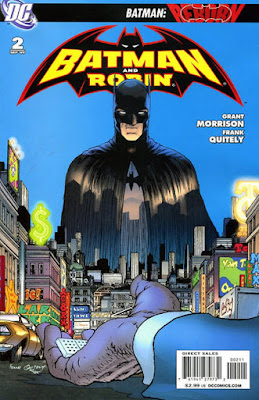
The 40 Years of Comics Project - Day 483: Batman and Robin #2, September 2009

http://www.comics.org/issue/629090/

Poor Dick Grayson. After the assured way he takes up the mantle at the end of Battle for the Cowl, he sees that becoming Batman and being Batman are two very different things. Of course, having Damian Wayne as Robin would be enough to tax the patience of event the most saintly (I wonder if there's ever been a Damian/Superman team-up?), so it's a good thing that he has the slight-yet-strong shoulders of Alfred to rest upon.

More and more as I read this run, I'm seeing Alfred as the quiet hero in the background. It's easy to privilege the costumes, but at the end of the day, or night as the case may be, to be able to come home to someone who cares for you with such devotion is fundamental to the mission. And Alfred's got a lot of other stuff going on. As I noted in the second issue of Battle, he's pretty good with the combat stuff, he's got an avid interest in detective fiction, and, probably most importantly, he's been the only real observer of Batman's methods since day one. How could he not have picked up some skills? And today's comic offers an Alfred who channels performance and performativity theory, telling Dick not to think of his taking up the cowl as a memorial -- "you and I know he'd hate that" -- but as a performance. "Think of Batman as a great role, like a Hamlet, or Willie Loman...or even James Bond." I've said it before, I'll say it again, Grant Morrison understands superheroes like few other people. Batman as the great, mad, rebellious son. As the trodden down remnants of the American Dream. Or as the rotatable master spy, different but ever the same. All three at the same time - and now with a little bit of the original Robin mixed in.

Have I mentioned how much I love this title?

Onward.

Jun 20, 2016

The 40 Years of Comics Project - Day 482: Batman and Robin #1, August 2009

http://www.comics.org/issue/629089/

Oh, I have been looking forward to this. Much as I've waxed lyrical over Morrison's handling of the mythic Batman, it's this series, in which the myth starts re-manifesting in another form that I really, really love. I think I could have become a huge fan of the Dick Grayson version of Batman. The old, or original, heroes always seem to have something of the past clinging to them. While Robin's got a long history himself, it's when we see someone like Wally West take over for Barry Allen, or Dick Grayson take over for Bruce Wayne, that the characters become contemporized for me. The New 52 tried to unhistoricize the characters in an effort to make them seem relevant in contemporary society. But the generational tale has far more impact, and retains far more respect for the origins, and originals, of the characters.

I also hadn't totally put it together last time I read the series, but there's a lot of the 60s Batman TV series in this issue. Grayson is certainly less gruff and grim than Bruce was, ready to crack a bit of a joke, much as deadpan Adam West did. And Frank Quitely's insertion of sound effects into the art work is probably one of the most amazing things I've ever seen in a comic (picture below), and certainly calls back to those prominent sound effects from the series. The other thing that came to me is that there's been a reversal of roles, in a way. Common thinking is, and what we've had articulated throughout the series is, that Robin brought light to Batman's dark world, that his optimism tempered what could have been a quick and disastrous slide into psychosis. But in this iteration of the team, Batman is the more light-hearted, while Robin, Damian Wayne, skirts the edges of that slide. It's a really lovely team-up. As I noted above, I only wish there'd been more.

Here's the Quitely art that made me grin, ear to ear, the moment I opened the comic:


Awesome.

Onward.