Thoughts, reviews, rants, laments, and general chatting about the wonderful world(s) of comic books.
Showing posts with label Legendary Comics. Show all posts
Jan 23, 2017
The 40 Years of Comics Project - Day 698: Annihilator #6, June 2015
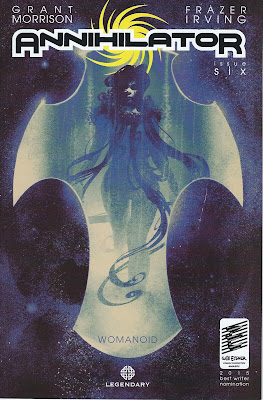
I know that I haven't spent much time on Frazer Irving's art, or not as much time as I've spent on Morrison's story. I mean, they're intrinsically linked, right? That's what we have to, have to, recognize about comics. So, let me just say that Olympia, Max Nomax's undead gynoid (or "Womanoid") is one of the loveliest women I've ever seen in comics. There's something timelessly beautiful and achingly vulnerable about the character. And, yes, *sigh*, that is coming from my completely subjective point of view, and not making any objective claims about the nature of beauty, nor is it intended to intimate that anyone not resembling this piece of art is not beautiful.
I feel, sometimes, like I need a disclaimer on my writing that says "Any opinions I express don't automatically mean that that is the only way I feel. It is simply one facet of my perception of the universe."
I'm still struggling to understand exactly what won out in this comic. I'd say it was love, except I'm not sure that it was. Obsession, maybe? Hope? Yeah, maybe that. Hope that in a world that seems like it is constantly falling into a supermassive black hole, we might still create meaning under the crushing pressure of oblivion.
Oof. Heavy stuff (*wink*). Onward.
(P.S. I really hope there is a sequel to this series, as is sort of teased. Max Nomax is the villain you love to hate)
Jan 22, 2017
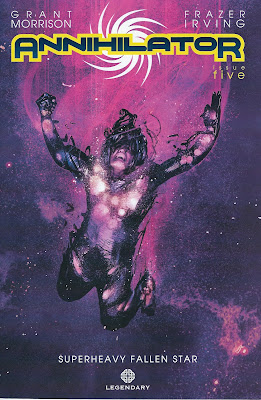
The 40 Years of Comics Project - Day 697: Annihilator #5, February 2015
Max's plan comes into focus, as much as we can focus on this plan, considering that "our world" is a failed attempt by the antiprotagonist to create a universe. It's a comic about the characters in a universe that has been created for the sake of art. Typical Morrisonian metametatext.
I think one of the things that I love the most about this series, from that metatextual perspective, is that it's quite blatantly demonstrating that the relationship we have with our fictions, especially those that we create, is reciprocal. Max needs his creations, the inhabitants of Ray's universe, to tell him his story, to point out the significance of his own life. I wonder how many authors look at their works from this point of view, not only from how their fictions might affect others, but what they reveal about they themselves? And would it even be possible for an author to look at a work and see it from that perspective, or is that why we have people who are literary critics? We're the people who reveal not only what the text is saying about the culture, but what the text is saying about the person/function (thank you, Foucault!) that transmitted it to us.
Neat. Onward tomorrow to the final issue!
Jan 21, 2017
The 40 Years of Comics Project - Day 696: Annihilator #4, December 2014
I've got people coming over for dinner tonight, and a fair bit to do, so it'll be a short one today.
I have no idea who, in this comic, I'm supposed to be identifying with. Everyone, except for Luna who is introduced this issue, seems to be a terrible human being/alien, though each of them appears to have one or two laudable traits. I remember reading a novel by Robert Rodi called What They Did to Princess Paragon, and by the end I felt I was slogging through a swamp because absolutely none of the characters were decent people. It's a strange thing to try to read, or experience, a piece of fiction in which none of the characters draw you to them. I like Max the most, I think, but only for his art above all else ethos. He's still pretty much a jerk, though.
Ah well. Can't like 'em all, I guess. I think I've come to the point in the series where the next couple of issues I've never read before, so that's cool. I have no idea how the story ends, or, really, where it's going. I'll find out tomorrow and Monday, I guess.
Onward.
Jan 20, 2017
The 40 Years of Comics Project - Day 695: Annihilator #3, November 2014
It's cliche, I know, but things are getting mighty strange in this comic. Which, of course, is what I expect from a Grant Morrison comic that doesn't feature corporately-owned characters (though his corporately-owned work is just really strange too). We get an interesting literary history of Max Nomax in this issue, and start questioning Max's assertion that he's real. While he claims that the early stories are echoes of his future works resonating back through time, and Ray starts thinking that perhaps he's actually a science fiction devil, I'm more of the opinion that Ray is somehow conjuring into reality these characters from his screenplay, perhaps through a heretofore unknown ability stimulated by the pressure of the tumour in his brain.
There's a good chance that none of these theories are correct, however, which is what I utterly, utterly love about a Grant Morrison comic.
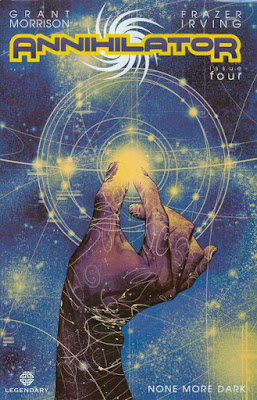
Let's talk about the covers for a moment. Frazer Irving did the art for Morrison's Seven Soldiers: Klarion series, and it was a wonderful, twisted, dark tale of underground Puritans and faeries from the future consuming the present. And while his art was quite glorious there, it was still cut from a superhero mold, in colour and design, perhaps. But here, with these covers, the twisted surreality of the story, the strange visions in Ray's head, come glorious and hideously to life. I'm of a mind to consider that these are what the visions Ray sees when he seizes look like: distorted faces, prison bars, immeasurable distances, and tiny, creepy teddy bears.
Oh. Hadn't I mentioned the tiny creepy teddy bear that keeps Nomax company on Dis, the prison that orbits the Great Annihilator? Maybe I need to add a bit of summary to these posts.
Onward.
Jan 19, 2017
The 40 Years of Comics Project - Day 694: Annihilator #2, October 2014
I think that, perhaps, one of the things that kept me from being fully enthusiastic about Annihilator as it was coming out is that it is a very thinly-veiled retread of many of the issues that Morrison dealt with 20 years prior in Flex Mentallo. Max Nomax fires his story as a "data bullet" into Ray Spass' mind, and the story must be told, the fiction made real, in order that a universe-destroying threat be neutralized. It's not identical, but it's pretty close. Now, this is not necessarily a bad thing. Morrison's career in comics has been a long consideration of the boundaries between the "real" and the fictional, a consideration I take up myself in daily life. We construct ourselves as narratives in the world, even as we are constructed as narratives by others. It's often the inability of a person to fulfill the roles we're cast in that pushes some into states of depression. That said, I think that Flex, which I'll get to reading eventually, is a much purer distillation of this concept, and it might well be because it's dressed up in gaudy superhero finery, rather than the leather and insect costume of Max Nomax. If we're going to meld or fuse with our fictions, it'd be nice to do it with the ones that are a little flashier, perhaps a little more optimistic, than our reality.
Moving away from the story itself, let me just note that Frazer Irving's art is, in a word, incredible. It is rare that you'll see such nuanced facial expressions in a comic book. Ray's feelings about his inoperable tumour, about his bizarre new buddy-cop life with Max Nomax, about his interactions with corporate Hollywood, are written plainly on his face. All the way back to Scott McCloud, we've talked about the erasure of detail in the faces in comics, a process that allows us to connect on a more fundamental level with the characters. This works well most of the time, but occasionally you will end up reading a story that you cannot, or do not, place yourself inside, and then you need defined people, people who look different from you, to tell you the story. What's kind of fascinating about this particular use of the detailed face is that it's in a story that's about meshing with our stories. So if we can't place ourselves into the remarkably individualized characters in Annihilator, what is that saying about the experience of placing ourselves into our fictions?
Onward.
Jan 18, 2017
The 40 Years of Comics Project - Day 693: Annihilator #1, September 2014
What's that you say? There's not enough Grant Morrison on this blog. Well, okay. I'll capitulate.
I have a couple of Morrison-penned mini-series sitting on my table that, for reasons unknown, I've simply not gotten around to finishing. Reading, that is. I'll admit that I'm less-enthusiastic about his later work than I am about his earlier stuff, but that likely has more to do with my propensity for superheroes than it does Morrison's craft. He still makes stories that are, in most cases literally, out of this world.
Annihilator is an interesting one. It fits into that metagenre of writers writing about being writers. Actually, perhaps that's a metametagenre. In Morrison's case, though, he acknowledges in critiquing the process of writing fiction that it is a fantastical pursuit, and so injects the fantastical into his story. There are, by my count thus far, three black holes in this story, and all of them are metaphors. We have the Great Annihilator, the supermassive black hole at the center of the galaxy. We have the mysterious sinkhole on the property that Ray Spass (pronounced "space," as in outer). And we have the dark hole on Spass' brain scan, an inoperable tumour. They're all the same thing, really: that spot of darkness from which springs forth creativity.
Though maybe I'm getting ahead of myself.
This series also does something that Morrison is well-known for: it blurs the lines between reality and fiction, introducing, at the issue's end, ultimate interstellar supervillain Max Nomax to his ostensible creator, Ray Spass. Nomax is the main character in Ray's new screenplay. As Warren Ellis has said, we have a strange relationship with our fiction, and only through fiction can we have conversations with it. Well, that and literary criticism, though oftentimes I find that criticism isn't actually having a conversation with fiction, but shouting over it and telling everyone what it means.
I might be a bit bitter, though.
Onward!
Subscribe to:
Posts (Atom)