Pages

Showing posts with label Paul Levitz. Show all posts

Jun 9, 2017

The 40 Years of Comics Project - Day 835: Wonder Woman #256, June, 1979

https://www.comics.org/issue/33436/

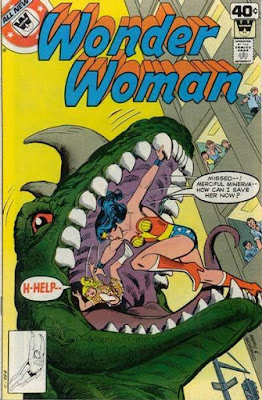
Kind of a bland adventure today, though the reveal that is teased on the cover likely came as quite a shock to regular readers at the time. I didn't have quite as much investment in the character, so his revelation as a super criminal was neat, but not affecting.

As far as I can tell, Diana has had enough of training to be an astronaut by the end of this issue, and packs up and moves back to New York. As I noted before, the choice to put her into NASA's astronaut training was a strange one - while I get that she has to have interests outside of her superheroing, this is the sort of thing that smacks of a young Clark Kent playing football. How can anyone stand up to the Amazon Princess? Couple this with her ability to literally go into space whenever she wants to, and isn't it a bit unfair that Diana is competing against "normal" humans for the opportunity to do so?

An odd characterization to be sure.

Not much else to say about this one. To make up for the Justice League comic in the middle of Wonder Woman week, I'll do a couple more this weekend, featuring the ever-entertaining Animal Man.

To be continued.

Jul 20, 2016

The 40 Years of Comics Project - Day 512: Wonder Woman v.1 #257, July 1979

http://www.comics.org/issue/853721/

Today is mine and my lovely wife's twentieth wedding anniversary. One of the great things that she brought to our joining together was a small, but very cool, collection of comics she'd had since she was a little girl. I thought that today I would read one, as a way of paying tribute to the most wonderful human being I know.

I was a bit flummoxed when I first got my hands on these comics. There were a lot of Disney and Archie comics, but sprinkled about for flavour were some cool superhero titles. Like this issue of Wonder Woman - published by Whitman? Now, many years ago, I figured out for myself that these comics were more than likely packaged together and distributed by Whitman, but, coincidentally, as I was reading the back matter of this issue, the question is actually posed to Bob Rozakis in his "Ask the Answer Man" column. He verifies that these comics were published as special value packs. I remember such things, but haven't seen any for many moons.

Pre-Crisis Wonder Woman is really pretty great. Unlike many of her incarnations, this one strides across the page like the Greek goddess that she is. Her thoughts and actions are epic. The comic begins with the invocation-like list of the deities that have gifted WW with her powers, echoing the beautiful opening captions of the earliest of her adventures, and calling to mind the incantations that Alan Moore takes up in his meditation on Wonder Woman in Promethea. This poetic aspect of the character is one that doesn't get nearly the attention it deserves. More than most of the mythic superheroes, Wonder Woman is one that almost self-consciously has her origins in language. She is a created figure, going by her original origin (I'll be honest, I have no idea if she's still meant to have been molded from clay in the newer iterations of the character), and where narratively she is sculpted from clay, figuratively, she's sculpted from words. This is something Marston understood very well in his original scripts. I'd urge you to have a look, even at just those opening captions. They're really quite lovely.

In this issue, Wonder Woman is faced with the menace of Multi-Man, an old Challengers of the Unknown villain, who has one of the most ridiculous costumes I've ever seen.


You're welcome.

(Also, we have a variation on the Wonder Woman being restrained theme here, though it's glass spheres and sleeping gas, rather than shackles and chains.)

Onward!

Jun 30, 2015

The 40 Years of Comics Project - Day 126: Adventure Comics #467, January 1980


As I selected this morning's comic, I had this awful feeling of how vast this collection is, and how long it's going to take me to read it all. I couldn't fathom just how long it'll take me to read the letter A alone, let alone the other 25 letters of the alphabet. Though some are less-prolific than others. I felt sure I must almost be done the letter A, but then I saw that enormous run of Alpha Flight, the more than half a box from Archie Comics. I know the project was a choice, but I feel the weight of it right now. The letter A takes up three full boxes. Time to start concentrating.

Today's comic is interesting, as it's ostensibly a new beginning for the venerable Adventure Comics, which seems over the course of its existence to have gone through a number of permutations. This issue is the first to be a 40-cent comic, where its predecessors, at least for a little while, were dollar comics that featured 4 stories. Only two in this one. And shortly after this issue, the series shrinks down to digest size. That aside, the comic also heralds the return of Plastic Man to comics (though I'm not sure when his last appearance prior to this one was) and the debut of the Levitz/Ditko "Starman." I'm only really a fan of Starman through James Robinson's spectacular series from the nineties, though I did collect Roger Stern's go at the character in the eighties. There's an interesting inflection moment in reading this story and knowing how everything ends up, at least in the Robinson series, for this particular iteration of Starman.

I was less-intrigued by the Plastic Man story, as I'm not certain that he's a character that can really carry his own title without becoming something of a one-trick pony. I enjoyed him immensely when he was a member of the JLA, but his humour and parody were tempered there, and he was given a bit more depth that one might assume from such a clownish character. I know Kyle Baker's run on Plas was quite excellent, but the proof, really, is in the pudding in that the series didn't last. Plastic Man, for all his morphing ability, can at times be pretty static narratively. But does a character have to have all these differing facets in order to be a successful story? I think it all depends on the context within which the character appears. If Plas were completely separate from the DCU, I could imagine reading his stories as simply humourous superhero bits, one-offs that had no greater impact than the laughs they produce. But as he is, intrinsically, a part of the DCU, we have to bear in mind that he should be as well-realized as the other characters in the shared universe in order that it make sense for him to exist in that universe. So playing him solely for laughs is a bad fit for a universe that relies as much on tragedy as comedy. Plastic Man's three-dimensionality shouldn't be solely relegated to his physical forms. There should be, as with any good character, mutli-dimensionality to his psyche as well.

Slight psychoanalytic analysis of Plastic Man? How come no one's done a paper on this yet?

See you tomorrow!