Pages

Showing posts with label J.G. Jones. Show all posts

Jul 15, 2017

The 40 Years of Comics Project - Day 871: Weather Woman #1, August 2000

https://www.comics.org/issue/1172306/

I've had Weather Woman kicking around in the collection for 15 years or so now, and I've glanced at it every now and again, mostly because of the alluring J.G. Jones cover on the first issue. I did a little bit of research on it before reading, mostly because I wanted to see how many issues there are (8, and I have  of them), and it turns out that the film adaptation of the manga was a surprise hit in Japan.

An interesting story so far, one issue in, and an opening page I won't soon forget (the main character masturbating in a bathroom). There's something disturbingly stalkerish about the lead male character, though I'm beginning to find that this is a relatively common trope in this kind of dramatic/black comedy manga. I'm sure he's in for much humiliation and embarrassment over the course of the next few days.

For those unfamiliar with the series the premise follows Keiko, a weather woman on a Japanese television station, who intentionally flashes her underwear on a broadcast, and subsequently becomes a star. I'm curious to see if the series rests on this premise, or if we're going to see, as the Wikipedia entry suggests, a bit more satire and consideration of how sex plays into television and whether (pun intended) or not it has any place on this kind of television.

To be continued.

Jun 15, 2016

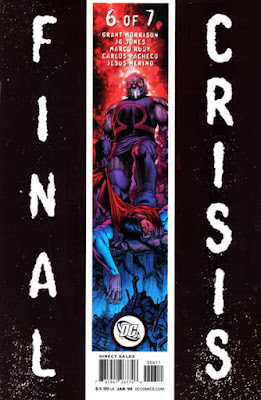
The 40 Years of Comics Project - Day 477: Final Crisis #6, January 2009

http://www.comics.org/issue/528860/

The coming season of the Arrowverse television shows fills me with the hope that we're going to see some really cool crossovers between the series. At the end of Legends of Tomorrow, I realized that the overall aesthetic for the series really was the line-wide crossover, but now with four shows to draw on (plus, with luck, Constantine if NBC are cool about it), we might actually see some shared narrative storytelling going on. I'm imagining a line-wide crisis of some sort that we see discretely through the lens of each show, but that is a larger picture when seen through the lens of all four. And if the writers could swing it so that, unlike many crossovers, we didn't need to watch each show, but would be richer for having done so, that would be amazing.

The reason I bring this up is that today's comic is that fourth act, the one where everything seems to completely fall apart. The world is spiraling down a singularity created around the incarnated Darkseid. The Green Lanterns are trapped in the event horizon, the Earth-bound superheroes fall to anti-life, one by one. Checkmate and S.H.A.D.E. are preparing to tunnel into a parallel universe to evacuate the world. And in the midst of it all, the man we've been following, that guy who dresses up like a bat, confronts the physical manifestation of universal totalitarian control in his own throne room.

When Superman finally returns to the pages of this series, it is as an exploding sun of grief and rage. He demonstrates exactly how powerful he is, bursting through the armies and shields of the New Gods as if they weren't even there. And he does this because his friend, the Batman, is dead. But it's not just friendship (that would be enough, but that's not all there is to it). Superman is invested in humanity becoming its better self. That's the tale we get hit over the head with in any other pop culture version of the character, the Jesus/Moses/Buddha/prophet of you choice metaphor. Hey, I'm not innocent of it either. As I never tire of saying, that idea was the seed from which my thesis grew. So then let's look back at yesterday's comic, where dark, animalistic gods find out that there is a human being, unpowered, driven by grief and rage, who turns the darkest of human emotions and experiences into weapons of light, tools to combat the manifestations of the worst of humanity (because, really, that's kind of what these dark gods are). For Superman, seeing this person die is seeing an aspect of humanity die that is all too rare: the strength to take what has damaged us almost beyond repair and turn it back against itself, to turn anguish and despair into strength and resilience. And love. Always love. I am reminded of this recent letter composed by the victim of the horrendous attack at Stanford. A warning - I could not get through this whole piece of writing. It is one of the most blatantly traumatic things I have ever read. But this young woman takes this event, this moment in her life that will colour everything for the rest of her life, and aims it back at the culture through which it is perpetuated. She speaks, turning her unbearable pain into a moment of love and support for everyone who has not been able to find this strength, standing as a paragon, as an example of how we can take in hate, take in the things that are meant to break us irreparably, and use those things to stop the very sources of our misery. She is a hero in every single sense of the term. And sometimes, just sometimes, all it takes to become that hero is to stand and use your voice. If only we all could find such courage.

Jun 11, 2016

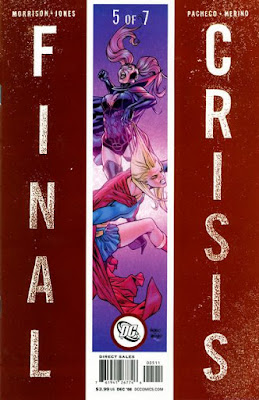
The 40 Years of Comics Project - Day 473: Final Crisis #5, December 2008

http://www.comics.org/issue/528859/

"They have only ever face the idea of a god before. Now is god incarnate come among them!"

I have a couple of board games based on the writings of H.P. Lovecraft - Arkham Horror and Eldritch Horror. In each of them, one of the Great Old Ones, main enemies in the game, that one can face is Azathoth, the nuclear chaos at the center of creation. When (if) he awakens, unlike the other Old Ones that are options as enemies, the game immediately ends. Unlike the others, he (it) is a GOD, all-caps, unbeatable - its will is creation and destruction themselves. For the majority of the game, the players are facing the influence of the god, the idea of it, but not the god itself. When that happens, the world ends.

So what does it say of the heroes of the DCU, from A-list to Z-list, that they do indeed stand against not simply the idea of Darkseid, but against the god himself? I have been, unsurprisingly, thinking about this a lot over the last few weeks, as I prepare to write the book that might be my dissertation, but that might simply be a book, about the incarnation of the mythic in reality. In the DCU, it is an actual presence, thinking, moving, living, that incarnates as Darkseid, an idea become flesh in two dimensions. But the DC heroes (and, as we'll see, villains) stand against this incarnated idea, proving themselves if not gods then mythic figures at the least. And if that's the case, if these are mythic figures, ideas, stories, how do they incarnate in our lived reality? I have what I think are the beginnings of answers to that question. I'll keep you apprised.

There is, in one panel, in one speech bubble, of this issue mention of Batman. Remember him? How we were reading through his final days? Tomorrow we'll see exactly what happened, what it means that the "Batman psycho-merge killed the clone army" that Mokkari and Simyan were trying to build.

To be continued.

Jun 10, 2016

The 40 Years of Comics Project - Day 472: Final Crisis #4, November 2008

http://www.comics.org/issue/528858/

There's a lovely moment in this issue where The Ray is outlining a plan to transport his fellows to the JLA satellite by becoming a teleport carrier wave, and the Tattooed Man questions the sanity of the plan, to which Ray replies "Seriously. I thought you were a super-hero, like the rest of us." The Tattooed Man is taken aback, to have been considered by this young hero to be "one of them." It's a nice continuation of the sentiment that Mark Richards' wife expresses at the end of yesterday's comic, though, unfortunately, my research into Richards' subsequent appearances shows that he was used simply as a low-level villain after this, with one or two attacks of conscience for good measure.

I don't have much more to say about this issue, though. It's a bridge, really, between the world that was and the world that becomes. The fall of Dan Turpin is absolutely heart-breaking, as he realizes that trying to fight Darkseid's influence is, as he notes, like trying to stop the ocean, and, in the end, all he can do is give in. I think this gives us a good, if distant, impression of the effect of anti-life: all you can do is give in. There is no choice, no hope. Only submission. Turpin's first-person narrative of his journey toward a choice that is not a choice is beautifully told. The heroes manage to communicate, briefly, Green Lantern Alan Scott offering a rallying cry to the anti-life survivors at the worldwide watchtowers, but the end of the issue, the incarnation of Darkseid, lets us know that the brief, green flame of hope that is offered is not going to be nearly enough. With Wonder Woman corrupted, Batman missing, and Superman absent as well, the DCU heroes are without their own gods.

To be continued...?

Jun 8, 2016

The 40 Years of Comics Project - Day 470: Final Crisis: Secret Files, February 2009

http://www.comics.org/issue/1011504/

There are two covers to most of the comics in the "Final Crisis" crossover. I really love the trade dress on these covers, the red bars slowly dissolving into black. But, having seen some of the other covers, which, like the cover of the Revelations hardcover, share the vertical titling but not the bars, I kind of wish I had those. Primarily, in the case of this cover, because the alternate would be a gorgeous portrait of FC villain Libra, rather than this godawful Jim Lee Wonder Woman. I don't actually remember where I read it, though it was likely Morrison somewhere, but a suggestion was made that Wonder Woman's costume doesn't really work when you strap it around a large bosom. The original H.G. Peter design was instead placed on a body that was slight up front, but featured the broad shoulders of someone who had spent her life in athletic training. A swimmer or weight lifter's body, rather than a supermodel's. Regardless, even if we account for the aesthetic shift of Western culture to privilege tiny waists and ample bosoms, there's no need for a picture of the greatest female superhero of all time to focus, literally front and center on both the cover and the picture, on her breasts. I would have bought the comic anyway.

(As an aside, Wonder Woman features in exactly none of this comic.)

Now, that said, it's not really a great comic. The lead feature is by Len Wein, whose name will forever be revered for his contribution to comics of the Swamp Thing. His story offers an origin for the mysterious Libra, one that, really, we probably could have done without. Mother dies, Father starts drinking, beats child, child grows up to become supervillain. Yawn. I think I'd have preferred not to know. Throughout this origin story, he seems somehow pathetic, rather than intimidating, as he is when we first meet him at the beginning of Final Crisis. And for all of his talk of balance, I don't see it played out through the story. I was close to only reading the Morrison and Rucka-penned sections of this issue, but then I remember that the larger project is reading comics, not just Grant Morrison comics.

Greg Rucka contributes a page from the Crime Bible to this issue, though I won't say much about it, as it's reprinted at the very beginning of today's graphic novel. Morrison gives us a short piece on the nature and history of the Anti-Life Equation, which is good, as over the course of its history, it's been a bit nebulous. Which, I suppose, is fitting for a god-weapon. We also get a sketch-book section from Morrison and J.G. Jones which doubles as a metatext of Nix Uotan's sketches, which we get a glimpse of in the early issues of the series when we follow the fallen Monitor into the real world(ish). Notable here, and actually in the Superman Beyond series, is that we get a glimpse of Doc Fate, mystic champion of Earth-20, and focal character in Morrison's later DCU epic Multiversity. I love seeing these things playing out over the course of decades. It speaks to the kind of creative vision that DC has been sorely lacking in the last few years. If you're going to set things up, you have to have some idea how you're going to knock them down before they simply crumble by themselves.

Tomorrow we'll move back into the story proper, and get a ground-level view of the end of the world.

To be continued.

Jun 1, 2016

The 40 Years of Comics Project - Day 463: Final Crisis #3, September 2008

http://www.comics.org/issue/528857/

Many superhero event comics focus on the efforts of the human and superhuman communities to stop the end of the world, or the universe, or the multiverse. It's usually a race against time and circumstance to stop a villainous plan that would see the end of everything. But with Final Crisis, the tag line "The Day Evil Won" rings very true, and sets things apart somewhat. This isn't about stopping the end of the world, but about bringing the world back once it's ended. The only other crossover I can think of that does something like this is the Bendis-penned Age of Ultron, but even that series relies on time travel to stop the problem before it starts. No such luck here, even though we've got a few time travelling Flashes on the stage.

So by the end of this issue, a few weeks into the future from where we started with Batman at the end of "R.I.P.," the world has ended, evil has won, and Darkseid has unleashed the anti-life equation on the population of Earth. Superman has been given a chance to save Lois' life, but only if he leaves her bedside, and leaves the problems of the world behind. We'll follow him into the Superman Beyond mini-series next week. Batman, last we saw, was strapped into an Apokaliptian machine. What's become of him is unsure.

This isn't the first time Morrison has played with this idea, and it might be interesting, once FC is done, to go back and re-read his "Rock of Ages" story in JLA, in which he envisions another iteration of the dark New Gods taking over the planet. There's certainly parallels, though I think FC is a bit darker. It's easy, perhaps, to envision what this event would be like at some undetermined future date, but to envision it contemporaneously makes the horror of it much more visceral.

As I noted earlier, I'll be taking a brief break from this read-through. Got to take vacations when you can in this life. And it's a good place to hang from a cliff - Wonder Woman and her Furies are about to attack Flashes West and Allen, anti-life appears to have consumed the planet, and Superman's nowhere (or everywhere) to be seen. Onward.

May 31, 2016

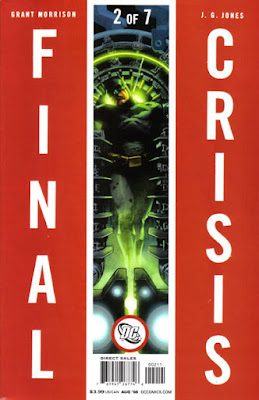
The 40 Years of Comics Project - Day 462: Final Crisis #2, August 2008

http://www.comics.org/issue/528856/

"Did you think that the Gods would tread lightly when they came among you?"

Shouted/hissed from the mouth of Alpha Lantern Kraken, host to Granny Goodness, this sentence really sums up the kind of Crisis the DCU is facing now. In many instances, these crossover events hinge upon powerful yet equally-fallible beings, whether from Earth or some other planet, and it is this fallibility, this mortality, that proves their undoing. They operate at levels of power that, for the most part, can be understood and conceived, even if they can't always be combatted to begin with. Such is not the case with Darkseid and the New Gods. They're Gods. They represent fundamental cosmic forces, evil ones, unfortunately, but fighting them is like fighting the laws of physics.

Morrison and Jones are very good at bringing this across in the series. The extremely unpleasant scene with Det. Turpin and the Mad Hatter highlights the primal change Terrible Turpin is undergoing. The ease with which the possessed Alpha Lantern incapacitates Batman (who always has a plan...maybe?) helps us to understand exactly how unprepared a world would have to be for the incarnation of Gods on its face. Something like Final Crisis could very easily be used at an end for the DCU, a horrible and unpleasant one, but an end nonetheless. And, really, it would be, if not for the fact that this fictional universe has been gestating a God of its own. It's during the Final Crisis that we begin to see what he might one day become.

Onward.

May 30, 2016

The 40 Years of Comics Project - Day 461: Final Crisis #1, July 2008

http://www.comics.org/issue/528855/

First, an admission - according to the reading order that I linked to the other day, DC Universe 0 takes place before this issue. It's penned by Morrison, amongst others, and does tie directly in to the events of Final Crisis, but it's also one of those comics that functions far more as advertisement than intrinsic story moment. And since I'm reading Final Crisis through the lens of Batman, and he's not, as far as I recall, in DCU0, I'm going to skip it. Maybe when I get around to reading the FC graphic novel one day, I'll read that comic first.

My favourite image in this issue is the second one, a double-page splash of Metron and Anthro. It has a real Fingerprints of the Gods kind of feel to it, something at once ludicrous and sacred - which, if you really think about it, is an excellent way of describing most religious beliefs. (That is not a denigration, btw. As I tell my students, critiquing something does not mean you don't love it, just that you don't accept its infallibility.)

So what do we do with this initial chapter? Vast, dark, terrible things happen, but it's almost subtle, understated somehow. The Gods have fallen to Earth and one has been murdered, replaying an archetype as old as religious belief. The Guardians have dispatched Alpha Lanterns (one day we'll read through the Geoff Johns Green Lantern run, one of the few places I feel he's really shone as a writer - the Alpha Lanterns are trouble), the Justice League is on the case, and Dan "Terrible" Turpin has wandered into something he's not even remotely prepared for. Though, in some ways, he's being prepared for something far more awful.

Jack Kirby's "Fourth World" saga has its ups and downs. It's not always great, but sometimes it's transcendent. I've never quite understood Darkseid's end goal, but leave it to Grant Morrison to show us. The ad rhetoric surrounding this series was that it was the final part of a trilogy. Looking back, though, I have a hard time placing Infinite Crisis on the same level as the first or the Final. The convoluted storylines made it hard to understand what was at stake, but with this series, and the first Crisis, it was clear: everything. Everything is at stake. And, though we know it's going to work out in the end, like watching a Shakespearean play, adapted from earlier texts, it's how things get to the end, how the story is told, that is important, that resonates.

Onward.

Sep 25, 2015

News

Facebook's abuzz this morning with news that Ta-Nehisi Coates will be writing Marvel's upcoming Black Panther series. Full disclosure: I am unfamiliar, completely, with Coates' writing, but his resume, as described in the linked article, speaks volumes. I've been fairly laudatory in my other sharings of this story on social media, but I'll note that I, as with any announcement like this, have to reserve some judgment until the finished produce has spoken. The Panther is slated to become another of Marvel's big stars with his film debut imminent, so one can imagine that some throttling of creator vision from editorial pressure might seep into the comic. Also, the article makes no mention of an artist, which is, of course, one of the fundamental measures of the success or failure of a comic. Regardless of how good a writer is, he or she is only telling half the story. I'm curious as to the visual aesthetic that will be chosen for the book.

For those interested in sampling Coates' writings, here's his author page at The Atlantic.

And for those interested in reading a brilliant run on Black Panther, check out Christopher Priest and J.G. Jones's run from the early 2000s under the "Marvel Knights" aegis. Amazing comics.