Thoughts, reviews, rants, laments, and general chatting about the wonderful world(s) of comic books.
Showing posts with label Western. Show all posts
Sep 11, 2016
The 40 Years of Comics Project - Day 564: The Rawhide Kid #50, February 1966 (Western Week, Day 7)
Finishing off Western Week with...well, a weak comic, I guess. Coming, as it does, in the early throes of Marvel's superhero renaissance, this comic falls into a strange trap. It revolves around the deception of an uncanny master of disguise named "The Masquerader," whose ability to perfectly mimic (and resemble) other people verges on the superhuman. Rather than allow Westerns to tell stories that are "Western stories," this comic is attempting to tell a superhero story in a Western genre comic. The Masquerader is obviously sporting some high-level superpowers if he can stand next to the person he's impersonating, using only materials available in the late 19th century, and be completely indistinguishable from the original. That's some Chameleon-level shit going on there.
So it's not surprise that the comic was written by Stan Lee, whose Chameleon had very likely appeared in the pages of Spider-Man not too long before. Having said that the comic was weak, I do have to acknowledge the fact that the writer and artist were attempting to push at the boundaries of the genre and tell a story that was unique and interesting. But I think that certain genres encourage larger and smaller deployments of the suspension of disbelief. The Western, taking place as it does in an ostensibly real historical period, and in a real geographic area, requires a lower suspension of disbelief in order to consider the realness of the tale. These "real life" markers act in such a way that when we see something patently ridiculous (such as The Masquerader's infallible skills) in such a setting, it rings even more false than it might usually.
Suspension of disbelief and the boundaries of genre. Hmmmm.
Onward.
Sep 10, 2016
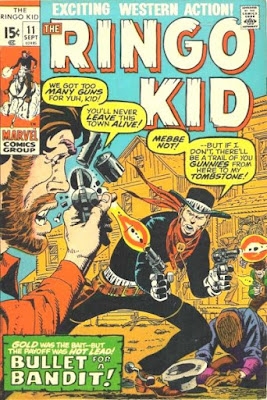
The 40 Years of Comics Project - Day 563: The Ringo Kid #11, September 1971 (Western Week, Day 6)
In stark contrast to yesterday's comic, this one is almost exclusively about a hyper masculine man wandering around a desert shooting at people. But I wouldn't go so far as to say it's stereotyped. The Ringo Kid seems never to shoot to kill. He instead uses his weapons to disarm, to deter deadly violence with a less final brand. Which, really, is kind of cool. It would be easy, given the very traditional set up of a rogue with a heart of gold dispensing justice in the "Old West," to simply have Ringo kill everyone he came across. It worked for Clint Eastwood, right? Instead, we have a conflicted character, one who recognizes the savagery of his situation, but refuses to become savage himself.
One of the stories is even about Ringo and his problematic Native American sidekick befriending a young boy and helping him to not be picked on by all the other children at school. To accomplish this, they show up at the school and take him camping and hunting with Dull Knife's brothers. There's no outlaws, no horse chases - just two people helping out a troubled little boy.
The Ringo Kid offers another nice glimpse into the different kinds of stories one can tell in the Western genre. Onward!
Sep 9, 2016
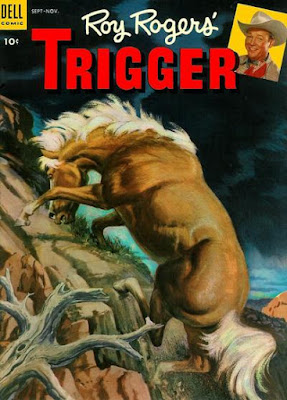
The 40 Years of Comics Project - Day 562: Roy Rogers' Trigger #10, September-November 1953 (Western Week, Day 5)
(Written on the 11th)
This afternoon, a friend came over and was browsing through this comic. Prior, he'd been looking through the issue of Rawhide Kid that'll be on the docket a couple of days from now. We both agreed that today's comic, about an action horse, contained some real dramatic moments, some actually interestingly constructed narratives, and did Westerns in a way that many traditional ones don't (in that, it was set in the West, and deployed the tropes, but wasn't about hyper masculine men wandering around deserts and shooting at people).
I often think that this is what the great writers of Westerns are going for - not the stereotype, but the behaviours and settings that are associated with the stereotype, but without the stereotype being present.
What I mean to say, then, is that of all the more traditional, old-school Western comics I've read this week, this one has been the best. Also the oldest, and definitely one of the oldest comics in the collection. I have a few from the very late 40s, but, like my copy of this comic, they're in very bad condition. The middle pages are missing from my copy, but I'm assuming that everything turns out okay. Except perhaps for the mountain lion in the first story. I get the feeling he doesn't make out okay.
Onward!
Sep 8, 2016
The 40 Years of Comics Project - Day 561: Mutant, Texas: Tales of Sheriff Ida Red #1, May, 2002 (Western Week, Day 4)
So, this is my kind of Western. Mutants formed by the conjunction of a comet crashing into a nuclear power station with the spiritual magic of the landscape produces an isolated town in the wilds of Texas populated by anthropomorphic plants and animals, and one or two mundanes as well.
With a team like Paul Dini and J. Bone, you're pretty much assured a quality comic. While Dini is something of a superstar thanks to his Batman Adventures work, he's not necessarily seen in the same light with print comics. And Bone is a reliable and innovative illustrator who's carved out a nice little niche in the industry over the last few decades. As far as I know they've worked together a bit on Dini's Jingle Belle one-shots, and Mutant grows out of that collaboration. Ida's a lovely character, as is Tia Oso. I remember when the series came out, slightly before my comic store shut down (which might account for my only having the first 2 issues), and Oni hyped the heck out of it. Well, as much as a smaller company like Oni can, that is.
Rambling today. Sorry. I'm pretty sick right now. This was a good comic, definitely a Western that's up my alley. As with Pilgrim yesterday, we've got a nice mixture of the Western tropes with the Sci-fi tropes, and perhaps that's what's working for me. A quick look through the rest of this week's comics reveals much more traditional fare, so we'll see what happens with them.
Bah. I'm going to go sit on the couch and feel gross. Onward.
Sep 7, 2016
The 40 Years of Comics Project - Day 560: Just A Pilgrim #1, May 2001 (Western Week, Day 3)
Today we jump ahead 50 years and have a look at a comic by a man who helped redefine the Western genre in the late 90s: Garth Ennis. His amazing Preacher series has finally made it to television (stay tuned for another installment of "Giant Box of Comics watches Television"), and in the 90s when the comic hit, it caused an insane furor in the industry. What is it about writers and artists from the UK coming to America and doing their "traditional" genres better than the Americans themselves?
Pilgrim is a follow-up of sorts to Preacher, coming out just as that series was winding up. There's a great deal of similarity, though Pilgrim incorporates the post-apocalyptic, Mad Max-esque setting, a setting that, really, grows quite organically from the Western. What is really quite excellent about both this series and its predecessor is that it takes the Western and applies the genre not as a series of set pieces, nor as a genre mired in a particular historical era, but as a an atmosphere, as a character attitude, and as a style of storytelling. Yes, the tropes are there: the desert, the lone wanderer, the people in need of a protector/champion (though this is a Garth Ennis comic, so those people had better be very careful). Ennis and Ezquerra show us that the Western as a genre is not one to be relegated to the late 1800s and early 1900s, but one that can be demonstrated across many periods, and meshed with many genres. As I say above, there's much to be made of the connection of the post-apocalyptic setting and the Western. Think of something like the much-panned Kevin Costner film The Postman, or the aforementioned Mad Max films. The Western is about that rugged individualism with a heart of gold that ostensibly forged the American West, and that's a character and story that can easily be translated to other settings. I live in anticipation of a Western about a wanderer in the deserts of the Middle East in the 17th century.
I enjoyed this one, much more than when it first came out. At that time, I think I was in Preacher overload, so this just seemed like more of the same. But it's really quite a different beast, and I'm looking forward to reading the rest of it. Perhaps after Western Week is done. Onward!
Sep 6, 2016
The 40 Years of Comics Project - Day 559: Two Gun Western #5, July 1956 (Western Week, Day 2)
Western Week continues apace. Is there something I'm missing about this genre? I just don't think I'm getting it. I'll put it out there front and center that my copy of this comic does not have the cover that you see above. A few months back I had the great fortune to pick up a stack of coverless old comics, including some Archies, some EC crime comics, and some old westerns from the 50s. Really great reading copies, but the covers are unfamiliar to me.
What this particular comic does do nicely is highlight some of the fantastic creators who were working in comics just before the advent of the superhero (or re-advent, I suppose). This comic is cover dated just a few months away from the Flash's return to comics, so it gives us a nice idea of what was on the stands around the same time that the costumed crowd started resurfacing. The art is, truly, quite gorgeous, especially the first story, scripted by the inimitable Stan Lee, and pencilled by Joe Sinnott. I'm not sure if Sinnott did his own inks (the GCD says he did), but the textures and detail on each face and each building are just stunning.
But the stories are just not doing it for me. I wonder if it's the same reaction I have to mob stories, or war stories. I just find them to be far too close to reality, almost a sensationalizing of a particularly violent aspect of the recent past. Or maybe it's because gun violence is a remarkable prevalent part of our culture that I have such a hard time with entertainment media that hinges on such weapons as fundamental narrative devices. I'm not denying that stories, great stories, could be told in these settings, but the amount of glorification has to be reigned in, otherwise it just looks like it's celebrating killing.
I'm willing to keep going, though. I recognize that there may be genres that I'm not a huge fan of, but I also recognize that great stories can be told in any genre. Onward.
Sep 5, 2016
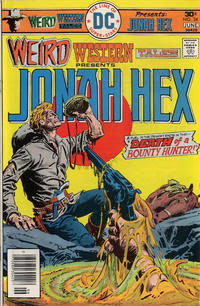
The 40 Years of Comics Project - Day 558: Weird Western Tales #34, May-June 1976 (Western Week, Day 1)
Sorry. Promise I'll catch up some time in the next couple of days. But welcome to Western Week!
I'm not entirely certain what was Weird about this story. It was a pretty straight forward tale, reading in a lot of ways like a short passage from Blood Meridian, though with less profanity and brutality. Hex runs afoul of a dishonest bounty hunter, and gets his revenge.
That's it.
I've noted many times before this that Westerns are not my favourite genre of storytelling, but I'm trying this week to keep an open mind. What's kind of cool about this issue is that it was written by Michael Fleisher, the person responsible for the excellent DC Encyclopedia series from the seventies. Though, I have to say it, perhaps he's a better archivist of comics than composer of them. That, however, is a judgment I should suspend until I've actually read a few more of his stories.
This one, though, was kind of meh. A slow start to Western Week, I guess. Onward!
Subscribe to:
Posts (Atom)