For information on stopping the spread of COVID-19, and on what to do if you are quarantined, have a look at the World Health Organization site.
Thoughts, reviews, rants, laments, and general chatting about the wonderful world(s) of comic books.
Showing posts with label Jim Lee. Show all posts
Nov 22, 2020
Oct 4, 2018
The 40 Years of Comics Project - Day 1317: Action Comics #1000, June 2018
I've fallen a bit behind on my current comics, so I though that in order to catch up on the new Brian Bendis Superman stories, I'd read them for the project. We'll start here, with Action Comics #1000, and see where he takes us.
What more can I say about Superman, though? There is actually something I have to try to work out. It's my understanding that Frank Miller is going to be writing a Superman series in the near future. I can't wrap my head around the idea of a right-wing nut job like Miller breathing life into Superman. Miller's politics seem antithetical to everything I believe about the Man of Steel. But that's the thing, isn't it? Superman's not real - he's a fictional character that can come to be representative of anything. This means he can come to be representative of things that I might not agree with. Not that I think you can push the character too far, unless you want a repeat of the original run of Supreme. There is always something of the socialist in Superman, right from the beginning. But if Superman is indeed for everyone, then he has to be for right- and left-leaning readers. Perhaps Miller's take will satisfy that other demographic.
As far as Mr. Bendis' work on the Big Blue, it's hard to say, thus far. He provides us with a nice little in media res prologue, and drops the bomb that Krypton's destruction may not have been what it seemed. Intriguing, but it's the handling of the characters that I'm more excited to see from Mr. Bendis. His gift for dialogue is virtually unparalleled in contemporary comics.
So, more Superman to come...
Jan 4, 2018
The 40 Years of Comics Project - Day 1044: WildC.A.T.S: Covert Action Teams #2, October 1992 (What I Missed in the 90s Week, Day 4)
Alright, a perfunctory entry to make up for my slacking.
Jim Lee has always struck me as the most talented of the Image founders - he's a good artist and a good storyteller, he sticks to his strengths, and has other people script his stuff most of the time. It's important to acknowledge your strengths and allow others to help you with things you're weaker at. Perhaps that's one of the problems of the Image experiment, at least initially. The people involved wanted so badly to be autonomous that they forgot that sometimes it's good to have people help you. Witness the great comics that came out of McFarlane's invitation to other writers.
Lee does things slightly differently, in that he's got in-house writers, from what I can tell. Which is a great way of brand-building, which of course leads to Wildstorm being one of the most recognized of the former Image studios.
To be continued.
Nov 25, 2016
The 40 Years of Comics Project - Day 639: Deathblow #4, April 1994
Okay, so it's jut the last issue that doesn't have a Cybernary cover, though the indicia does indicate Cybernary as still being a distinct entity from the Deathblow comic. One imagines that the lack of cover may have had something to do with Nick Manabat's hospitalization.
Deathblow is beginning to venture into more superheroic territory, which is both good and bad. In a shared universe, it's important to remember that the significant changes to reality (i.e., superpowers) are going to influence every facet of that reality, including Black Ops missions in Iraq. I'm not sure where Deathblow's story goes, and who the "Black Angel" is, but I'm sure it'll be bloody and violent.
A letter in the back of one of the previous issues asks when Cybernary is set, offering the assumption that it's some time in the future. This is another facet of that shared universe influence, as the story takes place in contemporary times. The Image universe embraces these influences in a way that similar situations in the Marvel or DC universes are not embraced, which Warren Ellis calls out with great facility in the pages of Planetary. The technology evinced on the island nation of Gamora is light years ahead of what technology actually was in 1995 (remember, that is basically a pre-Internet world), the result of alien incursions onto the planet.
Not sure where I was going with that. I'm having one of those weeks where I simply don't have enough spoons to do everything. I'll keep reading everyday, but my apologies if the posts are short, or a bit choppy.
Onward.
Nov 24, 2016
The 40 Years of Comics Project - Day 638: Deathblow #3, February 1994
Okay, okay, I have no idea why anyone takes anything I say as the truth. I think what the case actually was was that the last issue of Deathblow is the only one without a Cybernary flip cover, and I got confused. That happens more and more often these days. The official release data, coupled with the orientation of the stories, means that this comic is actually called Deathblow, even though it included just as much Cybernary. What happens is when there's no Cybernary cover on the fourth issue, my OCD takes over and tells me that I can't possible simple alphabetize the last issue under an assumed, rather than actual, cover.
Honestly, this is what the inside of my head is like all the time. But I'm trying to combat these things, so perhaps I'll be able to re-file these as Cybernary, not Deathblow. Perhaps.
Anyway, the stories continue in much the same fashion. We get some early Tim Sale work on the Deathblow side of things, which is cool. He's definitely got that Frank Miller-style thing going on, but Sale's work surpasses Miller a few years later. His work with Jeph Loeb on their meditations on the early days of superheroes are pretty much across the board wonderful, and his style, which is grim'n'gritty here becomes simple and whimsical, without sacrificing any of the drama he's capable of.
Manabat and Gerber begin to reveal a bit about Cybernary, who she is, where she comes from, and we start to get the idea that she's more than just a faulty "nympho-droid." Each issue of this series makes me more and more sad that Manabat never got a chance to really show the world what he was capable of. His art is so metal. Over at Comic Vine, a relative of Manabat's started posting some of his sketch work, so we have a bit more of this amazing artist's work. But still, too little.
Onward.
Nov 23, 2016
The 40 Years of Comics Project - Day 637: Deathblow #2, August 1993

Okay, I lied yesterday, though it was unintentional. Issue #2 has a flip cover as well. The back of this issue has a short missive from Jim Lee, detailing how Deathblow is set to become a quarterly comic, rather than a monthly (though the August cover date suggests thirdly, not quarterly), and in which he cites Frank Miller as an influence on the story. No surprise there. It gets me thinking about the differences between tribute, or inspiration, and direct copy, and Deathblow skirts the edges of these categories a bit dangerously. Having read the last couple of issues, I really would not have been surprised to find out this was actually produced by the horrendous Frank Miller (seriously, look him up - he's probably an Orange Man supporter). That's how closely this comic mimics the style of The Dark Knight Returns. To be inspired by an artistic style is one thing, but to simply offer pastiche does little to further the cultural conversation that art represents. Perhaps, later in the series, Lee brings his own brand of storytelling to the character, while retaining influence from Miller. But these early issues are direct mimicry.
Cybernary, on the other hand, continues to look like little else that I've seen in the Image universe, and in superhero comics more widely. There's something of Chris Bacchalo's early style to it, and it occurs to me now that Generation X was being published around the same time as Deathblow/Cybernary. One letter complains about the overuse of black in the art on Manabat's story, but the whole thing, from those pervasive shadows to the blue-tinges on everyone's skin, gives a real feeling of a story happening at night, away from the bright lights of the superhero universe the characters inhabit, somewhere deep in the shadows, almost unnoticed. Which, considering the pomp and circumstance of Minotaur's arrival on the scene, is ironic.
A couple more issue of the flip book, and then we're on to Cybernary's series proper. I looked up Nick Manabat yesterday on the GCD, and he's got a scant 6 issues credited to him, two of which are pin-ups (in Backlash and the Wetworks Sourcebook). I'm curious if he did any other work before getting into Image comics, though that doesn't appear to be the case.
Onward.
Nov 22, 2016
The 40 Years of Comics Project - Day 636: Deathblow #1, April 1993

While it may look like I've read two comics today, that's not the case. As I mentioned a couple of times over the last few days, I've become a bit fascinated with the early Image universe, and its remarkable internal consistency, so I thought I'd read a bit more. And if that bit more includes Steve Gerber, so much the better. The first installment of the Gerber/Manabat Cybernary is presented as a back-up feature in the first issue of Jim Lee's Deathblow, and is even given a flip cover (which is how I always have it catalogued). Unfortunately the next three issues of Deathblow, even though fully half of the issue is devoted to the Cybernary story, don't have flip covers. A pity.
Deathblow finds Jim Lee and co-writer Brandon Choi at the Frank Millerian best - short, clipped caption boxes, chunky, almost etched-looking artwork, remarkably different from what I would have characterized as Lee's usual style. Though maybe it's a bit too much Miller, and that's why his later work bears only scant resemblance to this one. The story is pretty tame, considering the violence we see in flashback, but perhaps over the next few issues it'll pick up.
For Cybernary, Gerber is credited as scripter, rather than writer, though I think this changes over the next few issues. The beginning of the story is quite good. Manabat's art calls to mind the work of Kelley Jones, though inflected with the Image house style, which sounds weird but actually works. We get these first four issues of his work and then Manabat sadly lost a battle with Hodgkin's Lymphoma, leaving behind a small, but impressive body of work. Gerber went on a couple of years later to do a Cybernary mini-series, partially in tribute to Manabat, so the character as introduced does get to play out at least a brief story. Escaped sex-bot becomes resistance badass on the island nation of Gamorra. It sounds like typical power-fantasy fare. But it's not.
Onward.
Oct 17, 2016
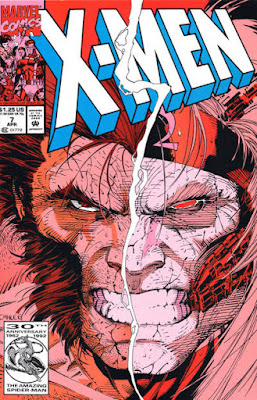
The 40 Years of Comics Project - Day 600: X-Men #7, April 1992
Had I thought ahead, I'd have planned something a little more impressive for my 600th day of writing. But instead, let's let the chips fall where they may.
I've often thought that there are both good and bad aspects to writing a team superhero book. On the one hand, you've got variety, so you're not likely to get bored writing the same character month after month. You also get to play with some second-stringers, who, by their nature, are more malleable than the A-list characters who have their own titles. Variety and opportunity for creativity would seem to be the good parts of a gig like this. On the other hand, though, you have to be able to balance the team's representation well, and I think this is where Jim Lee's X-Men falls apart. I look at someone like George Perez, who has an uncanny (if you'll pardon the pun) knack for having huge groups of superheroes on a single page but still is able to make each character feel like they're an individual, rather than part of an amorphous group. It's the sense that, for each character they are the center of the story. With this comic, and the last few issues, it's really felt like all of the other characters are there simply to further Wolverine's story, rather than to be stories in and of themselves. Jubilee, for example, pops her head in, says something witty with the word "like" inserted a couple of times, and then disappears.
So, the long and short of it is, I'm going to switch to something else before I just start ranting about how bad X-Men comics can be for a paragraph or two every day. That doesn't seem healthy. We'll get back to the X-Men at some point. There are eras of the team that I really love, but, as the last few days have proven, there's eras that I have very little time for.
Onward.
Oct 16, 2016
The 40 Years of Comics Project - Day 599: X-Men #6, March 1992
Still sick. Not even slightly better, so let's blame that for how much I fucking hated this comic. What the hell was wrong with creators in the early 90s? Six issues into the new series, even the readers were starting to ask what the hell was going on. Letter writer Kieron Brennan, though happy to see the team update into the 90s, says "Don't sacrifice the personal lives of the X-Men just to please the PUNISHER and X-FORCE fans! The personal interplay between various X-Men hasn't been carried over into this 'new era of the X-Men.'
He's not wrong. It is brutal fisticuffs cover to cover. Oh, and development of Wolverine's character, probably, aside from Batman, the most overdone superhero in the history of superheroes.
I'm concerned now that there's so much of this bad 90s superhero stuff in the collection that I'm going to have to read. Perhaps rather than reading it in chunks like I've attempted here, I should break them up. Or, y'know, try to maintain some distance from my subjects.
But the comics are just so bad.
Onward.
Oct 15, 2016
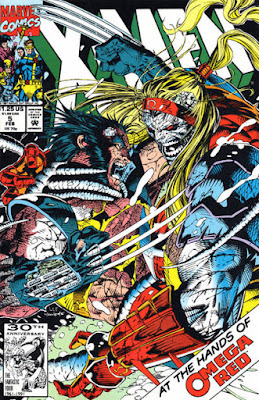
The 40 Years of Comics Project - Day 598: X-Men #5, February 1992
I'm very sick today. See that cover up there? That's all you need to know about this comic. People beat up Wolverine and kidnap him. The X-Men intervene.
There is one bit I have to mention. Psylocke is swimming at one point, or that's what she says as she runs into the ready room in the tiniest depiction of a two-piece swim suit Lee could get away with without having a "Mature Readers" label on the cover. And as she, Colossus, and Cyclops are called away to rescue their comrades, Betsy isn't even allowed the dignity of putting her costume on (not that it's much better than the bathing suit). Lady swimmers, let me know if I'm wrong, but a tiny, itty-bitty two piece bikini is not even remotely the best thing to be swimming in if you're exercising, right?
*sigh*
There's going to be so much of this nonsense in 90s comics, isn't there?
Onward.
Oct 14, 2016
The 40 Years of Comics Project - Day 597: X-Men #4, January 1992
I sometimes think that in the wake of a creative team transition, there should be an issue or two that is simply pictures of heroes hanging out, having breakfast, watching Netflix. It could be all splash pages (which Jim Lee is so very good at) of them relaxing, if only for a single issue. The events of the last three issues have been not only physically very perilous, but have played psychic havoc with many members of the team. That they're thrown right back into a life or death situation just seems unfair.
That said, the basketball game between the teams of Jubilee and Gambit, and Wolverine and Rogue, is pretty great, especially once they decide to let their powers loose. It's interesting to see Wolverine and Gambit's relationship, which is played similarly to the one that Wolverine and Cyclops have shared for so long, only reversed. Wolverine, in his dotage, appears to be the responsible one.
I don't have too much more to say about this issue, but I think that has to do with the fallout form the previous issue - we just need a moment to recover from the revelations, deaths, and changes that Claremont's final (sort of) story dropped. I say "sort of" because, about 10 years after leaving, Claremont returns to the X-Men with the X-Treme X-Men title (worst X-Men title ever, I think). I never read any of them, nor do I have any in the collection. At the same time, Marvel had put Grant Morrison on New X-Men and Joe Casey on Uncanny X-Men, so a new Claremont title held little allure, at least for me.
We'll keep plugging away tomorrow, and hopefully get a bit of background on the new menace of Omega Red!
Onward.
Oct 13, 2016
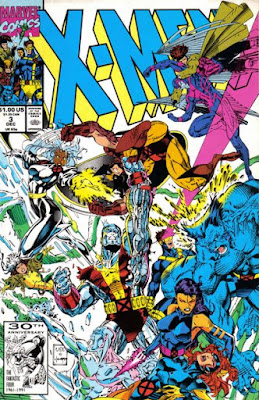
The 40 Years of Comics Project - Day 596: X-Men #3, December 1991
I had not realized that this issue represented the end of Chris Claremont's epic run on the X-titles. I've been quite critical of Claremont's writing style over the last while, but one cannot deny his influence on the genre. Before him, the soap-y nature of superheroes was rough and raw - he refined it to a delicate art, the influence of which is found in just about every superhero comic that follows. There's something almost Shakespearean to the level of dialogue, spoken and thought, in a Claremont X-comic. Like every moment, every thought or word, is expressing something fundamental. And, in a very real sense, they are - the words are, in part, what make up the narrative, and without them there would be none.
Now, this said, I still think that, occasionally, and especially if you're going to be writing an almost 20-year long story, there have to be moments of slipping out of that upper level linguistic realm - imagine being a character in a Shakespearean play for 20 years! And I think this is the thing that irks me a lot about Claremont's X-Men work (because his Excalibur is nothing like this) - everything is in a constant state of urgency. It really must be exhausting to be an X-Man.
Anyway, I actually have no idea who takes over next issue, so that'll be interesting. Onward.
Oct 12, 2016
The 40 Years of Comics Project - Day 595: X-Men #2, November 1991
When I sat down to read my comic this morning, and I was gently peeling back the tape that holds the bag closed, I started to smile. I was actually quite excited to read an X-Men comic. I know I was quite harsh about this "new" X-Men series yesterday, but it seems the nostalgic, 14-year old self that resides just below my adult surface was quite chuffed to be reading the X-Men.
That said, I'm certainly not going to retract any of the statements I made yesterday. The comic is still rife with flaws. I'm not sure why Lee and the artists who accompany/follow him think that adding so many lines to each face and costume make them seem more realistic. From what I can tell, most humans have fairly smooth skin. And don't speak, constantly, from between gritted teeth (the Liefeld Effect).
What I do really like about this comic is the characterization of Magneto. Here, I think, Claremont has established a really cool interpretation of the character, and one that offers a view of where the current cinematic version of the character springs from (I can't comment on the current incarnation in comics, as I haven't followed X-Men comics for many years). Magneto is always at his best when he's allowed to be pure in his beliefs. For example, in this comic, he still cares nothing for humanity, but he's completely chagrined over battling the X-Men, who he sees, if not as equals, as fellows. He fights them reluctantly - something that the X-Men don't seem to grasp, with the possible exception of Rogue.
It's nice to see that relationship, as well, as it was one of my favourite parts of the Age of Apocalypse. I hadn't realized it was something that had been established earlier.
Anyway, looking through the collection, I have the run of numbers 1 to 8 of this title, so we'll make our way through and see what the hubbub was about. Onward.
Oct 11, 2016
The 40 Years of Comics Project - Day 594: X-Men #1, October 1991
This will be one of approximately 5 times I'll be reading this comic over the course of this project. Often lauded as one of the best-selling mainstream comics of all time, X-Men #1 only carries this distinction because it was produced at the height of the collector boom in the early 90s, and sports a total of 5 different covers. And I think I have them all.
It's been a while since we've delved into the X-universe, and the last time was an extended foray into an alternate universe with the Age of Apocalypse. At the time that today's comic was originally published, I'd given comics up, so I missed the rapid expansion and collapse of the speculator market, and the defection to, and creation of, Image comics by a number of prominent Marvel artists, today's Jim Lee amongst them. What this also means is that I'd given up on the X-Men a few years prior as well, and reading today's comic, I remember why. Now, I don't want you to think that I don't appreciate a little soap opera in my superheroes. I was a very early adopter of Noble Causes, which is pretty much all soap opera, and it's really well done. But Claremont X-soap opera is just too much. There's too many characters, to much pathos from EVERYONE - it's like the amount of angst present in an entire season of Supernatural, but condensed into one comic. Every panel oozes either dull sarcasm or mediocre soul-searching. Couple this with my general dislike for Jim Lee's art, and we have a perfect recipe for me not enjoying this comic at all.
Well....aside, perhaps, from the ironic stance I try to maintain when it comes to such comics. I was teaching my class about contextualization of pieces of writing, about the importance of recognizing the cultural moment from which a piece of fiction emerges, and I'd hardly be a good teacher if I didn't practice what I preach. This comic comes from a very specific era, one defined, unfortunately, by the worst of fanboys, and the most unrealistic and sexist of art. But it's also an era that pushed comics, by way of the aforementioned speculator market, a little more into the mainstream. We were still almost a decade away from the first X-Men movie, but the prices that some variant covers were commanding, and the attention some artists were grabbing, was starting to make people sit up and take notice of these things called comics that had been relegated to the back room role-playing game clubs in high schools for most of the previous decade. So I have to have some affection for the comic, even if I don't have a lot of respect for its narrative execution.
That said, I think I'm going to stick with the series for at least a few days. I'm curious about how it maintains its momentum. Onward.
Mar 15, 2015
The 40 Years of Comics Project - Day 19: The 100 Greatest Marvels of All Time #5, December 2001
A fantastic, but tiring, weekend, so a shorter post.
The 100 Greatest Marvels project is very interesting. Based on reader votes, this countdown really does offer some of the highlights of Marvel's venerable history.
This issue, however, I call afoul.
Contained within is a reprinting of Chris Claremont and Jim Lee's X-Men #1:
This relaunch of the series is rife with badness. From the insane expository thought bubbles to Jim Lee's badly hyper-sexualized renderings (and, seriously, it looks like Cyclops is made of balloons in the above picture. W.T.F.?). Claremont is a great concept man, but I've never found his dialogue particularly great. Except in Excalibur. He shone in that.
And then somehow this is a more important comic than the 95 that precede it. Which includes the Avengers comic in which Captain America returns, Wolverine's first appearance, and a host of other milestone comics. I do understand its million-selling status is important (even taking into consideration the 5 different covers), but sales alone can't make a comic great. Look at Youngblood #1. I suppose we acknowledge Lee's importance, especially as he departs with the other Image artists not long after the launch of this comic.
Just a few thoughts. I'm going to bed now. See you tomorrow.
Subscribe to:
Posts (Atom)