Pages

Showing posts with label Age of Apocalypse. Show all posts

Sep 23, 2015

The 40 Years of Comics Project - Day 211: X-Men: Omega, 1995


I gave us an extra-large cover shot today, in celebration of the ending of the Age of Apocalypse.

If you've been following along over the last few weeks, you'll know that, for the most part, I've been pretty happy with the AoA, from the standpoint of how it functions as a crossover, how it reimagines some seminal characters, and the overall structure of the narrative. It's not without its flaws, but it's been a pretty enjoyable read. One of the biggest problems that faces a crossover of this magnitude, however (and I'm looking squarely at you, Secret Wars), is that it eventually has to end, and hopefully in a manner befitting the epic scope of the story. Does "Age of Apocalypse" manage this fantastic feat?

I think the honest answer is "sort of." For example, where on Earth did the whole Warren Worthington with a bomb strapped to him and apparently in love with Karma storyline come from? This is literally 3 pages in this final issue, and, as far as I can tell, there was little to no set up that would make this suicidal course of action believable for Angel or demonstrate the depths of his feelings for Karma. Contrasted to that, the final knock-down between Magneto and Apocalypse was just great. Magneto's power armour that he builds from surrounding tech is totally badass, and he takes down Apocalypse in a fashion that, I have to admit, I've been waiting to see since X-Factor #4. There were also a lot of deaths in this issue that I'm not entirely certain were necessary, considering the nuclear apocalypse that was on its way to the former New York. And, as I mentioned in my Generation Next reviews, the characterizations of Colossus and Kitty Pryde irked me more than I can say. Though, to be fair, it's not outside the realm of possibility that a situation like the Age of Apocalypse would have been enough to drive a gentle soul like Colossus over the brink into madness. Maybe I need to rethink my assessment of that one.

In the end, though, and I mean the literal end, things close out quite dramatically, emotionally, and satisfactorily. The final image as the bombs detonate, even after Bishop has reset the timeline, reinforces what the X-Men, like the Fantastic Four, at their best stand for: family. One fights and fights for a better world, and regardless of the breadth of one's ambition for that better world, in the end it is about making the world safer and more comfortable for the people we love. Magneto, Rogue, and Charles' poignant ending is contrasted with the tragic ending of the Summers brothers, and I am saddened that these characters have had their brief moment, never to return.

I'll admit, staunchly ambivalent about the X-Men as I am, that I'll miss my daily encounter with these characters. I have a huge run of Uncanny X-Men in the collection, but I think it's time to move on to something else, something different. I don't know what that is, yet, but I've got a few hours to figure it out. Thanks for taking this ride into a dystopic Marvel U with me. Wherever tomorrow might take us, I'll see you there.

Sep 22, 2015

The 40 Years of Comics Project - Day 210: X-Universe #2, June 1995


Anyone who's read my review of issue one of this series probably expected as little from it as I did this morning when I started reading it. I was surprised, rather pleasantly. I don't know what happened with the first issue, but this second one read like the amazing ending to some crazed, dystopian sci-fi movie, complete with a 2001: A Space Odyssey-esque ending. It was actually really, really good.

Sparkling praise aside, there were still moments that felt a bit rushed, which got me wondering why a series like X-Universe was only given two issues. This could have been a really amazing series if it had been given the same attention in the AoA as all of the other series. We hear about Mikhail Rasputin, the "Forgotten Horseman" a few times over the course of the main AoA series, but are only exposed to him in this series. Given a couple more issues, he really could have been a memorable villain, rather than another hastily erected and then torn down caricature. The Matt Murdock story, the end of which in this issue was truly moving, had it been given slightly more space to expand, could have been one of the really great Daredevil stories. The same goes for Tony Stark, who gets hands down the best line in this issue, name-dropping the Avengers in  a world in which they never existed.

X-Universe had amazing potential. As much as seeing the iconic versions of the X-Men showing through their AoA counterparts was great, the comparable slim treatment afforded the rest of the superheroic universe within which they exist speaks to the annoying prevalence of all things X in this era of Marvel comics.

Let me talk about the end of the series a bit. Spoiler alert, btw. The human evacuation plan works, and we see a group of arks lifting out of the atmosphere and into space. How this all links up with the nuclear strike plan of the regular series, I have no idea. But then the ships, I don't know, blast into hyperspace or something, the final panel a burst of brightness, the caption boxes stating "-mystery whispers..." "...and behind these chosen few-" "-reality passes..." There isn't even a box at the end saying "End." Just "reality passes." As far as I've been able to tell, these characters have never shown up again, though, as I note above, they're pretty great takes on some of the big names of the Marvel U. Where do they go? Are we to assume that, as the regular universe reasserts itself, these travellers are retconned out of existence? Or do they avoid the revision wave, jumping outside space-time as it hits, and continue the human adventure somewhere else? I like to think so. That would be fantastic.

Tomorrow we get to the grand finale. We know what's going to happen, but certainly not how, and I'm excited. See you then.

Sep 21, 2015

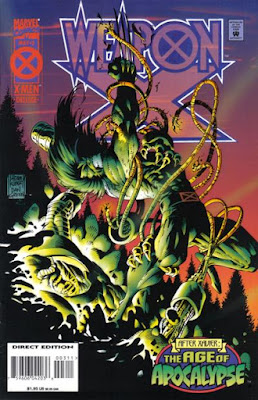
The 40 Years of Comics Project - Day 209: Weapon X #4, June 1995


2 issues to go. As with yesterday's issue, this was a bit of a set-up issue, though slightly more exciting and interesting that the Amazing X-Men's final flop. Weapon X has been a bit of a weird one, in that I haven't really found the story to be particularly intriguing. It's like it's happening out in the distance, away from all of the other series that are intrinsically linked together, and as a result it feels...well, distant, like I said. I suppose it is because the Weapon X story isn't one of Magneto's plans. It's the plan that's going to happen if Magneto fails. So, in some ways, you're really hoping that Wolverine's plan will fail. Reading a comic that's ostensibly about a hero in which you hope the hero fails is a weird thing.

It could also be that, coming up to the end of the crossover, I'm just about done with the X-Men for a little while. This era, and I expect some argument here, is certainly not the best era of the X-Men, though it is beloved by some. I mean, look at that cover. I get that Wolverine's a berserker and all, but he looks like he's made out of snakes. And kind of resembles a dog chewing an Eat More.

Okay. I think it's time for me to move on from this. Tomorrow is the second issue of X-Universe, which, based on the previous issue, I don't have high hopes for. And after that is X-Men:Omega, which I'm excited for, not the least reason for which is that Mark Waid had a hand in it's creation. Onward.

Sep 20, 2015

The 40 Years of Comics Project - Day 208: The Amazing X-Men #4, June 1995


I don't have anything to say about this comic.

Isn't that odd?

This is pretty much all set-up for the final showdown in X-Men:Omega, and as such manages to look like it's got a lot of action and drama when it really doesn't. There's even a thoroughly terrible line where one of the characters (and I can't even be bothered to check which) says something along the lines of "It looks like all of Magneto's plans are coming to fruition." Because it was so hard for us to get that ourselves.

Nope, sorry. Fabian Nicieza's writing on this one is really quite terrible, I'm afraid. Everything that happened could have been done in an aside in one of the other stories.

Hopefully tomorrow's comic will be better. See you then.

Sep 19, 2015

The 40 Years of Comics Project - Day 207: Gambit and the X-Ternals #4, June 1995


I have to admit, as we come closer and closer to the end of the Age of Apocalypse, I'm finding it harder and harder to read one comic each day. The stakes keep raising, and somehow, despite the foregone conclusion of the crossover, the outcome of all of Magneto's plans continues to seem shaky. It's been long enough since I've read AoA that I don't actually remember how it all comes out, so the fact that I've got a scant FOUR ISSUES LEFT is frustrating and intoxicating all at the same time. I could sit, right now, and read these four comics and satisfy my curiosity.

I won't, because that's not what the project is all about, and anticipation is such a delicious thing.

But I could.

There was a twist in this comic that I did not see coming, and answers to questions raised in some of the other series, and, more so than any of the other final issues so far, the possibility arises that all of Magneto's plans, which, to be fair, were pretty flimsy to begin with, might collapse like the proverbial house of cards. It's a fairly typical narrative device in bombastic story-telling like the AoA, but it's deployed very effectively in these intertwining comics. Often I'm not a fan of stories that have no real single focal character, and especially those that have 30 or 40 characters that one needs to keep track of. But the single, focussed vision, or mission, perhaps, that each of these characters is dedicated to does, in some ways, give the story(ies) a focal presence. I recall reading a piece of writing by an Arctic explorer in which he talks about a third presence that seemed to form between himself and his partner as they neared the pole, an amalgam of their personalities that also seemed to be a separate entity in and of itself. I see something similar happening in these series, this separate entity that is the focal viewpoint of all the action taking place in so many disparate locations throughout the AoA universe. An novel way of considering this is that perhaps the focal presence created by these varied individuals is, in fact, Charles Xavier. Not only does the action of each series attempt to return the universe to one in which Xavier lives, but the "third presence" that forms as a gestalt of these character is itself Xavier.

There's something to that. I'll have to think on it a bit more. Onward toward our conclusion tomorrow. See you then.

Sep 18, 2015

The 40 Years of Comics Project - Day 206: Factor-X #4, June 1995


Things really are coming to a head in the AoA. And as they do, we're seeing more and more glimpses of the original versions of these seminal characters shining through. It's an interesting metatextual moment, yet another one to emerge from Factor X, as the closer we come to a return to the "actual" timeline, the closer we come to seeing the "actual" versions of Cyclops, Jean Grey, Angel, etc. But what does this mean for the characters for whom this doesn't happen?

Life under Apocalypse corrupts these characters in much the same way that life under Xavier...purifies them, I suppose. What becomes fascinating to note is which characters become fully corrupted, and whether or not that says anything about the purified version that exists in the regular continuity. I've suggested in some of my earlier posts that the AoA actually crystallizes better versions of some of these characters, that individuals who, in the prime timeline are corrupt have that corruption reversed somehow by existing in the shadow of Apocalypse. But then we have Havok and the Beast. Alex Summers, as I've also previously mentioned, has never been the most stable or likable of characters, so his corruption doesn't come as too much of a surprise to me. The feud with his brother has always simmered just below the surface, and for it to become a fundamental aspect of his character was really just a matter of environment. Hank McCoy, on the other hand, has proven for the last 40 or so years to be one of the most morally upright and genuinely good characters in the Marvel U, so why, in this iteration of reality, does this aspect of his character disappear completely? In all my years of having read the Beast, I've never had the sense that somewhere beneath the surface lurked a diabolical geneticist with no regard for life of any kind, not in the same way that the insanity of fraternal jealousy has always lurked beneath the surface of Havok. Perhaps that's why the Dark Beast (as he comes to be known when he somehow finds his way into the regular continuity) has never really sat well with me. With the vast majority of the other characters, the change we see in the Age of Apocalypse is an amplification of minor traits that have at least been marginally visible in the regular continuity. Aside, perhaps, from the version of Hank McCoy we've seen in New Avengers, I'd argue that there has never been even a hint of this kind of cruelty and misanthropy in any of his other appearances. And even in New Avengers, he's clinical and scientific for the purpose of saving the human race, and in the end can't even bring himself to take the course of action that inevitably occurs.

(Sorry, I know that was vague, but if you haven't read Hickman's Avengers/New Avengers run leading up to Secret Wars, I am thoroughly loathe to spoil it for you.)

There are 5 full issues left in the crossover (though I may cheat a bit and read the X-Men: Prime special that is meant to reintroduce the prime universe). It's strange, because there's a part of me that feels no suspense whatsoever. Of course we're going to return to the mainstream Marvel U. That was never a question. I think the suspense comes from the fact that we've had the opportunity to grow attached to these different iterations of the characters, and, right now, it seems that none of them will survive the end of the crossover. Indeed, for the regular Marvel U to return, all of them have to cease to exist. And that's sad. But, ever onward, I'll see you tomorrow.

Sep 17, 2015

The 40 Years of Comics Project - Day 205: X-Man #4, June 1995


Nate Grey, in this incarnation, is one of the few truly lasting vestiges of the Age of Apocalypse, managing a substantial 76-issue (plus annuals) run until his eventual cancellation with the demise of the Counter-X project. While he appears to have made some minor returns to action in latter X-titles, he seems not to have regained the status afforded him by Mr. Sinister, and then himself, as a messianic/shamanic figure for the tribe of the mutant.

This comic makes an interesting argument for something Alan Moore has one of his alternate Supremes note about the 90s avatar of the Man of Majesty. I'm paraphrasing, since I don't have the comic in front of me, but it's something to the effect of being careful of these 90s heroes; their powers are so ill-defined as to be potentially unlimited. This is the sense one gets from Nate Grey. Why is Apocalypse so scared of telepaths? What is it in particular about Nate Grey's combination of telepathy and telekinesis that makes him such a formidable threat. Thus far in the series we've seen little evidence that his powers are any more formidable than any of the other major characters in the crossover. Yes, at the end of this issue, he manages to kill the nigh-unkillable Mr. Sinister, but one is tempted to ascribe this to his rage, not his powers. Perhaps, as we move into X-Men: Omega, and all of the storylines converge, we'll see just what it is that makes Nate not only so deadly an adversary of Apocalypse, but also worthy of transcending the boundaries of the very story he inhabits.

Think about this for just a moment. Bishop is our only holdover from the primary Marvel universe, and this is because, being already time-displaced, the revision wave (to use another Moore-ian notion) did not revise his history. But nowhere else do we see any characterizations from the primary universe, only revisions of characters. And when (if?) Magneto's plan is successful, the revision wave will erase the continuity of the Age of Apocalypse, purging from reality Sinister's experiments that led him to create Nate Grey. We've talked already about how this crossover leaves very few visible scars on the characters, but more than a few on the readership. Nate Grey is the exception (and the Dark Beast, who somehow shows up later on). He is the one scar on reality, the one physical reminder of the revision that led to the Age of Apocalypse, and not only in a narrative sense, but in a metatextual sense as well. The X-titles could very easily have carried on after the crossover no worse for the wear that they were unaware of having experienced for 4 months, much as is the case with so many crossovers. But instead there is a wound, albeit a healing one, that will always remind them of what happened. I'm not sure how much this is taken up in the X-Man series as it continues through into the regular continuity, but in considering Nate's origins and lack of connection to anything in this particular iteration of the universe, it really does make sense that he would take up a pseudo-shamanic role for his community.

With any luck, and considering Marvel's remarkable output in the last little while, he'll get another chance to play that role. I think it might be glorious.

So, with the end of X-Man, we come to the final few issues of the Age of Apocalypse. In my collection, I keep them bagged in groups of 5 or 6, so we have, at most, 6 comics left. Unlike my previous attempts at reading full series, I haven't grown bored with the AoA, probably because there's enough diverse stories and diverse storytellings, but also because the larger tale being told is really pretty epic. And it's asking, through the medium of a 1990s terminally pop culture super hero comic some of the really interesting fundamental ontological questions we really ought to bear in mind more often. I don't know what I'll be moving on to in a week, but I'm going to enjoy seeing how this epic tale plays out. See you tomorrow.

Sep 16, 2015

The 40 Years of Comics Project - Day 204: X-Calibre #4, June 1995


On the list of rotten things that happen to characters in Warren Ellis comics, having the Shadow King make Mystique simultaneously shift into every form she's ever held has got to be amongst the most awful. Not that anyone else in this comic gets treated much better than this. Ellis does here, to the nth degree, what he's really good at: torturing characters and destroying happiness. My understanding, from those who've met him, is that in person he's a lovely, unassuming gentleman. In his fictions he's anything but, and that's honestly one of the reasons I sometimes have trouble starting up one of his series, be it one I've read or one that's new. Something unimaginably awful is going to happen to one of the characters in that series, and it's not always going to be to the character who deserves (if such a thing can be deserved) it.

Now, this said, let's also bear in mind that, in this case at least, he's dealing with superhumans, these paragons of virtue or decadence, these myths encased in comic book flesh. And the things these characters do, be they virtuous deeds or heinous crimes, are often so far beyond the realm of normal human experience that we can't always be surprised when the tortures and misfortunes that befall them are also of that ilk. And this is something that I think Ellis understands very well, along similar, though in many ways opposite, lines as the mythic hero theory of Grant Morrison. Where Morrison might place the characters in situations that can only be overcome by the deployment of mythic forces, physical or mental, and these tasks prove the heroes worthy of their god-like status, Ellis is more likely to demonstrate the sorts of tortures these kinds of characters can endure and still retain a modicum of their sanity and drive. Sometimes a very small modicum.

Still and all, I would hate to be written by Warren Ellis. It'd be nice to have such snappy dialogue, but I couldn't leave the house for fear of being eaten by rabid squirrels over the course of 10 hours or something. And on that lovely note, I'll see you tomorrow.

Sep 15, 2015

The 40 Years of Comics Project - Day 203: Generation Next #4, June 1995


So we finally reach the end of the story that started off the Age of Apocalypse proper (after all that prefatory matter, I mean). Generation Next is a creepy comic. The villains in it are truly repulsive and, what's more, so are some of the heroes. This series does a spectacular job of making Kitty Pryde and Colossus two of the most unlikable characters in the X-universe, AoA-style. The main title from which this series derives has a similar sort of feeling to it, but nothing quite as nihilistically bleak as what happens in this series.

As we know, the next generation of X-Men have been tasked with rescuing the time-travel capable Illyana Rasputin. What this comic suggests is that this next generation will also face a next generation of villainous mutants. In the beginning, characters like Toad and The Blob were pretty repulsive, or meant to be. So as the newer mutants become more and more edgy, for lack of a better term (think Chamber's blown-apart chest, or Husk's ripping off of her flesh), so too will their enemies evolve with them. It's like that suggestion the Joker makes in Nolan's The Dark Knight. One's villains and oneself are not always so far apart.

But let's get back to the Kitty and Piotr thing. I've suggested in earlier posts that there are certain characters whose representations are moving iconically through the different iterations of the universe. Cyclops is the one who springs to mind, his heroism, his seemingly unerring sense of right versus wrong. Do Shadowcat and Colossus have that? Something that does carry through in the characters and, aside from their powers, really the only recognizable thing about them, is their love. They love each other. You can see it. That's not to say that they seem to like each other very much. But they love each other. So while I was, in some places, disgusted with Colossus' behaviour, I could see shades of the individual he could be in the "proper" universe.

I will miss reading the Lobdell/Bachalo corner of the X-universe, AoA or no. As I noted earlier, it's really like this little chunk of the X-Men franchise broke away and fell in with those Vertigo ne'erdowells and brought a little bit of that charm back to the House of Ideas. I'll get to the Generation X series eventually, but perhaps not for some time.

We'll move on to another pre-Finale finale tomorrow with X-Calibre #4. See you then.

Sep 14, 2015

The 40 Years of Comics Project - Day 202: X-Universe #1, May 1995


I'm quite sick today, so this will be a short update. There's a couple of problems with this comic. First, why place it under the aegis of the X titles when it's obviously about characters whose usual exploits do not fall under that banner? While the trade dress lines up with the other series penchant for "witty" X-titles, there's really no reason to lump members of the Avengers, the Fantastic Four, and Spider-Man's supporting cast under that letter. If one looks ahead to the "Onslaught" series, the specials that finish that crossover are Onslaught: X-Men and Onslaught: Marvel Universe--so why not call this comic Marvel Universe and simply have the AoA trade dress prominently on the cover.

Well, the easy answer is that there's already been a number of comics called Marvel Universe, so perhaps that would cause confusion in readers who....can't read the words on the cover of the comic?

The other problem is that this comic comes far too late in the crossover. These characters are being introduced literally during the climax of the AoA, when the nuclear strike is all but immanent. We've heard obscure references to the Human Council (a racist name if ever there was one), and even seen a few of them, but not actually any of the characters in this issue. X-Universe needed, if it was to be effective, to be a longer series, and to function both as a historical document, a la X-Men Chronicles earlier in the crossover, and as an intrinsic part of the story, which is what the current piece attempts.

Maybe it'll pick up in the second issue, but I have no interest in any of these characters. I've a friend who, in reference to Christopher Nolan's Dark Knight films, uses the term "grit-washing," which is exactly what we've been given in X-Universe: a grit-washed version of some beloved characters. But to give us this without giving us context is insulting both to readers and to the characters. AoA would have been better off without this afterthought comic.

I think that might be one of the more critical things I've said about a comic in the last 200 days or so. But, as I said, I'm sick, and my head hurts. And this comic was pretty bad. See you tomorrow.

Sep 13, 2015

The 40 Years of Comics Project - Day 201: Gambit and the X-Ternals #3, May 1995


It definitely says something about the era of comics that we're looking at right now that, all the other players aside, it comes down to Gambit and Bishop being responsible for saving all of reality. My understanding is that, at the time, they were both very popular, a fact I think derives from their resemblance to the Image superheroes that dominated the market at the time. For me, they've always been bit players in the X-universe, but I suppose every dog has their day, and this day is Gambit and Bishop's.

This comic engages with the ontological dimensions of the crossover very explicitly. Gambit et al are sucked inside the M'Kraan crystal and encounter Jahf, one of it's guardians. Jahf explains to Gambit a sobering truth: the reality he inhabits was never meant to exist. He even goes so far as to refer to the mainstream timeline as "the actual reality," a problematic statement in and of itself. What is actuality? And, as I've asked before, what makes any one reality more "actual" than any other. Now, Jahf goes on to note that, due to Xavier having died when he did in this iteration, the X-Men's previous interaction with the crystal never took place, thus Phoenix never repaired it, thus it now endangers not only the universe, but all universes, with extinction. Are we seeing the beginnings of Hickman's Avengers/Secret Wars epic here, perhaps? But this is a fundamental moment for our consideration of the viability and the right to existence of the AoA universe. If, by its very existence, it threatens, or even promises, the end not just of one universe, but of all of them, should it then be sacrificed for the good of the many? Again, this is the very conundrum that the Illuminati have been facing in New Avengers for the last few years: what is the acceptable cost, or the acceptable sacrifice, one is prepared to make to save everything?

We know it'll come down to Magneto making the choice. And though Bishop and Gambit are the lynch pins of the plan, Magneto will almost certainly be the one to pull those pins out and watch everything crumble.

See you tomorrow.

Sep 12, 2015

The 40 Years of Comics Project - Day 200: Weapon X #3, May 1995

Day 200! That's a milestone I feel like celebrating, so let's get back to the Age of Apocalypse a day early. I hope you enjoyed the little romp through my saucier comics, and I certainly needed the brief break from the daily update, but I'm back, recharged, and ready to see where this excellent crossover leads us.

http://www.comics.org/issue/57053/ 

Wolverine is such a downer. I mean, I know he lives in a nightmare reality, I know he's missing a hand, and I know his lady-love has deserted him, but, y'know, crack a smile every now and again, bub.

The further adventures of Marvel's most over-rated character in the AoA continue, and actually give us a lovely glimpse of what we'll have, hopefully, fully revealed in the X-Universe series that will follow in a couple of days: an idea of what happened to all of the other superheroes in this iteration of reality. Wolverine and Carol "Captain Marvel" Danvers have always had an interesting relationship, one that I've always found far more believable and intriguing than any of the other friendships the Canucklehead has had. So it's nice to see that this friendship is alive and well in the AoA, at least for the first 20 or so pages of the comic.

That was a little subtle hint that poor Carol does not make it through this issue.

Which is another interesting facet of the crossover. I've talked about how there is, implicit in this text itself, the promise of return to the main timeline, with little or no effect on the characters themselves. And as such, it allows the writers and artists the freedom to do things with the characters that, in the regular Marvel U, would be unthinkable...like killing Carol Danvers. If this had happened in the main timeline, it would have been a huge deal, but here she's tossed out of a plane, serving the purpose of the story, but not really giving her the death we might expect for a mainstay of the Marvel U. (Not that she necessarily was big noise at the time, but can you imagine casually killing off Carol now?)

I imagine this wholesale slaughter will continue apace as the crossover reaches its climax, and I'm curious as to whether or not the writers will attempt any emotional appeals in these deaths, or whether they'll simply be gratuitous. My bets on the latter, but the crossover as a whole has surprised me so far.

Nice to be back. See you tomorrow.

Sep 5, 2015

The 40 Years of Comics Project - Day 193: The Amazing X-Men #3, May 1995


First things first: to anyone living in Calgary this weekend, Happy Pride! The weather might suck, but I can't imagine it'll damp the spirits too much of the celebrants.

I'll start on today's comic at the end. The final sentence of this issue gave me goosebumps. This issue, from the Nicieza/Kubert team was everything that an X-Men comic should be. Soap opera meets action movie meets light philosophical journey. Sort of like The Matrix. So let me back up and start from the start.

Magneto, on the opening page, asks the most important question, but it's sadly one that can never have an answer. While standing over the grave of Charles Xavier, he asks if Professor X would make the same decision he is wrestling with. But for Xavier, the question is not whether or not he would sacrifice everything to save the world, but whether or not everything should be sacrificed for him to save the world. How does one, even a dead one like Professor X, even begin to deal with that question? And it's also a question that invites X-readers into this conundrum on a very profound level. Long-time readers are invested in Xavier's dream, of his world of freedom and equality. It's virtually impossible to be a fan of the X-Men without having some investment in this ideal, and as such those fans are also well-versed in the fundamental beliefs of Professor X. So Magneto's question at the beginning, and it's slight reversal from the professor's perspective begs an answer not from the man whose grave he stands over, but from the readers sharing the moment: would Professor X sacrifice literally everything to return to life and save the world? It's the question of a delicate balance between a selfless and a selfish act.

We finally have the confrontation that seems to have been a long time coming in this issue as well: Magneto versus Apocalypse. I have to remind myself that, from a publication perspective, the stories I've been looking at over the last few weeks only took 3 months to come out, but, as I've noted before, one of the great things about this crossover is that it is so well-wrought as to feel like this reality had been around for ages. The confrontation is a nice parallel, taking place as it does at Xavier's grave, of the climactic confrontations we've often seen between Xavier and Magneto over the course of the X-universe's history. A little more physically-inflected, perhaps, but similar in tone. And, given that Magneto has been depowered, there's also an interesting parallel to Xavier's confinement to a wheelchair. This loss, on the part of both men, stokes a fire in their souls to use everything in their power to do what they believe is right.

I had a conversation with a very good friend and comics scholar recently about my reading of the Age of Apocalypse, and he noted how much he liked some of the revisions of the characters in this reality, even to the point of preferring them to the originals. I have to concur with this assessment, especially in the case of Magneto's son, Quicksilver. In the original universe, Quicksilver is, if you'll forgive the colloquialism, a dick. I've never liked him, never understood the character, never appreciated any of his qualities. But in this iteration of the X-universe, he's noble almost to the point of Cyclops-ian sacrifice. Which, with that goosebump-inducing final sentence, of what it means to be X-Men, returns us to the question Magneto asks at the issue's beginning. How much sacrifice is too much? How many of these individuals are better people as a result of the circumstances of their existence. We, as readers, are torn with regard to Magneto, whom we know will become an apocalyptic villain in his own right if his plan is carried through, and this feeling of being torn carries over to some of the characters who revolve around Magneto and his team. This, I think, is perhaps the most brilliant aspect of this crossover. We know, of course, that things will return to normal, and if they do, there will be very little change in the regular continuity. This is often the case with major crossovers, and actually is a great criticism of them. They offer the illusion of drama. But the Age of Apocalypse offers something that none of the others, that I can think of, do: loss. We lose these characters, these better selves of some of the less-likable people in the X-stable. So while the fictional universe itself will, by and large, be unchanged, the readers are. We continue on through the ongoing drama of the X-Men knowing how things could have been, and, dare I say it, should have been, for some of these fictional individuals.

And that, I think, is as good a place as any to stop for a bit. With the beginning of school this week, and my first proper, full-on lecturing starting, I've prepared some pre-read and written posts for the next week, a break for a bit from the Age of Apocalypse. We leave at the cliffhanger, major characters in the hands of the villains, heroes desperately trying to salvage a plan that seems to be unraveling. And when we return, we'll get a glimpse of the other heroes in the Marvel U, and how this turn of events has effected them. Will they be better selves?

In the interests of fair warning to those who are faint of heart or sensibility, the next week will be looking at the Eros Comix "mangerotica" line from Fantagraphics. It's explicit, lewd, and occasionally off-putting porn and erotica. If it's not to your taste, please give the week a miss. I'll be back to the Age of Apocalypse next Sunday. See you, if only virtually, tomorrow.

Sep 4, 2015

The 40 Years of Comics Project - Day 192: Factor X #3, May 1995


Two cool things happen in this comic. First, and closest to my heart, there's a reunion of sorts of the original X-Men, sans Iceman who might be a bit awkward in this setting. It's really cool to see Jean, Scott, Hank, and Warren all revolving around the same storyline, and it makes me wonder about the contentions I've been making about Scott's inherent nobility in my considerations of the last couple of issues of this series. Is there something fundamental about this original grouping of the X-Men as well? I'm not sure it rests on the same kind of level that I've been considering for Cyclops, that archetypal identity that seems to transmit through the various incarnations he's taken, or had thrust upon him, over the years. More, I think, it's the aura that surrounds that original grouping, the promise that, retrospectively, we can see in the old Lee/Kirby stories, knowing as we do where the various stories under the X-aegis have led. It relies a bit more on nostalgia, the same way as the Barry Allen Flash stories I've talked about in my re-reading of Mark Waid's run on the series. We honour and revere the original tales, and the original team, more for what they foretold than what they actually were. That said, there really is something special about this mixture of characters, which I imagine is why their regrouping in X-Factor was so successful.

Which brings me to the other interesting facet of this series: the Summers conflict. Alex and Scott have never really seen eye to eye, but their antagonism has generally been tempered by some deep-seated fraternal affection. That's missing in this series. But more interesting is the fact that the two are at each others' throats, and that Havok assumes leadership of the EMF in this issue, in much the same way that he takes leadership of X-Factor after the original X-Men left the title a few years prior to this storyline. So there's an interesting meta-textual commentary going on here, in that we're supposed to sympathize with Scott, Jean, maybe even Warren, in this series, and we're supposed to revile the backstabbing Havok. What is this suggesting about their respective tenures on the main X-Factor title? That Havok took the series by force, that fans were not ready for the original X-Men to leave their new home, one that had served them so well?

An interesting, but ultimately unanswerable, question. Tomorrow we get into Amazing X-Men again, and if the cover featuring Magneto and Apocalypse in battle is any indicator, shit's about to get real. See you then.

Sep 3, 2015

The 40 Years of Comics Project - Day 191: X-Man #3, May 1995


I hate those days that I leave reading my comic until the last minute. I always feel like I rush through them and don't spend the time each deserves. I've noted before that I've a lukewarm response to Jeph Loeb's writing. It's not bad, it's just....meh. Though, in fairness, his collaborations with Tim Sale well after this series was published are quite excellent. But in this one he seems to be trying to inject into the expository boxes the sort of "theatrical" language that young Nate and his thespian comrades might pass off as pseudo-Shakespearean entertainment as they travel the wastelands. This kind of writing can often be effective, but it just doesn't seem to jibe with the coming of age tale that X-Man is telling. The series would benefit from a first person narration, I think. If we were inside Nate's head as the terrible events of this issue unfold, it would be far more affecting. Instead we're given hyperbolic descriptions of how he feels, or should feel. It's that difference between showing and telling.

Which raises an interesting notion. The pictures in a comic are both showing and telling, in that they are visual images that relay both a static moment in time and a language that communicates a narrative movement. Is it possible for the words to both show and tell? I think, in the case of a first person voice, it is certainly possible. A first person narrator can both tell the reader what is happening, and through word choice and delivery, show reactions and plot points that go unspoken, so to speak. But a third person narration? I'm not so sure. This is probably why caption boxes and internal monologues have become somewhat passe in comics. If all we get is the dialogue, we can glean unspoken interactions from the timing of delivery.

I'm going to think on this more. It's a very interesting question, but it's also very much time for bed. See you tomorrow.

Sep 2, 2015

The 40 Years of Comics Project - Day 190: X-Man #2, April 1995


I talked yesterday, or the day before, about the short-lived "Counter-X" initiative, helmed by Warren Ellis, that revamped some of the B-list X-titles. The three that received this makeover were Generation X, X-Force, and X-Man, and they were all really fantastic revisionings of the characters. Unfortunately they were around for less than a year when the head honchos at Marvel scrapped a lot of the X-titles and brought in bigger names to relaunch the franchise. And while this gave us the excellent Joe Casey Uncanny X-Men and Grant Morrison's superlative New X-Men, we lost some really great titles. At the end of his run, Nate Grey, the X-Man, had taken on the role of shaman for the mutant tribe, striding across realities and dealing with adventures of a more spiritual nature. It really was an excellent take on the character, especially give the origins we're witnessing in the Age of Apocalypse. Though it hasn't been revealed yet, Nate is an artificially grown mutant, an identity that puts him outside a group of outsiders. This, to me, is a very good definition of a shaman. A holy person of this sort is supposed to be a part and also apart from the group he or she represents, and X-Man is certainly that. And where we see Nate discovering his powers in these initial issues, the payoff comes in his embracing his outsider role in the Counter-X revision. I really do think that the three Counter-X titles could have been some of Marvel's best mutant-related output, though much in the same way that I've suggested that Generation X, at the beginning, was maybe just a bit too Vertigo for mutant fans, perhaps the Counter-X books were a bit too Transmetropolitan.

As far as this particular issue goes, I have to say I'm enjoying Mr. Sinister the most of all the characters. He's a fascinating villain, and the way he both cares and does not care about Nate makes him one of the more truly complex characters in the Age of Apocalypse.

On a separate note, my commitments to school start in earnest today. I'm going to do my best to keep up with the comics and graphic novels, but I fully admit that things might become very hectic. Apologies in advance for the short entries, or incoherent ramblings, that might follow. See you tomorrow!

Sep 1, 2015

The 40 Years of Comics Project - Day 189: Generation Next #3, May 1995


I've spent a lot of time in my Generation Next reviews heaping praise upon Chris Bachalo (and this issue is no exception. He's brilliant), and not looking too closely at the scripting and dialoguing of the comic. I find this to be one of the difficulties of writing critically about comics, especially those that are composed by two or more creators. There seems (or maybe it's just me) to be a propensity for focussing on one creator, often the one deemed the most talented. Which, I suppose, is fair in some ways. Today, though, I want to mention Scott Lobdell.

Lobdell has had a tough time in comics writing. His era of the X-Men is categorized as hyperbolic in the extreme, a symptom of having to try to keep up with the over the top antics of the Image Comics creators. I think I can safely say that I've only passably enjoyed most of the comics of his that I've read. He's got a decent grasp of superheroics, of dialogue and of plot, but, really, it's all pretty mediocre.

Except for Generation X.

I've run into this problem before. After finishing James Robinson's utterly, utterly brilliant Starman, I decided I should read anything else he's written. And, sadly, for the most part it was mediocre. We've even discussed this in the comics class I took last year, considering Art Spiegelman. Maus was a big hit for him, but has anything else that he's written come even remotely close to being as good? No. I think Lobdell falls into this categoy. His work, with Chris Bachalo, is a confluence of perfect conditions to create one of the most original titles in the X-stable. As I've noted with Bachalo, it's like looking at the X-Men through a Vertigo lens. Lobdell's scripts take all of the best elements of the wonderful early New Mutants stuff (and, actually, the art owes a lot to Bill Sienkiewicz's amazing run on that title), updates it for the nineties, and then heads off full tilt into amazing-ness. How's that for hyperbolic? I'm looking forward to getting to the regular Generation X comic at some point in the future. When I discovered it, around the time that the reigns were briefly passed over to Warren Ellis, it was the first time I'd actively pursued an X-title in almost 2 decades. I loved the characters, I loved the setting, I loved the art. Like all ongoing series, it goes through its down phases, but all of the writers on the title managed to maintain the integrity of the characters, if not the plot, which kept me interested. It's a shame the "Counter-X" stuff at the end didn't get a chance to flourish. It might have been great.

But that's getting ahead of myself. This brief foray into the Age of Apocalypse also highlights a character who gets very little play in the main title: Mondo. I'm not really sure what happened with him in Generation X. He gets introduced and then, seemingly, forgotten. At least, that's how I remember it. In Generation Next, however, he's fundamental to the rescue plan and, in this issue, is the one who ultimately carries it off. His role in the regular title is tangential, and I think he's ultimately taken over by a villain and killed. Again, this seems to be bringing some Vertigo sensibility to the X-universe. In a lot of ways the early Gen X is a precursor to the direction the Marvel Knights imprint would eventually take. Perhaps it just happened too early to be successful in that endeavour.

Continuing on on the morrow! See you then.

Aug 31, 2015

The 40 Years of Comics Project - Day 188: Generation Next #2, April 1995


Okay. Back on track.

First, as I'll probably do with any of the issues in this series, I have to say that reading a comic illustrated by Chris Bachalo after having read some of the more typical superhero art in the prior comics is an absolute treat. His sense of page composition and aesthetic is unparalleled in superhero comics of the nineties. It's obvious that he came out of the Vertigo renaissance, but the fact that Marvel were willing to take someone whose aesthetic was so completely different to anything else being published in the mainstream at the time and let him loose on an X-comic is pretty amazing.

I admit, I'd forgotten all about the "let's rescue Illyana because she might be able to time travel" story. As much as I love the regular Generation X series, I found this particular iteration of the team a bit forgettable. It might be because they take my beloved Kitty Pryde and make her into an unlikable character. More likely is that there's been precious little reference to this thread in any of the other crossovers titles so far. Most of them, to this point, have at least, in passing, referenced the events of other comics in the crossover, enough to keep said threads embedded in one's consciousness. I think, if I'm remembering right, there's been maybe one reference to the rescue attempt in any of the other comics. I'm not sure why this might be, but I'm almost certain it's why the rescue was not even in the back of my head while reading the other series.

Far from being a bad thing, though, this actually works in the narrative's favour. It's obviously a deeply covert affair, as we see from the heist-like nature of the plot in this issue. So to keep the narrative not only quiet in its own title, but in the rest of the crossover, highlights the absolute need for secrecy about this mission. In many ways, this is the lynch pin to the whole plot. In order to reset the timeline, there is a need for time travel, and Illyana seems the best choice for such power. If they can't rescue her, then it's all for naught. So while there are the more overt missions, the rescue of Chicago, the assist to the human evacuation, they are simply distractions to keep the more secretive missions from popping up on the radar of Apocalypse's security systems.

I'm probably reading far too much into that, but that's what this particular story, and reading order, have facilitated for me, so I'm going to go with it. Reading really is as much about what we bring and it is what's set before us.

We'll continue on with this covert mission tomorrow. See you then.

Aug 30, 2015

The 40 Years of Comics Project - Day 187: The Astonishing X-Men #4, June 1995


One of the difficulties in reading a crossover like this in any kind of narrative order is that such an order very rarely follows the publication order. For example, in this issue, there's a scene between Magneto and Apocalypse that is obviously meant to have been experience after a couple of the other issues in the crossover, and as such made very little sense. There's a couple of ways around this conundrum. The first, a virtually impossible task, would be to read bits and pieces of all the comics concurrently, jumping from comic to comic mid-story, in order to get a sense of events occurring simultaneously. While I think this would be an amazing way to read this (or any) crossover, the amount of time and effort one would need to expend is, at the very least, well beyond what I'm willing to put in.

The second way of reading is to assume flashback sequences (i.e. previously published issues) will fill in the gaps. So we get the scene I'm talking about here, and trust that a subsequent issue will jump us slightly back in time to explain exactly how those characters got to that place. It puts me in mind of how Lost utilized the televisual medium in a similar way. That said, up to this point, things have unfolded in a relatively linear fashion, so to have this scene in here was a bit jarring. But, honestly, I think that the reason I gave up on the X-Men comics when I did back in the late eighties was that they became very predictable. So to have a moment occur that, while not necessarily dramatically surprising, but very much narratively surprising, knocks things just so slightly off-kilter that I am encouraged to keep reading. Not that I wasn't going to keep reading, but it's nice to come across the unexpected every now and again.

Next we'll move on to a storyline that, I have to admit, I'd completely forgotten about in the gorgeous Generation Next.

Aug 29, 2015

The 40 Years of Comics Project - Day 186: The Astonishing X-Men #3, May 1995


Okay, what can I say, what excuse can I give? There was a lot of alcohol, and a going away celebration for a dear, dear friend. Aren't Monday mornings designed for catching up on all the things we let go over the weekend?

Some slugfest, some more of the excellent Blink/Sabretooth drama, Bishop and Magneto discuss the ontological and experiential ramifications of resetting the timeline. And Rogue proves that she is more than capable of being a major X-figure.

Let me pontificate for a bit on the Magneto and Bishop scene. Bishop claims that the universe in which they live "never should have happened." Again, I'm struggling with this idea that there's a universe that should exist, and one that shouldn't. If we leave aside for the moment the idea that either Bishop or Magneto have the right to decide an existential question like this, the bigger question is what makes one universe the one that should exist? There's obviously an implicit Judeo-Christian spiritual view running through most North American comics, so is the universe that should exist the one that God approves of? Maybe that's a bit heavy-handed, but if we look at it metatextually, who is the God that sees all and knows all about these characters, and whose habits dictate the very existence of these fictional people? It's us. And we want our regular continuity back.

There's a longer conversation to have about readers and their relationship with the fictional characters they love. And better comics to use to have the conversation. But it's nice to see these sorts of concerns arising in a notoriously shallow era of superhero comics.

I'd say see you tomorrow, but that would be a lie.