Pages

Showing posts with label Roy Thomas. Show all posts

Nov 5, 2020

The 40 Years of Comics Project - Day 2080: Conan the Barbarian #10, October 1971

  For information on stopping the spread of COVID-19, and on what to do if you are quarantined, have a look at the World Health Organization site.


We enter the Bronze Age with a tale of the Iron Age, or one of them at least. My exposure/knowledge of Conan can be summed up in hazy memories of Arnold Schwarzenegger's turn in the roll. I've read a bit of Robert Howard's stuff, but mainly his Lovecraft-inspired mythos tales. The Conan stuff never really did it for me. I think I also must have read a few of his stories when I was first getting into Cerebus, if only for context. And today's comic offers that as well.

Barry Windsor-Smith is a fantastic artist. He stands out to me alongside someone like P. Craig Russell for having come out of the 70s with an art style unlike anyone else producing comics at the time. Marvel's Bronze Age, I think, is characterized by their house style with superheroes, but in the non-continuity, non-superhero titles, there was a little more wiggle room for differing aesthetic choices. Russell's Killraven and Windsor-Smith's Conan are wonderful examples of this.

Storywise, not bad. I think I enjoyed the Black Knight story that is sandwiched between barbarians in this comic, a reprint from a comic of the 50s. Sir Percy is an interesting character, effecting what really seems to me to be a medieval version of Clark Kent to keep suspicion away from his identity as the Black Knight. A fun little story, borrowing liberally from the Robin Hood tales.

More to follow.

Jan 14, 2020

The 40 Years of Comics Project - Day 1784: Secret Origins Annual #1, 1987

https://www.comics.org/issue/42248/

For the first time in I can`t even remember how long, I have a brand-spanking-new computer, after having lost my former computer in our move. So I thought I`d try, once again, to get back on the horse and write in this blog every day. It`s good for me. I don`t know why I don`t just do it.

And to do this, we`re going to leap back into the World`s Strangest Heroes, The Doom Patrol! When we last left our intrepid crew, the New Doom Patrol had assembled, had a few adventures, a few guest appearances, Cliff had reverted to his original body and gone on some adventures with the Titans. Honestly, for my money, the best issue of the previous bunch of comics was actually one that starred The Brotherhood of Evil. If you`re a fan of Tintin, I urge you to find a copy.

The Secret Origins series is a bit hit or miss, and I realize now that it`s a vehicle to bring people up to speed on a particular character, rather than to tell a story about that character. When I originally bought this comic, I had no idea of the Doom Patrol`s history, having only recently begun searching for Morrison`s run in the late 90s. It served its purpose well then, filling me in on everything up to the beginning of the 1980s run. But reading it today, it was just kind of blah. We get a rundown of each character`s origin, as well as the origins of the two versions of the team, capped with a cliffhanger appearance by an old teammate. Of course, this leads directly into tomorrow`s comic, the first issue of Doom Patrol.

Honestly, I probably needed a bit of a recap since the last time.

Kupperberg`s run is a tough one to read, as he tries to make the team into a regular superhero team, forgetting that that`s only really the secondary reason the Patrol is together.

Oh, and we get a Captain Comet origin backup - it`s pretty cool, kind of riffs on Superman with slightly more Nietzsche. Comet is born to `John and Martha` as a comet streaks over the house. He grows up to be a future evolution of humankind, gifted with amazing superpowers. He`s even show outracing a train, taking the Superman analogy even further. But, unlike the Ubermensch, Comet does not attempt to replace regular humans, but uses his gifts to help us.

Which, sadly, is probably the most unrealistic thing about the whole story.

Nov 14, 2018

The 40 Years of Comics Project - Day 1358: Marvel Super Action #33, July 1981


The Clint Barton/Goliath era of the Avengers is one with which I have little familiarity. What I have read from the 70s is mostly the horror stuff, and strange titles like Man-Thing and Howard the Duck. I've not spent much time with the superheroes in this era. Today's story was pretty good, though I was definitely coming in a little late in the tale. The make-up of the team was a bit off-putting, in that the Wasp was the sole female representation in the book. And the dialogue was a little stilted for my tastes. The designs of the Zodiac villains is pretty great, and utterly ridiculous, considering how sinister they're played off.

Also, although he appears to be in the battle with the Avengers, Captain Marvel never actually materializes in the story.

I know that reprint series like this one were simply a way for the company to cash in on previously published material, but I am glad for them. They offer a nice cheap alternative to the more expensive original publications.

All in all, not a bad read. Better than yesterday's Batman/Mr. Miracle debacle, though some of Hawke...I mean, Goliath's dialogue was almost as cringe-worthy. Clint really only comes into his own once he heads up the West Coast division.

More to come...

Oct 30, 2017

The 40 Years of Comics Project - Day 978: Jack Kirby's Secret City Saga #0, April 1993

https://www.comics.org/issue/52859/

Standby.
Normal transmission will resume tomorrow.


I'd like to make an admission.

(And as I write this, I feel like I've already made this admission before.)

Sometimes, I just don't get the hoopla surrounding Jack Kirby.

I think that we have literally seen developed every idea the man had over the course of his life. Very often they involve cities made out of trees. And underground complexes. In fact, were we to put the vast majority of Kirby's ideas onto the same planet, we would be living on a giant ball of Swiss cheese.

When I feel like this, I have to remind myself of my experience reading Judith Butler's Gender Trouble. As I made my way through that...dense...tome, I kept shaking my head and wondering why this was so important. She would come to a conclusion of some sort, and I'd sort of nod my head and say "Yep, how is this news?" Until I realized that, before her, no one was saying these things. In some ways, Kirby is the same. Before him, there was no Marvel Universe. And, yes, his art is amazing and dynamic and all of the other superlatives one likes to use. But does this mean we need to keep mining little notes and ideas and sketches and attaching his name to them to make more comics?

All this said, I found today's comic to be quite enjoyable. There's an old saw that is often repeated by comics people that Kirby was amazing, yes, but he needed an editor more than most. What we see in today's comic is just that. Roy Thomas, editor (amongst other things) extraordinaire guides the interconnected Secret City Saga, and it reads so much more naturally than, say, Captain Victory. In fact, I'm intrigued enough to see about tracking it down (through dollar bins, of course). A secret civilization, the "Ninth Men, in an age fifteen millennia before our own," whose time is over. A few individuals stash themselves away in life support pods, and hope for the best.

I can only assume a few of them come out in the next issue.

To be continued.

Sep 15, 2017

The 40 Years of Comics Project Friday Magazine 19: Epic Illustrated #4, Winter 1980

https://www.comics.org/issue/34915/

So I actually read the feature article in today's magazine. It was about the next evolution of comics, the graphic novel, and the various early attempts at the format. Most interesting was reading this from a pre-Maus perspective. Each time writer Archie Goodwin gestured to that unknown work in the future that would cement the idea of graphic novel, all I could think was "Just wait a couple of years!" He does, however, offer a list of interesting works, some I know and others I don't, that might be worth looking into.

For interest's sake, Gil Kane's Blackmark and Ken Steacy and Dean Motter's The Sacred and the Profane (serialized in Star*Reach) are the two that stood out to me most. I'll have to keep an eye out.

The magazine continues to have a remarkable graphic pedigree. The inclusion of Starlin and Russell in the magazine almost guarantees it's going to look great. Throw in some Veitch, some Hempel, some Steacy, and you've got a beautiful thing to look at. Are the stories maintaining the same level of excellence? Maybe. The stories are entertaining, and in some cases quite beautifully wrought, but right now two of the three main pieces running through the magazine (Elric and Almuric) are adaptations of other works. Only Starlin's Metamorphosis Odyssey is an original lengthy contribution. This is not to say that the adaptations aren't good, and aren't important. One of the best ways we see the effect of a piece of imaginative fiction is when it's adapted into another medium. Stories have different things to tell us dependent on the medium within which they're presented. Thank you, Marshall McLuhan. But I think I'd like to see more original work. The shorter pieces that pepper the magazine are all very good. They actually could be considered as being graphic ancestors of today's microfictions. I'm hoping to scan one or two of them in the near future and put them up here. Hopefully no one'll mind.

See you next week!

Sep 8, 2017

The 40 Years of Comics Project Friday Magazine 18: Epic Illustrated #3, Fall 1980

https://www.comics.org/issue/34687/

While the stories are still strong, and the quality of the art and writing are pretty good, there's something missing from Epic Illustrated that I see in the early issues of Heavy Metal with which its competing. There's something vital about the European science fiction and fantasy that elevates it just a bit above this more North American version of the adult fantasy genre. The article I noted last week suggests that European fantasists go in one of two directions: either into myth and fairy tale, and the more traditional fantasy, or into the future, and a world of technology so far advanced that it acts like magic in the narrative context, and therefore the stories are fantasy and not science fiction.

I think the stories that one might call science fiction in Epic are actually science fiction, rather than technologically-inflected fantasy. I wonder if this is because in North America we're brought up to be very rational in our beliefs. This is perhaps one of the detriments of the hard separation of Church and State. Such a thing is more fluid in many European countries, giving the imaginative literature more scope to accept the irrational as simply a part of the everyday. The stories in Epic Illustrated almost implicitly ask you to believe that what's happening in the story is scientifically explainable. The Heavy Metal stories don't care if you don't understand. You don't need to.

Though I'm not a fan of the Elric stories of Michael Moorcock, it's lovely to see an adaptation of one of them here from P. Craig Russell. I don't think I've ever seen anything he's done that I haven't marveled at, even if I didn't read it. Certainly one of our great comics artists.

Onward!

Sep 1, 2017

The 40 Years of Comics Project Friday Magazine 17: Epic Illustrated #2, Summer 1980

https://www.comics.org/issue/34450/

A solid second issue, though perhaps not quite as strong as the first. The inclusion of some of P. Craig Russell's operatic adaptation is nice, as is the continuation of "Metamorphosis Odyssey." I'm not as keen on the R.E. Howard adaptation in this issue - Esau Cairn is far too "manly" a protagonist for my liking.

The stories are quite novel in that it's hard really to say what's coming next. Sometimes a fantasy story will morph wholesale into science fiction, and then back again. Or main characters are killed and the story end with them, and we're left not knowing what's just happened, really. There's also a fair bit of overt environmental and social critique going on. Archie Goodwin and Michelle Brand's "Sinner" questions excesses of both technology and faith quite nicely, though their conclusion is a little pessimistic for my liking.

Epic is overall a pretty readable magazine. The stories are cool, and some of the text articles are quite interesting. I haven't been reading them all as part of the project. It is about comics after all. But there's an article in today's comic, outlining the history of fantasy in European comics, that's looks really neat.

More Epic in a mere week! See you then!

Mar 10, 2017

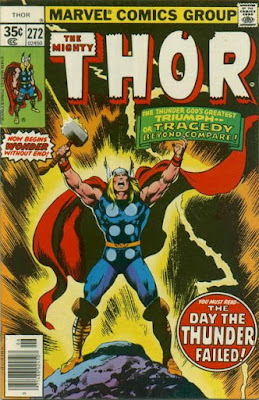
The 40 Years of Comics Project - Day 744: Thor #272, June 1978

https://www.comics.org/issue/32351/

A bit more sword and sorcery, though the first words in this comic are "Portrait of a super-hero." Thor has always been a tricky one for me. I think it's that attempt at faux-Shakespearean dialogue that puts me off. Even people in Shakespeare's time didn't speak like that. It's poetry, not conversation.

Today's comic fits into a neat little subgenre that I might have to start tracking: the text of mettle. Thus far I can think of only one other example in my collection, though I imagine there's others. The basics of the genre are thus: a hero wanders into a situation in which they are faced with having to perform a certain number of tasks or they'll be imprisoned/killed. The tasks seem easy enough (i.e., in this issue, Thor is tasked with lifting a house cat), but, for some reason, are virtually impossible. Once the tasks are all failed, the hero thoroughly confused about said failure, the antagonist reveals themselves to have been testing the hero's fortitude, and that the challenges were actually remarkable feats (the aforementioned cat, for example, was actually the Midgard Serpent, which Thor managed, impressively, to lift slightly), and that the hero has proven themselves worthy. There's a Supreme back-up story in one of Alan Moore's Supreme issues with a very, very similar tale. And I'm sure that both of these stories draw inspiration from older pieces. I'm curious to see if such stories appear every now and again in a superhero's myth, at moments where, either narratively or ontologically, it makes sense to test and reaffirm the fortitude of hero. I'll think some more on this.

To be continued.

Mar 9, 2017

The 40 Years of Comics Project - Day 743: Red Sonja #3, May 1977

https://www.comics.org/issue/31051/

What I had not realized was that Red Sonja did not start out life as a part of the Conan mythos, but was actually a minor 16th century gunslinger character that Robert Howard wrote about. It was Roy Thomas who transposed her to the mythology that she's not firmly ensconced within.

Red Sonja is just excellent. She's by far the most famous of the chainmail bikini characters, but she doesn't let it get in the way of being a total, total badass. She takes down an entire kingdom's worth of champions in this issue, and then takes on the queen of the realm, who transforms into a giant spider that Sonja subsequently kills, and then she just ups and leaves, not caring about the power vacuum she's just created. If you'll forgive the colloquialism, literally no fucks are given for the fact that she has just destroyed, pretty much, an entire society's political system.

Frank Thorne's artwork somehow manages to be both highly stylized and highly detailed all at once, and it's a nice mixture for a fantasy comic, especially a high fantasy comic like this one. High fantasy characters live in the same very simple world as superheroes, but since they exist, more often than not, in fantastical places (as opposed to the contemporary cities of most superheroes), there needs to be far more detail in order that the world be believable. Thorne manages this with great panache. This is the only Red Sonja comic I have, but I'm going to have to keep my eyes open for others, I think, and especially the Thorne ones. There's something really quite cool going on here.

To be continued.

Apr 29, 2016

The 40 Years of Comics Project - Day 430: Sgt. Fury and his Howling Commandos #136, October 1976 (War Week, Day 3)

http://www.comics.org/issue/30336/

As with last week's Marvel Ai, I just can't leave my beloved superheroes alone for too, too long, though today's issue is only sort of related. Well, that's not true - given that it's an origin story for Nick Fury, it's a pretty fundamental part of Marvel U history, even it it's been retconned out of existence.

The story's not great, but also not terrible, telling the origin of the Howling Commandos, replete with racial epithets that are, at least, appropriate to the time period, and with bullets-flying-everywhere battle scenes. One interesting thing is that though there are indeed a number of problematic racial constructions of both Japanese and German people, the Commandos themselves are also racial stereotypes, so at least in their essentializing, Marvel were somewhat equal opportunity.

I've not much else to say about this comic. It was good, but that's all. The art and writing were competent, but the story was middling.

Tomorrow I'll be at the Calgary Comic and Entertainment Expo, giving a paper at 12:30, and wandering about for most of the rest of the day. Not sure when I'll get a chance to post tomorrow, and depending on my haul of goodies, we may take a brief break from "War Week," just so I can show off my finds from the con. Onward!