Pages

Showing posts with label Flash. Show all posts

Nov 3, 2020

The 40 Years of Comics Project - Day 2078: Famous 1st Edition F-8, September 1975

 For information on stopping the spread of COVID-19, and on what to do if you are quarantined, have a look at the World Health Organization site.

Where was I?

After having sold a few comics at Purple Gorilla, I picked up some nice vintage-y stuff in exchange, including a couple of Famous First Edition Golden Age reprints and some cool Silver Age superhero stuff. I thought, as I try to wade back into daily writing (the pain has gotten much better in the last little bit), I'd do a comic from each of the major "Ages," one a day, for a while.

The delineation of ages I use comes from www.keycollectorcomics.com, and breaks down thus: Golden Age - (1934-1955),


Jun 5, 2020

The 40 Years of Comics Project - Day 1927: Countdown Special: The Atom #1, February 2008

For information on stopping the spread of COVID-19, and on what to do if you are quarantined, have a look at the World Health Organization site.


https://www.comics.org/issue/394851/

I watched, for the first time, Batman v. Superman last night. The "Ultimate" edition.

Bear with me for a moment.

It was 3 hours long, which, even for me, is a long time to spend with superheroes. But I, to be totally honest, didn't mind it. While I was watching it, I was texting my kid, and I suggested to them that the thing about Zack Snyder films is that, to a certain extent, they just play like fan fiction. For superheroes, Mr. Snyder has a very clear vision of what he wants to see: a combination of Moore and Gibbons' Watchmen and Miller's The Dark Knight Returns. But literally. Hence fan fiction. That said, and acknowledging that that's what was going on, it was a decent enough superhero movie with some good set pieces, and Ben Affleck is fucking amazing as old Batman. I would bring him back to that role in a heartbeat.

Near the end, however, I was chatting with my housemate about why it was so panned, and why, again by the end, I had just had enough. And she suggested that, quite rightly, people are just so fucking tired of seeing angsty white dudes on the screen, working out their issues in godlike exercises of power. There's a stab at diversity, in crowd casting for certain, and in the fact that we have an Israeli woman, a Japanese woman, and a Black man in supporting roles. But the three leads, the Bat, the Boyscout, and the Reporter, are white. And angsty. Today's comic reminded me of that.

With the exception that there were no People of Colour in the comic. Okay, I lie. There's one panel, in the latter half of the comic, the part illustrated by my featured creator today, Arvell Jones. In one panel, a group shot of a bunch of telepaths' heads, there is front and center a Black man. I have to assume that Jones placed that there himself. The rest of the comic is, as Batman v. Superman is, a bunch of white dudes. And Supergirl.

Mr. Jones has had a few mentions in the blog, having illustrated a Doom Patrol story in Super-Team's predecessor publication, and having been featured in my first Black Lives Matter-related readings, with Super-Villain Team-Up, and one of the weirdest comics I've ever read.

So what to do with this comic. First things first, it's a late 2000s reprint of stories from the late 70s. I've noted a couple of times in the last few days how strange it must have been for Black artists of the Bronze age to illustrate stories in which they saw nothing of themselves. Do we have to look to the colour artists, perhaps, or whomever it was who created the colour guides for each page. Why are all the background characters white? In fact, by this point in DC continuity, there had been a Black Green Lantern for 6 years. Why not use John Stewart in the story, rather than Hal Jordan? I mean, the short answer is systemic racism. The people involved in these stories very likely aren't racists - they're people who have been brought up in a society that has racism woven into its fabric. There was a default society, and it was white, and that was simply how it was. As comrades to the Black Lives Matter movement, it's incumbent on us to recognize how that racism has manifested so that we can pull the threads, unravel the fabric, and make something new together.

More to follow.

Further Reading and Related Posts

The Atom has shown up occasionally in my 40 Years project.

Slightly more so the Green Lantern.

Dec 31, 2017

The 40 Years of Comics Project - Day 1040: Wednesday Comics #12, September 23, 2009

https://www.comics.org/issue/648753/

Alright, alright, let's wrap this up!

My votes for the best three features in this series are "Metamorpho," "Supergirl," and "Hawkman." Not how I would have seen things turning out when I started the series. Each does something cool or different with the format. "Metamorpho," much like its protagonist, shifts and melts and fits into the tabloid-sized page in a number of different ways. There are traditional panel arrangements followed by a two-page table of elements-as-dialogue/maze that really pushes what one is able to do, visually at least, with this kind of space. The story was okay - clever, but not really that entertaining.

"Supergirl," on the other hand, uses a very traditional technical structure, but tells a story that is just charming. It's nicely-plotted, something interesting happens in every segment - I think what I want to say about it is that it suits the medium of its publication - the newspaper strip. It wasn't trying to be deep and philosophical. It was trying to be entertaining Saturday morning breakfast comics. And it succeeds.

I have to admit that "Hawkman" was not one of the strips I'd have said I'd enjoy - he's never been my favourite character. But in this iteration, told by Kyle Baker, he's much more interesting. Add to this that somehow in the space of these 12 pages, Baker manages to tell us two really awesome, really short, superhero stories disguised as one story. It really is pretty great.

And we're done with Wednesday Comics. Not my favourite series that I've read, but overall pretty cool.

Tomorrow. Oh, tomorrow.

We'll start with early Image stuff. Oh yes.

To be continued.


Dec 30, 2017

The 40 Years of Comics Project - Day 1039: Wednesday Comics #11, September 16, 2009

https://www.comics.org/issue/648752/

Climax achieved! (Not that way - get yer mind out of the gutter!)

All that remains for each story is a brief moment of crisis, and then a denouement. I'll be in a better position to comment on the narratives tomorrow, I think, as I'll finally have all the pieces I need to see them fully. There are definitely strips that got it right, "it" being that feeling of the newspaper comic supplement strip, but there are others that were more 12-page comic stories published as 12 separate pages. There's a difference, I think.

One strip that I'm actually consistently entertained by, and that I've overlooked thus far, is Kyle Baker's "Hawkman." It's good, solid, adventure, full of terrorists, aliens, dinosaurs, and superheroes, and is actually a very interesting look at the superhero in crisis management - (SPOILER) the plane that Hawkman is rescuing crashes on an island populated by ferocious dinosaurs, and his harness is destroyed. And there's no help coming. We get to see what kind of a hero Hawkman actually is, I think. He's brutal, often to the point of savagery, and in that way resembles at his best that other famed comic book superhero survivalist, Wolverine.

To be continued.

Dec 29, 2017

The 40 Years of Comics Project - Day 1038: Wednesday Comics #10, September 9, 2009

https://www.comics.org/issue/648751/

I've figured out the perfect analogy for reading Wednesday Comics. It's like when we had really slow dial-up Internet, and you'd have to wait 20 minutes for a single image to load. You saw the image in little tiny increments, which in a lot of ways took away from the image in its entirety when it loaded. Sometimes the power of a work of art is in its immediacy.

There's another problem I've encountered, and it's one that regular newspaper comics wouldn't necessarily run into. As the series was set up as a limited run, with a finite number of issues, each creative team was aware of how many pages they had, and when the story had to end. As a result, every story in this series is hitting its climax right now. It's hard to maintain that level of emotional investment for all of the stories, and this inevitably leads to a lack of emotional investment in any of them.

And yet, I still think I like the series. Perhaps its the characters they've chosen, or just the sheer size of the art. There's something quite wonderful about Wednesday Comics, even though, as a collection of stories, I just don't think it's working that well.

To be continued.

Dec 28, 2017

The 40 Years of Comics Project - Day 1037: Wednesday Comics #9, September 2, 2009

https://www.comics.org/issue/648750/

Sort of continuing on from my post yesterday, we're seeing each story hit its high point, its climax. I teach a very simple way of understanding narrative to my classes, called "Freytag's Pyramid." It's a very basic tool for thinking through narrative, but quite effective. These newspaper strip styled comics are adhering to the pyramid quite nicely. These climactic moments are presented in a nice array of styles, from Superman's figuring out of his dilemma to the Flash's maddening skipping through time and dimensions. The climax is the highest emotional point in a story. So how is it that a story told in single pages across 12 weeks can have such a thing? Is there not something to the sense of immediacy a climax has when one is reading a novel or a short story? What if you had to read the story in chunks of predetermined length? Would that affect your enjoyment of the climax when you reached it?

I think I might be talking nonsense today. But that's fine - I've given the ol' brain a few weeks off.

To be continued.

Dec 27, 2017

The 40 Years of Comics Project - Day 1036: Wednesday Comics #8, August 26, 2009

https://www.comics.org/issue/648749/

I've been trying to figure out why it is that I just don't have a lot to say about this series. It could be that it's because I'm blogging and reading it at a very busy time - some days, I'll admit, I just don't want to write anything about the comic I'm doing. But I feel like there's been an unusual preponderance of posts for Wednesday Comics that I haven't felt like writing.

But what I think it might actually be is the format itself. A single page of a story isn't really that much to talk about. I could perhaps go on about the art, but, if we're to be honest, the art is the side of comics that I know the least about. Narrative is kind of my jam. And while the pages are pushing their respective stories ahead, each story is so short that these page-by-page installments might actually be too short to offer much insight into their respective plots. Perhaps we need just slightly more information. This might be why Ben Caldwell's "Wonder Woman" works relatively well, despite my earlier misgivings, because it manages to include so very much on one page. There's an arc to the chunk of narrative that's presented in that strip.

Perhaps. Whatever it is, I'll finish out the series, but I'm not really getting too much out of it. I'm tempted to re-read the stories in completion to see if I appreciate it more. I'll let you know how that turns out.

To be continued.

Dec 26, 2017

The 40 Years of Comics Project - Day 1035: Wednesday Comics #7, August 19, 2009

https://www.comics.org/issue/648748/

So let's do the back end of Wednesday Comics.

I seem to recall when I picked this up, it was purely out of excitement over Neil Gaiman and Mike Allred's collaboration on "Metamorpho." I've always been partial to the character, as he for some reason holds a similar resonance as the Doom Patrol, though I don't know that their adventures are really anything like one another. It's just an odd association, I guess. And while it is a pretty good strip, I have to say that the "Deadman" and "Superman" strips are knocking it out of the park. Particularly "Deadman." I've mentioned before, but it's got that DC Animated U look to it, but it's so much more visceral. Quite an interesting combination, and is making for excellent "newspaper" comics.

I'm kind of into the "Kamandi" strip as well - it's set up like a Prince Valiant-style comic, where the characters don't speak in speech bubbles, but in the text boxes that accompany each panel. It's not my favourite style of comics, but it works quite nicely in this pastiche of the old adventure strips.

To be continued.

Dec 15, 2017

The 40 Years of Comics Project - Day 1024: Wednesday Comics #6, August 12, 2009

https://www.comics.org/issue/648747/

Losing my interest in this series, I'm afraid. Though the Superman story continues to be pretty great, as does the Adam Strange strip, the rest aren't really blowing my mind that much. But that's okay - I'm going to take a break for the next little while and start reading Christmas comics - if I can find any that I haven't already read for the project, that is.

I will say that the Deadman strip is actually pretty cool - it's riffing on the DC Animated style (as is Wonder Woman), and it's kind of a cool take on Boston Brand. He's one of those heroes I'm not super familiar with, but whenever he shows up in a comic, I enjoy his sarcasm. Also, should you ever get the chance to read any of Kelley Jones's work on him, do it. Jones is a treasure.

So, tomorrow we'll start with some holiday cheer. I wish I had some Hanukkah comics, or anything else that celebrated the various holidays that happen this time of year. I'm sure there must be some Yuletide ones out there. And, I'm embarrassed to admit, I still don't have all of Grant Morrison's take on the early days of Santa in Klaus. Maybe I'll treat myself to an early present.

To be continued.

Dec 14, 2017

The 40 Years of Comics Project - Day 1023: Wednesday Comics #5, August 5, 2009

https://www.comics.org/issue/648746/

Not quite half way through the series, and I still think the Superman story is the best one. I really quite like the Wonder Woman strip as well, though I think that Ben Caldwell's decision to use tiny, tiny panels in the strip might have been a mistake. Sometimes I have trouble figuring out what's going on.

And that's all the brain I have today. To be continued.

Dec 13, 2017

The 40 Years of Comics Project - Day 1022: Wednesday Comics #4, July 29, 2009


Hopefully you'll forgive the brief reviews this week. Not only am I sick (though getting better), but I'm also deep in marking for the end of term. It leaves me with very little brain power at the end of the day.

Wednesday Comics is a pretty great read, though. What I'm curious about is whether, when it was reprinted, the stories were collected together, or the weekly page-by-page format was kept.

To be continued.

Dec 12, 2017

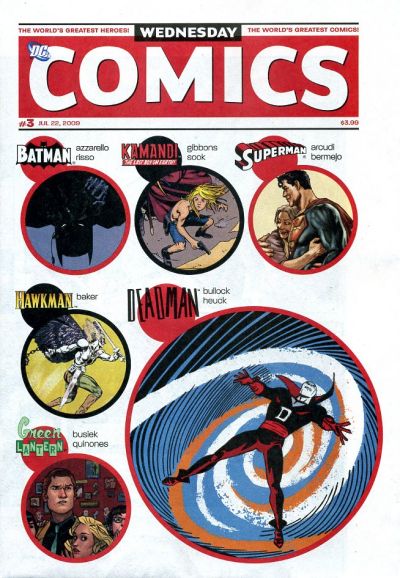
The 40 Years of Comics Project - Day 1021: Wednesday Comics #3, July 22, 2009

https://www.comics.org/issue/648744/

Apologies. Same situation as yesterday. Even typing hurts.
This comic was pretty cool. The Metamorpho and Superman features are definitely my faves.
To be continued.

Dec 11, 2017

The 40 Years of Comics Project - Day 1020: Wednesday Comics #2, July 15, 2009

https://www.comics.org/issue/648743/

Really quite sick right now. I thought it was allergies.

I'll say, the "New Frontier" era Green Lantern (and perhaps Flash) stories in this series are excellent. And John Arcudi's take on Superman is really pretty great. The only dark spot is the Titans story, not for its content, but because it was written by disgraced former-editor Eddie Berganza.

Afraid that's all I've got for today. To be continued.

Dec 10, 2017

The 40 Years of Comics Project - Day 1019: Wednesday Comics #1, July 8, 2009

https://www.comics.org/issue/648742/

There's something to the tabloid size comic. One of the most beautiful books I own is McSweeney's Quarterly Concern volume 13, the comics issue. The entire dust jacket folds out into a tabloid-sized comic. The size opens up so many possibilities, both for larger reproduction to deliver more awareness of detail, or also for sheer size to be able to pack information into. Wednesday Comics takes advantage of the format in both of these ways. There are stories that are little more than a blown up 3/3 grid, but the amount of reproductive detail is just wonderful. And there are others that pack amazing amounts of art into the space. None of them have sucked me in yet, though I remember being a fan of the "Wonder Woman" story in here. As the series goes on, I feel that the artists were starting to experiment with the medium. Some of Mike Allred's "Metamorpho" pages are wonderful.

I'm curious to see if this series works with a shorter wait between comics. When I teach comics, I sometimes include a section about serialization and the effect it has on storytelling. This series was conceived as a weekly series. I wonder if there are things that will come up and perhaps not work when it's being read on a daily basis.

To be continued.

Mar 8, 2017

Giant Box of Television: Arrow Season 2


Most of the write-ups of Arrow cite this season as being the high point of the show thus far. Criticisms of seasons 3 and 4 note sloppy storytelling, or trying to pack too much into the show, or mishandling of relationships, but many see season 2 as a near perfect superhero series. Having just finished the whole series (well, up to the current episode), I'm not sure I agree, but I'm also not sure I disagree. I think season 2 is the tightest story arc. The flashbacks to the island impact directly on the contemporary storyline, showing us the descent of Slade Wilson into the Mirakuru-fuelled madness that leads him to put his hands around Starling City's throat. Other flashbacks in other seasons have thematically attempted to follow the main storyline, but this is the only one that has seemed like we were watching one large story told in a non-linear manner. So, for that reason alone, I can understand the privileging that season 2 receives.

It's also where Oliver starts to become a hero, rather than a murderer, the ramifications of which are still being felt on the show. Though the Mike Grell run on Green Arrow that inspired the series shows the character indiscriminately killing, it's hard to reconcile this kind of a "hero" with the larger DCU, which, thankfully, starts to show up a bit more in this season. As I watch the current season (5), I'm conflicted about the character of Oliver Queen. Should he get away with the wholesale slaughter of season 1, simply because he's decided that he's going to be a hero and stop killing? This is obviously what the season 5 villain Prometheus is also asking, which makes us beg the lovely question as to who is really hero and who is really villain in this piece.

But in season 2, Oliver was trying very hard to be a hero, and by the end of the season, he's there, I think. The other great thing about this season is that the supporting cast comes nicely into focus. They spent much of the previous season getting to know one another, but now they're becoming a family. Oliver and John's relationship is one of the nicest homosocial pairings on television, and Felicity Smoak, who for some reason catches a lot of flak from reviewers, is adorably dorky, fiercely intelligent, and super-sexy all at the same time. And don't think Oliver's not noticing.

Villain Slade Wilson is just great. I don't know if it was intentional, but the character bears a lot of similarity to the depiction of Deathstroke in the Teen Titans cartoon from a few years ago. He's brutal and lethal, but also charming and charismatic. He serves as a perfect foil for Oliver in this season, demonstrating the void that remains when someone gives themselves up to despair and death, a lesson that Oliver has to learn in order to emerge on the other side of the season as someone, or something, else.

Mar 5, 2017

The 40 Years of Comics Project - Day 739: DC Special Series #1, 1977

https://www.comics.org/issue/30578/

With a leisurely Sunday morning to spend in front of the fire, an 80-page comic seemed just the thing. When I checked the GCD listing, only the Flash story from this particular comic has been reprinted - at least, in English. I'm not surprised. The comic is rife with problems. The Flash story is a clever one, and actually read much like an episode of the TV series might have - further proof that the television show is drawing very much on this late Silver age aesthetic. I'd also say it was the best of the bunch in here. The Aquaman story is a good one, and it's interesting that these one-off tales are all very firmly rooted in their contemporary continuities. Aquaman's story takes place as he returns from battle with Black Manta, and is dealing with the death of his son. You'd think something like this would have been reprinted somewhere, but I wonder if it's because of the really terrible depiction of a Middle Eastern character that it wasn't. In fact, there's quite a lot of really terrible racism in this comic. Aquaman's nemesis du jour decides he's going to use his newly-acquired powers to create a new Persian empire, which obviously means he's evil and must be stopped. There's a little aside at the beginning of the story talking about the wealth disparity in the Middle Eastern city that the villain hails from, ostensibly to make America look better? It doesn't work, especially from a current standpoint. And then we come to the Batman story, which actually seen the Dark Knight using racial slurs against the henchmen he's fighting. It was extremely off-putting to hear these things coming from the mouth of the Batman.

That aside, the Green Lantern story was nice in that the main character never really knew what was going on, and never does. I read an issue of Ultimate Marvel Team-Up a couple of years ago in which something similar happens. I quite like this kind of story - superheroes are more than human, yes, but that doesn't gift them with omniscience, so leaving them confused as to what just happened in their crazy lives every now and again makes me happy.

But not happy enough to ignore the horrendous racism of the comic. *sigh*

To be continued.

Apr 24, 2016

In case you're new here....

...Hi! Thanks for taking a moment to stop in and see what I have to say. Here's a link to the beginning of the 40 Years Project, to let you know what it's all about, and a bit about who I am. But that's not all I do on the blog. I've been known to write about The Flash, both the show and the comic, the links between music and comics, the wondrous glory of the Dollar Bin (and, that joy of joys, the Quarter Bin), and other assorted things.

Have a poke about.

I've been known to bite only occasionally, and never very hard.

Nov 18, 2015

On the Run: Mark Waid’s The Flash - Part 4 - Pasts and Futures


I've been struggling with this particular section of this series for some time now. As is totally obvious from the horrendous delay between sections. What I've been struggling with is trying to define this particular run of comics. We're coming off Wally's realization that he is every bit as capable as Barry Allen of being a legendary hero, off his having discovered a lineage of speedsters, something that Waid is very carefully setting up in this run. One of the portions of my dissertation is going to deal with the building of a coherent physical and historical universe in DC comics, and though it's not the top of my list, this particular aspect of Waid's run on the title will definitely come into the conversation.

None of which says much about this bit of Waid's run. Wally has his revelation about Barry, and then immediately leaps into action with Nightwing and Starfire, two colleagues from his days on the Teen Titans. The story arc that features these two is called "Back on Track," which I admit I don't really get. I suppose from a psychic perspective, Wally is back on track, but my understanding of the prior storyline was that the track he was on was not necessarily the right one. The previous "Return of Barry Allen" story was all about Wally dealing with self-imposed limitations that come about because of his past relationship with Barry, and then immediately he takes up with old friends who are, through no fault of their own, emblematic of the era he has ostensibly just escaped.

Why would Waid take us immediately into yet another of Wally's cul-de-sac pasts, when he's just spent a fair bit of the preceding issues telling us that, in order that he be the best Flash he possibly can be, Wally needs to escape his past?

Well, perhaps it's because Wally doesn't just have one past he needs to escape. The Barry one is obviously the big one, but Starfire and Nightwing are reminders not of the man that Wally has always measured himself against, but of his time as a sidekick, and as a Titan, reminders of a time when he was not among the A-list heroes of the DCU. Remember, as of this comic's publication date, Barry Allen had only been dead about 6 years. For about 25 years before that, Wally was a B-list sidekick on the Teen Titans. In order that we understand why this adventure comes immediately after the Professor Zoom one, we should take note of the specific characters who are featured. Starfire is from the Wolfman/Perez era of the Teen Titans, a team that transcended their status as B-list and rocketed to popular and critical acclaim during that team's tenure. I remember when these comics were coming out, and it was a big deal that they were matching Marvel's X-Men in terms of sales. So Starfire gives us that notion of the B-list heroes breaking the glass ceiling (note that cover) and moving into territory usually reserved for the Big Three and their hangers-on. Nightwing, on the other hand, represents the earliest of Wally's teammates, and the earliest time as a superhero. The original Teen Titans were Kid Flash, Robin, Wonder Girl, and Aqualad. Of course, Robin grows up and becomes Nightwing. He carries on his mentor's legacy, but is not trapped within it, which is basically the story we've just witnessed in the previous section of comics. So one hero represents transcendence of status, and one represents transcendence of origin, both of which Wally desperately needs to do in order to move forward as a character. Thus, by the end of this storyline, Wally has witnessed what it means to become a hero in one's own right, as well as putting to rest an old love story from the pre-Waid issues. That's the pasts of the title of this post. But what of the futures?

Waid takes things in a few different directions to get Wally into the future he needs to be in. The first is to team him with another hero in Central City: Argus. Argus comes from the "Bloodlines" crossover, specifically Flash Annual #6, which would have been part of the previous post had I not become bogged down in Derridean literary theory. Wally does not like Argus, a fact that really demonstrates his movement into being an A-list superhero - they never seem to like having someone else on their turf. It's a problem that Marvel Universe superheroes have made peace with, but it often seems that in the DCU, each superhero stakes out a claim and everyone else respects it. But Argus is also an attempt at the grim and gritty superheroes that were all the rage at the time of his appearance, so we're witnessing a character from the Silver Age of comics moving, ironically, very slowly into the Modern Age. But I don't want anyone to make the mistake of thinking that Waid makes the Flash into a Leifeld-esque angst-machine with poorly-drawn feet. Rather, he takes the character and demonstrates how this sort of superhero can co-exist with the other kind, and that they bring interesting nuances to each others' stories by virtue of the type of superheroes that they are. Waid really lays the groundwork for Morrison's JLA here, in that the stories are unquestionably modern (or postmodern, as the case may be), but not grim purely by dint of their modernity.

However...

The next story line, which runs almost to the end of this particular chunk of the series, is grim. Waid and company do something seldom seen in comics - they show what happens when a superhero is not able to save the day. There's an interesting argument to be made about these particular issues that they demonstrate a sort of post-traumatic stress in Wally's reaction to failing to save a woman from a burning store in a shopping mall. The woman survives, though is quite terribly disfigured, and Wally goes on what can only be termed a rampage of heroic acts, trying to prove to everyone, but mostly to himself, that he's fast enough to save everyone. There is a slight problem here, in that Waid's treatment of Wally's behaviour significantly takes away from the trauma suffered by the young woman he fails to rescue - we can write this off on the fact that the comic is called Flash, but it's still a bit troubling that it is Wally whose pain and suffering we witness, rather than the person who was actually the victim of the accident. There are early shades of the sorts of tropes from which grow "Women in Refrigerators," and while it is certainly problematic, I'm going to have to take the other perspective here, and note that the story is about Wally, and that there are always going to be secondary characters in stories whose sufferings or triumphs are simply not the subject matter of the narrative. Part of Wally's growing up over the course of these comics is realizing that he can't save everyone, and that punishing himself is not going to make him a better hero. We are often told that all we need to do in life is try our best, but it is usually ourselves who are the hardest to convince that we have done. Wally is no exception, though by the end of this story line, he's getting there.

So you'd think that at this point, Waid would cut poor Wally some slack, give the guy a holiday or something. He's just come out from under his mentor's shadow, witnessed the growing up of his childhood compatriots, and come to the realization that, superhero or no, he's still just a fallible human being. But instead, our hero is thrust into yet another "adult" role, and is given a sidekick in the form of Impulse - a speedster from the future, grandson of Barry Allen, and all around obnoxious kid. Almost immediately after having realized that he did not have to be Barry Allen, he takes on a role for which he only has one model - Allen himself. How Wally will deal with Impulse will be the focus of the next few bits of the run, I'd imagine.

One last thing I'll say about Impulse's introduction into the story line is that it casts our perspective in a direction, speedster-wise, that we haven't yet: the future. So far we've seen numerous super-fast heroes from the past in the forms of Jay Garrick, Johnny Quick, and Max Mercury, but here we see where that line goes. The DCU is remarkable for its attention to lineages, and nowhere is that more evident than in Mark Waid's Flash comics. But before we can really get into how Wally deals with Bart Allen, there's another crossover to come. We'll have a quick look at Wally's Zero Hour experience next time, and then jump back into his mentoring, and the shenanigans that ensue.

Sep 23, 2015

On the Run: Mark Waid’s The Flash - Part 3 - Ghost Story


If you’ll forgive the appropriation, in the era we’re considering, there is a spectre haunting the DC Universe—the spectre of Barry Allen.

I’m going to be a little more academic this time around than in the last couple of articles, and probably more so than in any of the ones that will follow. I suggested in my first Flash article that Barry Allen is a nostalgically-relevant character. Derrida calls it, in Spectres of Marx, “this first paternal character, as powerful as it is unreal, a hallucination or simulacrum that is virtually more actual than what is so blithely called a living presence.” There’s a lot to unpack there. The use of the term “simulacrum” immediately calls to mind Baudrillard and his musings on the postmodern, but I’m not sure that’s a line of questioning that is necessarily fruitful in thinking Barry Allen as spectre. Derrida notes, early in the text, that he makes a mistake in calling on the “spectres” of Marx, in the plural, as the first line of The Communist Manifesto, which I borrowed to open this piece, invokes a spectre in the singular. But this mistake is propitious, in that there are varied spectres of Marx, those that haunt his ideological children and those that haunt his ideological opposites. He calls this the “haunting obsession that seems…to organize the dominant influence on discourse today,” that “no disavowal [of Socialist thought] has managed to rid itself of all of Marx’s ghosts.” From this perspective, Marx, or his spectre, haunts the neo-liberal organizings of society and culture, haunts the hegemonic and the repressive. In some ways, too, this spectre haunts the Marxists, the Socialists, of the world. Derrida calls the “Marxist inheritance…absolutely and thoroughly determinate…We live in a world, some would say a culture, that still bears…the mark of this inheritance.” What Marx (and Engels, to be fair) have to say to us is still being said to us, still fundamentally describes a situation within which we all exist, regardless of whether we celebrate that situation or not.
But let’s move on from that. The notion of this haunting, of hauntology, is taken up in popular culture by thinkers of electronic music. Mark Fisher restates some of Derrida’s more impenetrable prose by describing hauntology as the “restatement of the key deconstructive claim that ‘being’ is not equivalent to presence.” By this point, if you’re still reading, you’re wondering what this has to do with the Flash. It’s this: Flash is a comic that is haunted by Barry Allen. Fisher phrases it thus, while discussing the hiss and crackle of a phonograph recording being redeployed in a contemporary piece of electronic music: “The surface noise of the sample unsettles the illusion of presence in at least two ways: first, temporally, by alerting us to the fact that what we are listening to is a phonographic revenant; and second, ontologically, by introducing the technical frame, the material pre-condition of the recording, on the level of content.” What I’ll argue here is that the costume that Wally wears is the equivalent of this crackle. We see Wally/Flash as present, as a character in and of himself. This is just not true, however.  Even Wally himself admits that he lives in the shadow of Barry Allen, that Barry Allen taught him everything, made him everything that he is. The costume is evidence. As with the crackle, it unsettles our illusion of presence by temporally constantly hearkening back to Barry Allen. Yes, there are slight variations, whether due to artistic license or to the active changing by Wally of the costume, but it is still fundamentally the costume that Barry Allen wore in comics for 30 years. As such, though we read a comic set, ostensibly, in the present, the costume is the crackle that reminds us that what we are reading is in some ways a “visual revenant.” From an ontological stance, what we might consider as the metatextual level of the costume’s unsettling nature, the “material condition” of the artwork, the concealment beneath the crimson cowl of an individual makes that individual virtually indistinguishable from any other piece of art featuring that character, past, present, or future. (For the record, later into the title’s publication history, Bart Allen dons the scarlet costume and, again, becomes indistinguishable from Barry or Wally.) Fisher says of this crackle effect “[w]e are suddenly made aware again of what the first listeners to phonograph recordings were acutely conscious: that we are witnessing a captured slice of the past irrupting into the present.” And is this not what we are seeing each and every time Wally puts on his Flash costume, a captured slice of the past irrupting, at high speed, into the present?
But so what? Comics have always had, or at least for a very long time now have had, this generational aspect to them, so what does it matter to note that this costume reminds us of a character long dead? Well, it’s not just us who are reminded. As I’ve just said, Wally is constantly reminded, and reminding himself, of all that he owes to Barry Allen. This legacy, as Derrida notes for Marx, is absolute and determinate. Be a hero, help as many people as you can. Be good. Be like me. Barry does not have presence in the comic, but he has being, and it is a being, a set of expectations laid down not only by the character but by the writers who have invoked him after death, that Wally, but certainly not only Wally, constantly struggle to live up to. What we, and Wally, wait for is the moment of fulfillment, either of the failure to live up to the being of expectation, or of the achievement of those things that we perceive as the fundamentalities of that being. These are two of the spectres of Allen that haunt us. And they do haunt us. We read The Flash are we’re intrinsically aware that there is this paragon, ghostly but a paragon nonetheless, to which our focal character, and we by association, must live up to. Wally tries. So do we. But how can we live up to something that simply has being? Is not presence, actuality, fundamentally influenced and changed by existence in a material realm? Being can exist outside of time, outside of causality. Presence is the manifestation of being in time. And time changes all things. If we are truly to exist as presences in this actuality, we must, to a certain extent, and to a greater extent than Wally has to this point, lay this spectral being aside, or manifest it and see what changes.
So we come to the section of the series I’ve called a ghost story. I think of it this way because we get to witness, sort of, the coalescence of the being into presence. Barry Allen returns. Imagine, for a moment, the celebration the world over if somehow Marx emerged unscathed from the clutches of death. Imagine every Marxist clamouring to study with him, to sit at his feet and hear his wisdom. Imagine his disappointment in how it’s all turned out. This is exactly what happens when Barry Allen returns to Central City and is confronted by what Wally has become, and by what has become of the world he left behind. We have seen, repeatedly, that one of the impetuses of Wally West’s life, of his time as the Flash, is to live up to the lessons he was taught, to make the world a better, safer place, just like his uncle did. He reacts exactly as one might expect when told that his efforts have been in vain, that he has failed, that the ghost he has carried around with him for years is disappointed not only in his performance, but in his appropriation of the ghost’s identity. Again, imagine Marx returning and telling every Marxist on the planet that they weren’t Marxists, that he was the only true Marxist.  It is, unsurprisingly, devastating. Now, because this is a superhero comic, and because to sully the name of Barry Allen in the DC Universe is tantamount to heresy, it of course turns out to not be Barry Allen. Professor Zoom, the Reverse Flash who plagued the younger version of Barry in the recent Flash television show, has travelled in time, taken on Barry’s appearance and persona, and is wreaking insane havoc on Central City. It’s up to Wally to stop him. But this is a Wally broken, a Wally who has been told that he has failed to live up to the being that has accompanied him throughout his superheroic career. There is only one way he can defeat this villain, and that is to understand that the ghost he carries is one of his own making, that the pressures of the spectre of Barry Allen are illusory and that Allen was never the paragon that Wally has made him into; all he ever was was a man. With this realization, Wally takes his first steps to becoming something more.
It may seem silly, even ridiculous, to try to apply this Derridean notion of the hauntological to a superhero comic. What’s important to take away from the theoretical base is the idea of the being versus the presence. The being, the ghost, is never what was the original, but what we carry with us as our perception of the original. What this part of The Flash allows us to theorize is the way in which the present, the “presencing” of the being demonstrates this fact. When Derrida read his book, the neo-liberal machine may well have feared the spectre of Marx, but it was a spectre of their own conception, not anything intrinsically linked to the man himself, much as the revered spectre of the Socialists and the Communists is a spectre of their own conception. What is important, then, what Wally’s experience teaches us, is that it is in our own best interests to acknowledge that the ghost we carry is the ghost we made, and is not the person whose presence creates a shell around the being.
There’s a good chance that none of that made even remotely any sense, and a blog post is not necessarily the best place to try to work out the ins and outs of Derridean hauntology and its application to the superhero comic. As I was writing up one of my 40 Years of Comics posts this week, it occurred to me that Charles Xavier is a haunting presence in the Age of Apocalypse storyline. I likened his presence to that of the “Third Man” than numerous explorers into isolated parts of our planet have reported, a presence that is both individual and gestalt, a companion and another self. Perhaps that is what I’m trying to get at with my contention of the hauntological in The Flash, that the being is a companion and another self, but that we often forget that it is another self, and gift it with autonomy. But a ghost can’t have autonomy, only nostalgia, only construction. A ghost is a memory, all in our heads.
Wally moves on next time. He comes back to the world, runs into old friends, old lovers, and old enemies. Waid has told us a big story here, one that has forced both the readers and the character to rethink everything they thought they knew. He tells us some little stories next, the small steps Wally needs to take to come back from the shock of Barry’s return, and to come out from beneath the shadow he has been casting upon himself.

Sep 14, 2015

Yet another apology

I'm well behind on my Flash series, which makes me sad. Of all the things I have on my docket right now, it's the one that I'm the most enthusiastic about, but is also consequently the one that I feel needs an appropriate amount of time to make it perfect. It probably won't be up this Wednesday, as I'd hoped, unless I'm hit with a miraculous burst of energy. Look for it later in the month, and, again, apologies for the wait.

tom.