Pages

Showing posts with label Frank Quitely. Show all posts

Mar 31, 2020

The 40 Years of Comics Project - Day 1861: 2020 Visions #3, July 1997

For information on stopping the spread of COVID-19, and on what to do if you are quarantined, have a look at the World Health Organization site.
https://www.comics.org/issue/60546/

Alex's story comes (which is a funny pun if you've read the story) to a conclusion that I'm not 100% on board with. After escaping Ellis Island with an army of plague-carrying revolutionaries, he plays his usual card, abandons the doomed attempt at social upheaval, and instead manages to sneak into the heart of the walled-off, elite section of the city. Climbing to the top of the tallest building (and let me tell you, it was off-putting to have him looking down at the tops of the the Twin Towers), he plans to leap off into an air conditioning system, thereby infecting hundreds, if not thousands, of the genetic elite with his lustful disease.
Which then burns out with the rising of the Sun, and we leave Alex as he's about to be beaten by cops and dumped back in the plague-infested part of the city from which we've just watched him climb. But he's had a turnabout, and sees life and the world as beautiful as well as ugly, and he's not ready to leave it yet.
Given the constant building of tension throughout the three issues of the story, the finale really does play like, in Alex's words, "another premature ejaculation," which is maybe the point, but it's not the ending I was hoping for. Of course, regardless of whether or not I liked the ending, it was all drawn by Frank Quitely, which means it was fucking gorgeous to look at. Endings are weird, and I feel like so many writers struggle with them. We've been programmed, in Western Culture at least, to embrace stories that never end. We're a Christian-based nation, of course - has the story of the Bible ended yet? So when our stories do end, I sometimes think there's some fundamental part of us that rails at it, regardless of whether it's a satisfying ending to the story or not. Or perhaps it's just that it reminds us that our stories too will end one day, and not a one of us is okay with that.

More to follow.

Mar 30, 2020

The 40 Years of Comics Project - Day 1860: 2020 Visions #2, June 1997

For information on stopping the spread of COVID-19, and on what to do if you are quarantined, have a look at the World Health Organization site.

https://www.comics.org/issue/60424/

I should probably walk back my claims of Jamie Delano's prescience a bit, in that this series is not a really a futurist speculation but a commentary on America at the turn of the millennium. If we read it as a far more metaphorical representation of American society, you can see the problems Delano is drawing attention to, and how they led us to the current state of United States socio-political organization. There's been no mention of who runs the country now, but I wouldn't be surprised to see that it was a celebrity of some sort.

This particular chapter is also a bit of a stroll through U.S. history, or part of it anyway. The 12 issues of this series share a setting - they're all set in the same United States in 2020, and there are apparently connections between the various characters, so maybe I'll have to go back and re-read the second story arc to see how Jack Atlanta's tale links to this first story. Most of today's issue takes place in the quarantine of Ellis Island, where immigrants to the U.S. were held until deemed healthy enough to enter the country, or were sent back where they came from. The island plays an opposite role in 2020, however, with victims of disease, any disease, sent to the island to waste away, out of sight, out of mind.

Well, that got a bit too real. Hopefully our current plague will get under control before something like this becomes necessary.

More to follow.

Mar 29, 2020

The 40 Years of Comics Project - Day 1859: 2020 Visions #1, May 1997


For information on stopping the spread of COVID-19, and on what to do if you are quarantined, have a look at the World Health Organization site.

https://www.comics.org/issue/60319/

I'm surprised it took me this long to get around to this series, given the year, but I think perhaps I've left it to just the right time. The premise of the first story in the series is a society that has gone full-totalitarian in order to stop the spread of a virus.

Yep.

While the political situation of the series is both identical and completely opposite the current U.S. one, the paranoia over the transmission of this disease is far too real. I honestly could see, with not too much pushing, our own society hitting the point of having special police to round up those who might be infected for mandatory testing and quarantine.

To give you an idea of how prescient, at least in a small way, this story is likely to be, here's a couple of captions that probably will reflect our own world in, oh, let's say, 3 weeks. If we're lucky.


Can't put it much better than that.

More to follow.

Dec 6, 2018

There is Only One Sound in All-Star Superman:Thoughts on Focalisation and Sound


There is only one sound effect in All-Star Superman.

Bear with me for a moment.

I think that the cold open for season 1, episode 21 of Brooklyn Nine-Nine is, hands down, the best one they do. The set-up is simple, seems to go in a direction we’ve seen before, and then veers off and becomes a beautiful study in character development. Andre Braugher’s expression at the end is one of the best performances I’ve ever seen. Have a look:


If the Netflix series summary is to be believed, we’re meant to experience Brooklyn Nine-Nine through the perspective of Andy Samberg’s character, Jake Peralta. We refer to this character in a narrative as the “focal character.” Simply, it is the character through which we focus our perceptions. ‘Niederhoff (2011) proposes that focalisation “may be defined as a selection or restriction of narrative information in relation to the experience and knowledge of the narrator, the characters or other, more hypothetical entities in the storyworld.”’ In the television series, Peralta sees Holt as a robotic Captain, so that aspect is played up in the comedy. Peralta’s perspective on the world of the show is the one we are expected to adopt.

In a medium like television, there are numerous ways to achieve this focalisation, such as the aforementioned utilisation of Peralta’s perspective to accentuate comedic moments, even when Peralta himself is not present. But another way that it can be achieved is through sound. In this particular case, the non-diegetic sound that signals the shift in Peralta’s understanding of the situation.

Go back and watch the clip. At 57 seconds, we hear a rattling sound. Aside from some background music, another indicator of the shift in tone of course, this is the first non-diegetic sound we’ve heard. It’s not really music. As Holt leans in, and his behaviour goes from robotic to something a bit more fluid, a snake-like rattle belies the fact that Peralta is about to be struck. Even the movement of Holt’s body at the end, as he pulls away, is serpentine. We’re removed from the more jovial atmosphere of the police precinct, created by the familiar diegetic sounds we hear in each episode, by a single sound effect, one that shifts atmosphere through a realigning of the perspective of the focal character.

But what does this have to do with comics, a largely silent medium, and All-Star Superman?

There is only one sound effect in All-Star Superman.


Chapter 3 begins with an invasion from the center of the Earth, led by the Prince of the Subterranosauri, a race of intelligent dinosaurs. You’ll note on that first page, there is smoke billowing, there are dinosaur soldiers rushing about behind, and an entire car is being lifted up into the air. But in that whole panel the only sound that is transmitted is Kull’s voice. The situation is similar for the Daily Planet reporters watching the scene unfold on the following page, until the fifth panel. Jimmy Olsen, Superman’s Pal, has sent his friend a signal, a signal only Superman can hear, the tiny “Zee zee, zee zee” we see superimposed (a word I use purposefully) over his hand. Is it not strange that we cannot hear the crashes of violence and chaos on the first page, nor anywhere on the second? Surely these sounds are wafting up to the watching reporters. Of course they are.

Later in the chapter, in which Superman bestows upon Lois Lane powers identical to his own for one day (LOIS: What is it? – SUPERMAN: My superpowers. In liquid form. Happy Birthday, Lois. – LOIS: You’re serious? I get to be like you? For a whole day?), Superwoman also comments on Jimmy’s watch. As her powers wear off she notes that she’ll “never have to put up the annoying zee zee zee of Jimmy Olsen’s Super-watch” ever again.

Of course, these examples are only from a single chapter of the book. However, in the very next chapter, as Jimmy spends a day on the Moon, this occurs:


Note once again that a chaotic and presumably noisy event is depicted without any sound effects whatsoever. Until, again, that last panel, in which the “Zee zee zee” of Jimmy’s watch is “heard” once more.

Take a moment, if you have the book, and flip through. There are no other sound effects. The only one that we ever hear is one that only Superman can hear.

So what shall we make of this? You can make what you like of it, really, but here’s my reading: When I teach sound in poetry, through alliterative and assonant phrasings, I suggest that the inclusion of this sound is intentional, just as I believe the use of this single sound in the series is intentional. As with the example from Brooklyn Nine-Nine, I argue that this sound effect aids in focalising us into Superman’s perspective. We are meant to understand this story through the lens of the Man of Steel. It is, after all, called All-Star Superman. We all star as the main character.

One of the main concerns of this series is the meeting of the mortal and the divine. Superman bestows upon Lois his powers, but only for a day. Jimmy is injected with the Doomsday formula, a human attempt to replicate the divine, which ends disastrously. The ancient Kryptonian astronauts later in the story fall from the heavens as divinities, but find themselves corrupted by the remnants of their own homeworld, divinity here shown to have to adapt to mortal surroundings or perish. Lex Luthor acquires Superman’s powers as well, and in the end realizes the truth of all divinity – it was never meant to make us harm one another, only love one another. It was created to stop us from being the animals that we so often are. Lex simply cannot handle this.

I’ve written elsewhere of the significance of chapter 10 of this work, in which we witness ostensibly the real world creation of Superman as a fictional character. But if we consider that the work is focalised through this character, that it is this particular perspective on events through which we are meant to understand the narrative, then this chapter takes on further significance. Each of the connections with the divine through the narrative are unsuccessful. Even the Superman-enabled Lois Lane only has her powers for a day, as does Luthor, and is worn and exhausted as they fade. Only one connection to these powers, this character, a metonym for “essential goodness,” the constitution of which Ben Saunders calls “one of the more beautiful challenges that postindustrial popular culture ever produced for itself” (from Saunders’ excellent book Do the Gods Wear Capes?), is successful in the story. And that is the “creation” of Superman at the hands of Jerry Siegel and Joe Schuster. Further, we see the success of this connection by the very fact that this event is being chronicled in a comic book the cover date of which is one month shy of the 70th anniversary of Superman’s first appearance.

The argument here appears to be that not only do we create the divinities we come to worship, but that the stories we tell of them really are the only ways we should try to embody, imitate, or access those divinities. We should never try to be them, nor should we ever think we know what a divinity wants. All we have are their stories. And, further, we should always recall their fictional nature. There’s nothing wrong with admitting that the thing you turn to for solace isn’t real. Just because a thing isn’t real doesn’t mean that it’s not true. If truth depended on reality, we would not have literature. In All-Star Superman, Morrison and Quitely provide us with the means to achieve this connection. As the book focalises through Superman, we are given a brief, 12-chapter glimpse into what it is like to live his life, to experience “reality” at divine levels. A question that is often posed to the Man of Steel is how he can possibly stand all of the noise his super-hearing must subject him to. All-Star shows us how he copes. I read this series with a sense of vast white noise behind it, punctuated only now and then by the sound he is listening for, the signal of Jimmy's watch. But still, it is only a taste, not a neverending ride, though chapter 10, itself entitled “Neverending,” suggests that the re-reading of these texts, and the re-conceptualizing of these texts, is the only way to be constantly in touch with the divine.

I’ve recently finished re-reading this book, paying close attention, and there really is only one sound in All-Star Superman, but it is a sound that connects us to an avatar of goodness. It offers clear direction as to how we are to understand the events of the story and the perspective of the narrative, and it allows us to see the answer to the question “What would Superman do?” And, to end on a hopeful note, it lets us hear the hero that lives within.


Jul 2, 2016

The 40 Years of Comics Project - Day 494: Batman #700, August 2010

http://www.comics.org/issue/760845/

"No matter when.
No matter where.
No matter how dark."

Though not technically a part of the "Return of Bruce Wayne" storyline, this anniversary issue of Batman offers a tiny little primer on time travel stories to get us ready for the convolutions of the "Return" story.

Well, maybe that's overstating things. It's a nice story for an anniversary, as it intertwines past, present, and future Batmans (Batmen?) in an adventure, though the locked room at the center of the story is not really a hard one to figure out. So much can be done with a time travel device. But, oftentimes, in depth story is not what an anniversary issue is about. It's about celebration, about seeing where a title has been and where it has the potential to go. With younger titles, it's also about relief to have made it this far, but very few hit the milestones that titles like Batman, Detective Comics, Action Comics, and all the old guard do.

For me, the best parts of this issue are the end bits that, while not partaking of the main storyline, offer visions and interpretations of what Batman has, and will, mean. The "And Tomorrow" chapter, illustrated by David Finch (who, I'll admit, is just a bit too Image-y for my tastes), gives tantalizing glimpses into possible future Batmen, heroes who may be part of the lineage, but also may be alternatives to one another. It's lovely to see the Batman and Robin of the 853rd century again, and Terry McGuinness - though isn't the presence of old Bruce there a bit of a giveaway? I'm not sure where the other two versions of the Bat that we see, one in a futuristic mega-city, one in a post apocalypse, come from, if they're canonical future versions or just extrapolations from Morrison's mind, but they demonstrate that Batman, or the idea of Batman at least, can function in the most diverse settings. "No matter when, no matter where." It's telling that the final pages bring us back to the present and picture everyman Commissioner Gordon shining the Bat Signal into the darkness, showing us that, regardless of the darkness of the costume and the character, Batman is hope and light.

But don't tell Bruce that. He'd just growl at us.

Onward.

Jun 22, 2016

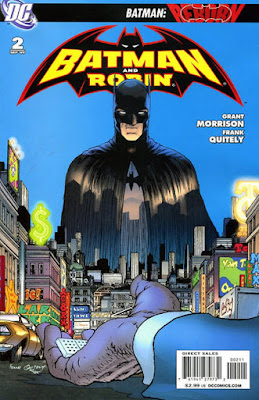
The 40 Years of Comics Project - Day 484: Batman and Robin #3, October 2009

http://www.comics.org/issue/629091/

It occurred to me while reading today's comic that new Bat-villain Professor Pyg is in a lot of ways the darkest of reimaginings of Mr. Nobody from Doom Patrol. In particular, he mutters a line ("hrrrn the box...the box, the "Despair Pit", he said...in the corner...the inside went on forever.") that echoes Mr. Morden's experiences that turn him into Nobody. I'm fascinated by the overlapping generic tendencies that can exist simultaneously in comic book universes. In an article I published in The International Journal of Comic Art, I called it "inflection theory." The idea is that while we're reading something like Batman and Robin, a grim, bloody, Noir-ish piece of writing, we also always have to remain aware of the fact that this universe is also inhabited by such characters as The Heckler, or Ambush Bug. Where Batman is a detective noir, Ambush Bug is a superheroic satire, almost a cartoon, yet the adventures of these characters take place in the same imaginary universe. If this is the case, then every time we read a noir in Batman, the story has to be inflected, even just slightly, by the satire. The nice thing about comics is that this inflection is not only demonstrated in the genre, but also in the art style. A comparison of Richard Case's work on Doom Patrol with just about anything by Alex Ross reveals a huge disconnect in the way the world is depicted, but this disconnect can never be fully...disconnected, I suppose. The characters are always in the same universe.

I'm still working out the ins and outs of it, but this resonance of Pyg with Nobody adds a very interesting layer.

The other interesting thing about this series so far is reading it retrospectively with regard to Damian Wayne. Something happens to him down the line, in the closing chapters of Batman Inc., but it's actually quite easy to see it coming. In the simpler world of the superhero, certain characterizations (such as leaving an innocent girl in a burning lab so that he can catch the villain) point us to his inevitable fate.

(Man, can I talk my way around spoilers or what?)

Onward.

Jun 21, 2016

The 40 Years of Comics Project - Day 483: Batman and Robin #2, September 2009

http://www.comics.org/issue/629090/

Poor Dick Grayson. After the assured way he takes up the mantle at the end of Battle for the Cowl, he sees that becoming Batman and being Batman are two very different things. Of course, having Damian Wayne as Robin would be enough to tax the patience of event the most saintly (I wonder if there's ever been a Damian/Superman team-up?), so it's a good thing that he has the slight-yet-strong shoulders of Alfred to rest upon.

More and more as I read this run, I'm seeing Alfred as the quiet hero in the background. It's easy to privilege the costumes, but at the end of the day, or night as the case may be, to be able to come home to someone who cares for you with such devotion is fundamental to the mission. And Alfred's got a lot of other stuff going on. As I noted in the second issue of Battle, he's pretty good with the combat stuff, he's got an avid interest in detective fiction, and, probably most importantly, he's been the only real observer of Batman's methods since day one. How could he not have picked up some skills? And today's comic offers an Alfred who channels performance and performativity theory, telling Dick not to think of his taking up the cowl as a memorial -- "you and I know he'd hate that" -- but as a performance. "Think of Batman as a great role, like a Hamlet, or Willie Loman...or even James Bond." I've said it before, I'll say it again, Grant Morrison understands superheroes like few other people. Batman as the great, mad, rebellious son. As the trodden down remnants of the American Dream. Or as the rotatable master spy, different but ever the same. All three at the same time - and now with a little bit of the original Robin mixed in.

Have I mentioned how much I love this title?

Onward.

Jun 20, 2016

The 40 Years of Comics Project - Day 482: Batman and Robin #1, August 2009

http://www.comics.org/issue/629089/

Oh, I have been looking forward to this. Much as I've waxed lyrical over Morrison's handling of the mythic Batman, it's this series, in which the myth starts re-manifesting in another form that I really, really love. I think I could have become a huge fan of the Dick Grayson version of Batman. The old, or original, heroes always seem to have something of the past clinging to them. While Robin's got a long history himself, it's when we see someone like Wally West take over for Barry Allen, or Dick Grayson take over for Bruce Wayne, that the characters become contemporized for me. The New 52 tried to unhistoricize the characters in an effort to make them seem relevant in contemporary society. But the generational tale has far more impact, and retains far more respect for the origins, and originals, of the characters.

I also hadn't totally put it together last time I read the series, but there's a lot of the 60s Batman TV series in this issue. Grayson is certainly less gruff and grim than Bruce was, ready to crack a bit of a joke, much as deadpan Adam West did. And Frank Quitely's insertion of sound effects into the art work is probably one of the most amazing things I've ever seen in a comic (picture below), and certainly calls back to those prominent sound effects from the series. The other thing that came to me is that there's been a reversal of roles, in a way. Common thinking is, and what we've had articulated throughout the series is, that Robin brought light to Batman's dark world, that his optimism tempered what could have been a quick and disastrous slide into psychosis. But in this iteration of the team, Batman is the more light-hearted, while Robin, Damian Wayne, skirts the edges of that slide. It's a really lovely team-up. As I noted above, I only wish there'd been more.

Here's the Quitely art that made me grin, ear to ear, the moment I opened the comic:


Awesome.

Onward.

Feb 29, 2016

The 40 Years of Comics Project - Day 370: Weird War Tales v.2 #3, August 1997


While I am always excited to see a new Grant Morrison work, regardless of genre or format, I am exponentially more excited every time I see a new Morrison - Quitely work. There are pairs of writers and artists that seem to synchronize so well that it's hard to imagine that it's actually two different storytellers behind the pages. I think of the seminal X-team of Claremont and Byrne. More recently, I think the Ellis - Cassaday pairing on Planetary achieved a similar effect. But Morrison - Quitely...sometimes it's like they're inside each others' heads. Flex Mentallo, Earth 2, All-Star Superman, The Invisibles v.3, #1. And this, this weird and wonderful war story about Action Man dolls and insects.

The Vertigo comics of the Nineties mark, for me, a high point in the art form. While there was certainly editorial oversight, the amount of freedom given to creators in the Vertigo stable resulted in some of the strangest and most wonderful pieces of comics I've ever read. When Vertigo was actually still a part of the DCU, it gave us a nice breadth of styles for our superheroes, and also gifted us with some amazing creator-owned pieces. This series, from the tail end of what I'd consider Vertigo's Golden Age, offers three great examples of comics short stories. They're limited in location, in time frame, and offer just enough detail (through dialogue and art) to introduce characters and situations, and then make us care about them. "New Toys" leads the charge, and is, as we really should expect from Morrison and Quitely, not your typical war story - it doesn't speak to a specific war, but to all of them, and asks us to think about what's waiting behind the calls to violence that our species seems to love so much. The next two stories are more straightforward war tales, one set during the Serbia/Croatia conflict, telling a tale of families and friends ripped apart by that conflict, and one set during the First World War, offering a scathing critique of the leaders of the British army. I'm not sure either of them was particularly weird, but they were remarkably well done.

I planned this week to bounce back and forth between early Morrison works and later works. The difference is often striking, though one has to wonder how some of the earlier tales might have fared if paired with an artist who "got" Morrison. (Probably they would have been just as basic, but a little prettier.)

On to some small press stuff tomorrow!

Oct 29, 2015

The 40 Years of Comics Project - Day 247: E is for Extinction #1, August 2015


I know it's probably just me, but I think way too many of the "Secret Wars" mini-series were focussed on various iterations of the X-Men. I mean, how many more series does this team merit?

I admit, I bought this particular title because it picks up some of the threads of my absolute favourite run on the mutants, Grant Morrison and Frank Quitely(ish)'s New X-Men. The extinction of the human race, a major plot point at the beginning of that early 2000s run, was seemingly dropped for more mainstream superhero concerns, and then the whole aesthetic was replaced with Joss Whedon's Astonishing X-Men. So a chance to return to this era? Sign me up.

What I think distinguishes E is for Extinction from the other X-titles in the crossover is that it actually takes that ephemeral now of the Marvel U and projects into the future - it ostensibly takes place "X" years in the future, which we can read as 10, or as a variable amount, but enough that Emma Frost has wrinkles, and Cyclops is a bit overweight. How on Earth Magneto is still alive, I'm not sure, but he's taken on an Xavier-esque role, which, if "Age of Apocalypse" has taught us anything, can only seem to happen after the death of Professor X. What's that all about?

The Burnham/Villalobos team does a nice job of capturing the aesthetic of this X-period, both in the character designs and in the look of the book in general. I've been trying to figure out exactly where in the original run this series diverges from (if anyone can tell me, drop a line - I wish I had the time to go back and re-read New X-Men right now). Regardless, the What If...? structure of many of these crossovers gives us a glimpse of what might have been had the Marvel U continued from particular points in its history, a swan song of sorts, I'm assuming, before we see a more cohesive, and more linked to the MCU, Marvel Universe emerge after Secret Wars. Though there have been hints that these are all parts of parallel universes, Marvel has traditionally avoided that trope more strenuously than their Distinguished Competition - these are more glimpses of the past, What If worlds, rather than Elseworlds, I suppose.

I'm interested to see where this all goes. Every now and then someone reinvents the X-Men, and pushes at the boundaries of what they're capable of, and of their potential to be truly innovative and versatile story telling tools. But then they'll often go right back to being Claremont/Byrne era shells, lacking in substance and vision, and telling the same old stories all over again. It's nice to see a what might have been.

More X-shenanigans tomorrow! I've missed the mutants since we wrapped up the AoA. It'll be nice to hang out with them for a few more days.

Aug 7, 2015

On the Run: Mark Waid’s The Flash - Part 1: Pasts, Presents, and Futures


Originally, I had envisioned my “On the Run” columns to be standalone pieces that commented on a particular writer or artist’s extended tenure on a particular title. Grant Morrison’s Animal Man, or Alan Moore’s W.I.L.D.Cats, or Warren Ellis’ Stormwatch. Or, to represent the artists a bit more, Chris Sprouse’s Supreme or Frank Quitely’s New X-Men. That may still be how the columns end up, but having just finished another go through the current The Flash television series, I was inspired to read through one of my favourite runs on any superhero comic ever: Mark Waid’s The Flash. I’ll add a caveat to that appellation, in that it was certainly not solely Waid who produced this comic. He’s ably assisted by numerous talented artists, and joined by Brian Augustyn as a co-writer for a large part of the series. But Waid is the fulcrum about whom this run rotates. I’ll give credit where credit is due, of course, when the time comes.


The problem is that this particular sustained run on The Flash (and, yes, the use of the term “run” is intentionally punned) is just over eight years long. It stretches from The Flash Annual #4 in 1991 to The Flash v.2 #159 in 2000, plus a little addendum of six issues in 2007 – 2008. How does one cover such a vast number of comics in a single post? I don’t even think such a thing would be possible, not if I wanted to do justice to what has to rank as one of the great stretches of superhero writing in the genre’s history. Thus, over the course of a number of columns, I’ll look at discrete portions of the run, at the themes that Waid and company touch upon, and at the reasons why I think this is one of the great superhero narratives.

That raises an interesting question. A couple of them actually. First, what is literature, or what makes writing great? When going over with my supervisor the changes I wished to make to my major field reading list in American Literature, we talked about this, about what distinguishes the literary from the non-literary. It was offered to me that the literary is something that stands out from the crowd, that does something different, and does it with grace and facility. I’m not sure I completely buy that that’s all that literature is, but it is a place to begin thinking about how we can define a literary portion of an ongoing superhero series. This is the second question. As an academic, I am trained to look for self-contained imaginative works that can have one or more theoretical paradigms applied to them, all in the service of saying something new and novel about the work and what it represents for our culture. How does one do this with an ongoing comic book series? The answer, I think, is to isolate particular stretches of those comics and demonstrate how they are literary, how they stand out from the rest of the series and from the genre they inhabit. Which is what I hope to do with this particular stretch of The Flash.

That said, I’m going to start in a strange place. Slightly before finishing his 8 years on the title, Waid and fellow scribe Tom Peyer, along with artists Barry Kitson and Tom Grindberg produced Flash & Green Lantern: The Brave and the Bold. Taking their title from a Silver Age team-up comic, this six-issue series tells stories of Green Lantern Hal Jordan and Flash Barry Allen. At the time of its writing, both of these characters were dead (or evil. I can never get Hal Jordan’s chronology straight). The series looks back nostalgically to these two seminal characters, but paints them in the rose-coloured hues of memory. I’ve had conversations with fellow fans about this, especially following Geoff Johns’ reintroduction of both characters into the DCU, pre-New 52. Were these characters really the paragons of virtue and, more importantly, good story-telling that they are often hailed as? I think the answer is no. I think, really, that these are two characters who became far more important to their shared universe after they died, in that they ascended from the incarnated demi-gods that the superheroes are to revered ancestors that could no longer be faulted. I’ll add yet another caveat here, in that I can hardly claim to have comprehensively read the 30 or so years of accumulated tales these characters were a part of before their deaths in the eighties or nineties. I’ve got the last chunk of the Barry Allen The Flash, and it’s actually quite gripping, telling the tale of the Flash being on trial for the murder of the Reverse-Flash. But the issues I have that predate that story are middling, at best. I think the same would have to go for most of the pre-Crisis Green Lantern stories I’ve read. At the time that this series was published, Wally West was, of course, the Flash, and Kyle Rayner had taken over as Green Lantern. They lived in the shadows of the “giants” that came before them, but that shadow is cast solely as a narrative device. My feeling is that Wally and Kyle were far better at their superheroic roles than either of their predecessors.

This is, of course, a matter of taste, and if the history of philosophy has taught us anything, it’s that taste is virtually impossible to quantify. As such, feel free to completely disagree with what I’ve written above. However, the preference of Barry over Wally, or vice versa, has little to do with the presentation of The Brave and the Bold series, which is absolutely presented as a series of memories of times gone by. Issue six even features a narrative frame from Hal Jordan’s mechanic Pie, and the use of this device begs the question of the reliability of the narrative voice of the whole series, be it Waid and Peyer’s, or the unseen narrative construction that exists within the shared universe. The series acts as a foil to the reverence with which Allen and Jordan are held in their successors’ series, a demonstration of how these characters are remembered in the shared universe, if not in the reality that we call home.

Before moving on to The Flash series proper, there are two more brief things to mention about The Brave and the Bold. First, it makes a lovely companion to the Waid/Augustyn/Kitson JLA: Year One series from a few years prior. Year One is a brilliant retelling of the Justice League’s origins, and is well worth a read. Waid’s JLA work may well show up in an “On the Run” one of these days, and Year One is definitely its high point. The second thing is the reason that I placed this series at the beginning of my read-through: Barry Allen haunts the Wally West Flash palpably. A shadow, a ghost, a reminder, an inspiration, barely two or three issues go by without a mention of the revered second Flash. This is one of the major themes of Waid’s run on the title, the ways in which we acknowledge and integrate the past into our present identities, and the ways that those integrations can go well or ill. Of course, because this is The Flash, there’s a lot of work on how we integrate our futures as well. Case in point is Waid’s earliest work on The Flash volume 2, the 1991 “Armageddon 2001” crossover annual.

(Note: this next section draws heavily from my “40 Years of Comics Project” review of the annual.)
The Flash Annual #4 is the earliest Flash story in Waid's run, as far as I know. Anyone who knows better, please let me know. I'm always excited to add something to my hunting list. It's a part of the "Armageddon 2001" crossover, a story about a time traveller trying to uncover which of Earth's greatest heroes becomes the deadly despot Monarch in the futuristic time of...2001. Apparently the whole thing was supposed to (SPOILER ALERT) culminate in Captain Atom being the big bad, but they decided against that at the last minute and made it Hawk. Of Hawk and Dove? Angry red and white guy? My understanding is that this was a last-minute decision, flew in the face of everything that had been set up, and basically made the whole crossover a bit silly.
 
But let's leave that behind, and consider it in the context of Waid's run on The Flash. What's remarkable about this story, though in many ways it's a pretty unremarkable tale, is that it presages so many of the themes Waid would take on in his run, about a year later, on Wally West's life. Alternate timelines, the Flash's children, his future spouse, the ramifications of his public identity. The framing sequence is frankly quite sinister, ending with a young lady probably about to be rubbed out by organized crime, and the Flash standing oblivious. The story of the year 2001 is a pretty standard piece, a bit sentimental, about a future that the Flash could have had (married to said soon-to-be-no more young lady, and hiding in witness protection), one seemingly averted on the very last page by the interference of the time travelling Waverider. From a particular perspective, this makes the whole story seem a bit pointless, as the timeline ceases to exist.

Or does it?

Rather famously, about a decade after this story, Waid and a number of co-conspirators introduced the concept of "Hypertime" to the DCU, a concept that restored, in some ways, what were perceived as the losses that surrounded the demolishing of the Multiverse in Crisis on Infinite Earths. In essence, Waid et al suggested a framework in which all possibilities happened, from thrown out continuities to Elseworlds stories, possibilities that made up the fabric of a far-less-traversable extra-dimensional medium called Hypertime.  Waid explored Hypertime in some detail in the end days of his Flash run, which we’ll come to eventually. The concept is now pretty standard in superhero universes, as evidenced in Wildstorm’s “Bleed,” and Marvel’s (now-deceased) Multiverse. Yet 10 years earlier, here's an alternate timeline flaring briefly into existence, offering the possibility of an array of futures, pasts, and presents. The story is a bit sloppy, in terms of the crossover. Waverider nullifies the future he glimpses, the future that apparently convinces him that the Flash does not become Monarch in the future. But if that future no longer exists, doesn’t the possibility still stand that Wally becomes a despot? Again, though, this brings us back to another of the major themes of the Waid years: possibility and probability.

I'm not claiming Waid had a giant master plan before embarking on The Flash. But I've had it suggested to me that all great writers pick a theme, or a story, and come at it from every possible angle, figuring out all the possible ways to ask a single question. I think Waid's a writer who does this. What he writes in one Annual here he dissects completely over the course of eight years on the main title. But before we get to that masterful dissection, there’s the little matter of an origin to address. Issues 62 – 65, cover-dated May and June of 1992, represent the real first steps in Waid’s run, a retelling of Wally’s origins that will resonate through the entirety of the series: “Year One.”

I don’t think I’m going to say a lot about the four issue origin story. It’s well done, covers all the pertinent details of Wally’s back story, the kind-of-insane coincidence of his gaining his powers (Flash Barry Allen arranges the chemicals in his lab to precisely mirror how they were when he got his powers, and then lightning coincidentally strikes Wally), and his first days as Kid Flash. It’s a competent superhero origin story, and out of context of the rest of the run would be fairly unremarkable. In context, however, the story lays the same kind of groundwork that Waid’s earlier annual does. We are introduced to Wally’s family, both those he likes and those he doesn’t, a family that plays a fundamental role in the development of the character over the course of Waid’s tenure. We’re shown Wally’s origin, its, even in a superhero story, highly unlikely nature, an origin that Waid explores fully through this run. And, as with most of the series, we’re given the spectre of Barry Allen. Please forgive a Wikipedia quotation now, but with Barry Allen in this run, I’m put in mind of Derrida’s notion of hauntology, in which "the priority of being and presence [is replaced by] the figure of the ghost as that which is neither present, nor absent, neither dead nor alive" (Gallix, 2011). I’ll be looking more closely at this idea as we move further through the series. It’s a smart move on Waid’s part to retell the origin, not simply to remind people or to start, literally, at the beginning, but also to point out, albeit subtly, the aspects of Wally’s story that trouble him, that have been present from the very beginning, and that are going to overwhelmingly inform the superheroic tales he’ll be telling with this character.

Which brings us to the final issue I’ll look at this time around, #66, “Fish Story.” This is a weird issue. After the promise of the origin retelling, this one is a fairly typical, and perhaps even subpar, team-up story between the Flash and Aquaman. Revolving around a telepathic villain whose powers work on Aquaman, the story tells, quite simply, of the Flash’s triumph over the villain. What I think we can take from this issue is that it’s a reminder that the Flash exists in a superheroic universe, in which he works with other heroes and in which ridiculous things often happen. Ridiculous to we readers, that is. The situation in this comic is quite serious for the characters involved, so it reminds us that Wally inhabits a world very different from ours. This counterpoints the angst presented in the origin issues with regard to family and one’s place in it, a feeling and problem that many of us in “the real world” deal with frequently. Wally, at the same time, deals with telepathic aquatic villains searching for magical ocean control crowns.

I did not make that up.

So that concludes the first section of The Flash, the Mark Waid era. I’m excited to get into the meat of the series, and I hope you’ll follow along. Fair warning, though, I’ll be moving at a slightly slower pace than the titular character.


Mar 14, 2014

Notes Toward a Comic Book Canon: A Field Reading List and Rationale


(Note: This was a final assignment in a graduate course on comics and graphic novels.  We were tasked with creating a candidacy reading list for the field of comics and graphic novels, and rationales for our choices.  It was one of the more difficult things I've had to do in grad school, but ultimately very rewarding.)
           The construction of a canonical reading list is, of course, a challenge fraught with uncertainty.  I have been reading comics, in pamphlet or graphic novel format, for over 30 years now, and have barely scratched the surface of what the medium offers.  I privilege the superhero as my favourite of the genres of the comic book, but to have spent the last 30 years reading only one genre in any medium would point, perhaps, to pathology in the reader, and certainly to an ignorance of the potential of the medium as a whole.  Regardless, this attempt at a canonical field reading list is in many ways a purely subjective exercise, based on my experience of the medium and its stories.  A true canon (whatever that might be) would require a longer list, a longer conversation, and certainly more than one person’s opinion.  But this is my opinion, for what it is worth, on how one might experience some of the breadth of the medium of the comic.  In preparing the list and the rationale, I keep in mind Thierry Groensteen’s assertion about his system of comics, that “[a]ll theoretical generalizations [have to be] cognizant of the trap of dogmatism” (Groensteen 20).  I strive not to be dogmatic, but suggestive.
            The list is arranged in broad categories, and then roughly chronologically within those categories.  This is not in an attempt to direct the order of reading, simply a tool for my own organizational purposes.  There is a mix of theory and primary texts, with primary texts in bold in the list.  The earliest text is Stephen Bateman’s A Christall Glass of Christian Reformation, from 1569, and the latest China Miéville and Alberto Ponticelli’s 2013 superhero series Dial H.  Laying aside subjectivity for a moment, this span of time demonstrates the other fundamental problem in constructing a canonical list.  Even by my conservative estimate, the history of comics covers over 400 years.  Add to this the debate over exactly what constitutes a comic, and canonical delineation becomes near impossible[1]. 
These debates acknowledged, I will proceed.  Entries preceded by an asterisk in the present list are pieces that I believe are fundamental to an understanding of the medium in some way, and are hence unnegotiable in the reading list.  Some cases provide the option of a choice.  In these cases, the text I have provided is simply representative of a larger body of work that I feel is important (for example, Manara’s presence on the list is representative of the influence of Heavy Metal Magazine on North American comics creators and readers).  Other cases (such as Jeff Smith’s Bone: Out From Boneville) are placed in one category, but obviously have ramifications outside of this category.  I will elucidate such ramifications in the rationale that follows each section of the list.   Overall, then, I will offer commentary on each broad category, with brief notes on why I would argue that each work belongs on the reading list, with emphasis on the asterisked works that I believe are vital components in a comics studies candidacy reading list. 
Theory
1. *“Essay on Physiognomy” – Rodolphe Töpffer
2. *Comics and Sequential Art – Will Eisner
3. “Writing for Comics” – Alan Moore
4. *Understanding Comics – Scott McCloud
5. *The System of Comics – Thierry Groensteen
            We must begin with theory.  One of the major concerns of comics studies scholars is the theoretical definition of the medium.  In this section I have included a small range of critical discourse about the nature and processes of comics.  Töpffer’s essay should certainly be included, not solely for its historical significance, but also for his foundational thinking on how the medium differs from other literary media.  His claim that “the picture-story, which critics disregard and scholars scarcely notice, has great influence at all times, perhaps even more than written literature” (Töpffer 3) is still relevant enough that it might have been drawn from a text in 2013 rather than 1845.
            The inclusion of both the McCloud and Eisner texts also serve a somewhat historical function, as they are amongst the earliest critical texts on comics to have gained significant academic traction.  In a discipline such as comics studies, I think it is important that we listen to the considered opinions of practitioners of the art, even if they are not scholars themselves, and their works not considered scholarly.  McCloud’s Understanding Comics in particular has exerted a significant influence on academic thought in comics studies, drawing both praise and disagreement, but, most importantly, provoking discussion.  Eisner’s work “diagnose[s] the form itself...dismantl[ing] the complex components of the medium” (Eisner xii) from the distinct point of view of an acknowledged master of the form.  From these two lay-scholars, I move to the work of Thierry Groensteen, whose semiologically-inflected vision of how comics work brings the theoretical discussion into a dialogue with traditional critical theory.  This juxtaposition of scholarly and non-scholarly writings provides a good basis for understanding the form from multiple perspectives, as well as acknowledging the historical lineage of critical comics studies thought.
            The one optional text in this section is Alan Moore’s 1985 essay “Writing for Comics.”  The other writers in this section focus, for the most part, on the combination of words and pictures, privileging, in some cases, the image over the word.  The inclusion of Moore reminds us that many stories begin with a script, or at least an idea, and even if an artist simply begins to draw with a story in mind, it is still a form of writing.  Moore’s essay also addresses the collaborative nature of the medium in a way that the prior theoretical pieces do not.
History
6. “Definitions and Descriptions of Emblem-Books” – Peter Daly and Elizabeth Morelli
7. *The Origins of Comics – Thierry Smolderen
8. “The American Comic Book: 1883 - 1938” – Robert Beerbohm and Richard Olson
9. “The American Comic Book: 1929 – Present” – Robert Beerbohm and Richard Olson
10. A Christall Glass of Christian Reformation, selections – Stephen Bateman and various artists (or one other representative pictorial emblem book)
11. *“A Harlot’s Progress” – William Hogarth
12. “Marriage à-la-mode” – William Hogarth
13. *Songs of Innocence and of Experience – William Blake
14. *“Histoire de M. Crèpin” – Rodolphe Töpffer
15. “Die Passion Eines Manschen” (The Passion of a Man) – Frans Masereel
16. Promethea #12: “Metaphore” – Alan Moore and J.H. Williams III
            The history of the comics form is almost as varied as its theoretical conceptions.  Thierry Smolderen’s forthcoming (in translation) The Origin of Comics is indispensable in this section, outlining from Hogarth to McKay the technical and cultural evolution of the form.  I would add to this history Daly and Morelli’s work on emblem books, and an example of one in Stephen Bateman’s 1569 A Christall Glass of Christian Reformation[2].  The two Beerbohm texts, often reprinted in the Overstreet guides, provide a brief overview of the twentieth century state of North American comics.  It is of course possible that a more academically rigorous analysis of the twentieth and twenty-first century history of comic books is available, and as such these two articles are not required, only suggested.  The remaining primary texts cover a range of historical periods, presenting sequential art and picture/word combinations that are traditionally considered as forerunners to the contemporary comic book.  The inclusion here of Moore and Williams’ “Metaphore” from Promethea is in conjunction with the inclusion of the emblem book.  I have argued elsewhere that this particular issue of the series is in fact an emblem book itself, and so I think it should be read here, in conjunction with Daly and Morelli, and with Bateman, so that the lineage to this sixteenth century art form is made explicit.
            It is important here to include at least one of Töpffer’s works, and I have listed it by its French title, as opposed to its English translation.  Not only is Töpffer’s critical thought on the medium vital to our theoretical and historical understandings, but his artistic contributions in his picture stories are also important.  Either translated or untranslated is acceptable, as the problems of translated texts are dealt with further down the list in the “International” section.  Masereel’s “Die Passion Eines Manschen” is included, as are Hogarth’s and Blake’s works, all of these as examples of early sequential art stories and word-picture combinations.  The descendants of such works might be seen in Vaughn-James’ The Cage and Niffenegger’s The Three Incestuous Sisters.  It is important the we note from these historical works and the contemporary works that follow them that a comic isn’t always the nine-panel grid of Watchmen.  The telling of stories with sequential pictures, with or without words, broadly fits this medium.  We should not limit that which we acknowledge in comics studies.
Comic Strips
17. *“Caricature” – David Carrier
18. Men, Women and Dogs – James Thurber (or any collection of single-panel comics, e.g. The Far Side)
19. *Krazy Kat (1 year worth of strips) – George Herriman
20. *Peanuts (1 year worth of strips) – Charles Schultz
21. My Crowd – Charles Addams (or any collection of single-panel comics, e.g. The Far Side)
22. Bloom County (1 year worth of strips) – Berke Breathed
23. Calvin and Hobbes (1 year worth of strips) – Bill Watterson
24. The Boondocks: Because I Know You Don’t Read the Newspaper – Aaron McGruder
            Before the pamphlet periodical, the comic strip “shape[d] the future of the form for more than a century” (Smolderen 75).  The comic strip provided, and continues to provide, an important stepping stone between the early days of the medium and the graphic novels we now attempt to canonize in our institutions.  This section of the list includes strips both historical and contemporary, though only Krazy Kat and Peanuts are required primary texts, having the weight of both critical and popular opinion in their support.  Carrier’s article speaks to the single panel comic and points to ways that we might incorporate these comics into the theory that often more closely scrutinizes strip or periodical comics.  I include Thurber’s and Addams’ works on this list as examples of the single panel comic, and also to highlight the literary pedigree that single-panel comics achieved very early in the history of the medium (having been culled from that most “literary” of magazines, The New Yorker).  These single-panel collections could be easily replaced by others (collections from Playboy, or treasury editions of The Far Side, for example), the important point being to recognize this less-prominent branch of the medium.
            The balance of the strips are culled from those that have achieved contemporary popular success.  Comic strips, at least before the advent of the internet, enjoyed a far wider readership than periodical comics as a result of their inclusion in major newspapers.  Thus, such works as Calvin and Hobbes or Bloom County drew far more popular praise than contemporaneous comic books.  Though the comics pages of newspapers continue to attest to the strip as a venue of choice for some comics artists, it is quickly being supplanted by the web comic.  Regardless, strips mark a vital part of the medium, and though we may not see the likes of Peanuts again in newspapers, the constant collection and redistribution of such strips speaks to their importance to the medium. 
These collections of strips highlight differences of narratology and composition for this particular branch of the medium, as we see the necessity of daily or weekly punch lines, and, in the single-panel comic, the relationship between picture and caption.  Groensteen’s spatio-topia of the comic album, the “invent[ion of] a scenario that can be incarnated in this medium” (Groensteen 22) is very different for the comic strip.  Like the proto-comics of the “History” section, and the comics included below in the “Experimental” section, the strips demonstrate the versatility of the medium, and the vastness of its boundaries.
Webcomics
25. *A Softer World (http://asofterworld.com/) – Joey Comeau and Emily Horne   
27. Garfield Minus Garfield (http://garfieldminusgarfield.net/) – Dan Walsh and Jim Davis
28. Hobbes and Bacon (http://www.tofeklund.net/?p=1173) – Dan and Tom Heyerman
29. Homestuck (http://www.mspaintadventures.com/?s=6) – Andrew Hussie
            In Reinventing Comics, published in 2000, Scott McCloud offers that once the “bandwidth barrier falls...comics will have found its native soil at last” (McCloud, Reinventing 231), a native soil that is no longer constrained to pages, panels, linearity, or corporate distribution.  His assertion is in the process of being proven or disproven, and though many web comics still adhere to the panel-based format, what internet publishing has changed is the distribution model, another of the comics revolutions that McCloud foresees in Reinventing.  A huge amount of material, some good and some bad, is now available to readers willing to put in the time to find it (which really is not so different from the experience of a comic book store).  Such works as Andrew Hussie’s voluminous and increasingly mutlimedia Homestuck, or the ever-popular and subversive Cyanide and Happiness demonstrate the virtues and advantages of web publishing. 
            Webcomics also owe a great deal to the comic strip, having in many ways supplanted it, and as such I include on this list web comics that grow directly from prior comic strips.  Dan Walsh’s Garfield Without Garfield offers a look at how digital technology and notions of remixing have appropriated Jim Davis’ beloved strip and made it new.  The same holds true for the Heyermans’ Hobbes and Bacon, a continuation of Bill Watterson’s Calvin and Hobbes.  It is hard to imagine either of these comics existing in a pre-digital era, and even if they did it would be in much cruder, and much less-accessible forms.  The web has allowed these kinds of pastiches and remixes to achieve a much broader recognition and acceptance than would be possible pre-Internet.  Yungbluth’s Clarissa also owes a debt to comic strips, borrowing a Calvin and Hobbes-ian art style, though Clarissa demonstrates the extremely dark uses to which comic strip-style art can be put.  It shares with Walsh’s and the Heyermans’ strips the advantage of its web-related availability.  The content of the comic is so dark that it is hard to imagine it being presented in a print form for as wide an audience as it currently commands.
            The single required text in this section, Comeau and Horne’s A Softer World, offers one of the few entries (Vaughn-James’ The Cage being the other possible candidate) of what I would term “comics poetry.”  The strip offers no real narrative or characterization, simply a combination of words and visual images that produces emotional response.  The visual imagery is most often photography, but manipulated in such a way that it evokes rather than depicts.  This manipulation is reminiscent of something Douglas Wolk points out in Reading Comics:
The most significant fact about comics is so obvious it’s easy to overlook: they are drawn.  That means that what they show are things and people, real or imagined, moving in space and changing over time, as transformed through somebody’s eye or hand. (Wolk, emphasis in original 118)
He goes on to note that the “chief tools” of cartooning “are distortion and symbolic abstraction” (120), which seems an apt description of the photography of A Softer World.  So the tools for both digital manipulation and digital distribution open up a wider range of modes of expression that we can characterize as comics.  In a print culture, A Softer World might be a book of photography, albeit manipulated photography.  In a web culture, it is a comic.
Canadian Content
30. *Invaders from the North – John Bell
31. *Cerebus: High Society – Dave Sim
32. Scott Pilgrim’s Precious Little Life – Bryan Lee O’Malley
33. Northwest Passage – Scott Chantler
34. *Wimbledon Green - Seth
35. Skim – Mariko Tamaki and Jillian Tamaki
            Canadian cartoonist Seth opens his foreword to John Bell’s Invaders from the North with the statement “Canada, as a nation, doesn’t seem very interested in its popular culture” (Seth 9).  While it may be a sad but true statement, Bell goes on to tell us that “English Canadian comic books first appeared in 1941” (Bell 16), so though we may not pay much attention to our popular culture, it does not mean we don’t have one.  The separation of Canadian comics from the rest of the list is based solely on the fact that the list is being prepared in Canada.  Were this a candidacy list for an institution in the United States, or Great Britain, Canadian comics would be included in the following section on “International Comics.”  I feel, however, it is incumbent upon me to distinguish some of the great Canadian works in order that we might combat Seth’s assertion.
            Dave Sim is ostensibly one of the best-known, and one of the most highly-regarded, Canadian cartoonists, despite his legendary slide into misogyny and religious fundamentalism.  The High Society volume of Cerebus represents a high point in a series full of high points.  It showcases Sim’s artistic and narrative abilities, and offers some particularly biting criticism of the democratic electoral process.  It is also one of the last times in the series that Cerebus embraces its humorous side before becoming a dark and philosophically ponderous work.  On the other hand, O’Malley’s Scott Pilgrim embraces its comedy throughout, as the first volume in the series attests.  The videogame-inspired work also points toward an interesting convergence of comic and videogame tropes, and the potential for storytelling that emerges from the confluence of the two.  A similar convergence of tropes is seen in Hussie’s web comic Homestuck.
            Northwest Passage and Skim dip into historic and social tensions evident in Canadian culture.  Chandler’s work looks at early settlement in Canada from the point of view of a rollicking adventure story, injecting some excitement into a subject that, if my own experience is any attestation, was dry and dull when taught in public school.  Jillian and Mariko Tamaki’s Skim hits the same kinds of notes as Gene Yang’s American Born Chinese, but with a decidedly darker vision.  Issues of both gender and ethnic prejudice play out against the backdrop of nineties Toronto, and shows that the Breakfast Club-like angst of teenagers is not solely relegated to our neighbours to the south.
            In the following section on comics from around the world, I bring up problems of translation, and specifically whether or not we need to somehow translate images from other countries and cultures in order that we properly understand a text.  This small selection of Canadian comics offers a group of texts that we, as Canadians, are in a unique position to appreciate.  Not only are the texts set in, or call attention to, our country and our cities, but they were produced within the culture that we call our own.  As members of that culture, these works speak to us in ways that they would speak to no one else, even other English-speaking readers.  One glaring omission from this section of the list, however, is the lack of any bandes dessinees from Quebec.  I have not encountered any works in this tradition personally, which speaks in some ways to Seth’s earlier assertion, but also to the problems of translation that I will outline below.
International Comics
36. “The Task of the Translator” – Walter Benjamin
37. *“Theorizing Translation” – Thomas Jackson
38. “Manga Translation and Interculture” – Cathy Sell
39. Le avventure africaine di Guiseppe Bergman (An Author in Search of Six Characters and Dies Irae) – Milo Manara (or two other stories by artists popularized in Heavy Metal Magazine)        (Italy)
40. *Any 1 Asterix – Goscinny and Uderzo (France)
41. *Any 1 Tintin – Hergé (Belgium)
42. *From Hell – Alan Moore and Eddie Campbell (United Kingdom)
43. *Any 1 year of The Beano Book or The Dandy Book – Various (United Kingdom)
44. The Book of Leviathan – Peter Blegvad (United Kingdom ?)
45. *Akira v.1 – Katsushiro Otomo (Japan)
46. “Gon Eats and Sleeps” – Masashi Tanaka (Japan)
47. Mushishi v.1 – Yuki Urushibara (Japan)
48. Zen Speaks: Shouts of Nothingness – Tsai Chih Chung (China)
            Though there are numerous problems with studying translated works, I believe it to be important in a comics reading list to acknowledge the international scope of the medium.  Publications such as Heavy Metal magazine, and the proliferation of Japanese manga in North America, have exerted a profound influence on English-language comics, and so must be read in conjunction with them.  I have included some general criticism on the process of translation to highlight the problems endemic in that process.  Benjamin’s essay notes that “instead of resembling the meaning of the original, [the translation] must lovingly and in detail incorporate the original’s mode of signification, thus making both the original and the translation recognizable as fragments of a greater language” (Benjamin 78).  Regarded this way, the translated works need not be looked upon as inferior copies, but as re-iterations of the originals that we can parse in an English-language setting.  Translation also raises an interesting question with regard to Thierry Groensteen’s assertion that comics are “a predominantly visual narrative form” (Groensteen 12, emphasis in original).  Is there a need to translate visual codes, or are they somehow universal?  Within the pages of a work like Akira, or Tintin, are there visual codes that require translation, and how does one go about this project?
            A further issue raised by the inclusion of international comics is the question of the nationality of works.  Where does one locate the nationality of a work such as The Book of Leviathan?  It is a comic strip from the U.K., written by an American by birth who seems to have chosen Britain as his home, but it is published in graphic novel form by a publishing house in the U.S.  Similar questions can be asked of numerous comics, especially since the much-lauded British Invasion of the late Eighties.  DC’s All-Star Superman features a quintessentially American hero, published by an American company, but written and drawn by two Scotsmen.  Is this a work of British or American literature?  Such determined categories are not so well-defined for comics, though are often definitional ones in academic structures.  Comics such as Leviathan ask us to rethink our nationally-divided syllabi, and perhaps point to a more holistic approach to literature.
Experimental
51. *The Cage – Martin Vaughn-James
52. *The Invisibles – Grant Morrison and Various
53. Quantum and Woody – Christopher Priest and M.D. Bright
54. Meanwhile – Jason Shiga
            In this category, I have included two works that are formally experimental, and two that are narratively experimental, though as Groensteen points out, such a delineation in comics is not always a productive distinction (Groensteen 22).  Comics are as much able to produce experimental works as any other medium, and it is important on a reading list such as this one to acknowledge this fact.  Both The Invisibles and Quantum and Woody present adventure narratives non-chronologically, and work against the idea that comics, and especially popular superhero comics, are easier to read than “proper” books.  Though Quantum and Woody’s storyline is ultimately incomplete, Priest and Bright’s technique in the narrative offers what Shklovsky might describe as “perception [that] is impeded [so that] the greatest possible effect is produced through the slowness of the perception” (Shklovsky ).  Quantum and Woody forces a reader to pay closer attention than the traditional chronological superhero comic book might, and offers great reward for such attention through the estrangement championed by the Russian Formalists.  Morrison’s The Invisibles plays similar games with the chronological ordering of the story, but also, through both the story and visual markers in the text, asks questions about the very existence of the text, and the role of the reader in its creation.  Over the course of its three volumes, the work comes back time and again to the same scenes, but from differing perceptions, offering not simply critique on how we perceive reality, but also on the medium, and on literature, itself.  Each time we approach a work, we are seeing it in many ways for the first time.  We bring different subjectivities to a work by virtue of our being creatures in a constant state of flux.  Morrison’s work asks us to question these subjective perspectives even as the text itself moves through numerous different focal perspectives.
            Vaughn-James’ and Shiga’s works are fine examples of the formal experiments that can be carried out with the medium.  The Cage’s lack of character and narrative (the lack of which, of course, could be argued) offers a glimpse at the edges of what we might call the comic book, verging into territory similar to that of Audrey Niffenegger’s The Three Incestuous Sisters.  Like the narrative experiments of Morrison, Priest, and Bright, The Cage demonstrates what the medium is capable of in the hands of an artist who does not consider comics a juvenile form.  Shiga’s Meanwhile reads much like a graphic novel correlative of Danielewski’s House of Leaves, the plot weaving backwards and forwards through the physical body of the text.  This work points to ways that the physical graphic novel can re-appropriate tropes of the web comic and of hypertextual composition, and adds to these tropes the weight of physicality.  There is something very different in flipping a page to follow a story than in clicking a hyperlink, but narratively Shiga’s book resembles such a hyperlinking story.
            Experimentation, and experimentability, is important in any medium.  An artistic form that either denies, or is incapable of, experimentation is ultimately a dead end.  Indeed, we might make the argument that if a form of expression, artistic or otherwise, is incapable of experimentation, then it is no longer a form of expression.  A further argument might be that there is no form of expression that is incapable of experimentation, but this veers off into philosophy, and probably into a very different paper than this one.
Adaptation
*“Not Just Condensation: How Comic Books Interpret Shakespeare” – Marion Perret (or one other theoretical work on comic book adaptation)
55. “Shakespeare for Americans” – Howard Chaykin and Walt Simonson
56. King Lear – William Shakespeare and Gareth Hinds
57. *Masterpiece Comics – R. Sikoryak
58. Manga Shakespeare: HamletWilliam Shakespeare and Emma Vieceli
            The comic book has a long history of adapting works from other media, many times in an effort to gain some kind of legitimacy as a literary form (the various Classics Illustrated series, for example).  Arguing from a perspective of the medium already being legitimate, I would argue that adaptations can instead serve to demonstrate the similarities comics have with other media, perhaps most notably film and drama.  The scripts that exist for these works make them prime candidates for adaptation into comics, and their nascence as scripts and execution as visual media gives them a great deal in common with the comics.  Perret’s article, though focussing on Shakespearean texts,  is useful in considering all adaptations in comics.  She notes that “comic book versions of Shakespeare’s plays are not just illustrated digests of plots and sketches of character; inescapably, they interpret as well as inform” (Perret 73).  This echoes Benjamin’s claim for translation that it “mak[es] both the original and the translation recognizable as fragments of a greater language,” and also John Sena’s assertion that the pictorial representations of Gulliver’s Travels “have a more significant function than merely supplying decorative ornamentation to a narrative” (Sena 50).  In all adaptations, we can see interpretive practices at work that (hopefully) both showcase and enhance the original narratives.
            Hinds’ King Lear is the most faithful of the adaptations in question, and serves the function of demonstrating what I would term a “traditional” adaptation, placing the action in a period similar to that of the original, and retaining vast amounts of the original dialogue and staging of the play.  The manga version of Hamlet too retains some of the original dialogue[3], but places the action in a science fiction setting.  As with dramatic re-interpretations, be they film or theatre, of existing dramatic literary works, this demonstrates the comics’ ability to bring something new to potentially very old texts.  Further, the visual aspect of the comic is not bound by the limits of technology or, to be blunt, reality, and can place these stories into realms that other media cannot. 
Both “Shakespeare for Americans” and Masterpiece Comics bring an additional level of satire to the works they appropriate, and demonstrate the ability of the comic medium to critique, both playfully and soberly, the canonical works of literature.  Masterpiece Comics in particular offers a critical view of not only the adapted literary works, but also “canonical” works of the comics medium.  In short, it adapts both famous comics and famous literary texts to point out the similarities between the two, and the problems with our canonization of said texts.
            Adaptation and translation serve similar functions on this list.  In that the list is being prepared for a post-secondary North American institute, it is important to direct our attention both inward, toward the medium, and outward, toward the influences upon the medium that already exist canonically within a literature department.  International comics and their translation remind us that comics are not a fundamentally North American medium, and adaptation reminds us that no literary form grows in a vacuum.  Literary media can cross-pollinate, often to the benefit of both media involved.  We will see examples of the reverse pollination, from comics to other media, in the section dealing with superheroes.
The Superhero
59. *“On the Place of Superhero Studies within Comics Studies” – Ben Saunders
60. *“Superman” (Action Comics #1) – Jerry Siegel and Joe Shuster
61. “The Sub-Mariner” (Marvel Comics #1) – Bill Everett
62. *“The Fantastic Four” (Fantastic Four #1) – Stan Lee and Jack Kirby
63. *“Spider-Man!” (Amazing Fantasy #15) – Stan Lee and Steve Ditko
64. The Essential Howard the Duck – Steve Gerber and Various
65. *Superfolks – Robert Mayer
66. “Franz Kafka, Superhero” – David Gerrold
67. Crisis on Infinite Earths – Marv Wolfman and George Perez
68. *Watchmen – Alan Moore and Dave Gibbons
69. *Batman: The Dark Knight Returns – Frank Miller
70. *“The Coyote Gospel” (Animal Man v.1 #1) – Grant Morrison and Chas Truog
71. Batman: Arkham Asylum – Grant Morrison and Dave McKean
72. “Nowhere Man,” “The Painting That Ate Paris,” “Labyrinths,” “The Kingdom of No,”    Going Underground” (from Doom Patrol v.2) – Grant Morrison and Richard Case
73. “Crossing Over” (Spawn #10) – Dave Sim and Todd McFarlane
74. *Flex Mentallo – Grant Morrison and Frank Quitely
75. *The Amazing Adventures of Kavalier and Clay – Michael Chabon
76. “The Amazing Life of Onion Jack” – Joel Priddy
77. *All-Star Superman – Grant Morrison and Frank Quitely
78. “Whatever Happened to the Caped Crusader?” (Detective Comics#853 & Batman #686)   – Neil Gaiman and Andy Kubert
79. Dial H – China Miéville and Alberto Ponticelli
            As noted in my brief introduction, the superhero genre is the one I privilege in my own reading habits with comics, and as such is the one in which I would claim the greatest breadth of knowledge.  What we must also acknowledge, however, is that, at least in North America, the superhero genre has been fundamental to the continuation and popularization of the medium.  Though their popularity has waxed and waned over the decades, the superhero has never fully vanished, and probably never will.  The ubiquity of this genre has also resulted in many (but not all) of the more talented writers and artists in the comics industry producing at least one or two superhero tales.  Many lauded writers, both within and outside of the industry, actively seek out superhero storytelling opportunities, which speaks to the great creative allure of the genre.  It is for this reason that I include so much of Grant Morrison’s work on this portion of the list, as I consider him to be one of the best living writers of our time.  His Flex Mentallo and “The Coyote Gospel” are prime examples of how the genre of the superhero has passed on from McCloud’s oft-quoted “crude, poorly-drawn, semiliterate, cheap, disposable kiddie fare” (McCloud, Understanding 3) to a space capable of telling thought-provoking stories of a literary quality.  Other “great writers” are included here, names such as Alan Moore, Neil Gaiman, Dave Sim, and Frank Miller.  As with The Book of Leviathan in the translation section, some of these writers, and the artists that work with them, question the national boundaries of the medium.  Of the five names I have mentioned so far, only one is American, one Canadian, and three British.  Within those three, two are English and one Scottish.  How then do we categorize by nation?
            For a theoretical piece, I have included Ben Saunders’ short appendix from Do the Gods Wear Capes?.  Saunders is a major proponent of the superhero genre in comics studies.  His essay outlines both the ways in which superhero studies must emulate the wider field of comics studies and also what that wider field can learn and take from the superhero genre.  A large amount of the critical writing on superheroes focusses on the problematic aspects of the characters, whether these be ideological, gender-biased, or any number of other critical lenses.  Saunders acknowledges these problems, but also asks us to look to the potential for good that the superhero represents.  All literatures, all stories in fact, have problematic aspects.  I can think of few that have been criticized for these aspects as soundly as has the superhero genre.  It is my hope that the stories I have included in this section of the list point to not simply problems, but perhaps solutions that superheroes can offer.
            Following Saunders, the first four texts on this list represent watershed moments in the genre.  Both Action Comics #1 and Marvel Comics #1 are definitional pieces in the genre, as are the later tales of Spider-Man and the Fantastic Four.  Depending on the predilection of the person reading the list, more of the earlier work might be preferable, but I offer my opinion that the superhero story is only now coming into its own in the last 10 – 20 years, and that the stories from the late Eighties to present time have produced some of the most literate superhero tales in the genre.
            The balance of the texts offer an overview, though, as with the rest of this list, a brief one.  Crisis on Infinite Earths and Spawn #10 – “Crossing Over” – offer examples of the inter-continuity and inter-company crossovers that are in some ways unique to the superhero comic book (though the practice has been taken up by television and film in the last decade or so).  Steve Gerber’s collected Howard the Duck performs a satire of late twentieth century America as cutting as any piece of “literature” of the same era.  Also included on the list are three prose pieces: Robert Mayer’s Superfolks, David Gerrold’s “Franz Kafka, Superhero,” and Michael Chabon’s The Amazing Adventures of Kavalier & Clay.  These works represent a crossover of another kind, back into the more legitimated realm of the novel and short story.  Gerrold’s piece intersects with an acknowledged, and critically popular, literary author, and Chabon’s novel is already hailed as a modern masterpiece, having won the Pulitzer Prize and having been nominated for numerous other prestigious awards.  As Bart Beaty points out in Comics Versus Art, there is a “narrow definition of comics as a cultural form offered by theorists...from Bill Blackbeard to Scott McCloud” (Beaty 150), so as with the “Experimental” section of the list, I offer these prose writings as yet another avenue down which comics has progressed.  The novels and short story still offer tales firmly rooted in the medium, both by dint of the characters and subject matter, and also the fact that the words upon the page are sequentially arranged images, albeit images from the far end of McCloud’s graph of iconic abstraction (McCloud, Understanding 52-3).
            Wolk says it well: “if you are going to look honestly at American comics, you are going to encounter superheroes” (Wolk 89), this in a section of his book subtitled “Why Superheroes? Why??  But, in the same vein as Saunders, he goes on to assert that “every major superhero franchise...can be looked at in terms of a particular metaphor that underscores all of its best stories” (95), and this is the perspective from which the superhero genre, pervasive, and to some invasive, as it may seem, must be approached.  There are easy answers to the question of why the superhero has dominated American comic books for so long.  The more difficult answers are certainly more interesting.
Other Genre
Children
80. American Born Chinese – Gene Luen Yang
81. Tommysaurus Rex – Doug TenNapel
82. *The Best of Archie Comics v.1 – Various (or other representative collection of Archie comics)
Comedy
83. *Bone: Out from Boneville – Jeff Smith
Drama
84. *A Contract with God – Will Eisner
85. Brooklyn Dreams – J.M DeMatteis and Glenn Barr
86. The Three Incestuous Sisters – Audrey Niffenegger
87. “The Revival” – James Sturm
Erotica
88. The Spider Garden – Michael Manning
89. Lost Girls – Alan Moore and Melinda Gebbie
Horror
90. *Sandman: Season of Mists – Neil Gaiman and Various
91. Preacher: Gone to Texas – Garth Ennis and Steve Dillon
92. Hellboy: The Chained Coffin and Other Stories – Mike Mignola
Mystery
93. The Mystery Play – Grant Morrison and John J. Muth
94. *Like a Velvet Glove Cast in Iron – Daniel Clowes
Non-Fiction
95. *Maus I & II – Art Spiegelman
96. A Treasury of Victorian Murder – Rick Geary
Underground
97. *“Fritz the Cat” – R. Crumb
98. Alias the Cat – Kim Dietch
            The “Other Genres” section of the list is easily the most difficult for me to comment upon.  It might have been easier to break this large topic down into its constitutive parts, but as Wolk notes, while “mainstream comics about anything other than superheroes aren’t entirely obsolete,...they’re definitely anomalies” (Wolk 90).  Again, as the list is potentially fluid, a reader with an avid interest in the Underground Comix of the sixties and seventies would be able to replace large swaths of the over-arching superhero genre titles with works more to his or her taste.  I will comment more fully, and perhaps sheepishly make excuses, on the prevalence of the superhero genre in my conclusion.
            In this section of the list are works that have to be on any comics studies list.  Spiegelman’s Maus is represented, as is Gaiman and company’s Sandman.  Jeff Smith’s Bone makes an appearance, as does Ennis and Dillon’s Preacher and a selection of the best of Archie comics.  Will Eisner’s graphic novel work is represented here too, a companion to his earlier inclusion in the “Theory” section of the list.  R. Crumb’s Fritz is also included here, so what the “Other Genre” section of the list accomplishes is to include works that are vital to our understanding of comics that don’t fit easily into any other categories.  Clowes’ Like a Velvet Glove Cast In Iron and Morrison and Muth’s The Mystery Play are included under the heading of Mystery, but they are not solely that.  They merely pull their primary tropes from that genre.  Smith’s Bone is not solely comedy, being also an all-ages work, a fantasy work, and drawing on a lineage of comic strips such as Kelly’s Pogo and Alfred or Barks’ Duck comics.  “Other Genre” could easily have been “Miscellaneous,” but that term seems to denote afterthought, which these inclusions to the list are definitely not.
            What this final section of the list does accomplish is something similar to the “Experimental” section of the list; it showcases the diversity of stories that can be, and have been, told in the comics medium, and the quality this diversity of stories represents.  It is not to say that these are the only examples of each genre (where, for example, are the EC horror comics of the fifties, or Harvey Pekar’s American Splendour?), only that each of these genres exists and is a vibrant part of the medium.  The works included in this section are simply individual pinnacles amongst many.
            As a way of concluding this paper, I must make plain that even over the course of writing and editing the paper, my list has undergone change.  Each time I read a fine example of what the comics medium can achieve (Marc-Antoine Mathieu’s 3 Secondes and Gene Yang’s American Born Chinese, which supplanted the Spiegelman and Mouly-edited Little Lit, being the latest), I struggle as to whether or not it is a viable contender for the list, and what it should replace in keeping with the limit of 100 individual titles.  This list bears little resemblance to that of The Comics Journal, and that list was compiled by individuals whose cachet within comics studies is far greater than mine.  The most honest justification I can offer for the titles included , and for the generic choices and distinctions, on this list is that they have all played some fundamental role in my own appreciation and education in comics and comics studies.  As we leave 15-20 percent of such reading lists open to the tastes of the student, there is certainly space to tailor the list, perhaps adding more horror and removing some superheroes, for example.  This list, then, is what I would recommend as having taught me the most about the medium, its history and theory, and the potential for its use as a vehicle of good, and sometimes great, stories.

Works Cited
Beaty, Bart. Comics Versus Art. Toronto: University of Toronto Press, 2012. Print.
Benjamin, Walter.  Illuminations. Ed. Hannah Arendt. New York: Schocken Books, 1969. Print.
Eisner, Will. Comics and Sequential Art. New York: Norton & Co., 2008. Print.
Groensteen, Thierry. The System of Comics. Trans. Bart Beaty and Nick Nguyen. Jackson:             University of Mississippi Press, 2007. Print.
McCloud, Scott. Reinventing Comics. New York: Paradox Press, 2000. Print.
---. Understanding Comics. New York: Paradox Press, 2000. Print.
Perret, Marion. “Not Just Condensation: How Comic Books Interpret Shakespeare.” College        Literature 31.4 (2004): 72-93. JSTOR. Web. 21 Sept. 2012.
Sena, John F.  “Teaching Gulliver's Travels.”  Approaches to Teaching Swift's Gulliver's Travels.    Ed. Edward J. Reilly.  New York: Modern Language Association of America, 1988.  44-    51.  Print.
Shklovsky, Victor. “Art as Technique.” www.vahidnab.com. N.p. n.d. Web. 12 Dec. 2013.
Smolderen, Thierry. The Origins of Comics. Trans. Bart Beaty and Nick Nguyen. 2014. TS.
Töpffer, Rodolphe. Enter: The Comics. Lincoln: University of Nebraska Press, 1965. Print.
Wolk, Douglas. Reading Comics: How Graphic Novels Work and What They Mean.          Philadelphia: Da Capo Press, 2007. Print.


[1] If we accept Scott McCloud’s assertions about Egyptian paintings from around 1300 B.C. (McCloud 13-14), all of a sudden the history of comics covers almost 3500 years.  How do we construct an inclusive canon from that stretch of time?
[2] I have seen little in the critical literature placing the emblem book as forerunner of some sort to the contemporary comic.  I will be presenting my own research on the topic at the 10th International Emblem Society conference in Kiel, Germany in the summer of 2014 (Note: This paper will not be presented, unfortunately, due to my inability to fund a trip to Germany.)
[3] Hence the writing of both Hinds’ work and the manga being attributed to Shakespeare.  The words are his, but the visual storytelling, the staging, so to speak, belongs to the artists involved.