Thoughts, reviews, rants, laments, and general chatting about the wonderful world(s) of comic books.
Showing posts with label New Gods. Show all posts
Apr 30, 2018
The 40 Years of Comics Project - Day 1160: New Gods #6, November 1984
I really, really, really was not expecting this series to end the way that it does. In the earlier issues, there are some editorials by Mark Evanier, and I think it's there that the idea of an alternate history of the New Gods is suggested. One is the primary timeline, the one that continues to this day, and that is made possible by the cancellation of the Fourth World titles before the conclusion of the tale. In this timeline, Steve Gerber gets to write Mister Miracle, and Grant Morrison tells what I feel is the best New Gods story in Final Crisis. The other timeline is the one that is enabled by today's comic, published with an entirely new conclusion to the saga, one that leads into the Hunger Dogs graphic novel. It's this timeline that is collected in the recent Fourth World omnibuses, and it's one that couldn't really be incorporated into the main DCU continuity.
Unless there's some great resurrection tech available on New Genesis...which there probably is...
Anyway, here we go, SPOILER ALERT!!!!
Since the beginning of this series, we've seen Orion barrelling headlong through battles and conversations, always with his eye on the prize of halting Darkseid and restoring peace to the universe. An interesting motivation for an ostensible god of war. But what we get at the end of the issue is the denouement of that headlong rush that was unexpected. We're trained, especially in comics, to expect the hero to win, even if it ends up costing a lot in blood, sweat, and tears. Instead in Kirby's opus, Orion is struck down on the second last page, his quest unfulfilled, and his enemy still alive and well. I'm dying with curiosity to see how The Hunger Dogs continues the tale, though I think I may be right out of luck finding a reprint of it. I was reminded of Final Crisis, in that the tag line for the series was The Day Evil Won, and it really seems like that's what's happened in New Gods. Who will stop Darkseid's conquest of Earth now? What I really need to do is go back and read Mister Miracle now as well. That way I will have read the clash of the New Gods from the perspectives of both of the switched sons. I wonder if his story is wrapped up in the graphic novel as well.
Back to Milligan and Batman tomorrow. More to come...
Apr 28, 2018
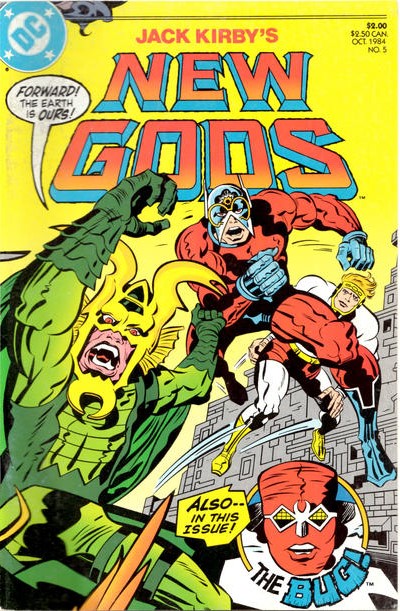
The 40 Years of Comics Project - Day 1158: New Gods #5, October 1984
An interesting element is added in today's issue in the bug civilization.
But my Mum and Dad arrived today, and I'm tired, so I'll fill you in on this tomorrow.
(A couple of days later...)
I'm fascinated by the idea that there is another sentient civilization living on New Genesis, though I suppose the same can be said of Apokolips and its Hunger Dogs. But that the "Eternals" of New Genesis see these creatures as vermin is a bit odd. Aren't the New Genesis gods supposed to be the magnanimous ones? But as far as I can tell, they're happy to exterminate the bugs, even though they appear to have a relatively advanced civilization. And then there's the problem of The Bug, or Forager as he's called in the issue. It turns out that he's not actually a bug, but a New God, but although this is revealed to him and to Orion and Lightray in this issue, no one tries to figure out how one of the young of New Genesis ended up being raised by the bugs.
The thing is, it's because that's not really that important to Kirby's story. I've been looking at this series as a very basic myth. Not too many bells and whistles, very direct, so the story of Forager's origin, assuming it is of no consequence to the larger tale, is unimportant. What is important is the role he plays in warning of the bug invasion of Earth. None of the characters do anything or are involved in anything that does not drive the plot forward. Perhaps it's a bit off-putting in that in contemporary media we're often exposed to an A-plot and a B-plot. Kirby has no B-plot in this series. Everything is A-plot. This is deployed in a very self-conscious manner. In fact, the final panel of today's issue seems to speak directly to the reader, as if the gods themselves, and not their writer, were telling us that they're here, on the pages of a comic book, but never too far away:
I think that Orion's statement there is as good an articulation of what I get from Kirby's cosmic superhero work (New Gods, Eternals, maybe even Thor) as anything. Note that even as Orion is talking about reflections, we are looking directly into his eyes, as if staring into a mirror.
More to come...
Apr 27, 2018
The 40 Years of Comics Project - Day 1157: New Gods #4, September 1984
When I think of Dan Turpin, all I can think of is the utter tragedy of his transformation in Final Crisis. It is a very intense sequence to read, seeing a personality recognize it's own demise as a foreign, and immensely powerful, entity takes control of the body.
So I have to admit, it was kind of nice seeing him stand up to Kalibak in today's issue. I still don't understand his dislike of the heroes, though the destruction that follows them around is kind of obnoxious. Do Damage Control do cross-dimensional work?
The first story in this issue is a flashback that reveals the origins of the war between New Genesis and Apokolips, and also the origins of both Mister Miracle and Orion. I hadn't realized this had been a secret. Having gained exposure to the New Gods through much later tales, I always just assumed that Orion's and Scott's lineages were common knowledge. There was something that bothered me in this otherwise excellent tale of the rise of Darkseid and the redemption of Highfather. In the beginning (words used purposefully, btw), Izaya's wife Avia is killed by Darkseid's uncle, Steppenwolf. That is literally her purpose in this story. 3 or 4 panels, and then dead, and it turns into Izaya's tragedy. I know we call this the "Women in Refrigerators" trope, but today's story was published about 20 years before that issue of Green Lantern. I'm coming to realize that Kirby's myth, at least this part of it, is pretty sexist. Though, perhaps we could also read it, given the cover, as an indictment of masculinity gone mad? I think this is one of those moments where I'm just too optimistic in my critical readings.
More to come...
Apr 26, 2018
The 40 Years of Comics Project - Day 1156: New Gods #3, August 1984
So. Good, mad, full-on New Gods vs. Apokolips action in today's issue! The giant pink whale monster that the Deep Six create is really pretty amazing, especially it's battering ram growing from beneath its jaw.
But there's also a weird little subplot about a man and his two children who are caught up in this conflict. The son is a conscientious objector, the father a conservative military man, and the daughter is...well, kind of whiny and useless, actually. I'm seeing this as a trend in New Gods. None of the female characters are really very necessary. This subplot plays out as one might expect, as the son eventually sacrifices his life to save father and sister, and the father sees that war really does have horrible consequences, and maybe his son wasn't so wrong after all. But the weirdest part is that in the end, literally the final panel of the comic, after the Deep Six have been defeated, as has the whale monster, and Orion and Lightray have left, the father is still there, tied to the mast of what used be his yacht. And he's left there, wondering about all that he believed and all he lost.
The End.
I was not expecting an ending like this, but as I think more on it, it fits with the mythic tenor of the series. The gods leave the man there because they know that on a symbolic, archetypic, level, it's the place that he's meant to be. It's almost like they're aware of the way in which they themselves, as icons in a comic book, must move and act in order to tell the kind of story they need to tell.
More to come...
Apr 25, 2018
The 40 Years of Comics Project - Day 1155: New Gods #2, July 1984
Well.
Notice how the character on the cover is dressed in red, blue, and yellow? He's dressed that way throughout the issue.
But his name is "Black Racer."
And, partway through the story, the Racer chooses another avatar to take on his role who is, surprise surprise, a Black man.
Kind of like Black Panther, or Black Lightning, or Black Goliath, I guess. At the time, I think this may have been seen as a progressive attitude, the presentation of diverse ethnicities in superhero comics, but the addition to the beginning of each name of "Black" simply serves to divide a community from the one that is ostensibly trying to curb such division.
There's also some problems with the idea that the only (thus far) character of colour in the series is one that literally everyone in the issue is afraid of - "Don't Let Him Touch You" the cover proclaims. Again, not really the message one wants to send about a Person of Colour, now or when it was originally published. This issue originally came out less than a decade after the signing of the Civil Rights Act, and racial tensions were worse then than they are now. Imagine instead of Ms. Marvel, she was called the Muslim Marvel.
How about we just refer to him as the Racer from now on?
More to come...
Apr 24, 2018
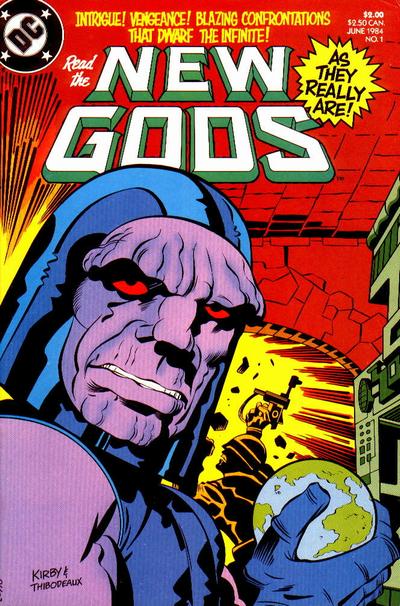
The 40 Years of Comics Project - Day 1154: New Gods #1, June 1984
I thought it was time I read this. I've always been intrigued by this story. Whenever I read it, all I can think about is just how far it could be taken, a warring society of gods played out as a war between archetypal patterns generated by the collective consciousness of...the Earth? The Universe? That is one thing I've never been too clear about - just whose gods are these anyway? Do different species see them in different forms, like when Martian Manhunter encounters Morpheus in the early Sandman issues?
I would really love to write stories using these characters.
Kirby's writing and art are Kirby's writing and art. I don't know what I could say about them that hasn't been said by hundreds, if not thousands, of more articulate scholars and fans than I. When we think about superhero universes operating more simply than our own, it is Kirby's that operate at almost the simplest level. His dialogue is stilted and choppy. But everything in this world is an event. His art cries this louder than anything else. And not just an "event," but an EVENT. In this kind of context, the staccato of the speech in the stories makes a certain kind of sense.
Now, while this is a cool way to tell a story, there are reasons that most of our stories that are mythically inflected add a dash of nuance to the bombast. I think this is why Kirby's stories are sometimes difficult to take. At the level of myth where the hero is superior to both environment and peers (or, indeed, has no peers), it's difficult to tell stories that are anything but kerygmatic. This kind of teaching text is not necessarily what one wants in a superhero comic, though it's really in all of them. So does that mean that Kirby is trying to teach us anything with this comic? I think, through most of his work, he actually is. He's offering perspectives on our relationship with the divine. If you think about it, the vast majority of his work looks to this, be it the incarnation of the divine in the superhero (Fantastic Four, elemental avatars, springs to mind) or straight up divinity itself, like today's comic.
That said, reading a comic in which everything is a SUPER-MYTHIC EVENT AEONS IN THE MAKING!!!! is exhausting. Hence nuance. If we can hold a less mythic story up in comparison, or in conflation, both are cast in new lights.
More to come...
Nov 1, 2016
The 40 Years of Comics Project - Day 615: Cosmic Odyssey #4, 1989
I'll admit, right off the bat, that by this point in reading this series, I'd started to lose interest. I really think it does come down to the promise of the covers versus the actual story within. We now have Dr. Fate brought into the mix, so there is some attempt, with both him and the Demon, to bridge the cosmic and the magical sides of the DCU, but I feel like it's too little too late. While magic, both fictionally and when treated in lived experience, does often function as a deus ex machina, it's a little too convenient here. Had there been some indication earlier in the series that there was something mystical about the Anti-Life entity, that would have been great. But there wasn't.
There's an interesting attitude on display here that stems from Arthur Clarke's assertion that any sufficiently advanced technology is indistinguishable from magic. Unfortunately, the way this assertion is most often interpreted is that all things that appear magical are simply technologies that we cannot understand. That's not what the assertion says, though. It says that these technologies are indistinguishable from magic, not that magic is an indistinguished technology, so to speak. But that's how the assertion is playing out in Cosmic Odyssey, that the magical and the technological are simply different aspects of one another, and the science fictional power of Darkseid is somehow pretty much the same thing as the magical power of Etrigan and Fate.
In the end, however, the major problem with this series is that it purports to be much larger than it is. I teach my students to pay attention to titles, and the title Cosmic Odyssey certainly promises some mythological-level adventure going on - I did not get this feeling from the comic itself. It was pretty much a run-of-the-mill superhero story. But, damn, does it have some beautiful covers!
Onward.
Oct 31, 2016
The 40 Years of Comics Project - Day 614: Cosmic Odyssey #3, 1989
Darkseid connects himself to the newly reunited Jason Blood/Etrigan, and journeys to the realm of the Anti-Life equation. It does smack of Kirby when you describe it in these little soundbites, though sadly it doesn't translate to the comic. Again, I'm not sure Starlin's brand of cosmic quite fits Kirby's. Kirby's Darkseid is basically a cosmic Lex Luthor, which works in the strange and simple world of the New Gods. They're new gods, right? So they embody, through particular traits that we layer over them ourselves, aspects of how we perceive the universe. In keeping with this, later depictions cast Darkseid as a cosmic force, something we can see the effects of, but can't necessarily understand or communicate with.
Unfortunately, Starlin has him, and Highfather, to be fair, cast as rulers of science fiction empires, without any of the characterization of either Kirby silliness or cosmic otherness. I think that the New Gods work best when they're written almost as superheroic versions of Lovecraft's Old Ones. They function on a level far above that of the mortal mind.
I'm also not 100% certain why Etrigan is even here. I mean, they explain it in the book, but I'm not sure why the character ends up being needed. Surely there are New Gods who could have supplied the same power as the Demon. What it seems to serve is bringing another Kirby character back into the spotlight, or just having a mini-series about Kirby creations. I don't think he was necessary, but, then again, look at that beautiful cover up there. Maybe that's reason enough.
Onward.
The 40 Years of Comics Project - Day 613: Cosmic Odyssey #2, 1988
No, that wasn't a hoax or a dream. The Anti-Life Equation is a sentient anti-matter creature.
So, anyway, its plan is to destroy a bunch of star systems in order that a gateway between its dimension and our own is formed, thus allowing it to take control of everything in the universe. The superheroes pair up and head off to stop the destruction of these planets.
What we have in this issue is a John Stewart Green Lantern that I don't think I've ever encountered, really. I don't remember him being quite this arrogant in Crisis on Infinite Earths, and he's certainly not this way in more recent fare. But here, he thinks he's such hot shit that he'll leave J'onn J'onzz behind and try to defuse an extra-dimensional super-god-bomb by himself. I don't imagine it's any surprise that he fails.
Well, actually, it kind of is. Superheroes don't fail in these kinds of situations. The planet full of innocent beings never blows up, especially not because the hero was too proud. You might think I'm being facetious here, but I'm not. It's a rare occurrence that results in the destruction of an entire civilization due to a superhero's negligence. That's what happens here.
The really infuriating part of this is that I was recently reading something featuring John Stewart, something outside of the Project, and they reference his failure at Xanshi. And the older, wiser John Stewart carries that burden, and it's what makes him the hero that he is currently (or, rather, last time I read/watched him).
So some bits are retconned, and some are not. Onward!
Oct 25, 2016
The 40 Years of Comics Project - Day 608: Cosmic Odyssey #1, 1988
I am in no way amongst a minority of people who, upon seeing Mike Mignola's name attached to a project, are immediately interested, no matter the subject matter.
Did I say that right?
I love Mike Mignola's art, is what I'm trying to say. I don't know where I found these comics, but I know they've been a part of the collection for some time now. I've started reading this particular issue a few times, but I've never finished it until now. There's a couple of reasons for this.
You'd think that if anyone could come to Jack Kirby's New Gods and make them incredibly cosmic and strange, it would be Jim Starlin. But I think Starlin's particular corner of the cosmic is inflected more by old school science fiction serials (think of Warlock, or Dreadstar) than is quite appropriate to the superhero genre. Superheroes need to stay just as firmly in the fantastic and the mundane as they do in the science fictional, but this series removes the superheroes from that milieu. When held up against the New Gods and all of the beings that inhabit the cosmos, Earth's superheroes just don't seem that special. And it's their specialness that we crave.
So that's one reason. The other is that I didn't really like the inking in the book. I know that Walt Simonson is attached to the New Gods, but I don't know if this is before or after his run with them - that said, the art looks very Simonson-y to me. Which is not a bad thing. Simonson's one of the originals of superhero art. But I was expecting Mike Mignola art, like that which we see on the cover. Such is not the case. Which is an interesting thing for me, because I'm not really very good at recognizing the amount of the look of a comic that inkers and colourists bring to a comic. Here, however, I have an excellent example.
Anyway, the last reason that I don't like this comic is that the Anti-Life Equation is revealed to be an extra-dimensional life form from the anti-matter universe that is trying to take over ours through the equation.
Um.
Yes, of course it was retconned. But some things in the series weren't, and we'll talk about that next time. Onward!
Jul 22, 2015
Artists to Check Out
Marhahering - gorgeous art style. Also, this particular picture reminds me strongly of a very good friend, and it's a lovely picture of her.
Natalie Hall - Ms. Hall has an amazing array of fox-headed women. There's something just remarkably liquid about her drawings. But my personal favourite is this picture of Titania and Bottom. What I wouldn't give to see her do an adaptation of A Midsummer Night's Dream.
What If Kirby - an amazing gallery of Jack Kirby originals. If I'm going to hype the new artists I find amazing, I should probably hype the forerunners as well. Kirby gets flack for his writing, and sometimes art, style, but he's an original. Few have managed to have the same impact on comics that he achieved.
Natalie Hall - Ms. Hall has an amazing array of fox-headed women. There's something just remarkably liquid about her drawings. But my personal favourite is this picture of Titania and Bottom. What I wouldn't give to see her do an adaptation of A Midsummer Night's Dream.
What If Kirby - an amazing gallery of Jack Kirby originals. If I'm going to hype the new artists I find amazing, I should probably hype the forerunners as well. Kirby gets flack for his writing, and sometimes art, style, but he's an original. Few have managed to have the same impact on comics that he achieved.
Subscribe to:
Posts (Atom)