Pages

Showing posts with label Nick Manabat. Show all posts

Nov 29, 2016

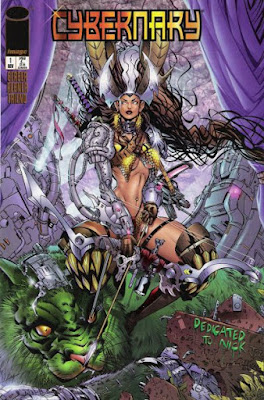
The 40 Years of Comics Project - Day 643: Cybernary #3, January 1996

http://www.comics.org/issue/259068/

Short one today, though the comic is starting to get kind of interesting. Anyway, I read this, but just don't have it in me to blog today. Very tired.

I'll make up for it with tomorrow's post.

Onward.

Nov 28, 2016

The 40 Years of Comics Project - Day 642: Cybernary #2, December 1995

http://www.comics.org/issue/259067/

A bit of a jump, but we find Cybernary prowling the streets of Gamorra City with her childlike robo-psychologist, looking for the young man for whom she sacrificed herself. And not much actually happens.

This is a pretty good set piece, but if you're looking for action, there's not much here. Cybernary pretty much shuts down every bad guy she comes across within a matter of moments - in fact, she's getting so good at it, one begins to wonder how there'll be anyone who does pose a challenge - unless it's that Minotaur guy who, apparently, in actually a centaur. Did not pick that up from Manabat's art in the original run. Maybe his art was, just occasionally, a bit dark and obscure....

That said, I'm afraid I'm just not buying Jeff Rebner's art on this series. It reminds me of John McCrea's work on Hitman, or Jim Baikie's work in Tomorrow Stories - the juxtaposition of this style with Manabat's original is jarring, and makes the mean streets of Gamorra look more like a cartoon and less like one of the circles of Hell. I think I preferred the original aesthetic.

Onward.

Nov 27, 2016

The 40 Years of Comics Project - Day 641: Cybernary #1, November 1995

http://www.comics.org/issue/259066/

A year and a bit after we last saw her, Katrina, the Cybernary, is back to tell us the rest of her story, aided and abetted by Gerber and artist Jeff Rebner. Rebner's art is remarkably different from Manabat's, falling more in line with the Wildstorm "house style," but he still manages to capture some of the grotesqueness of Manabat's vision of this strange underworld on Gamorra Island.

Today's issue was origin story, pure and simple. The exposition covering the previous installments of the story was handled very well (are we surprised?), and the twisted tale of Cybernary's creation is revealed. Her connection, through blood, to the Clan Gamorra, ruling clan of the nation and one of the main, non-alien bad guys of the Wildstorm universe, is a neat plot twist, and one that I never see coming (I'd forgotten about it when I read the comic this morning). It apparently gets taken up more fully in Cybernary's appearances following this series, but my recollection of the current series is that it's a bit of a revenge flick. Like Kill Bill, but with superheroes.

I've been slowly, but surely, working on a book about Steve Gerber's minor contributions to mainstream comics. He does just a few bits of work with Image. There's a brief run on Codename: Strykeforce, a WildC.A.T.S. special, these Cybernary works, one issue (and four pages) of Pitt, and a Savage Dragon/Destroyer Duck crossover. They're certainly not amongst his best works, but we can see him working through the grittier kinds of narratives that would eventually lead him to Nevada and Hard Time. But I think there's also some evidence of his dissatisfaction with the industry as a whole. We're not getting the intelligent commentary of Howard or Man-Thing, or even his brief Captain America stories here. This is surface Gerber, lots of flash, but only the hint, the gesturing, toward substance.

Onward.

Nov 25, 2016

The 40 Years of Comics Project - Day 639: Deathblow #4, April 1994

http://www.comics.org/issue/54879/

Okay, so it's jut the last issue that doesn't have a Cybernary cover, though the indicia does indicate Cybernary as still being a distinct entity from the Deathblow comic. One imagines that the lack of cover may have had something to do with Nick Manabat's hospitalization.

Deathblow is beginning to venture into more superheroic territory, which is both good and bad. In a shared universe, it's important to remember that the significant changes to reality (i.e., superpowers) are going to influence every facet of that reality, including Black Ops missions in Iraq. I'm not sure where Deathblow's story goes, and who the "Black Angel" is, but I'm sure it'll be bloody and violent.

A letter in the back of one of the previous issues asks when Cybernary is set, offering the assumption that it's some time in the future. This is another facet of that shared universe influence, as the story takes place in contemporary times. The Image universe embraces these influences in a way that similar situations in the Marvel or DC universes are not embraced, which Warren Ellis calls out with great facility in the pages of Planetary. The technology evinced on the island nation of Gamora is light years ahead of what technology actually was in 1995 (remember, that is basically a pre-Internet world), the result of alien incursions onto the planet.

Not sure where I was going with that. I'm having one of those weeks where I simply don't have enough spoons to do everything. I'll keep reading everyday, but my apologies if the posts are short, or a bit choppy.

Onward.

Nov 24, 2016

The 40 Years of Comics Project - Day 638: Deathblow #3, February 1994


 Okay, okay, I have no idea why anyone takes anything I say as the truth. I think what the case actually was was that the last issue of Deathblow is the only one without a Cybernary flip cover, and I got confused. That  happens more and more often these days. The official release data, coupled with the orientation of the stories, means that this comic is actually called Deathblow, even though it included just as much Cybernary. What happens is when there's no Cybernary cover on the fourth issue, my OCD takes over and tells me that I can't possible simple alphabetize the last issue under an assumed, rather than actual, cover.

Honestly, this is what the inside of my head is like all the time. But I'm trying to combat these things, so perhaps I'll be able to re-file these as Cybernary, not Deathblow. Perhaps.

Anyway, the stories continue in much the same fashion. We get some early Tim Sale work on the Deathblow side of things, which is cool. He's definitely got that Frank Miller-style thing going on, but Sale's work surpasses Miller a few years later. His work with Jeph Loeb on their meditations on the early days of superheroes are pretty much across the board wonderful, and his style, which is grim'n'gritty here becomes simple and whimsical, without sacrificing any of the drama he's capable of.

Manabat and Gerber begin to reveal a bit about Cybernary, who she is, where she comes from, and we start to get the idea that she's more than just a faulty "nympho-droid." Each issue of this series makes me more and more sad that Manabat never got a chance to really show the world what he was capable of. His art is so metal. Over at Comic Vine, a relative of Manabat's started posting some of his sketch work, so we have a bit more of this amazing artist's work. But still, too little.

Onward.

Nov 23, 2016

The 40 Years of Comics Project - Day 637: Deathblow #2, August 1993


Okay, I lied yesterday, though it was unintentional. Issue #2 has a flip cover as well. The back of this issue has a short missive from Jim Lee, detailing how Deathblow is set to become a quarterly comic, rather than a monthly (though the August cover date suggests thirdly, not quarterly), and in which he cites Frank Miller as an influence on the story. No surprise there. It gets me thinking about the differences between tribute, or inspiration, and direct copy, and Deathblow skirts the edges of these categories a bit dangerously. Having read the last couple of issues, I really would not have been surprised to find out this was actually produced by the horrendous Frank Miller (seriously, look him up - he's probably an Orange Man supporter). That's how closely this comic mimics the style of The Dark Knight Returns. To be inspired by an artistic style is one thing, but to simply offer pastiche does little to further the cultural conversation that art represents. Perhaps, later in the series, Lee brings his own brand of storytelling to the character, while retaining influence from Miller. But these early issues are direct mimicry.

Cybernary, on the other hand, continues to look like little else that I've seen in the Image universe, and in superhero comics more widely. There's something of Chris Bacchalo's early style to it, and it occurs to me now that Generation X  was being published around the same time as Deathblow/Cybernary. One letter complains about the overuse of black in the art on Manabat's story, but the whole thing, from those pervasive shadows to the blue-tinges on everyone's skin, gives a real feeling of a story happening at night, away from the bright lights of the superhero universe the characters inhabit, somewhere deep in the shadows, almost unnoticed. Which, considering the pomp and circumstance of Minotaur's arrival on the scene, is ironic.

A couple more issue of the flip book, and then we're on to Cybernary's series proper. I looked up Nick Manabat yesterday on the GCD, and he's got a scant 6 issues credited to him, two of which are pin-ups (in Backlash and the Wetworks Sourcebook). I'm curious if he did any other work before getting into Image comics, though that doesn't appear to be the case.

Onward.

Nov 22, 2016

The 40 Years of Comics Project - Day 636: Deathblow #1, April 1993


While it may look like I've read two comics today, that's not the case. As I mentioned a couple of times over the last few days, I've become a bit fascinated with the early Image universe, and its remarkable internal consistency, so I thought I'd read a bit more. And if that bit more includes Steve Gerber, so much the better. The first installment of the Gerber/Manabat Cybernary is presented as a back-up feature in the first issue of Jim Lee's Deathblow, and is even given a flip cover (which is how I always have it catalogued). Unfortunately the next three issues of Deathblow, even though fully half of the issue is devoted to the Cybernary story, don't have flip covers. A pity.

Deathblow finds Jim Lee and co-writer Brandon Choi at the Frank Millerian best - short, clipped caption boxes, chunky, almost etched-looking artwork, remarkably different from what I would have characterized as Lee's usual style. Though maybe it's a bit too much Miller, and that's why his later work bears only scant resemblance to this one. The story is pretty tame, considering the violence we see in flashback, but perhaps over the next few issues it'll pick up.

For Cybernary, Gerber is credited as scripter, rather than writer, though I think this changes over the next few issues. The beginning of the story is quite good. Manabat's art calls to mind the work of Kelley Jones, though inflected with the Image house style, which sounds weird but actually works. We get these first four issues of his work and then Manabat sadly lost a battle with Hodgkin's Lymphoma, leaving behind a small, but impressive body of work. Gerber went on a couple of years later to do a Cybernary mini-series, partially in tribute to Manabat, so the character as introduced does get to play out at least a brief story. Escaped sex-bot becomes resistance badass on the island nation of Gamorra. It sounds like typical power-fantasy fare. But it's not.

Onward.