Pages

Showing posts with label Marv Wolfman. Show all posts

Apr 24, 2020

The 40 Years of Comics Project Friday Magazine 33: Psycho #7, July 1972

For information on stopping the spread of COVID-19, and on what to do if you are quarantined, have a look at the World Health Organization site.

https://www.comics.org/issue/25294/

There's this weird thing that a lot of the 70s horror magazines did where they told stories in the second person. That means that each caption box used the term "you" for the focal character, as if the reader were meant to be stepping into the shoes of the character in the story. I'm sure at the time it was a cool way of writing stories, and it hearkens back somewhat to the EC horror comics of the 50s, as I've noted before about some of these B&W horror magazines. But it gets a bit tired when virtually every story in this issue is doing it. Further, there's actually a story that not only uses the second person voice in its captions, but also presents all of the action from a first person point of view. It sort of works, but it sort of doesn't, though I kind of wonder if this has something to do with readers being slightly more critically savvy, and slightly more aware of ironic distance, in contemporary times. Or maybe it's just me.

There's some amazing Pablo Marcos art in this issue. He's an artist I'm coming to appreciate more and more, and I think I'll have to start going through the old horror mags I've got to see a bit more of his work. It reminds me of the old historical comics in style, just with lots more nudity and violence.

More to follow.

Sep 16, 2019

The 40 Years of Comics Project - Day 1665: Night Force #9, April 1983


I see Night Force comics in numerous dollar bins, and I've never really given them much thought. Just another obscure DC title from the early 80s that didn't make much of a splash.

Well, I will not be passing them over any more. This was a creepy and very strange comic, and I'm dying with curiosity to see what happens to the people trapped by the weird creature on the cover. The Night Force themselves don't really show up in this comic, either. The protagonist is a murderer who has been pressed into service by the mysterious Baron Winter to do battle against the creature. There's some really murky morality on display here, and the comic's not shy about addressing that fact.

It's Gene Colan on art, so you know it's going to be good. Apparently this series was the first time that Marv Wolfman and Colan collaborated again since Marvel's Tomb of Dracula, which, given the quality of this comic, I may actually have to see about reading. I'm sure I've got a couple of issues, at least.

Worth your time if you find this in a cheap box.

"Only now she's gone. I don't know if the creature got her or not."

Jun 8, 2019

The 40 Years of Comics Project - Day 1565: The New Teen Titans #15, January 1982


That strange pool that the Titans are in ends up devolving them - Starfire starts looking like a cat. I wonder if it's ever canonically addressed that Tamaranians are feline-descended? I really don't know a lot about the Teen Titans, especially this new version. I know that they were really big just as I was getting into comics, but I ended up going the Marvel route in the early days of my collecting. I never really found my way into DC until I started reading Animal Man, and that was much later on. It's kind of cool to be experiencing them now. George Perez's art is a revelation. His layouts are amazing, as is his attention to detail. I've no idea how he managed to do this on a monthly basis.

Rouge and Zahl get their comeuppance, and we get a nice wander into the sunset moment of the Doom Patrol survivors at the end of the issue that probably would have worked as a nice coda to the Doom Patrol series proper. In much the same way that characters come back from the dead, superheroes very often get "endings" that just turn out to be latest adventure in an unending serial. That's probably why Rita Farr has been such an interesting character as it took decades for her to return to life. There was an actual ending to her story for a while that seemed pretty solid. I'm not sure I'm articulating this properly. Every creative team wants to put a proper ending on their run, so we get moments peppered throughout a superheroic narrative that could serve as terminal moments for the narrative. But what happens to the emotional impact of such a moment when we know that there will be another comic the following month? I can understand writing an ending if a series has been cancelled or is finishing - but if you're writing an ongoing serial, an ending is just going to feel clunky.

Damn. That thought did not translate onto the screen as well as I'd hoped. I'll have to think on it a bit more.

"Quit makin' like some philosopher while they sneak right up on ya!"

Jun 7, 2019

The 40 Years of Comics Project - Day 1564: The New Teen Titans #14, December 1981


Mento really is the worst. Today's portrayal of him even tries to be kind to the character, but he's still the worst. And the new costume is just not right.

Anyway, as the cover notes, the quest for the Doom Patrol's killers continues apace. At this point we know where they are, but not necessarily how to get them. What is required is another blast from the past, and one with a vested interest in Madame Rouge: the Brotherhood of Evil. I did a little research a few weeks back because I was curious as to what the treatment of the Brain and M. Mallah had been post-Morrison Doom Patrol. The two end up declaring their love for one another just before they blow up. But, as is the way in superhero universes, both characters return to life and start getting up to their old tricks again. I'm curious as to how their relationship was portrayed in this second life. I've yet to find the answer.

Madame Rouge is a pretty tragic figure, though at this point it almost feels like she's chosen to give in to evil, that she could have decided a different path. The character shows up again, most prominently in the New 52 My Greatest Adventure - but we'll get there eventually. Our current tale of vengeance concludes tomorrow.

"Eat your heart out, John Dykstra --"

Jun 6, 2019

The 40 Years of Comics Project - Day 1563: The New Teen Titans #13, November 1981


I just had a quick look back to see if I'd mentioned the idea that the Doom Patrol function somewhat hauntologically for a short while in the Seventies and Eighties. I posted about this a few years ago with regard to Barry Allen's presence in Mark Waid's masterful The Flash (which, I promise, I will get back to reading through soon - I promise!). In the same way that Barry Allen's spectre haunts Wally West's time as the Flash, so does the Doom Patrol haunt Changeling, specifically in his early days breaking away from the identity of Beast Boy, and its attachment to a traumatic past.

At this point in the Patrol's history, the originals, sans Cliff, are still dead. As I wrote yesterday, Cliff has gone back to his original body for some reason, and there's been no mention whatsoever of the other members of the New Doom Patrol. I get the sense that Wolfman and Perez recognized those characters as problematic for the Doom Patrol and chose to ignore their presence. Cliff Steele (who in some ways haunts the Doom Patrol itself) is tasked with finding Gar's lost adopted father, Steve Dayton (the version of whom that appeared in the TV series was by far the most sympathetic one. Dayton sucks). After little communication from Cliff, part of the team track him to Uganda, and discover the above! Cliff, while close to Gar, also reminds him physically, as opposed to solely in his memory, of the presence of his adopted mother, Rita Farr.

That's as far as I got with that thought. I'll likely come back to this, as the Patrol functions in this way until their re-debut in the Secret Origins annual.

The other neat thing about this comic is that the cover looks like it depicts a climactic moment, something you might not want to give away on the cover, but it's actually not. This happens fairly early in the comic. It's a nice touch, and shows a deft understanding of the workings of the medium. Little surprise, coming from the pair it does.

"It's a good thing I'm dead -- otherwise I'd barf!"

Jun 5, 2019

The 40 Years of Comics Project - Day 1562: The New Teen Titans #10, August 1981


An interesting side-effect of the Doom Patrol television series is that I'm paying a lot more attention to Cyborg these days. He's a character I know, or knew, virtually nothing about, but he's made a pretty good addition to my beloved Patrol. What stands out for me about him in this issue is his friendship with Gar Logan. It's really nicely realized, and a testament to Marv Wolfman's grasp of characterization.

There isn't too much Doom Patrol in this issue. Gar has asked Cliff to track down his adoptive father, Steve "Mento" Dayton, and recounts to Cyborg, briefly, his history with the Patrol. Cliff appears briefly on a video screen, having tracked Dayton to Brazil, and is in his original body again. He thanks Gar for putting him back in the original, though no reason for his dislike of the old body is forthcoming.

For a long while in the 80s the Doom Patrol served mostly as back story for Changeling. The decision to not have him involved in the DP television series is strange, especially given the team's appearance in the Titans series. While they're supposed to be different versions of the team in different universes, the replacement of Gar with Vic is an odd choice. I'd be curious to understand why it was made. According to Jeremy Carver, he was told he had to use Cyborg along with the traditional team members. But why?

Not that I really mind, as Jovian Wade's performance this season was fantastic, and he meshed with the team nicely. We'll see a bit more of Cyborg over the next few days as the hunt for Dayton, and for the killers of the Doom Patrol, heats up in New Teen Titans.

"For fourteen people they didn't even know...the Patrol, and my mom--died...just like that."

Oct 4, 2018

The 40 Years of Comics Project - Day 1317: Action Comics #1000, June 2018

https://www.comics.org/issue/1800610/

I've fallen a bit behind on my current comics, so I though that in order to catch up on the new Brian Bendis Superman stories, I'd read them for the project. We'll start here, with Action Comics #1000, and see where he takes us.

What more can I say about Superman, though? There is actually something I have to try to work out. It's my understanding that Frank Miller is going to be writing a Superman series in the near future. I can't wrap my head around the idea of a right-wing nut job like Miller breathing life into Superman. Miller's politics seem antithetical to everything I believe about the Man of Steel. But that's the thing, isn't it? Superman's not real - he's a fictional character that can come to be representative of anything. This means he can come to be representative of things that I might not agree with. Not that I think you can push the character too far, unless you want a repeat of the original run of Supreme. There is always something of the socialist in Superman, right from the beginning. But if Superman is indeed for everyone, then he has to be for right- and left-leaning readers. Perhaps Miller's take will satisfy that other demographic.

As far as Mr. Bendis' work on the Big Blue, it's hard to say, thus far. He provides us with a nice little in media res prologue, and drops the bomb that Krypton's destruction may not have been what it seemed. Intriguing, but it's the handling of the characters that I'm more excited to see from Mr. Bendis. His gift for dialogue is virtually unparalleled in contemporary comics.

So, more Superman to come...


Oct 2, 2018

The 40 Years of Comics Project - Day 1315: Mirror Walker #1, October 1990

https://www.comics.org/issue/1761529/

A really weird little comic - more than any other comic I've read, I got the suspicion that this one didn't really know what it wanted to be. Which, given it's format, is understandable.

The banner at the top of the cover proclaims "The first photo/animated comic!" - a claim the truth of which I'm not sure. What it means by the banner is that all of the backgrounds for the comic are photographs, and the characters are drawn over top of those pictures. The effect appears very much more like animation than traditional comics.

The story seems like it might be interesting, but this issue felt like it had a bit too much set up. The use of mirrors as a way of travelling between dimensions places the tale in an illustrious lineage, with such works as Through the Looking Glass, or the Flash villain Mirror Master, making excellent use of the trope. Using such a story, in conjunction with the photographic backgrounds, suggests that the story could be asking questions about representation, reflection, and how we differentiate those two when it comes to our cultures. Well, maybe.

The series never got beyond this issue, though it was only supposed to be a 2 issue series to begin with. Sadly, this leaves our focal character, Alan, stranded on a desert island with a woman who seems to both want him and want to kill him. Hopefully she's erring on the side of the former.

More to come...

Jun 17, 2017

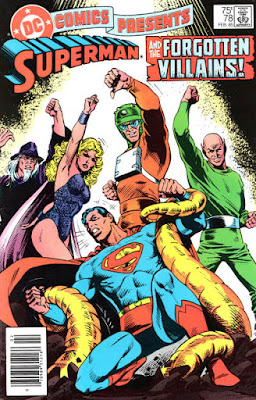
The 40 Years of Comics Project - Day 843: DC Comics Presents #78, February 1985

https://www.comics.org/issue/1680325/

(A busy day today, so I'll get to blogging this tomorrow. But the coolest thing is that it's literally a direct prologue to Crisis on Infinite Earths. The last page basically starts off the Crisis series.)

So, as I say up there, this is quite literally the opening pages of Crisis. The story itself is a bit mediocre, though if we consider it in terms of what starts in the final pages, it's actually a bit of a tribute to characters that writer Marv Wolfman probably knows for sure are not going to survive the reboot of the DCU. The trouble is that I don't think the story takes advantage of the premise it sets up nearly enough. Basically we have three wizards, one in the past, one in the present, and one in the future (and the future one is a magic-using planet called Yggardis) to gain control of the universe (can anyone tell me what that would even look like - how do you control something infinite?). The time travel angle is not exploited to its utmost, and the fact that these three magicians are manipulating reality but not causing any paradoxes for one another is really interesting. It says something about the nature of time as a whole, as a 4th dimensional solid that exists all at once, but that can't be perceived in that way by humans.

This said, Mr. Wolfman was probably preoccupied by the twists and turns of the Crisis series he was navigating, and perhaps could not pay closer attention to the cool spacetime playground he established in this story.

The end of the issue, however, is a half-page dialogue between the Monitor and Lyla (soon to be Harbinger), a conversation that leads directing into the opening pages of Crisis and the destruction of Earth-3. I wonder if these little bits and pieces were reprinted in the Crisis collections that have come out. Probably not, though this one seems to be to be quite important.

To be continued.

Jun 16, 2017

The 40 Years of Comics Project - Day 842: DC Comics Presents #77, January 1985

https://www.comics.org/issue/1437668/

The Forgotten Heroes return, having held a press conference to announce their presence as a superhero team to the world. Sadly it seems the name they choose becomes a self-fulfilling prophecy, as this adventure, spanning this comic and the next, is the team's last appearance. There's a brief Crisis cameo by a few members, and then that's it.

It seems to me that the reason this kind of team fails ultimately, and why the characters themselves are not particularly memorable, is because they're very limited. Rick Flag is a typical Army special forces character. Cave Carson explores...well...caves (though I haven't read his current series, which sounds very weird). Dane Dorrance, the Sea Devil is even more water-bound than Aquaman, and lacks the powers. Congo Bill is kind of geographically limited. And Immortal Man can be killed. Remember Mr. I from the Great Lakes Avengers? This is an attempt at a serious take on him. Or Mr. I is a parodic take on Immortal Man. Anyway, the only two characters that have enough breadth of conception to carry a story are Dolphin and Animal Man. I'm pretty sure Dolphin becomes part of Aquaman's supporting cast, and we all know what happens with Animal Man. This breadth of conception is key for a superhero. Yes, Spider-Man has a limited set of powers based on his origin, but it doesn't limit the kinds of adventures he can get into. With a team like the Sea Devils, though, the audience is going to expect a particular kind of adventure, and then tire of it very quickly, I would think.

Once a character has this potential, it's simply a matter of exhausting all of the easy stories (i.e., stories to do with animals, or animal-based characters for Animal Man), and then take the character out of their comfort zone and start doing interesting things with them. The Animal Man series vacillates on this front, but for the most part steers away from telling easy stories.

Today's comic is good, and an interesting preceding piece for Morrison's final story in Animal Man, wherein he reunites Animal Man with some actually forgotten heroes in the realm of Limbo. This comic also features one of the many times Superman is transformed by a villain, this time becoming a fire-breathing dragon that is ultimately defeated by everyone's favourite orange-clad character with animal powers.

We'll finish up this story tomorrow, and then see where things go. To be continued.

Jun 15, 2017

The 40 Years of Comics Project - Day 841: Action Comics #554, April 1984

https://www.comics.org/issue/38503/

Isn't it strange that we can forget things that seem like they would have made an impression upon us? I remember this comic and the basic premise, but going back to it today, I find that it speaks to so many of the ways I've been trying to conceive of the superhero for so many years now.

This brings up some interesting ideas. The golden pyramids that we encountered with Superman and the Forgotten Heroes over the last couple of days turn out to be structures placed by an alien race that, once activated, erase the violent impulse from a species' development. As such, humanity has no myth, no tales of heroism or of overcoming obstacles. It's not the most factually solid of foundations as far as the development of the species goes, but we should recall that the tale is talking to us about the power of imagination, of myth, of the hypotheticals that we envision in our stories. In the wake of this removal of heroic myth from humanity's development, the planet is rife for conquering by the race that left the pyramids in the first place.

Except for two young boys, Jerry and Joe, who conceive of a "super man" who would be able to stand up to the invaders. And they manage to believe Superman back into existence. The salient point here is that, despite the fact that Superman defeats the alien armada, it is the power of belief in this figure, the faith that the two boys have in a character they created themselves, that provides the tool with which to remove the shackles of slavery within which humanity finds itself. Honestly, that's my dissertation right there. Marv Wolfman and Gil Kane said it in words and pictures when I'd just turned ten years old.

Which brings up another idea - the intersection of fan/professional scholarship and thought with that of academic scholarship and thought. I was on a panel a couple of weeks ago for the local Panel One comics festival, and we spoke at length about comics scholarship and the links to the greater comics community. Comics are one of those kinds of fandom that have, since the beginning, encouraged the kind of high-level thinking we often only associate with post-secondary education. The difference between someone who is a FanAc (Fan Academic) and a scholarly academic is that scholarly academics have a particular, and precise, set of tools, concepts, and words to talk about specific aspects of the medium that FanAcs might lack. But the breadth of knowledge of the medium, and how it works, are not solely the purview of the scholar. In many cases, in fact, the FanAc, free of the restrictions of the academy, will have much more broad knowledge and ideas of comics. It's important to recognize this kind of knowledge, and to work with it. Which is what I try to do.

We'll get back to Animal Man tomorrow, but this comic is a great favourite of mine, and I'm glad I took the time to read it and finish off the story of the golden pyramids. Belief in a thing can make it real. That doesn't mean it's not still a fiction. It's simply that it's become a fiction that has measurable effect in "the real world."

Whatever that might be.

To be continued.

Jun 14, 2017

The 40 Years of Comics Project - Day 840: Action Comics #553, March 1984

https://www.comics.org/issue/38388/

This has been a very strange adventure (pun intended), in that there's very little action. A lot of this story has been people talking to one another about action, or about the problem facing the team and Superman, but the actual steps taken to stop the problem happen in literally 2-3 pages of this second issue.

And not much is really revealed or solved, aside from Superman no longer spreading prehistoric seeds across Metropolis.

In terms of Animal Man's development, we're beginning to see the limitations of his power set - in order to be useful, he's really only good if he's around animals that might have useful powers. Though "usefulness" is an aspect of the powers that is fully explored in his series, it's not really delved into here. Buddy is sent back to Brazil, where he by some random chance has seen a jaguar (and anyone who's walked around forests full of wild animals knows just how often you happen upon one by chance), and so can use those powers to defeat the government officials guarding the mysterious temple. The expansions his powers undergo in his eponymous series, from sensing animals around him to tapping into the morphogenetic field exponentially raise the level of his powers, making him into a remarkably powerful character in the end. And perhaps it's this overcoming of the limitations of his powers that finally allows Animal Man the shot at having his own series. Indeed, much of the early part of Morrison's run is about Animal Man discovering the true extent of his powers.

But we'll get there eventually. The end of today's story leaves the audience with the possibility of Superman not having survived his encounter at the beginning of time. We might take a quick detour into the next issue of Action Comics, just to see what happens, and then we'll pick up with Animal Man again in DC Comics Presents.

To be continued.

Jun 13, 2017

The 40 Years of Comics Project - Day 839: Action Comics #552, February 1984

https://www.comics.org/issue/38267/

Four years pass between Animal Man's appearance in Wonder Woman and his next one in Action Comics. This is very much a set-up piece, gathering together a group that, briefly, come to be known as the Forgotten Heroes, who have all had adventures that have led them to a strange temple, the knowledge of which brings them into conflict with the American government. Concurrently, Vandal Savage unleashed a plan against Superman that, one can only imagine, is connected to the temple and the Forgotten Heroes' adventures.

Animal Man expresses some surprise here that someone else knows his secret identity. It's the first time I've seen reference to the secret identity issue from Animal Man, as his identity is, as far as I know, a public one through most of his self-titled series. His characterization is also a bit odd...his dialogue sounds to me like Hawkeye's from his early 60s Avengers appearances. Using words like "figger" and such. What I come to realize though is that I read every single Animal Man appearance through the lens of his own series, even those that come before that series happens. It's an odd phenomenon, and one that can really only occur in serialized fictions like these, though with the caveat that they are serialized fictions whose creative teams change regularly. Until someone defines a character like Animal Man, his personality is going to be in flux across his appearances. And then once he's been established, prior appearances might not gel with what is now canonical. Where things get interesting is with a group like the Doom Patrol, who I also read from a particular perspective, yet whose personalities were long ago established in their first series. In such a case, perhaps we can see the shifts in character as growth and development of those characters, rather than being a personality in flux.

The Forgotten Heroes do manage to get a few adventures in, even making a brief appearance in Crisis on Infinite Earths, but it's a scant four years until Animal Man gets his own series, and the DCU gets its first taste of the madness of Grant Morrison. Once this happens, Animal Man is no longer forgotten, and this motley crew of adventurers falls by the wayside.

Will the Forgotten Heroes and Superman actually meet up next issue? It seems likely, but you never know.

To be continued.


Oct 20, 2016

The 40 Years of Comics Project - Day 603: The Tomb of Dracula #34, July 1975

http://www.comics.org/issue/28802/

Of all the 70s Marvel horror titles, The Tomb of Dracula is the most lauded, boasting a great creative team in Wolfman, Colan, and Palmer, and a great pedigree in Stoker's undead protagonist. I think it's because Wolfman understands that the book Dracula isn't about the creature himself, but about the people around him, who are sucked into his orbit, and about how his evil impacts those people. Dracula appears only briefly in this issue, the rest of it devoted to the lives of those who have come within his sphere of influence. Some react by joining him, or thinking they can exploit him, and some react by trying, in vain, to stop him. Though a character himself (which is evident in the brief moments we get with him), it is as a catalyst for change, for declaration of one's good or evil intent, that the character functions as, at least in this comic. Or, it seems that way anyway, given that I'm coming in part way through a story, and leaving before it ends.

One of these days, I should actually read the novel, I guess.

Onward.

Oct 7, 2016

The 40 Years of Comics Project - Day 590: Marvel Spotlight #5, March 1980

http://www.comics.org/issue/34217/

I find it amusing that this comic came out just around the same time as Edward Said's Orientalism. I think he'd find this comic troubling.

But I don't really feel like going into that today. This comic was kind of bad. I mean, yes, Marv Wolfman wrote it seemingly mere moments before he and George Perez became the darlings of the industry with New Teen Titans, and Steve Ditko illustrated it, though it seems to lack the manic energy of Shade, the Changing Man, which is coeval with this comic.

There's even a glaring editorial error that makes the whole comic make no sense. The whole set-up hinges on an ancestor of the contemporary Tako Shamara having died trying to defeat a Gozilla stand-in (no joke - apparently the rights lapsed the year before, so the monster just sort of looks like Godzilla) - but in the very panel in which the monster is defeated, we have a caption box reading "He roars, flails, he sees the insect [Taka Shamara] ride off whooping in victory..." The next we hear, apparently Tako has fallen trying to defeat the dragon. It makes no sense whatsoever, and really is a remarkable error, given that it undermines the entire story that takes place, and, narratively, the 500-year long oath sworn by the sons and ancestors (because of course it's the sons, right?) of Shamara.

And then, in the current storyline, the 70s Tako Shamara actually summons the dragon from a remote mountain wilderness into his suburban neighbourhood in order to battle it.

Just a bad story all around, really. Ah well. They can't all be winners.

Onward!

Mar 1, 2016

The 40 Years of Comics Project - Day 371: Secret Origins #46, December 1989


I don't know why I was convinced that the Morrison story in this issue was the Legion one, not the JLA one.

Yesterday I said we'd be looking at an indie comic short, but the issue of A1 that I was planning on reading was quite long, and I ran out of time, so we're looking at this one instead.

Technically, this is one of the earliest Grant Morrison Justice League stories, though his issue of Animal Man that featured the JLE might have come slightly earlier. I honestly have no idea whether or not the elements laid down in this story are ever picked up again - the basic premise is that the mountain that housed the original Justice League's headquarters is sentient, and contains a record of its entire history that is activated by sound. Morrison's iteration of the Doom Patrol briefly takes up residence here, but there is certainly no sentient mountaineering in that series, even though it would have fit the Doom Patrol's aesthetic very well.

The other stories of headquarters in this issue are quite good. We are given a look into Cyborg's memories of his father, who built Titans Tower. I'm not overly familiar with the Wolfman-era New Teen Titans, and whether or not Cyborg ever articulates the feelings he has when entering the tower the way he does in this story. It's a nice touch, and inflects Cyborg's character quite nicely. The Legion story in this issue is excellent, telling the tragic tale of Fortress Lad, who turns into a fortress to protect those around him - sadly, after transforming to protect the Legion, he has his memory erased, and simply becomes the Legion headquarters. Again, I'm not sure that this ever comes up again, but it certainly adds an interesting element to all of those old Legion stories and that big yellow building.

That's all for today. I'm very tired, and feel like everything I'm writing is awkward. We'll finish of Morrison Week tomorrow with A1 #3. Onward!