I gave a talk at the Memorial Library in Calgary this weekend as part of the kick-off celebrations for Pride this year. I love doing this event. When else is a comic-geek like me given 2 FULL HOURS to talk to a captive audience about comics?
It's a really great chance to meet other readers and collectors, people dipping their toes back into comics after years absent, creators, and the merely curious. I like to think we have a good time and get a chance to talk about comics from a perspective that's interesting to all of us.
I promised a list to this year's audience of titles that I mentioned in the presentation, and some others, that I think are interesting parts of the history of queerness in comics. I welcome any suggestions, for sure. This is a history that is fascinating to uncover.
The earliest stuff I mentioned was Marston's original Wonder Woman stuff. There's lots of reprint volumes, depending on how high quality a reproduction you're looking for. Very cool, and much more readable than I find many Golden Age comics.
A recent discovery, for me at least, is David Anthony Kraft's Defenders #48-50 arc featuring Scorpio - I recently read an interview with Kraft where he says he was trying to subtly suggest that Scorpio was gay. To be honest, from a contemporary perspective, it's not that subtle.
Must mention Northstar in Alpha Flight, of course.
The next section dealt with Vertigo. I'll just list the titles. It's hard to go wrong with early Vertigo in general, though be warned that it's often dark and quite violent.
Sandman Mystery Theatre (specifically #13-16, "The Vamp") - Seagle, Wagner, Davis
Enigma #1-8 - Milligan and Fegredo
2020 Visions (specifically #4-6, "La Tormenta") - Delano and Pleece
Doom Patrol (specifically #64-88) - Rachel Pollack and others
I didn't mention quite a lot of Vertigo titles. There's The Sandman, The Invisibles, Lucifer, lots of really great stuff.
21st Century starts to get copious.
Kevin Keller #1, I still think, is one of the most important queer comics. Blonde-haired, blue-eyed, all-American Kevin Keller is gay, out, and headlining his own comic in Riverdale for goodness' sake! I've always thought Archie Comics were a pretty great publisher. They're not afraid to change and shift with the times. That's the secret of their success.
Greg Rucka and J.H. Williams' Batwoman in Detective Comics is a beautiful piece of art, a challenging and tense narrative, and a queer woman headlining one of the most revered superhero comics titles in the history of the medium. You can't go wrong, honestly. Can't wait to see the television series this Fall.
Other stuff: The Infinite Loop from IDW publishing, Small Favors by Colleen Coover.
I'd recommend anything from the Young Animal imprint at DC. Though I haven't read Bug yet, the first wave of titles is highly recommended, with Doom Patrol and Shade, the Changing Girl being particular favourites for me. Eternity Girl is amazing too. I just pick this stuff up on principle now. I've never been disappointed.
And I think that's it. I'll see if I can upload the presentation for those who might be interested. And I'll be back to updating in the next couple of days. Gotta recover from the vacation ;D
Showing posts with label Batwoman. Show all posts
Showing posts with label Batwoman. Show all posts
Aug 25, 2019

Jun 28, 2018
The 40 Years of Comics Project - Day 1219: Detective Comics #863, May 2010

Batwoman's final issue of Detective (too soon, too soon) packs a nice little punch. I have, of course, read all of these comics before, when they came out, but I noticed so much more in this story arc ("Cutter") than the last time. All three issues are this wonderful study in parallels. One that stood out to me for especial notice this month was one panel in which we see an interaction between Batman and Commissioner Gordon, and then immediately next to it is a panel depicting an interaction between Batwoman and Maggie Sawyer. From two straight while males to two gay white women is a pretty great change to see, and certainly one that Rucka and Jock are very clear about pointing out. I will say that having re-read this series, I'm even more curious about Rucka's much-lauded Wonder Woman.
We do leave a bit of a cliffhanger here for the other feature in Detective, the one that I haven't talked much about: The Question. But I think I'll leave that story for now, until I've managed to track the rest of it (if it exists) down.
More to come...
Jun 27, 2018
The 40 Years of Comics Project - Day 1218: Detective Comics #862, April 2010

One of the reasons I decided to include the blog part of this project, rather than simply reading a comic every day, was that if I thought people were potentially reading, I'd feel more compelled to do this every day. And, for the most part, it's worked. I don't really know how many read this, but I enjoy, for the most part, airing whatever little idea has crossed my mind while reading a particular comic. So when I miss a few days, I feel very guilty. The trouble is I've been experiencing some bad joint pain for some time now, and typing is one of the worst things for it. So please don't think that my missing a few days in a row is a sign of my boredom with the project. It's more about the pain.
Now on to the comic.
I don't think I like Jock's art work in this run. I know Williams had left to go and work on the Batwoman series, but the shift in art styles is quite jarring. Jock reminds me of a more mainstream Ted McKeever (whose work I'm rediscovering, and who we'll see some of in July), which is super-different from Williams' style(s). That said, this is a choppy story, both narratively, and technically. The jumps from Bruce to Kate, the cutting nature of both villains, perhaps the choppy art is fitting. Tomorrow's our last issue for this run, so we'll see.
More to come...
Jun 26, 2018
The 40 Years of Comics Project - Day 1217: Detective Comics #861, March 2010
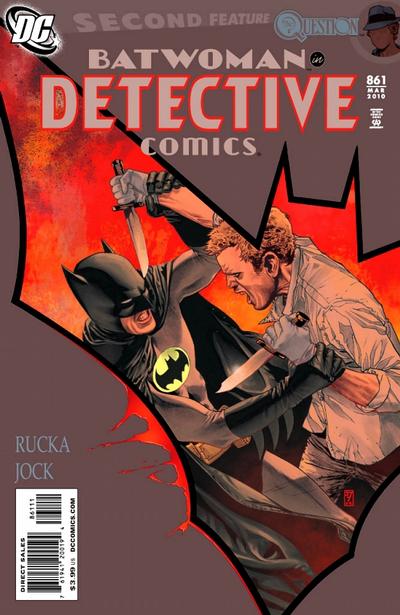
An unfortunate thing happens shortly after this issue in Batwoman's history: the New 52. For those not in the know, this was a line-wide reboot of DC Comics. After #863, Batwoman departs the title, ostensibly for her own series, but only a zero issue is published before everything is rebooted. And, for some reason, I never followed the reboot. Honestly, the New 52 left a sour taste in my mouth about DC that I've only recently got past with the Young Animal titles.
So we get a sort of team up between the Bats, though they don't really interact much in today's issue. They're pursuing different cases, as far as I can tell, but you know with these sorts of things, everything will likely come together.
Then again, maybe it won't. Mr. Rucka is a pretty smart writer, so perhaps the ending I'm expecting won't be the one I get.
Here's hoping. More to come...
Jun 25, 2018
The 40 Years of Comics Project - Day 1216: Detective Comics #860, February 2010

Today marks the last issue of Detective illustrated by J.H. Williams III. I want to say something about his art, because it demonstrates so perfectly the way that comics communicates with its audience. Williams' art style is constantly shifting throughout the series. Whenever a character is in costumed regalia (thus far on Batwoman and Batman), they take on a much more realistic mode than the characters do when they're in their civvies (trying to embrace the Army-speak of Kate and her Dad). It's almost as if, in embodying a mythic principle, the costumed characters become more real than the reality they inhabit. Which is, of course, exactly what happens with superhero comics.
No more J.H. Williams, but more to come...
Jun 24, 2018
The 40 Years of Comics Project - Day 1215: Detective Comics #859, January 2010

When we last saw Kate, she'd just found out that her twin sister might not have died in the terrorist attack that claimed her mother's life.
I guess you really do have to have some bizarre tragedy in your past to dress up and do what these Gothamites do.
Today's issue deals quite explicitly with Kate's queerness. As I noted in my earlier reviews, Kate's affectional preference is gestured toward but never made the focal aspect through which we experience Kate's life. That's what Batwoman is. But today's issue chronicles young Cadet Kane's parting with the U.S. Military, ironically upholding the values for which the Marines ostensibly stand, but being discharged for her sexuality anyway. Remember, this is set in 2003(ish), so DADT was still a thing.
We also get "the moment." The Bat-moment. Kate fends off an attack in Gotham, and is leant some assistance from a scowling man in a cowl. And as he leaps off into the moonlight, the myth takes root in another person.
More to come...
Jun 7, 2018
The 40 Years of Comics Project - Day 1198: Detective Comics #858, December 2009
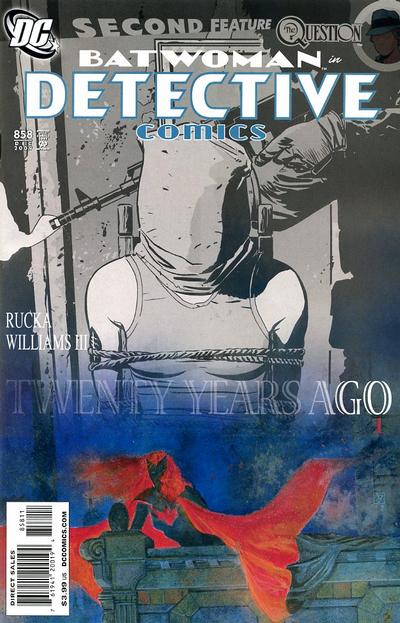
A good bit of background on Kate in today's issue. A friend of mine wrote his Master's thesis on representations of trauma in female superheroes, and he looked specifically at Batwoman as a way of thinking through reactions to trauma. Everyone in Gotham is traumatized. That should be clear to even the most casual of Bat-fans. To throw yourself at the kinds of monsters that prowl those streets, you have to be damaged in some way. Though said throwing is also a way of addressing said damage.
There hasn't been much on Kate's life outside of the Bat in the last few issues. We do have an interesting moment in flashback where Kate worries that her twin sister (!) is telling a boy that Kate likes him. She stresses that she doesn't even. It's not blatant, but it puts me in mind of when those sorts of thoughts start to cross one's mind. I've read many reports where gay people have said they'd known from a very early age. I don't know how early early is, but I probably started having inklings around 11 or 12. I could just never quite understand why anyone would limit themselves based on gender. Weren't we always told it's what's on the inside that counts?
We'll take a break from Detective Comics for a bit, though we will return to Ms. Kane's adventures later in the month. Tomorrow we'll have a look at some other badass gay icons.
More to come...
(Edit: I was thinking that I didn't really address the idea of trauma in this comic very well, and it's such an important piece of the puzzle that is Kate Kane. It's definitely not my strong suit from a theoretical perspective, so take any of this with a grain of salt! We'll see her striving for an ordered existence in the military, one that focusses her hurt until that existence clashes with her sense of what is right. And then she sees a symbol - Batman. She takes up that symbol to channel the pain of what she went through into something just. What's important about Kate's story is that it doesn't come out of the Batman story, in the way that Robin or Batgirl (Barbara Gordon) do, nor is it a story that serves to solely push forward Batman's story. It is a story that comes to the Batman story, a character with enough similarity of purpose to Batman's mission that she too comes to emblematize what it is that Batman does. In Kate's story we get a perspective on the difference between law and justice from a vantage that the Bat-titles, in my limited knowledge of them, rarely do: that of the military. There's a clash coming between Kate and her father that will touch on this, and I think we'll have a bit more to think about when we return to the title, as the final pages of this issue feature Batwoman testing some of Alice's DNA for...well. That would be telling.)
Jun 6, 2018
The 40 Years of Comics Project - Day 1197: Detective Comics #857, November 2009

Apologies, but nothing really leaps out at me about today's comic. Which is a bit ironic, given that a large portion of the comic is given over to Batwoman leaping out of one plane and onto another. It's a pretty sweet action sequence, and showcases Williams III's ability to do the widescreen superheroics of something like The Authority, but with an incredible painterly eye. The cover is interesting, showing more of Alice than of Kate, but the comic itself reflects that, in that much of this issue focusses on the antagonist.
One more look at Batwoman tomorrow, a peek into her past. More to come...
Jun 5, 2018
The 40 Years of Comics Project - Day 1196: Detective Comics #856, October 2009

There are two ways I'd like to think about queerness in this comic.
First, there are three lycanthropes in this issue. These characters were servitors of the previous leader of the Crime Religion, but were disillusioned when Batwoman defied their prophecy. They now hold her in some regard, and turn out to be allies in the battle against Alice. But I think their presence in a comic that is helmed by two lesbians is a little more symbolic. In story, they are form-shifting members of an underground society - a description one might easily ascribe to some kinds of queerness. And even more basically, the idea of shifting form, of being fluid between identities, is intrinsic to the idea of queerness.
Second, Batwoman and the Question used to go out. I can't believe this hadn't occurred to me before. It's revealed that, before either of them became the superheroes they are, Kate Kane and Renee Montoya dated. We enter their joint story after the fact. They're civil, but I think there's still some hurt feelings. So what's really interesting is that theirs are the two stories we're getting in this comic. I haven't said much about the Question's story. It's a gritty tale of human trafficking, and though a really good story, it pales in comparison to J.H. Williams's art. Is there something to this pairing? I feel like there's something to the fact that we're able to follow both women's stories, rather than experiencing their continuing narratives through only one focal character. And there is acknowledgment of the shared history in each others' tales. In yesterday's issue, one of the hallucinations Kate suffers is the Question coming to her rescue. Again, it's something I'd have to think longer on. Have we ever seen this kind of a story told with a heterosexual superhero pairing? Did Green Arrow and Black Canary every have a period of separation like this? And what is the idea of a shared focalization doing to our reading of a story of a broken-up couple?
(Even reading that back to myself, I'm not sure how much sense it made! But, as I noted in my intro to this month, queering is about breaking down binaries - in life and in theory!).
More to come...
Jun 4, 2018
The 40 Years of Comics Project - Day 1195: Detective Comics #855, September 2009

I'd forgotten how relatively long a history Batwoman had by the time she took over Detective. Introduced in the collborative series 52, she played guest roles in both 52 Aftermath: Crime Bible (an amazing series starring the other queer lady in this comic, the Question), and in Final Crisis. But Detective is her first starring role, and it really is glorious.
We get a full introduction to Alice, the new leader of the Religion of Crime, who seems to be styling herself on a mix of Alice from Wonderland and the Joker. I was at first a little put off by this - why do we have to give Batwoman her own version of the Joker? Why not give her her own iconic villains. But then I realized that this is what a comic set in Gotham does. It pits traumatized people against homicidal maniacs and hopes for a positive outcome. So of course Kate Kane has to have her version of the iconic Gotham villain, who is the Joker.
We get a brief glimpse of Kate's background in this issue, but only through the lens of Alice's hallucinogenic poison, so the images don't make too much sense. Terrorists and a kidnapping? (I know that answer of course, but I'm trying to build the suspense for you!). Along with this revelation, there's some really nice interplay between Kate and her father, the Colonel. Much like Bruce Wayne has Alfred (another of the icons of Gothamic existence, the reliable aide), Kate has her father, an army (I think) colonel. He stays on comms with her, gets her intel, and co-ordinates operations. And he's a bit of a badass himself. But in the midst of combat, he still has a moment to call Kate "baby," and tries to calm her. I'm trying to think it we've seen another version of this relationship in superhero comics, the parent that backs up the superhero's mission. I'll have to give this some thought.
The queerest thing about this issue was its absence, if you see what I mean. One of the conversations we have about representation is that queer characters have had, in the past, the propensity to become representatives, rather than representations. In that, a character comes to stand for the entire queer community, and the narratives woven around these characters tend to focus solely on their queerness, and the queer world within which they exist. Something like this is not an option in a long-form superhero narrative. You can't just tell one kind of story. So where we had an explicit acknowledgement of Kate's queerness in the previous chapter, this one says nothing of it. The character's queerness is simply not a factor in this part of the story.
More to come...
Jun 3, 2018
The 40 Years of Comics Project - Day 1194: Detective Comics #854, August 2009
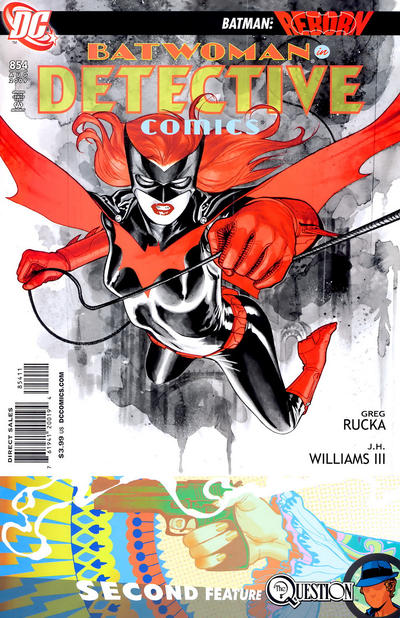
This is one of those comics that I could just sit and gush about. Everything about the Kate Kane Batwoman is fantastic, from her narrative construction to her incredible depiction by J.H. Williams III.
Who, by the way, is on my very short list of artists that I actively will collect.
Kate makes her way into the DCU by way of 52 and 52 Aftermath: The Crime Bible - her story in 52 is shepherded by Greg Rucka, who also tells her tale here. But here's why she's really, really important: she's an openly lesbian woman headlining one of the oldest superhero institutions in the world. Next to Action Comics, Detective's about as far back as superheroes go. So putting a queer woman in this title, without the euphemisms or typical tropes, is huge.
Speaking of the typical tropes, Batwoman manages to avoid them. She's not the poster child for lesbians. In fact, the first instance of her non-heteronormative sexuality that we see is her being dumped by a woman for not taking the relationship seriously enough. This is a woman who has trouble keeping all her identities on track, be they superhero or girlfriend. It's one of the things I appreciate most about Kate, her difficulty in balancing her lives. There's an excellent article by George Gustines that was in the New York Times called "Out of the Closet and Up, Up and Away," about gay superhero parties at the Stonewall Inn. One of the interviewees talks about how the superhero really makes a great metaphor for closeted queer people. Kate isn't closeted, but Batwoman is definitely her most certain self, the one that knows what she's doing and how to do it. Sometimes it's not so much the masks we take off that reveal our true selves, but the ones we put on (ask any drag artist). This seems to be the case with Kate, and really with most of our superheroic myths. As the old saw goes, it's really only Superman that takes off his mask to reveal his true selves. Everyone else puts one on.
I'll stop there for today. We're going to be spending a few days with Detective, so I'll gush about Batwoman some more tomorrow.
More to come...
Apr 10, 2010
In the Shadow of the Bat: Batman, Batwoman, and the De-gendering of the Superhero
An essay I wrote for a class in "Theories of Gender and Sexuality." With thanks to Dr. Nadine Attewell for introducing me to the thought of Judith Butler.
To claim that there is a prejudice towards superhero comic books is perhaps to state the obvious. In the foreword to Beloved, Toni Morrison says “I don't know what comic book that notion came from” (xvi) of her thought that a “grown-up” writer made a living only by writing. The implication is that notions from comic books are simplistic or naive. Superhero comic books are doubly denigrated, not only as simplistic because of the format, but also because, for a long time, they have been written off as “just adolescent power fantasies” (McCloud 11). Surely, though, to ignore the content of a whole genre solely because of historical and cultural perceptions is to do a grave injustice to the writers, artists, and characters, that have inhabited that genre since its inception. Judith Butler says that “to conform to an historical idea of 'woman' [is] to induce the body to become a [specific kind of] cultural sign” (“Performative Acts...” 272). The term “comic book” could easily be substituted in that claim. Conforming to a historical idea of the comic book is to induce an entire body of work to become a particular kind of cultural sign, a simple one, literally and figuratively. As evidence of the genre's depth, the recent reintroduction of the character of Batwoman stands out as an instance in which the superhero comic is espousing something far more than simplistic notions and power fantasies. By comparing this new character with the venerable Batman upon whom she is modeled, a nuanced and progressive reading of gender can be seen. Consideration of this comparison through Butler's theories of performativity, and their historical antecedents in Western philosophy, demonstrate that what is going on in Batwoman's tales in Detective Comics is far from simple. Batwoman's imitation of qualities supposedly intrinsic to Batman do not show an appropriation of male qualities by a female, but serve to de-gender qualities once linked to maleness.
A very brief history of the two characters will serve well to provide a contextual basis for the comparison. Batman's history is relatively well-known. In short, Batman is “secretly Bruce Wayne, a millionaire socialite and philanthropist who, while still a young boy, vowed to dedicate his life to 'warring on all criminals' after seeing his parents murdered by a hoodlum” (Fleisher 30). While over the decades since his original appearance in 1939 there have been many revisions and addenda to this origin, the seed of it has remained the same: a young boy vows to stop crime in memory of his slain parents. Batwoman's origin is slightly more complicated. Kathy Kane first appeared in 1956, a female crime-fighter who periodically assisted Batman. She reflected the social mores of her time with her “'shoulder-bag utility-case'” (140), and, as might well be imagined, did not last long into the more forward-looking Sixties and Seventies. The last appearance of this incarnation of the character came some time in 1965 (146). Jumping ahead to the twenty-first century, an event within the fictional DC comics universe compels Batman to take a year's leave of absence from his role. Into this void step many heroes, including a new version of Batwoman, the cowled Kate Kane. As comic universes undergo periodic revisions, in the current continuity there was never a Kathy Kane, so the current Batwoman is also the first Batwoman. Such things are commonplace in fictional superhero universes. Kate Kane's origin bears some scrutiny. A child of military parents, Kate witnesses the execution of her mother and sister by terrorists while still very young. By way of compensation, a revenge/justice motif similar to Bruce Wayne's tale, Kate enters the United States Military Academy at West Point with the hopes of becoming a marine. Once ejected from that institution due to infringements on the draconian “Don't ask, don't tell” rules, Kate, with her father's help and money, straps on a black bodysuit and cowl and debuts as Batwoman. Even here, in the stories of these characters' beginnings, similarities present themselves, similarities that will help to question the gendering of qualities present in the Batman.
To facilitate a comparison of the two characters , the intrinsic qualities of Batman must be delineated. While theories of performativity maintain that there are no intrinsic qualities of gender, only performances, a character must have a particular set of qualities in order to be identified as that character. This holds especially true for characters in comic books, who are passed from writer to writer and artist to artist over the years. Batman's qualities fall within “[t]raditional definitions of masculinity...attributes such as independence, pride, resiliency, self-control, and physical strength” (Thompson 4). Examples in the literature of such qualities can be found in Morrison and Kubert's Batman #655. Page ten of the comic gives us a day in the life of Bruce Wayne/Batman, including weight training (and a super-buff bod!) to demonstrate his physical strength, independence and pride demonstrated through his dining alone and employment of a manservant, and resiliency in his ability to perform complex repair procedures on his own equipment (Morrison 10). Further, “[i]t is considered manly to take extreme physical risks and voluntarily engage in combative, hostile activities” (Thompson 7), a state of affairs that, really, sums up Batman's entire seventy year history. This brief overview places Batman squarely in the realm of the masculine. His reputation as a lone crime-fighter, using his wits and his strength to defeat evil marks him as a supposed paragon of maleness. But what happens to this paragon when it is held up against the rookie hero Batwoman?
Having been witness to a familial murder and thrown out of the Marines, Kate Kane turns to vigilantism. As with the revision of history, this is an all too common occurrence in super hero comics. What is pertinent about Kate's choice is the mirror of Bruce Wayne's choice that it reveals. Detective Comics #860, part of a 3-issue origin sequence, features the early training of Batwoman, in which she is seen to be displaying “qualities like courage, physical strength, and independence, which are traditionally associated with masculinity” (). She trains to become a martial artist, gymnast, and scientist, along with various other disciplines that will assist her in crime-fighting (Rucka 10-11). She is shown to be learning these abilities on her own, showcasing the independence with which she approaches her calling. In comparison, Batman is said to be “a superb athlete...a world-renowned acrobat and gymnast...'a deadly fighting machine'...[and] 'an ace criminologist'” (Fleisher 52-53). Each of these abilities or areas of knowledge are explicitly replicated in the origin of Batwoman. But to what end? Why create a new superhero as a carbon copy of an old one, one whose popularity has never waned and who has been a consistent best seller for over seventy years? An answer can be found in the application of performativity theory to these remarkably similar heroes.
Performativity draws on historical discourses in theater and philosophy. Any consideration of performance needs to acknowledge the roots from which performance is derived. The theater of ancient Greece is especially useful in configuring contemporary performativity theory with the Batman/Batwoman problem. Because of the size of Greek theaters, “actors wore large stylized masks representing basic character types” (Klaus, Gilbert, and Field, Jr. 12), and amongst these character types were roles of different genders. In Batman and Batwoman, performance of character and gender coalesce, and “the concrete and historically mediated acts” (Butler “Performative Acts...” 273, emphasis in original) through which Bruce Wayne's and Kate Kane's genders are constituted are replaced by the cowl that, if the stories of the two heroes are read at face value, represent basic qualities of the traditional male. Another discourse tied in to performativity is that of the purpose of not only theater, but of performance in general. Hegel's The Philosophy of Fine Art addresses this question, as have many others before and since. One of the contentions that Hegel argues against is Plato's view that all art is “an imitat[ion]...thrice removed...from the truth” (Plato 15), and therefore that is has “no true or healthy aim” (18). If Plato's view of imitation was adhered to, the performance of traditional male roles by Batwoman would be, as Hegel puts it, a “superfluous task” (Hegel 503, emphasis in original). As was asked above, why create a copy of something when the original is still viable? His answer to Plato's theory of art is that art “contains an end bound up with it” (501,emphasis in original), that rather than simply being a copy of something already in existence, art serves a purpose all its own. That purpose is one which Hegel goes on at length discussing, but for our purposes, the idea that art, and by association with drama, performance, is not simply imitation, but contains its own end, is the salient one. Drawing these two considerations together, the picture of Batwoman goes from mirror of “traditional male” Batman, to wearer of a costume that represents a basic character type, but has a purpose of its own bound up in it.
What are we to make of Kate Kane's assumption of the mantle of the Bat? Is the costume of the superhero, specifically the Batman, a gendered one? Does wearing the costume necessarily mean wearing the gender it ostensibly represents? While Batwoman's costume, through the lens of Hegel and Greek tragedy, can now be seen as an assumption of a character with a purpose bound up in that assumption, the purpose itself is somewhat unclear. At this point, the equation of Batman with “traditional male” qualities needs to be questioned. Indeed, the very notion of “traditional male” qualities itself needs to be questioned. Butler states that “if gender is instituted through acts which are internally discontinuous, then the appearance of substance is precisely that, a constructed identity, a performative accomplishment” (“Performative Acts...” 270). This statement bears close scrutiny. To begin, gender is “acts which are internally discontinuous.” Setting aside for the moment the superhero, this means that there is no inherent biological or psychological origin for acts, or behaviours, that are considered stereotypically of the male or female gender. A “body becomes its gender through a series of acts” (“Performative Acts...” 273), not through any inherent quality of its own. This is to draw the distinction between sex and gender, of course. Sex, or primary sexual characteristics, is something all living creatures are born with. One facet of gender, then, seems to be the ways in which we relate socially to other beings with both similar and different primary sexual characteristics. The particular performances of “male” that I choose to enact inform the ways in which I relate to others of both the same sex and other sexes. This performance is further complicated by the ways in which others choose to relate to same and different sexes: their genders. However, the fact remains that according to theories of performativity, gender is not inherent. It is “a constructed identity,” a series of “historical [and cultural] situation[s] rather than a natural fact” (“Performative Acts...” 271). If this can be true for gender, that it is not inherent, then it can also be true for the superhero. The act of donning a costume, to return to the example of Batman and Batwoman, does not carry with it any inherent fact of gender. The gender roles that are ascribed to Batman, the “traditional male” qualities that he is seen to embody, are simply acts that over time have come to be identified with maleness. Where Butler talks of drag, we might substitute costumed superheroism, in that it “is not the putting on of a [costume] that belongs properly to some other group, i.e....that 'masculine' belongs to 'male'” (“Imitation...” 371). Indeed, Kate Kane's assumption of these qualities through the desire to become a superhero, whether intentional on the author's part or not, seems to be denying that the qualities are male at all, but are simply attributes that any individual can achieve, regardless of sexual characteristics or gender identification. Butler argues a seemingly Platonic viewpoint when she affirms that, with reference to gay culture imitating heterosexuality, “it is always and only an imitation of an imitation, a copy of a copy, for which there is no original” (“Imitation...” 379). Her point, though, is not to say that the imitation has no purpose, as Plato does, but to recognize that there is no reason to ascribe primacy to any act, regardless of temporality. That someone with male sexual characteristics performed an act first by no means makes it a male act. The claiming of such acts as male or female serves particular power discourses within society. Kate Kane's choice to become Batwoman denies those discourses, ungendering the male qualities of the superhero and turning them into human qualities.
The creation (or re-creation) in recent years of Batwoman, and her starring role in the seminal Detective Comics, shows a de-gendering of qualities that were once thought traditionally male. When the character is viewed through the lens of the Hegelian philosophy of fine art, that her “imitation” has purpose, her performance of particular attributes supports Judith Butler's assertion that no act is inherently male or female. By portraying characteristics that have, for seventy years, been associated with the hero Batman, the writers of the Batwoman stories have wrestled such qualities as “independence, pride, resiliency, self-control, and physical strength” from the domain of the male. What they have not done, however, is tried to demonstrate that they are female qualities, but instead that they are qualities with no intrinsic gender relation. This constitutes a reclamation from the historical and cultural discourses of power of the ascribing of particular qualities to particular genders, and an acknowledgment of the meaninglessness of gender in defining the qualities an individual can achieve.
Works Cited
Butler, Judith. “Imitation and Gender Insubordination.” Women, Knowledge, and Reality. Ed. A. Garry and M. Pearsall. Routledge, 1996. 371-87. Print.
---. "Performative Acts and Gender Constitution: An Essay in Phenomenology and Feminist Theory." Performing Feminisms: Feminist Critical Theory and Theatre. Ed. Sue-Ellen Case. Baltimore: Johns Hopkins University Press, 1988. 270-82. Print.
Fleisher, Michael L. The Original Encyclopedia of Comic Book Heroes volume 1: Featuring Batman. New York: DC Comics, 2007. Print.
Klaus, Carl H., Miriam Gilbert, and Bradford S. Field, Jr. “Classical Greek Theater.” Stages of Drama: Classical to Contemporary Masterpieces of the Theater. New York: St. Martin's Press, 1991. 9-12. Print.
Hegel, G.W.F. “The Philosophy of Fine Art.” Aesthetics: A Reader. Ed. D. Goldblatt and L. Brown. Prentice Hall, 1997. 501-6. Print.
McCloud, Scott. Reinventing Comics. New York: Paradox Press-DC Comics, 2000. Print.
Morrison, Grant, writer. “Batman & Son Part 1: Building a Better Batmobile.” Batman #655. Art by Andy Kubert. Colours by Dave Stewart. Letters by Nick J. Napolitano. New York: DC Comics, 2006. Print.
Morrison, Toni. Beloved. New York: Random House, 2004. Print.
Plato. “The Republic.” Contextualizing Aesthetics. Ed. H.G. Blocker and J.M. Jeffers. Cengage Learning Nelson Education, 1999. 11-21. Print.
Rucka, Greg, writer. “Go 3.” Detective Comics #860. Art by J.H. Williams III. Colours by Dave Stewart. Letters by Todd Klein. New York: DC Comics, 2010. Print.
Thompson, Cooper. “We Should Reject Traditional Masculinity.” To Be A Man: In Search of the Deep Masculine. Ed. Keith Thompson. Los Angeles: Jeremy P. Tarcher, 1991. 4-10. Print.
To claim that there is a prejudice towards superhero comic books is perhaps to state the obvious. In the foreword to Beloved, Toni Morrison says “I don't know what comic book that notion came from” (xvi) of her thought that a “grown-up” writer made a living only by writing. The implication is that notions from comic books are simplistic or naive. Superhero comic books are doubly denigrated, not only as simplistic because of the format, but also because, for a long time, they have been written off as “just adolescent power fantasies” (McCloud 11). Surely, though, to ignore the content of a whole genre solely because of historical and cultural perceptions is to do a grave injustice to the writers, artists, and characters, that have inhabited that genre since its inception. Judith Butler says that “to conform to an historical idea of 'woman' [is] to induce the body to become a [specific kind of] cultural sign” (“Performative Acts...” 272). The term “comic book” could easily be substituted in that claim. Conforming to a historical idea of the comic book is to induce an entire body of work to become a particular kind of cultural sign, a simple one, literally and figuratively. As evidence of the genre's depth, the recent reintroduction of the character of Batwoman stands out as an instance in which the superhero comic is espousing something far more than simplistic notions and power fantasies. By comparing this new character with the venerable Batman upon whom she is modeled, a nuanced and progressive reading of gender can be seen. Consideration of this comparison through Butler's theories of performativity, and their historical antecedents in Western philosophy, demonstrate that what is going on in Batwoman's tales in Detective Comics is far from simple. Batwoman's imitation of qualities supposedly intrinsic to Batman do not show an appropriation of male qualities by a female, but serve to de-gender qualities once linked to maleness.
A very brief history of the two characters will serve well to provide a contextual basis for the comparison. Batman's history is relatively well-known. In short, Batman is “secretly Bruce Wayne, a millionaire socialite and philanthropist who, while still a young boy, vowed to dedicate his life to 'warring on all criminals' after seeing his parents murdered by a hoodlum” (Fleisher 30). While over the decades since his original appearance in 1939 there have been many revisions and addenda to this origin, the seed of it has remained the same: a young boy vows to stop crime in memory of his slain parents. Batwoman's origin is slightly more complicated. Kathy Kane first appeared in 1956, a female crime-fighter who periodically assisted Batman. She reflected the social mores of her time with her “'shoulder-bag utility-case'” (140), and, as might well be imagined, did not last long into the more forward-looking Sixties and Seventies. The last appearance of this incarnation of the character came some time in 1965 (146). Jumping ahead to the twenty-first century, an event within the fictional DC comics universe compels Batman to take a year's leave of absence from his role. Into this void step many heroes, including a new version of Batwoman, the cowled Kate Kane. As comic universes undergo periodic revisions, in the current continuity there was never a Kathy Kane, so the current Batwoman is also the first Batwoman. Such things are commonplace in fictional superhero universes. Kate Kane's origin bears some scrutiny. A child of military parents, Kate witnesses the execution of her mother and sister by terrorists while still very young. By way of compensation, a revenge/justice motif similar to Bruce Wayne's tale, Kate enters the United States Military Academy at West Point with the hopes of becoming a marine. Once ejected from that institution due to infringements on the draconian “Don't ask, don't tell” rules, Kate, with her father's help and money, straps on a black bodysuit and cowl and debuts as Batwoman. Even here, in the stories of these characters' beginnings, similarities present themselves, similarities that will help to question the gendering of qualities present in the Batman.
To facilitate a comparison of the two characters , the intrinsic qualities of Batman must be delineated. While theories of performativity maintain that there are no intrinsic qualities of gender, only performances, a character must have a particular set of qualities in order to be identified as that character. This holds especially true for characters in comic books, who are passed from writer to writer and artist to artist over the years. Batman's qualities fall within “[t]raditional definitions of masculinity...attributes such as independence, pride, resiliency, self-control, and physical strength” (Thompson 4). Examples in the literature of such qualities can be found in Morrison and Kubert's Batman #655. Page ten of the comic gives us a day in the life of Bruce Wayne/Batman, including weight training (and a super-buff bod!) to demonstrate his physical strength, independence and pride demonstrated through his dining alone and employment of a manservant, and resiliency in his ability to perform complex repair procedures on his own equipment (Morrison 10). Further, “[i]t is considered manly to take extreme physical risks and voluntarily engage in combative, hostile activities” (Thompson 7), a state of affairs that, really, sums up Batman's entire seventy year history. This brief overview places Batman squarely in the realm of the masculine. His reputation as a lone crime-fighter, using his wits and his strength to defeat evil marks him as a supposed paragon of maleness. But what happens to this paragon when it is held up against the rookie hero Batwoman?
Having been witness to a familial murder and thrown out of the Marines, Kate Kane turns to vigilantism. As with the revision of history, this is an all too common occurrence in super hero comics. What is pertinent about Kate's choice is the mirror of Bruce Wayne's choice that it reveals. Detective Comics #860, part of a 3-issue origin sequence, features the early training of Batwoman, in which she is seen to be displaying “qualities like courage, physical strength, and independence, which are traditionally associated with masculinity” (). She trains to become a martial artist, gymnast, and scientist, along with various other disciplines that will assist her in crime-fighting (Rucka 10-11). She is shown to be learning these abilities on her own, showcasing the independence with which she approaches her calling. In comparison, Batman is said to be “a superb athlete...a world-renowned acrobat and gymnast...'a deadly fighting machine'...[and] 'an ace criminologist'” (Fleisher 52-53). Each of these abilities or areas of knowledge are explicitly replicated in the origin of Batwoman. But to what end? Why create a new superhero as a carbon copy of an old one, one whose popularity has never waned and who has been a consistent best seller for over seventy years? An answer can be found in the application of performativity theory to these remarkably similar heroes.
Performativity draws on historical discourses in theater and philosophy. Any consideration of performance needs to acknowledge the roots from which performance is derived. The theater of ancient Greece is especially useful in configuring contemporary performativity theory with the Batman/Batwoman problem. Because of the size of Greek theaters, “actors wore large stylized masks representing basic character types” (Klaus, Gilbert, and Field, Jr. 12), and amongst these character types were roles of different genders. In Batman and Batwoman, performance of character and gender coalesce, and “the concrete and historically mediated acts” (Butler “Performative Acts...” 273, emphasis in original) through which Bruce Wayne's and Kate Kane's genders are constituted are replaced by the cowl that, if the stories of the two heroes are read at face value, represent basic qualities of the traditional male. Another discourse tied in to performativity is that of the purpose of not only theater, but of performance in general. Hegel's The Philosophy of Fine Art addresses this question, as have many others before and since. One of the contentions that Hegel argues against is Plato's view that all art is “an imitat[ion]...thrice removed...from the truth” (Plato 15), and therefore that is has “no true or healthy aim” (18). If Plato's view of imitation was adhered to, the performance of traditional male roles by Batwoman would be, as Hegel puts it, a “superfluous task” (Hegel 503, emphasis in original). As was asked above, why create a copy of something when the original is still viable? His answer to Plato's theory of art is that art “contains an end bound up with it” (501,emphasis in original), that rather than simply being a copy of something already in existence, art serves a purpose all its own. That purpose is one which Hegel goes on at length discussing, but for our purposes, the idea that art, and by association with drama, performance, is not simply imitation, but contains its own end, is the salient one. Drawing these two considerations together, the picture of Batwoman goes from mirror of “traditional male” Batman, to wearer of a costume that represents a basic character type, but has a purpose of its own bound up in it.
What are we to make of Kate Kane's assumption of the mantle of the Bat? Is the costume of the superhero, specifically the Batman, a gendered one? Does wearing the costume necessarily mean wearing the gender it ostensibly represents? While Batwoman's costume, through the lens of Hegel and Greek tragedy, can now be seen as an assumption of a character with a purpose bound up in that assumption, the purpose itself is somewhat unclear. At this point, the equation of Batman with “traditional male” qualities needs to be questioned. Indeed, the very notion of “traditional male” qualities itself needs to be questioned. Butler states that “if gender is instituted through acts which are internally discontinuous, then the appearance of substance is precisely that, a constructed identity, a performative accomplishment” (“Performative Acts...” 270). This statement bears close scrutiny. To begin, gender is “acts which are internally discontinuous.” Setting aside for the moment the superhero, this means that there is no inherent biological or psychological origin for acts, or behaviours, that are considered stereotypically of the male or female gender. A “body becomes its gender through a series of acts” (“Performative Acts...” 273), not through any inherent quality of its own. This is to draw the distinction between sex and gender, of course. Sex, or primary sexual characteristics, is something all living creatures are born with. One facet of gender, then, seems to be the ways in which we relate socially to other beings with both similar and different primary sexual characteristics. The particular performances of “male” that I choose to enact inform the ways in which I relate to others of both the same sex and other sexes. This performance is further complicated by the ways in which others choose to relate to same and different sexes: their genders. However, the fact remains that according to theories of performativity, gender is not inherent. It is “a constructed identity,” a series of “historical [and cultural] situation[s] rather than a natural fact” (“Performative Acts...” 271). If this can be true for gender, that it is not inherent, then it can also be true for the superhero. The act of donning a costume, to return to the example of Batman and Batwoman, does not carry with it any inherent fact of gender. The gender roles that are ascribed to Batman, the “traditional male” qualities that he is seen to embody, are simply acts that over time have come to be identified with maleness. Where Butler talks of drag, we might substitute costumed superheroism, in that it “is not the putting on of a [costume] that belongs properly to some other group, i.e....that 'masculine' belongs to 'male'” (“Imitation...” 371). Indeed, Kate Kane's assumption of these qualities through the desire to become a superhero, whether intentional on the author's part or not, seems to be denying that the qualities are male at all, but are simply attributes that any individual can achieve, regardless of sexual characteristics or gender identification. Butler argues a seemingly Platonic viewpoint when she affirms that, with reference to gay culture imitating heterosexuality, “it is always and only an imitation of an imitation, a copy of a copy, for which there is no original” (“Imitation...” 379). Her point, though, is not to say that the imitation has no purpose, as Plato does, but to recognize that there is no reason to ascribe primacy to any act, regardless of temporality. That someone with male sexual characteristics performed an act first by no means makes it a male act. The claiming of such acts as male or female serves particular power discourses within society. Kate Kane's choice to become Batwoman denies those discourses, ungendering the male qualities of the superhero and turning them into human qualities.
The creation (or re-creation) in recent years of Batwoman, and her starring role in the seminal Detective Comics, shows a de-gendering of qualities that were once thought traditionally male. When the character is viewed through the lens of the Hegelian philosophy of fine art, that her “imitation” has purpose, her performance of particular attributes supports Judith Butler's assertion that no act is inherently male or female. By portraying characteristics that have, for seventy years, been associated with the hero Batman, the writers of the Batwoman stories have wrestled such qualities as “independence, pride, resiliency, self-control, and physical strength” from the domain of the male. What they have not done, however, is tried to demonstrate that they are female qualities, but instead that they are qualities with no intrinsic gender relation. This constitutes a reclamation from the historical and cultural discourses of power of the ascribing of particular qualities to particular genders, and an acknowledgment of the meaninglessness of gender in defining the qualities an individual can achieve.
Works Cited
Butler, Judith. “Imitation and Gender Insubordination.” Women, Knowledge, and Reality. Ed. A. Garry and M. Pearsall. Routledge, 1996. 371-87. Print.
---. "Performative Acts and Gender Constitution: An Essay in Phenomenology and Feminist Theory." Performing Feminisms: Feminist Critical Theory and Theatre. Ed. Sue-Ellen Case. Baltimore: Johns Hopkins University Press, 1988. 270-82. Print.
Fleisher, Michael L. The Original Encyclopedia of Comic Book Heroes volume 1: Featuring Batman. New York: DC Comics, 2007. Print.
Klaus, Carl H., Miriam Gilbert, and Bradford S. Field, Jr. “Classical Greek Theater.” Stages of Drama: Classical to Contemporary Masterpieces of the Theater. New York: St. Martin's Press, 1991. 9-12. Print.
Hegel, G.W.F. “The Philosophy of Fine Art.” Aesthetics: A Reader. Ed. D. Goldblatt and L. Brown. Prentice Hall, 1997. 501-6. Print.
McCloud, Scott. Reinventing Comics. New York: Paradox Press-DC Comics, 2000. Print.
Morrison, Grant, writer. “Batman & Son Part 1: Building a Better Batmobile.” Batman #655. Art by Andy Kubert. Colours by Dave Stewart. Letters by Nick J. Napolitano. New York: DC Comics, 2006. Print.
Morrison, Toni. Beloved. New York: Random House, 2004. Print.
Plato. “The Republic.” Contextualizing Aesthetics. Ed. H.G. Blocker and J.M. Jeffers. Cengage Learning Nelson Education, 1999. 11-21. Print.
Rucka, Greg, writer. “Go 3.” Detective Comics #860. Art by J.H. Williams III. Colours by Dave Stewart. Letters by Todd Klein. New York: DC Comics, 2010. Print.
Thompson, Cooper. “We Should Reject Traditional Masculinity.” To Be A Man: In Search of the Deep Masculine. Ed. Keith Thompson. Los Angeles: Jeremy P. Tarcher, 1991. 4-10. Print.
Subscribe to:
Posts (Atom)