Pages

Showing posts with label 1950s. Show all posts

Feb 8, 2022

The 40 Years of Comics Project - Day 2410: Two-Fisted Tales #7, April 1994

For information on stopping the spread of COVID-19, and on the importance of being vaccinated, have a look at the World Health Organization site.


Publisher: Russ Cochran

Writer: Harvey Kurtzman & Ed Rock

Artists: Harvey Kurtzman, Jack Davis, Wally Wood, Johnny Craig, John Severin

We're coming up to the end of Year 7, and, as I noted in the last post, this year has been difficult. Hell, the last couple of years have been difficult, but that's the same story that everyone has right now, so at least I'm not alone. But I've quit my delivery job, I'm having a go at writing full time, and I love it, and I want to get the project up and running again.

I don't read, or generally consume, media that has to do with war or crime. They're two human activities that I am pretty much against hallowing through art. Unless, that is, the art is decrying the darker natures that lead us to these pursuits. While I acknowledge that they're fertile places for stories to be told, the sometimes celebratory atmosphere of such tales makes me uncomfortable. But when Mike at the Purple Gorilla suggests something to me, I'd be a fool not to listen. And, of course, the tales in this comic don't celebrate war - they decry it and point to the horrible inequities and violence that grow from it.

That said, as much as the stories and art were fucking brilliant, it didn't resonate with me as much as the horror and sci-fi titles coming out of the company at the same time. I have a much easier time finding my metaphors in things that I can fully divorce from reality. In stories that take place in less-stylized settings, I sometimes have a hard time finding the piece of the tale that resonates with me. Perhaps that's something to keep in mind as I move on.

Onward.

Nov 21, 2020

Nov 8, 2020

The 40 Years of Comics Project - Day 2083: Famous Funnies #213, September 1954

    For information on stopping the spread of COVID-19, and on what to do if you are quarantined, have a look at the World Health Organization site.


Back in time we go to the mid-50s, just before the return of The Flash and the advent of the Silver Age. Or rather, just before the destruction of the comics industry by Wertham and his cronies and the introduction of the Comics Code. Depends how full your glass is today.

My copy is coverless, and no wonder. That's a Frank Frazetta cover up there, and it's fucking gorgeous. I would be completely unsurprised to find that the cover to my copy ended up gracing a wall somewhere. Beautiful.

The stories inside are pretty good, a couple of nice adventure/drama/science fiction newspaper reprints and some odd 2-pagers about "real heroes" and the heroic things they did. A cool little glimpse back at the history of the medium and its origins in the Platinum Age.

Which I will read some stuff from, promise. Just gotta figure out what.

More to follow.

Oct 29, 2019

The 40 Years of Comics Project - Day 1702 - 1707: Catching Up

One of the things I've been talking with my therapist about with regard to my ADHD is, of course, tools to help one muddle through with this kind of mind. One thing that works for me, though I rail against it, is a schedule. I once joked to my wife that I had driven myself crazy by loving chaos but actually requiring structure.

This blog was one such, and I think it's important for me to make it so again. So, a catch-up, and then I'll start blogging again.

This week's theme was "Brown." I typed it into my database, and these were some of the comics that it suggested.


May 17, 2019

The 40 Years of Comics Project - Day 1543: The Mighty Atom and the Pixies, 1951


[Note: the issue that this image links to is for the 1949 US edition. Once I figure out how, I'll add the entry for the 1951 Canadian edition. Published by Superior Publishers, has all Canadian ads.]

In my Instagram post about this comic I noted that there was only one overtly racist story in the issue, which is not bad for 1951. I think that the thing I find most disturbing about these racist stories is not that they existed. No, I think what I find most disturbing is that there are people out there right now who would read these caricatured and cruel depictions and see absolutely nothing wrong with them.

I got nothing else about this. Don't be racist. This shit isn't funny. It's gross. Don't treat other human beings this way.

My POC comrades, I got your back.

"...in a flash of lighting and roar of thunder, the Mighty Atom appears!"

Nov 10, 2018

The 40 Years of Comics Project - Day 1354: Vault of Horror #2, October 1990


(I'm a bit behind. I read the comics, but I'm just getting them blogged now.)

Now that I have a bit of perspective, I can see where the kinds of stories Bruce Jones told in yesterday's comic come from. While I stand by my assertion that Mr. Jones is a master of the short story form, I also see now that he is upholding a venerable, and important, tradition in comics. Something I think is interesting about this is that his stories, like those in today's comic, do not suffer under the auspices of the Comics Code. And are therefore better.

I know that sounds like a sweeping statement, and some of the greatest comics I've read were produced under that governing body. But I also know that a number of the comics I've read in my life were significantly changed from the way that their creators originally envisioned them. In a well-told story, the parts aren't simply interchangeable. You can't swap out one climax for another. The parts work together as a gestalt. The trouble of censorship is that it ignores the holistic nature of storytelling and encourages a pattern instead. It may be a wide pattern, but it's a pattern nonetheless, which by its very nature occludes that which is not part of the pattern.

Anyway, the reason that these horror comics are so good is that they are allowed to think beyond the pattern. In fact, they were creating the medium from which, in this case, the pattern was born. I think I've already said that I recently read The League of Regrettable Superheroes, and one thing that Mr. Morris mentions in the introduction is that this early period of comics was one of unprecedented experimentation. Though they weren't always good, the ideas were very often strange and novel. The Comics Code discourages this kind of experimentation and encourages instead that writers pull from a large, but still limited, subset of medium's capability. It's publications like Jones' Twisted Tales, from an indie publisher, that keeps this experimental attitude alive until the mainstream catches up in the late 90s to early 2000s.

I've been struck over the last decade or so by the amazing variety of really, really good comics that are out there. It's impossible to read them all, and across the board, all genres, all (most?) publishers, are telling some fantastic stories. I think in part the dissolution of the Comics Code in recent times has allowed writers to tell stories they want to tell in much greater range, and in mainstream vehicles. Rather than the subset, they have access to the Source. I mean, if the Code were still around, there's no way we'd have the Bat Penis.

And that is all you will ever see me say about that most stupid of recent comics phenomena.


More to come...

Sep 13, 2018

The 40 Years of Comics Project - Day 1296: Crime Does Not Pay #97, April 1951


When I picked up today's comic to read it, I realized that it's a year older than my Mum. Easily one of the oldest pieces in the collection, the other interesting thing is that, literally, minutes ago when I downloaded this cover from the GCD was the first time I've ever seen the cover of this comic. The copy I have was part of a lot of coverless issues I picked up a couple of years ago. Many of them are this old, and I'm happy to actually have some representation of this era in my collection, despite their coverless nature.

And that's a pretty great cover, really.

The stories, ostensibly ripped from the headlines and police reports of the time, are actually pretty cool. I haven't read much in the way of crime comics, but these ones did not disappoint with their grim, noir detectives and dames, and the crafty crooks who menace them. The lead story, "Death on the Run" follows a detective as he stumbles through a case when he is hired by a man who is, seconds later, murdered, and the crooks go after the detective as well. He solves the case even as he has to stay one step ahead of them.

The stories definitely live up to the title of the comic. The criminals in each story meet bad ends, learning that the straight and narrow is the only way to avoid Death's icy grip.

More to come...

Nov 11, 2016

The 40 Years of Comics Project - Day 625: Millennium Editions: Superman #76, July 1952 / April 2000

http://www.comics.org/issue/263621/

This comic, or its original anyway, is where it all started, where the tale that, of late, has culminated in the reviled Dawn of Justice film began.

And it's a pretty bad story, really. Set up like the beginning of some strange buddy-cop movie, Clark Kent and Bruce Wayne are unexpectedly made to share a cabin on a cruise they've both booked. Trouble on the dock before setting sail requires a costume change from the two, so they turn off the lights, only to have their identities revealed as the light of a fire shines through their cabin window. Of course, Lois finds her way on board, and for the most part Superman worries that she's fallen for Batman more than he worries about capturing the jewel thief who is aboard.

But wait. It gets so much worse.

The second story (which is actually a pretty good one), follows Superman as he tries to make the dreams of a young man who wants to be an FBI agent come true. The man is paralyzed by fears, and kept from becoming what he wants to by some physical problems, so Superman secretly uses his powers to help the young man succeed in his various jobs. But the man, Joe Harris, is too honest to take credit for what he sees as coincidences, and quits each job, rather than continue under false pretenses. It's actually an interesting articulation of Superman realizing that he can't simply use his powers to make everyone's lives better; rather, he needs to help people embrace what is special about themselves in order to make a difference. Eventually realizing that Joe has remarkable knowledge of detection and criminality, he gets him a job as an instructor for the FBI.

And here's where it gets worse:

The final story in the issue is basically Lois Lane trying to play pimp for her roommate and Clark Kent, so that she'll have Superman all to herself. It's awful. Lois is awful. Superman is awful. Even Lorraine, Lois' roommate, is a simpering fool who agrees to Lois' plan to marry her off to Clark. Thank goodness she has a change of heart, and ends up with someone she loves, and who loves her. But this last piece is definitely a great example of how horrendously bad the superhero tales of the 50s could get.

Onward.

Oct 21, 2016

The 40 Years of Comics Project - Day 604: DC Silver Age Classics - Action Comics #252, May 1959/1992

http://www.comics.org/issue/277988/

There's a few comics from the Golden and Silver Ages that I would gladly acquire, had I the resources. I've often said that if a ridiculously large lottery win was ever mine, Action Comics #1 would be amongst the first things I'd get. I think I'd have to add #252 to the list - my affection for Supergirl, in all her incarnations, grows as the new TV show continues to knock it out of the park.

Having watched the most recent episode (and ranted, briefly, about how great it was on Facebook), I thought I'd read the Maid of Might's origin story, as presented here in this reprint series. It's likely not a coincidence that this issue of Action also features the first appearance of Metallo, who is the featured villain in the latest Supergirl shows, but now I want to go back to the episodes and see if there's a sly Congorilla reference somewhere.

The lead story in this issue is notable for Metallo's first appearance, but other than that it's a bit lame. Corben is kind of a cardboard cut-out villain, and I'm amazed that as a staple of the Superman comics he's lasted so long. His gimmick (the Kryptonite heart) is a good one for a one-off story, but he's now been a thorn in the Man of Steel's side for more than 50 years. Supergirl's origin story is a good one, introduces the Kryptonian survivors of Argo City, and gives us a moment that was nicely captured in the recent television show of the two Kryptonians realizing their bond and how important it is. It's quite lovely to see that that has been a primary notion in the mythology from very early on - the loneliness that such beings feel, and the relief of connection.

As with Superman, if you want to read some really great Supergirl stories, see if you can track down the issues of Supreme that Alan Moore wrote that feature Suprema, the Girl of Our Dreams. Well worth a look. Onward!

Sep 9, 2016

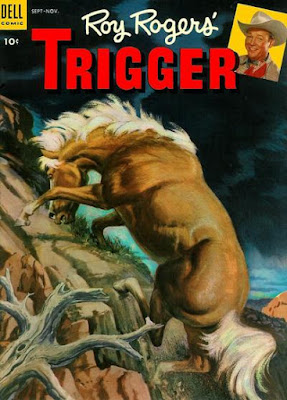
The 40 Years of Comics Project - Day 562: Roy Rogers' Trigger #10, September-November 1953 (Western Week, Day 5)

http://www.comics.org/issue/240517/

(Written on the 11th)
This afternoon, a friend came over and was browsing through this comic. Prior, he'd been looking through the issue of Rawhide Kid that'll be on the docket a couple of days from now. We both agreed that today's comic, about an action horse, contained some real dramatic moments, some actually interestingly constructed narratives, and did Westerns in a way that many traditional ones don't (in that, it was set in the West, and deployed the tropes, but wasn't about hyper masculine men wandering around deserts and shooting at people).

I often think that this is what the great writers of Westerns are going for - not the stereotype, but the behaviours and settings that are associated with the stereotype, but without the stereotype being present.

What I mean to say, then, is that of all the more traditional, old-school Western comics I've read this week, this one has been the best. Also the oldest, and definitely one of the oldest comics in the collection. I have a few from the very late 40s, but, like my copy of this comic, they're in very bad condition. The middle pages are missing from my copy, but I'm assuming that everything turns out okay. Except perhaps for the mountain lion in the first story. I get the feeling he doesn't make out okay.

Onward!

Sep 6, 2016

The 40 Years of Comics Project - Day 559: Two Gun Western #5, July 1956 (Western Week, Day 2)

http://www.comics.org/issue/203257/

Western Week continues apace. Is there something I'm missing about this genre? I just don't think I'm getting it. I'll put it out there front and center that my copy of this comic does not have the cover that you see above. A few months back I had the great fortune to pick up a stack of coverless old comics, including some Archies, some EC crime comics, and some old westerns from the 50s. Really great reading copies, but the covers are unfamiliar to me.

What this particular comic does do nicely is highlight some of the fantastic creators who were working in comics just before the advent of the superhero (or re-advent, I suppose). This comic is cover dated just a few months away from the Flash's return to comics, so it gives us a nice idea of what was on the stands around the same time that the costumed crowd started resurfacing. The art is, truly, quite gorgeous, especially the first story, scripted by the inimitable Stan Lee, and pencilled by Joe Sinnott. I'm not sure if Sinnott did his own inks (the GCD says he did), but the textures and detail on each face and each building are just stunning.

But the stories are just not doing it for me. I wonder if it's the same reaction I have to mob stories, or war stories. I just find them to be far too close to reality, almost a sensationalizing of a particularly violent aspect of the recent past. Or maybe it's because gun violence is a remarkable prevalent part of our culture that I have such a hard time with entertainment media that hinges on such weapons as fundamental narrative devices. I'm not denying that stories, great stories, could be told in these settings, but the amount of glorification has to be reigned in, otherwise it just looks like it's celebrating killing.

I'm willing to keep going, though. I recognize that there may be genres that I'm not a huge fan of, but I also recognize that great stories can be told in any genre. Onward.

Apr 15, 2016

The 40 Years of Comics Project - Day 416: The Dodo and the Frog #92, November 1957 ("Hey Kids! Comics!" Week, Day 4)

http://www.comics.org/issue/71770/

Yet another comic about a frog who's not a very nice person. Or frog, I suppose.

I'd said that the Little Lulu comic from a couple of days ago was one of the oldest in the collection, but this one predates it by a few months. The more I think on it, the more I realize that the oldest pieces in my collection are children's comics. On the one hand I think it has to do with the condition these comics end up in (my cover for today's selection doesn't look remotely as nice as that picture above), and on the other, I think it's because, of all the genres published at the time, children's comics are amongst the least collectible of the lot.

I've decided, after reading only this one issue, which also happens to be the last issue of the series, that this is a funny animal version of the Superman-Lex Luthor relationship. Dunbar Dodo is the last of his species, living a low-key(ish) existence in....a forest somewhere, I think. Fenimore Frog is the mischievous rascal who constantly is trying to take advantage of Dunbar, and whose plots consistently go awry due to the naive goodness of Dunbar. They even have the alliterative names. While I know much of Joseph Campbell's thinking on monomyth has been mostly disproven, looking at something like this, or Superman, or even Doctor Who, I feel like there's something going on with the notion of the goodness of a lone representative of a species, the hope that if it came down to there only being one human being left in existence, the goodness in us would win out over the bad.

Of course, there's also the critique, in the form of Fenimore, of the human propensity to take advantage of someone in dire circumstances, but, again, good seems to win out. Could it be that we're actually a fairly hopeful species?

And speaking of Superman (sort of)...more tomorrow!

Edit: One other interesting thing about this comic is that there are no ads in it whatsoever. I get the suspicion that the middle pages are missing from my copy, so maybe that's where they were, but there's nothing in the rest of the issue. Even the back cover is a promo for another DC comic.

Apr 13, 2016

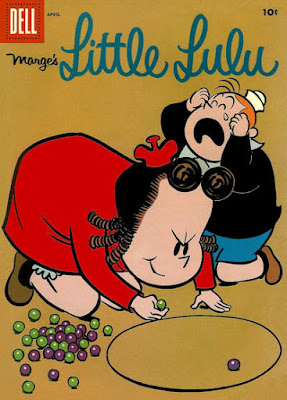
The 40 Years of Comics Project - Day 414: Marge's Little Lulu #118, April 1958 ("Hey Kids! Comics!" Week, Day 2)

Before getting to today's comic, the subtitle of this week's theme needs a bit of explanation. Back when comics were more commonly available in convenience stores, they were housed on the dreaded spinner rack - this was a convenient way of displaying the comics, but didn't do much for keeping them in the pristine condition we collectors like to see (that's sarcasm, btw). Some places still use the spinner rack, but more commonly now comics are displayed like their magazine cousins. But the top of many spinner racks looked a little like this:


Hence, our subtitle.

http://www.comics.org/issue/223110/

There are so many things that are fascinating about this comic. I've had this run of kid's comics sitting, waiting to be read, for a few months now. I'm not sure when I got this Lulu comic, but it's not in my database for some reason. I must have procured it, set it aside for a week of children's comics, and then never entered it into the collection. I'll remedy that today, though I cannot for the life of me think of where I got it.

This is one of the oldest pieces in the collection, almost 60 years young, and it really shows. The ads inside are incredible, and I learned from the back cover that the company 3M, you know, the one that makes Scotch tape and stuff, is actually called the Minnesota Mining and Manufacturing company. One day I'll compile ads from old comics into a post, and at least a couple from this comic will be included.

As I've noted a few times over the last months, I've been teaching a course on dream literature, and I wish I'd come across this comic right at the beginning of term, rather than here at the end. The opening story in this issue would have been a perfect text for the class. Lulu falls asleep (but has that Alice-esque moment of dream and reality bleeding into one another) and then starts growing and shrinking while her dolls and stuffed animals complain about not having enough room in the bed. It's obviously trading on the Alice stories, as well as McKay's Little Nemo comics. But not only does this happen to Lulu in the first story, but to Tubby in the final story, and he even goes down a rabbit hole and discovers the secret Easter Bunny egg-making factory. Both stories exhibit that same kind of uncanniness that books like Alice, or Maurice Sendak's Where the Wild Things Are, do, while also paying tribute to McKay's remarkable strip. Of course, being who I am, I can't help but see parallels to Little Ego as well, but perhaps a discussion of children's comics is not the place to bring up that particular bit of erotica.

What these interesting stories do is mask, to a certain extent, the buried mores evident in the comic. It's from 1958, remember. The cast is completely white-washed - I suppose it's better than having the usual stereotypes one finds in comics from this period (have a look at the Barks duck comics some time), but apart from one outburst from Lulu's friend Annie ("We'd fix the food, Tub!" says Lulu. To which Annie adds "That's what girls are for, silly!"), Lulu presents a remarkably independent and assertive female presence. I'm curious about the comic now, both for its stories and for its potentially forward-thinking position on gender politics. Though I'm not sure how much more Lulu I have in the collection.

Onward! Tomorrow some more contemporary children's fare.

May 22, 2015

Constructing a Collection - Don't Knock the Quarter Bin

Five years ago, I started what I'd hoped would be a series of articles about constructing a comic collection. Five years later, all I have is that introduction, but I still think it's a pretty interesting thing to talk about. I do love talking and thinking about collecting (as this currently-fallow blog attests), so I'm resurrecting the series. We'll start with a consideration of the quarter bin.

(I'm going to pepper this post with actual scans of things I've found in dollar bins, just to give a sense of the scope and quality of comics available in such places.)

 Probably the first question/comment would likely be "What the heck is a quarter bin?" It's a testament to the time in which I was beginning to think about these articles that I would think of the bargain bins of many comic stores as "Quarter Bins." Sadly, the days of quarter comics, except at the occasional garage sale, are over. It' much more likely you'll see a "Dollar Bin" nowadays. But if we consider that some comics hit upwards of five dollars per issue, a dollar is pretty good.

Secondly, let's expand our definition of a Quarter/Dollar bin, which will actually place the notion of a 25 cent comic back on the table. Dollar Bins don't have to be located in comic stores. A flea market might have comics kicking about on a table for anything from a quarter to a dollar. I've found packages of comics for $10, which turned out to mean 50 cents per comic. The Quarter/Dollar bin is a collecting metaphor. Really, we can consider it as any place where one can procure comics for less than they are likely to be new or as collectibles in a comic store.

As far as I've ascertained, there are four categories of comics, one of which I've not yet been fortunate enough to procure. Every so often one will hear a story, be it online or from an acquaintance, about someone who is pouring through a stack of old comics at a flea market or garage sale, and comes across something ridiculous like Action Comics #1. It may not be in pristine condition, but, really, who cares?! Imagine finding that comic, regardless of condition, and getting it for a dollar. Or less. I live in hope that one of these days something similar will happen to me, so I have that kind of story. But not yet. This is not to say, however, that the other categories of comics one can find are not every bit as fun and exciting. It's just in different ways.


The above comic is The Adventures of Mighty Mouse #132, published by Pines Comics in, according to the GCD, 1956-ish. My old copy of the Overstreet lists this issue at $65 Near Mint, and $5 Good. I got this one for 50 cents. The staples are still good, the center page is still there. It's missing a cover, but, really, the cover is simply there to, well, cover things. For readers, at least, it's what's inside that's important. My point for this comic, and similar ones in my collection, is that I likely wouldn't have paid even $5 for a copy of it. I like the mid-eighties Mighty Mouse from Marvel, but the character's not a particular favourite. This comic, however, coming in a stack of similarly aged and conditioned comics, was a wonderful find. It's utterly, utterly strange, and revealed to me that the attributes I admire in the aforementioned Marvel version of Mighty Mouse are not unique to that era of the comic. And if I'd turned my nose up at cheap, coverless comics, I'd never have discovered it. The Quarter/Dollar bin can be a treasure trove of strangeness. Weird independent comics that never got much play on the shelves, battered up copies of old comics from the fifties (a decade that really was another planet). In my delving into these troves, I'll often pick out the strangest covers I can find (I know, I know, judging books etc.). Often they'll be bad. But occasionally, they'll be good.

Comics like this one are often shunned by collectors. They're in bad condition, they don't give the full presentation of what the original material artefact was. I prefer to see these comics as being well-loved. The rounded corners, the slight oil stain at the edge of each page, the dulled almost to brown pages and equally dulled colours. They've been around, seen a lot of wear. They've been read. And really, for a narrative in any medium, to have been told and retold, or to tell and retell, I suppose, is really the highest praise it can receive.

Further up the page is the Steve Gerber-penned Cybernary #1. A good portion of Gerber's output in the nineties was with Image, and much of it suffered from the fact that he had to cleave to the shared universe within which he wrote, a universe of gravity-defying breasts and psychotic superheroes. It is no secret to anyone who's read this blog for a while that I'm a huge fan of Gerber's work. But he's not one of those writers, like Gaiman or Moore, who is voraciously, and more importantly popularly, collected and read by the general comics reading public. Gerber's writing demonstrates another of the categories of dollar bin finds. I've found many, many of his old works in such places, the one-offs he did for Creatures on the Loose for Marvel, his 4 issues of Captain America from the late seventies. They're not well-regarded comics, likely because they were fill-in issues for the regular writer/artist team, but they do have something about them that's intrinsically Gerberian (a notion I'm exploring over at Sequart). If you've a propensity for the work of someone like Doug Moench, or would love to read the old adventures of Morbius, the Living Vampire, the dollar bin is a good bet. That said, I've definitely found obscure works by the likes of Moore and Gaiman in dollar bins. The popularity of a writer/artist/title is no guarantee of high cost for all of the associated works. If you're clamouring to read all of Neil Gaiman's comics output, have a look in your local dollar bin for Elric #0 from Topps, beautifully illustrated by P. Craig Russell. Or Moore's old Time Twisters from 2000 A.D. in Quality's Time Twisters series. The dollar bin is a wonderful place to find oddities that fit your collection that, in some cases, you never even knew existed.

"Those three types of comics are all well and good, Tom" I hear you say, "but what about new stuff?" Well, you're in luck, but only in a few places. The coverless old stuff, the quirky collection stuff, they're staples of the dollar bin. The rare find is just that, rare. The fourth category I've discovered isn't ubiquitous, and often only happens in comic stores that are quite small. My local store in Calgary (Phoenix Comics N.W.) has very limited space, and no back issue boxes, so when comics get too old and don't sell, they're relegated to the dollar bin. To the right is issue #3 of Dark Engine, publication date October 2014. So the comic's just slightly more than 8 months old. I found the first three issues of this series in Phoenix's dollar bin, and picked them up because, well, a dollar! And it turns out to be a really great and intriguing series, which, again, I very likely would not have picked up for the cover price. That said, I'm going to keep reading the series, and pay full price for subsequent issues. This particular use of the dollar bin is quite wonderful, I think. I get to try a new comic for a substantial discount, and the store stands a chance of creating a new reader who will then pay full price for the rest of the series. Phoenix Comics has been remarkable for this sort of find for me. A number of the series I am currently reading I initially found in that dollar bin, and I'm so grateful for the opportunity to try new series without too much of an "am I wasting my money?" feeling.

(I probably shouldn't have mentioned where I got those new issues. All you Calgarian readers are going to go and scoop up all the good stuff now!)

I'll never stop shopping in the dollar bin. At the moment it's a nice way to grab a pile of comics and stay within a graduate student budget, but even when I start making actual money (that does happen, right?), I keep going to the dollar bin. For me, it is the place where the real wonder and fun of collecting comics is crystalised. There is the thrill of finding something cool and unique, of discovering the new or re-discovering the old. The smell of old newsprint wafts from them, the dust of years accumulates on your fingers as you search, your heart leaps when you think you've found something great. Were I ever to counsel someone on starting to build their own comics collection, I would say this: Take $50, go to a comic shop that has a substantial dollar bin, and get 50 comics. Base your purchase on how the comic looks, the characters on the cover, the genre it seems to be. You'll find great things and terrible things. And it will be one of the best $50 you spend in your life.

May 11, 2015

The 40 Years of Comics Project - Day 76: Li'l Genius #10, August 1956


This comic was pretty bad. Banal adventures of an obnoxious kid who doesn't really live up to the title of his comic. We also have a pretty thoroughly racist cover, and a final story about "Paco and Pico" that I can't quite decide if it's being racist or hearkening back to some American Regionalism with its use of dialect. Though I suppose the two are not necessarily mutually exclusive.

Here's the interesting thing. At the top of the first page, next to a big Comics Code Authority seal, is the following text:

"This seal of approval appears only on comic magazines which have been carefully reviewed, prior to publication, by the Comics Code Authority, and found to have met the high standards of morality and good taste required by the code."

There's a bit more, but I think that's the salient amount for us to be able to appreciate the irony. Again, look at that cover. Morality and good taste?

As much as I've enjoyed my stack of reading copies from the fifties, I can't recommend this one. The stories are just boring, and the art's kind of mediocre. Except that last story. The art's pretty good in that.

Okay, back to work for me, I'm afraid. I'll become more verbose in a couple of days when I'm done writing my exam. See you tomorrow.

Apr 20, 2015

The 40 Years of Comics Project - Day 55: The Montreal Standard Comics, Saturday, November 9, 1957

First, an apology. The "Ballad of the Fantastick" is not done, and might not be for a little while. My time is at a bit of a premium these days. Soon, I promise.

So, the something special I had planned. As a bit of a break, today I read a comics supplement from The Montreal Standard from 1957. I found this at a flea market years ago, and it was super well-preserved, along with the rest of the paper, because it's a commemorative issue about Queen Elizabeth II's visit to Ottawa that year. I checked inside, and there was a comics section. I have a collection called The Sunday Funnies, edited by Richard Marschall, which reprints comics supplement pages from 1896 - 1950, and I have one old front page of a supplement from 1937, but this one is the only complete one I've seen. That said, I remember reading the comics pages when I was a kid, looking forward to Bloom County every weekend. Part of me wishes I'd kept some of those now...

The nice thing about this paper is that it hits a bunch of the well-known names that one hears bandied about when speaking of mid-century comic strips. "L'il Abner," "Mary Worth," "Terry and the Pirates," "Bringing Up Father." As much as it's nice to see re-touched collections of this material appear, reading it in it's original form adds an experiential component to the experience. This is how a lot of comics were consumed 48 years ago. There's something I note in my upcoming, and much delayed, series on building a collection about comics from the dollar bin: the really beat up ones have a certain element to them. Almost as if a Benjaminian aura had been re-established around them by virtue of their having been read and loved. I don't know if this comic supplement has been read before, but it's in a form that was read in mass quantities, so the format of the medium, even though mechanically reproduced, asserts a temporal aura.

Enough of that. As for the comics themselves....I didn't enjoy them that much. There were one or two chuckles, mainly from a single panel gag cartoon called "Grin and Bear It," by George Lichtenstein. Some were obviously serials, and so dropping in halfway told me nothing. What I found interesting is that the serials fell into a number of different genres, rather than just an adventure model, which I had always thought had something to do with the old matinee adventure serials. But "L'il Abner" is obviously a domestic comedy, "Pogo" a strange mesh of about 4 genres through the lens of funny animals. So those I had a hard time getting into due to the serialization. The rest just seemed really culturally specific somehow. I'm reading Thierry Smolderen's The Origins of Comics right now, and I get the same feeling from the comics in this supplement that I get looking at the old reprinted broadsheets from the Victorian period in that book. I see that they're comics, they're using a visual and prosaic language I understand, but there's a cultural language bound up in it that I don't understand.

What worries me is that that can go the other way, and eventually I'll get to a point where I don't get contemporary comics because I will have become mired in a particular period. Aging is a funny thing.

Anyway, I hope you enjoyed this glimpse at an esoteric corner of the collection. I'm going to see about scanning more of this and talking about it a bit more, but my scanner won't accommodate it (I had to stitch that above picture together), so it'll be a bit. Not sure what's on deck for tomorrow, but it'll be something interesting, I'm sure. Til then.