Pages

Showing posts with label Marvel Knights. Show all posts

May 1, 2019

Microcollections 1.1: More Superhero Ephemera

A few years back I posted a short write-up of some of the weird things that accumulate around a superhero-heavy comics collection. These were mostly toys from fast-food restaurants or Kinder Eggs, little tiny avatars of the bigger ideas represented by superheroes. A chunk of my dissertation would have looked at this ephemera, considering it in the same way that we might the various religious trinkets that people never tire of making, selling, or buying.

Aside from the toys, there are other bits and pieces that have accumulated. Every so often, when a big event is happening, publishers will release promotional items. Or, back in the old days, many of the comics magazines (Wizard primary amongst them) included special giveaways. That's what some of this is.


I honestly have no idea where I got these stickers. I think they're from a Wizard magazine.


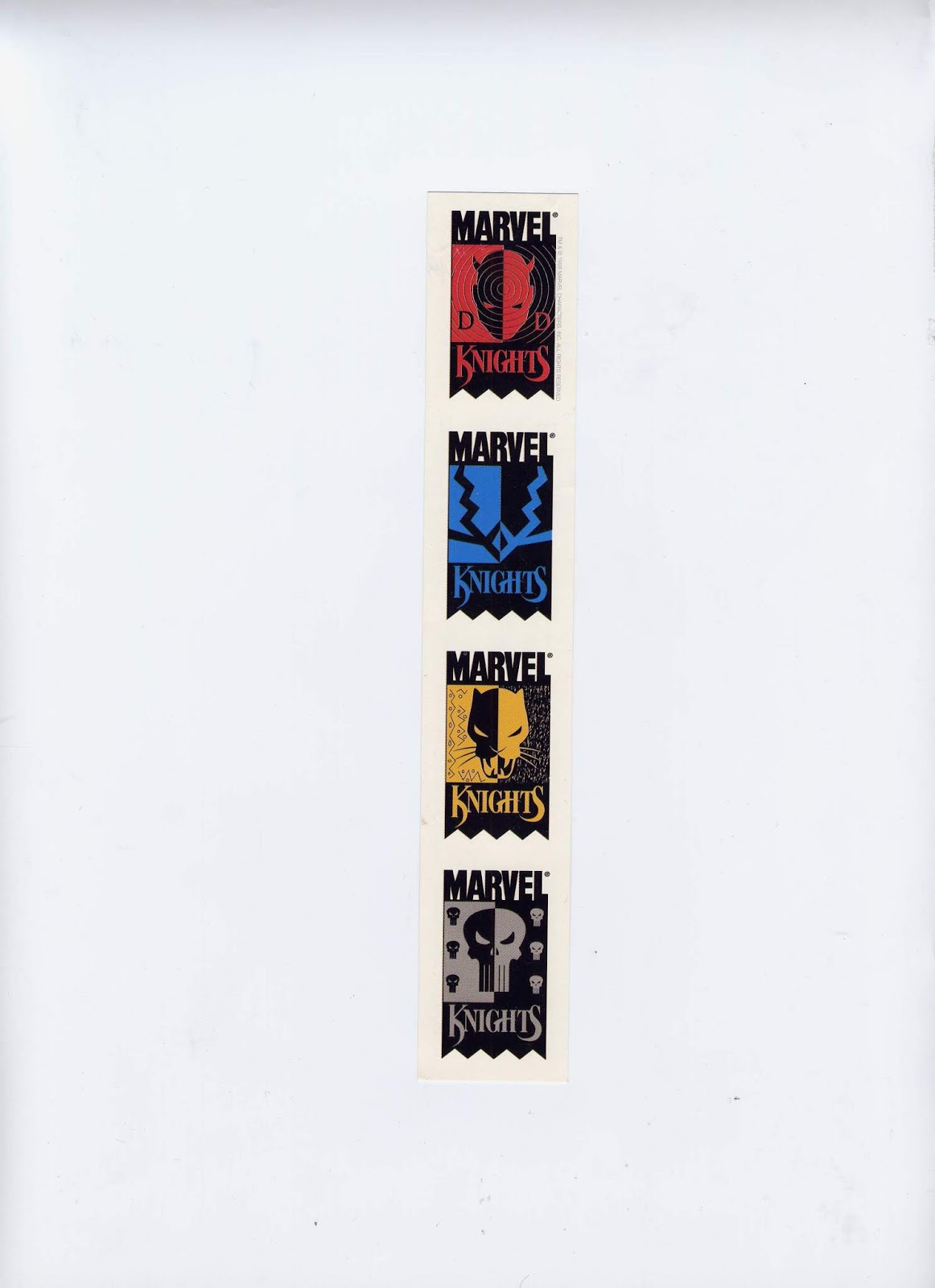
This bookmark, as I noted above, was a promotional item when the Marvel Knights line started up. I enjoyed all of these series, though the Black Panther one by Priest and Texeira stands out. So good.


Go on. Guess which crossover this was a promotional piece for.


I've had these stickers for a long time. Again, no idea where they came from. They're copyrighted 2001, so I probably found them at a garage sale.


And finally, some commemorative Superman stamps from a couple of years ago. We Canadians like to lay some claim to Superman, as creator and artist Joe Shuster was born in Toronto, though he moved to Cleveland quite early. But that's okay. We'll accept a bit of credit, quietly and politely, and we know that all the good bits of the character - they're the Canadian bits ;P.

Apr 22, 2017

The 40 Years of Comics Project - Day 787: Black Panther #1, November 1998

https://www.comics.org/issue/63445/

I'll fully admit that leaving Black Panther to be the last comic I read in my couple of weeks highlighting Black creators is purely a case of leaving the best, in my opinion, for last. I love this run of comics, even though I don't actually have them all. When Marvel Knights premiered in the late 90s, I'd already been reading Quantum and Woody for a bit, so Christopher Priest's use of his ridiculously (but in a good way) post-modern storytelling style wasn't a shock, but I certainly wasn't sure how it was going to translate to mainstream superhero comics. I was pleasantly surprised, as I think many were. If you haven't guessed already, Mr. Priest is my featured creator today. And, as I've noted before, I think that his run on Black Panther is one of the most under-rated superhero comics of all time. It's funny, it's remarkably smart, it's beautiful to look at, and it tells a story in a way that, barring Q&W, I'd never seen before in comics.

Our narrator is Everett K. Ross, described in the editorial at the back as "king of all white-boys." He's a government agent assigned to liase with T'Challa while he's in the United States investigating the death of a child in connection with a charitable foundation he set up. The first issue is a cacophony of images and little sketches that Ross is telling his boss/girlfriend about losing his pants, hunting a rat with a handgun, and a visit to the Panther's rooms (in a poor neighbourhood in NY - T'Challa refuses to stay somewhere swanky while investigating the death of a poor Black child) by the Devil. Literally.

What one ought to draw from that brief and under-stated description of the first issue is that Mr. Priest is not interested in any kind of white-washing, be it with characters or situations. It's also, or it was in my experience, one of the first comics to actually treat the Panther as a king of a foreign country, and specifically as a king of an African country.

I'm sitting here trying to think of things to say about this comic. Here's the thing: just go and read it. I know there was a remarkable amount of noise over Ta-Nehisi Coates and Brian Stelfreeze taking the reins of the Panther, but Priest was there with an Black-centric version of the character years and year earlier. In an interview with the New York Daily News, Priest says of his focal character "I realized I could use Ross to bridge the gap between the African culture that the Black Panther mythos is steeped in and the predominantly white readership that Marvel sells to,"and the comic does an amazing and wonderful job of taking that African culture, and the Black culture that the comic comes to be steeped in, and showing the "predominantly white readership" how foolish and biased their views of those cultures are. It's an important comic, in my opinion, and, thankfully, also a really, really good one.

Last thoughts: I've, as is always the case with a themed reading, read some really good comics and some really bad ones over the last couple of weeks. What this little sub-project has definitely done for me is helped me to recognize a small portion of the diversity that has always been a part of the comics, even if it hasn't always been a visible part of the comics. Which, I suppose, is one of the reasons I did this.

Onward.

(I should also add that the cover date of this comic is the same as the date my son was born, which makes the comic very special to me.)
Feb 27, 2016

The 40 Years of Comics Project - Day 368: Marvel Knights Double-Shot #2, July 2002


(Read today. Will blog tomorrow.)

(It's tomorrow now - isn't that an odd statement to make?)

 This comic was sort of made for me. Not only does it feature a very typically Morrisonian tale of uncertain identity and twist endings, but the second story is a Man-Thing tale written and illustrated by the amazing Ted McKeever. I don't have a lot of McKeever's work, but, for me, he represents that farthest reach, stylistically, of the aesthetic that crystallized in 90s Vertigo. Though his work with Rachel Pollack on Doom Patrol is not amongst the best-remembered parts of that series, I quite enjoy it. McKeever's messy unreality always jibed well with the tone of the series to me.

The Morrison tale in today's comic is a nice little piece of work, trading rather explicitly on the PKD connection I mentioned the other day. We've got telepathic mutants who aren't actually telepathic mutants, double and triple agents who aren't aware of their own double-ness, a badass super spy whose powers seem to include always ending up with very attractive women. There's a call-back of sorts in the story to Morrison's work on Animal Man, in that the "telepaths" in the story resemble the yellow aliens that originally gave Buddy Baker his powers. For Morrison's run, these aliens were ciphers for the creative force of the universe (i.e., Morrison himself), so what they're doing here, and their true identities, are interesting questions to ponder.

When we discuss short stories in an academic setting, we often make the distinction between time and place. Short stories are not meant to necessarily be about time - that's why they're short. They're a brief glimpse at a discreet slice of time, in which the important elements to note are the place-based elements. The setting, the interactions of the characters. We're not in it for an extended meditation on these things, but to witness, or experience, the action, and to take from that action a small kernel of knowledge. Given the very visual nature of comics, I wonder what differences in the parsing of comics short stories has from that of prose short stories. Fodder for further thought, I think.

Alright. Continuing on our Morrison week, we'll jump back a bit in time tomorrow, back to some 2000 A.D. material. Onward!