Pages

Showing posts with label John Ostrander. Show all posts

Oct 7, 2020

The 40 Years of Comics Project - Day 2051: Lady Death: Mischief Night #1, November 2001

   For information on stopping the spread of COVID-19, and on what to do if you are quarantined, have a look at the World Health Organization site.


I read a little bit of Avengelyne a while back, and noted the fact that, like Chaos!, Avatar seems to publish it's characters ongoing adventures as a series of discrete series, rather than as a single, continuing piece. I think that it must be a marketing thing, though I suppose it also gives a chance for creators to keep on schedule with breaks between each series.

Today's issue throws a bit of a wrench in the works, though. Set between the events of the Alive and Last Rites series, Lady Death has an adventure involving Sarah, the young woman she rescues in Alive, and who returns to her everyday life in the Last Rites series. According to today's issue, Sarah manifests an entity called Shriek who attempts to spread and/or quell fear - it was a bit unclear. However, in the first issue of Last Rites, there's absolutely no mention of this event, only that Sarah needs to return to her family. Both were written by John Ostrander, and both were published not too distantly from one another, so it just seems to be sloppy writing to not mention the previous/subsequent adventure (chronologically versus publication, that is.)

That said, I quite liked today's story. As Sarah is a teenager, when she turns into Shriek she is, unlike every other Chaos! lady, actually completely clad in a costume and her breasts aren't the size of her head. It was a nice change. There was some interesting philosophical stuff about death being the source of all fear that I really think could have been addressed a bit more fully, but as this was meant as a holiday-themed one-shot I can understand why it wouldn't have gone that route. I'm curious to see if the earlier Lady Death stuff deals with that fear, or if it's only after the main character becomes mortal again that we start to see some consideration of what death, and Lady Death, mean to finite creatures like ourselves.

More to follow.

Further Reading and Related Posts

I really ought to go back and tag the rest, but here's some other holiday-themed comics I've reviewed. Surely there must be more out there than just Christmas stuff, though.

And another take on Death, famously, appears in Star*Reach #1.

Jan 21, 2020

The 40 Years of Comics Project - Day 1791: Doom Patrol and Suicide Squad Special #1,1988


Let's just talk about Erik Larsen just for a second. He's a pretty great artist, though definitely comes from a school of comics art of which I'm not 100% a fan. As I mentioned yesterday, at least in his earlier work, I just don't get the physics of breasts that he's going for. Check out Psi's chest (she's the one in the barely-there gold) - she looks like she's just got gold suction cups pulling on the flesh of her chest.

(Actually, in the first couple of shots of that character, I wondered if Larsen was going for a more masculine appearance. It could be that I spend an awful lot of time around drag queens, but Psi definitely looks like she might be bending gender a bit.)

Now, all this said, he's a master of motion in a comics panel. That cover is fairly crackling with energy, and none of the characters have that unfortunate cardboardness to them that can sometimes happen with comics. I've referenced an interview with Steve Lightle a couple of times in the last few days, and at one point, though praising Gary Martin's inks, he notes that at times the characters seemed somewhat flat. Larsen suffers no such problems, inked here by Bob Lewis.

But on to the story - it's pretty good, though perhaps way too political for a Doom Patrol story. It's also one of those stories that simply has not aged well. In fact, the argument could be made that it hasn't aged at all. It simply could not happen in any period other than the 80s, making it difficult for us to place it into sliding continuity. That said, of course, with all of the reboots since, it's hard to say whether this version of the team even existed in the fictional history. But before simply tossing it out as a continuity anachronism, we can also consider the comic as a time capsule of sorts. Rather than seeing it in the context of a part of the Patrol's history, we can look at it as indicative of the things that were informing the writers and artists working in the field at the time. The inclusion of Ronald Reagan, an actual president rather than a fictional one, cements this position. As I read through this run, there are moments like this, but this one stands out, more so than the absence of cell phones or Internet in what is, ostensibly, only a few years removed from current continuity.

More to follow.

Apr 12, 2018

The 40 Years of Comics Project - Day 1142: Detective Comics #624, December 1990

https://www.comics.org/issue/48876/

Honestly, I'd read the entire series of Simon Petrarch's adventures as Batman. The brief glimpses we get in these three comics are mad, but such a pleasant strain of madness.

The villain gets his, eventually, and Batman figures it all out. Looking back over the story, I see now that the mystery was really just an excuse to have Flint Henry and Dick Sprang come onto the book and make something magical. It was a pretty run of the mill Batman story, but it facilitated one of the coolest Batman stories I've read. According to the GCD, this run of Detective has never been reprinted, but I highly recommend tracking it down if you want to see a really different interpretation of the Dark Knight.

I think there's something to this story that I'm going to have to think about more deeply. A repentant Satan and a soul-less adventurer team up to fight crime in Gotham City, assisted by a child possessed by an angel calling himself Robin and his psychiatrist in a red wig as Batgirl. The very explicit inclusion of Christian imagery is neat. We only usually get such blatant references in Superman stories, but Batman as repentant Satan? That's a new one for me. But I'll think more on this later.

An excellent little tale, a nice dipping of the toes back into the mainstream DCU. But tomorrow we're going somewhere else, somewhere no man has ever gone before.

More to come...

Apr 10, 2018

The 40 Years of Comics Project - Day 1140: Detective Comics #623, November 1990

https://www.comics.org/issue/48755/

I taught my class this week about the idea of "iconic abstraction." It's something that Scott McCloud talks about in Understanding Comics, and though it's looked at as naive by scholars these days, I still find it to be a useful way of thinking about not just the styles and ways of making comics, but also the ways in which myths function in our culture. Icons are metonyms. The Cross is everything that is bound up with the philosophies of Jesus. That Bat-symbol up there in the lower corner of the cover, divorced of context, still carries with it everything that is bound up in the idea of Batman. When I'm teaching visual grammar, the primary recognition of something being a representation, and a subjective one at that, is very important.

What this particular storyline is doing in a really cool way is showing us the same process happening within the fictional world of the DCU. The superhero story is iconic, in that it occurs in a simpler universe than the one we inhabit. More than anything else in their existence, the superhero has been used as metaphor. The struggle with inner darkness and despair - Batman. Explosive anger issues - the Hulk. The mythic stories that play out in superhero comics are similar to the kerygmatic texts of the major religions, taking common human dilemmas or concerns, and playing out ways of dealing with them through the magic of story. So what happens when this fictive, simpler, iconic world, is represented in a comic in it's own universe? The iconic abstraction, in this case, is a further simplification. The premise of the Batman comic we glimpse in the pages of Detective hinges on the redemption of the Devil, the most iconic (at least in Western literature) expression of evil. In today's issue, the Joker's hideout is filled with silly signs, like "No Swimming" over a vat of acid. It's like Batman as seen through the lens of Looney Tunes. It's still grim'n'gritty, but in a far more slapstick way. Is this how fictional civilians in the fictional universe think about the superheroes with whom they share this universe? Do they imagine the lives of the superheroes in the same way that we imagine the lives of the gods and heroes of Greek myth? How, then, is the psyche of the average person in a superhero universe affected by the presence of what they perceive as the equivalents of such characters as Ajax or Agamemnon? (That's a silly question, really, but it's definitely something I think about!)

Also, Bathound transforms into the Batmobile. It's pretty epic.

More to come...

Apr 8, 2018

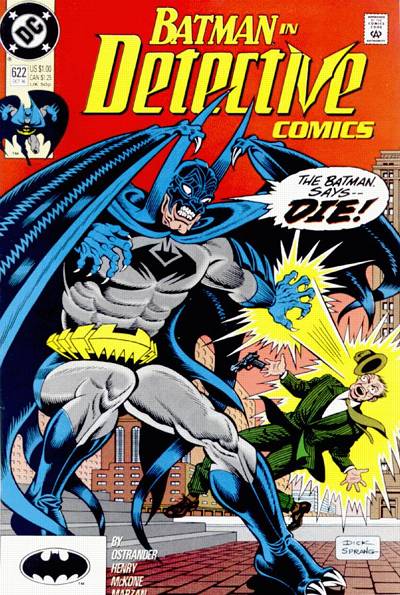
The 40 Years of Comics Project - Day 1138: Detective Comics #622, October 1990

https://www.comics.org/issue/48631/

As I was rearranging my collection a while back, the Batman comics we're going to look at over the next few days jumped out at me because of these AWESOME COVERS!! It really is just some over-the-top nuttiness, and so beautifully rendered by legendary Dick Sprang. The story beneath the covers is part of one of my favourite superhero sub-genres, in which the hero(es) must figure out a mystery through the vehicle of a comic book. In today's issue, an unauthorized Batman comic appears to be connected to a series of killings, responsibility for which is claimed by "the Batman." This issue opens with 9 pages of an alternate version of Batman, one linked to a repentant Satan, but still based in Gotham. In looks, he's very like Quinn and Vigil's Faust, who himself owes much to Batman. An interesting loop. And when the Batman is revealed in the pages of this faux-comic, we immediately cut back to Bruce Wayne at home, reading the comic, and reacting to this strange iteration of his story.

I'll get a little more into how the comic within a comic is functioning over the next couple of days, but one cool thing is the slight hint we're given, straight from page 1, that this is not "real." Each page of the comic is slightly smaller that the actual page it's printed on, and has another "border" that is ostensibly the edge of the page. So the whole page of the fictive comic, including its edge which is actually a border, are contained within the page and boundaries of the actual page. I'll have to get back to my Groensteen to see what all that means.

All that aside, it's an entertaining little Batman story, perhaps the first I've looked at for this project since I read through Morrison's Batman.

More to come...

Edit: I did a bit of research on the colourist for this issue, and sadly Ms. Roy passed away in 2010. Here's an example of her art outside of comics, and of a place I'd love to visit one day, the New Jersey Pine Barrens:

Jan 27, 2018

The 40 Years of Comics Project - Day 1067: Deathmate Blue, October 1993

https://www.comics.org/issue/53851/

So I'm having a pain day, and I'm quite medicated. Apologies if this rambles a bit.

Our first (and only?) sojourn of Supreme into another company's universe. Sort of. I am only very vaguely aware of the characters published by Valiant Comics. I read some of their stuff under the Acclaim banner, but they'd sort of fizzled out in the mid-90s when I got back into comics. I know some about the old Dell characters they have, and some about the original properties, and I've had the recent Valiant stuff highly recommended to me. I just can't get past them not having Christopher Priest back to write Quantum & Woody. Criminal, if you ask me.

What's pretty neat about this issue is that we get a real glimpse into Supreme's character. In fact, it's so significant a glimpse that I wonder why it happened in this crossover, rather than in his own title. He teams with Doctor Solar to stop an oil fire in Northern Alberta after which Solar asks him for help in stopping his future self from destroying the universe. As one does. Supreme, all beardy here, agrees, and then waxes a bit lyrical about how upset he is to find the heroes he's returned to after 50 years in space little more than corporate mercenaries. And all of a sudden, the anger he displays is slightly, but only slightly, mitigated, and the tear that we see in his eye at the end of the first issue is perhaps explained. I guess the idea is that Superman returns after 50 years to find the DCU populated by narcissistic assholes.

Am I giving Supreme too much credit for self-awareness here? I'm not sure.

Anyway, what Deathmate gives us is a brief look at a more thoughtful Supreme. Not quite the naive paragon of Justice of Alan Moore's run, but certainly more of a hero.

To be continued.

(Edit - I forgot to say that the apocalypse that threatens the universe is demonstrated in the far-flung apocalyptic future of April 8, 2018! Don't say you weren't warned!)

Mar 20, 2017

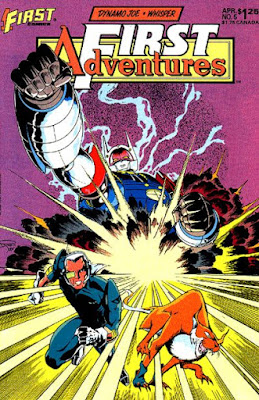
The 40 Years of Comics Project - Day 754: First Adventures #5, April 1986

https://www.comics.org/issue/41304/

You might be forgiven, considering the cover of today's comic, for thinking that its a comic aimed at younger audiences. I think perhaps it's the propensity to add the word "adventures" to titles over the last few years when marketing kid-friendly comics. But let's remember that this was published by an indie publisher in the mid-Eighties. It's not a comic for kids. Though the "Dynamo Joe" feature very well could be, the death of one of the main characters of the series in today's final installment speaks otherwise. And the installment of "Whisper" is just dark. Really dark.

I've noted before that I have a soft spot for anthology titles, though one usually has to contend with a couple of bad stories packaged in with the good stuff. It seems to me, however, that First Adventures had a couple of really great features all along. The art is excellent, the writing top notch. The proof is in the fact that this is the final issue of the anthology title, and each of the constituent series moves to its own title after this one.

One thing that happened today that rarely happens is that I read the end of a couple of stories, without having any context for those endings. It's an interesting thing, to end a story. Both endings felt strangely satisfying, even though I have no clue what led to those endings. There's something about an ending, that slide down to the end of Freytag's Pyramid. The two installments in today's comic basically started at the climax of the story and then gave us falling action. Is this evidence that I don't need to read complete stories, just climaxes and endings? Probably not. I'm just tired this morning.

To be continued.

Feb 6, 2016

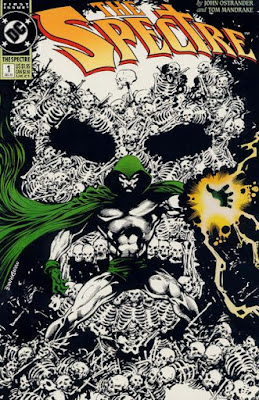
The 40 Years of Comics Project - Day 347: The Spectre v.3 #1, December 1992

As with yesterday. Read, but blogged tomorrow.

http://www.comics.org/issue/77947/

I've been collecting this particular run of The Spectre for years now, but I'm nowhere close to having the series. On my list of comics I'm looking for (which I might, one day, post here), I have series that are high priority and those that are low priority. The Spectre, though interesting, has always been low priority.

I'm not sure why. I began tracking it down when I read somewhere a review that compared it favourably to Gaiman's The Sandman. The thought of a series of that quality situated firmly in the DCU was alluring, especially to someone who had recently discovered Robinson's Starman. But all things Morrisonian or Gerberian took precedence, and The Spectre was relegated to the back burner. Having re-read this opening issue, however, all that might change. The creative team of Ostrander and Mandrake are not entirely unfamiliar to me, but they're not entirely familiar either. The art definitely has that early Vertigo feel to it, and the deployment of the surreal aspects of the character are really fantastic. I wrote on the character a while back, an older iteration of the hero by Jim Aparo, and while the Mandrake and Ostrander version seems to be keeping with the spirit of vengeance origins of the character, Mandrake's art is far less superhero than Aparo's, which, I find, it appropriate.

I don't have issue #2, so we probably won't see any more of the series until I've got a bit of a run to get through. But it might also be moving to the medium urgency priority list.

(I don't know who I'm kidding. All comics are high priority for me. Isn't that evident by now?)