Pages

Showing posts with label Dave Gibbons. Show all posts

Jan 3, 2019

The 40 Years of Comics Project - Day 1409: Doctor Who (1984) #1, October 1984


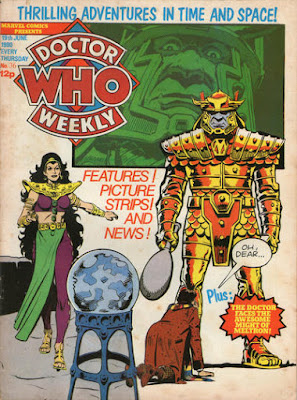
Doctor Who Weekly #19, from which part of today's comic is drawn, is perhaps the comic I have that is the one that I remember having read the longest. It came out in February of 1980, which means I very likely had it while I was still in England. "The Starbeast," the story featured in today's reprint comic, is permanently emblazoned in my brain, along with the Wrarth Warriors and the Meep. And, of course, Sharon, who I've just confirmed is the first POC companion in the series history. Only took 17 years :D.

What's kind of cool about this reprint is that it's been coloured. The original weeklies were all in black and white, so I've always envisioned the Meep as being white, but he's apparently blue. I suppose that makes sense, given that he's got green blood. White would not be a natural colour for him. I guess. I don't know why I'm trying to figure out alien physiology from a single re-coloured panel of a Doctor Who comic.

The other neat thing about this issue is that in the text feature that gives some background on the Doctor, there's an amazing picture of the fourth Doctor and the second Romana by Walt Simonson. It's a bit of a revelation for me, but I can't imagine a better-suited artist. Mr. Simonson's incredible command of movement in his panels would be a brilliant fit for the Doctor and his adventures. Sadly, these appear to be the only illustrations of the Time Lord that he's done, all reprinted from Marvel Premiere #60 (which I read yesterday).

More to come...

Oct 12, 2018

The 40 Years of Comics Project Friday Magazine 28: Doctor Who Summer Special, 1980

https://www.comics.org/issue/1537729/

Thinking about it, it's entirely possible that I actually brought this comic with me when we moved to Canada in 1980. We emigrated in July of 1980, so there's a good chance I'd been bought the Summer special to read on the plane. I'm going to have to headcannon that one - my memory doesn't stretch that far back (except in those strange, dream-like flashes that accompany early memory - this is one of those comics that helps me to understand Benjamin's "Unpacking My Library," in that I can almost hear and see myself as a six year old, based on my knowledge of how they act - I have very vague remembrances of the woman sitting beside me, upon whom I think I vomitted - I remember being at the very front of the 747, moved there because my Mum needed a crib for my youngest brother, barely 6 months old - my Mum, who travelled to Canada, a month behind my Dad, with a 6 year old, a 3 year old, and a 6 month old, is as close to a superhero as any of us are every going to see - how many times have I opened this comic in the last almost-40 years?).

The special reprints the first adventure of the Doctor in his weekly comic, and I just love this story. I've been reading it for so long that it's ingrained on my brain. Reading it again, encountering the Iron Legion again, after so many years, was like meeting up with old friends, and you pick up a conversation like no time at all has passed. I missed Morris, and Vesuvius.

Onward.

Apr 28, 2017

The 40 Years of Comics Project Friday Magazine 10: Doctor Who Weekly #1, October 1979

https://www.comics.org/issue/901579/

I just realized that I didn't do my magazine last Friday. Must be that memory thing that happens with age.

Today's magazine has got to be one of the oldest inhabitants of the collection. Not, necessarily, by it's actual age, but by the amount of time it's spent with me. The first issue of DWW I ever got was #19, but my Mum and Dad managed to track down a few back issues for me and have them sent to us in Canada in early 1980. I'm still trying to track down one or two to fill out my run of the weekly series - perhaps the Calgary Expo this weekend will bear some fruit.

Speaking of, I know I say it every year, but I'll try to do a full write-up of the con next week. I'm presenting a paper on Sunday afternoon, if you're about.

Today's inaugural issue features the first part of "The Iron Legion," one of my absolute favourite Doctor Who stories - imagine Rome never fell, and rampaged across the galaxy at the behest of demonic aliens for millennia. It's good and epic and everything that the television series was unable to be in those early days. It's amusing, and slightly unnerving, to me that one of the articles in this issue notes that the series began "16 years ago" and here we are in 2017 celebrating it's 50+ anniversary! There's something wondrous about the fact that this show has managed to stay around for over half a century, especially given the ridiculousness of its premise. But then, I'm a guy who love superheroes. Ridiculous premises are par for the course.

I read a few issues of this series a while back, but perhaps I'll put it on deck for my Friday magazines to come. Might be interesting to take a look back not just at old comics, but at comics that have been with me for a really, really long time.

Onward!

Aug 20, 2016

The 40 Years of Comics Project - Day 542: Doctor Who Weekly #38, 3rd July 1980

http://www.comics.org/issue/901616/

And so we come to the conclusion of this particular adventure of the Doctor and Sharon. It's a very strange confrontation, as the Doctor demonstrates just how quick a mind he really has, and just how fundamental an understanding of the strangeness of the universe he has. He tricks Brimo into re-imprisoning herself, unsticks the TARDIS from the gap between the universe and the blank dimension, and leaves Brimo there for all eternity.

It's one of those things that they deal with occasionally in the television series, this propensity of the Doctor to not kill, but to occasionally mete out punishments that one might consider worse than death. In particular "The Family of Blood" story with David Tennant addresses this in its denouement, as the villains of the piece realize that he was trying to spare them his wrath by running from them, trying to spare himself having to implement these horrific punishments. Brimo will never, ever hurt anyone again, and she will have eternity to think on that. Chilling.

There's also a cool moment at the end of the story where there's a glitch in the TARDIS's ability to return to normal space, and although it's an instantaneous transition, the inhabitants of the machine age four years each. For the ancient Doctor, this is no problem, but the teenaged Sharon grows into an adult - this presents some problems for her return to her time, and high school, which will be dealt with later in the series. We'll get there eventually.

"Black Legacy," the story of Maxel the Cyberleader and the ultimate weapon also comes to an end with Maxel destroying himself and his ship in order to keep the weapon from escaping the planet and ravaging the universe. The characterization of the villains in these comics is very interesting. In both this story and in "The Dalek Tapes," we see much more emotional reaction to situations than in the television series. Where the Cybermen ostensibly have their emotions removed, it seems that anger and hatred remain, much more like we might imagine the Daleks, really. And the Daleks, in their story, are far more individual than their televised counterparts, having names and drives of their own rather than being the obedient drones we're used to. This is one of the things I love about the idea of transmedial storytelling, the influence of the medium itself even on the characters whose stories we're experiencing. As Maxel and the Dalek Emperor are our focal characters in the stories, there has to be some common link that we can latch onto as we read, even if it's negative emotions.

Something different tomorrow. Onward.

Aug 19, 2016

The 40 Years of Comics Project - Day 541: Doctor Who Weekly #37, 26th June 1980

http://www.comics.org/issue/901615/

I had a thought this morning that was a bit of a consternation for me. What if, as I was finishing one serial in this series, another began and I had to read the comics for the rest of time? Or, well, until I found a convenient stopping point, at least. But no worries - both "The Time Witch" and "Black Legacy" end with the next issue, so we'll move on to something else from there.

There's a very "Doctor" exchange in this issue, with Brimo yelling for her guard to kill the Doctor and Sharon, and the Doctor yelling for him to make another cup of tea. I have this interesting conversation quite often with my Mum about the Doctor - he's, ostensibly, always the same person, regardless of how he looks, though the whole conundrum of regenerating every cell of his body, including his brain, begs the question of how we define the continuity of this entity. There must be something fundamental on a psychic level that continues. Regardless, every now and again, in both the television show and the comics, I'll catch a moment where I see this continuity, these quirks of personality that prove that this is the same character, regardless of face. The Kill Them/Make a Cup of Tea moment was one of these.

I remember really loving this issue, as it featured lots of cool photos of monsters from the series. When I was first getting these comics, I'd only really seen some of the Tom Baker serials, so there was a vast array of adventures and characters whose only familiarity to me was through information gleaned from this magazine. It's still the case that I haven't seen some of these monsters in the flesh, so to speak, but my knowledge of the series is a slightly more complete than it was for my 7 year old self. I did love the pictures of the monsters, though, even if, seeing them now, they look like amateur cosplay.

One more issue of Doctor Who Weekly, and then on to other things. I've got a couple of theme weeks coming up, and hopefully a return to some longer pieces on a weekly, or bi-weekly, basis. Onward!

Aug 18, 2016

The 40 Years of Comics Project - Day 540: Doctor Who Weekly #36, 19th June 1980

http://www.comics.org/issue/901614/

When I teach comics, and specifically trade paperback collections of monthly comics, I tend to remind my students that the end of each chapter is also the end of a comic, and that, in most cases, there's a tendency to hit a mildly climactic moment, in order to draw readers back a month later. I'm assuming that these weekly installments of the serials in Doctor Who Weekly are composed in much the same way, but the climactic moments are slightly less....elevated, I suppose. I could see these exciting moments at the end of each installment as simply moments at the end of a page that entice you to turn to the next one. For instance, at the end of today's installment of "The Time Witch," the Doctor's cup of tea is shattered by a lightning bolt from somewhere off-panel. I've little doubt that the source of it (likely Brimo, the witch, herself) will be revealed at the beginning of tomorrow's comic, and though it's exciting, it's hardly the kind of cliffhanger that would keep one wanting more for a whole month.

I'm kind of fascinated by serialized storytelling, and how it affects the ways in which a story is told. The "Black Legacy" Cyberman story by Moore and Lloyd that rounds out these magazines is told in 2-page portions. 2 pages! It's a testament to the skill of the creators involved that they can get anything accomplished in such a small amount of space, and still be able to offer these mini-climaxes at the end of each section. When considering these comics for my daily read, I had thought that maybe I should read whole stories ("The Time Witch," for example, runs 4 installments of 4-5 pages each, so pretty much equivalent to a single monthly comic) rather than individual issues. But that wouldn't have really fit with the project, so serialization it is. The long and short of this little musing on serials is that these weekly ones, and the monthlies I love so well, offer a remarkable proof of McLuhan's aphoristic pronouncement that the medium really is the message.

Tomorrow, the Doctor and Sharon meet Brimo (I assume). It occurred to me that having Sharon, a high-school aged young lady, as companion in these comics puts the comic stories in a much closer vein to the current television series than the shows that were airing at the time of the magazine's publication. But I'll have to think on this a bit more.

Onward.

Aug 17, 2016

The 40 Years of Comics Project - Day 539: Doctor Who Weekly #35, 12th June 1980

http://www.comics.org/issue/901613/

I was inspired by my thinking yesterday of these old comics, and decided to read a few. I have a number of them set aside in my active magazine collection (time for another metadata post, I think...) because they feature very early work by Alan Moore, along with other British luminaries such as Steve Moore, Dave Gibbons, and David Lloyd. I was talking yesterday with my Mum about these comics, and how the stories have been collected into trades that I think I may have to pick up. I'm not sure what it is, in contrast to the newer Who comics that I haven't enjoyed that much, that draws me to these little snippets of tales. There's probably a heavy dose of nostalgia involved, though there's also the fact that the time in which it was published was a far less continuity driven time, so the stories don't seem to do much to align themselves with the television show. We also have a nice variety of stories in here - the lead one is a typical (if such a term can be used to describe Doctor Who) Doctor Who story, but the other three tales encompass a telling of the ancient history of the Daleks, a reprint (I'm pretty sure) of an old Marvel weird tales-style adventure - this magazine provided my first exposure to both Kirby and Ditko through these reprints - and a Moore/Lloyd horror tale featuring the Cybermen. We definitely see shades, in this last piece, of the kind of horror stories with which Moore would make a name for himself in the pages of Swamp Thing later in the decade.

I think about anthology titles and their relative lack of success in the North American market. I wonder if, in order to maintain the kind of momentum one needs, at least with a serialized anthology, if the weekly publishing schedule is more suitable? With a week between installments, rather than a month, following 3 or 4 different stories, recalling what was happening in each, would not be so hard.

So it'll be a few more issues of this series for the next few days, at least until the saga of the Time Witch has run its course. After that, I guess we'll see, but I do have to say it was a lovely comic to sit and drink my coffee with this morning. Onward!

Feb 26, 2016

The 40 Years of Comics Project - Day 367: 2000 AD Presents #13, April 1987


It's appropriate for this issue to show up at the beginning of my second year. Back at the beginning of the project, when I thought there was going to be some kind of order to my read through, I did a couple of weeks of 2000 A.D. With this issue, I finally get to finish a couple of the stories I started a year ago. Sort of. This is the last issue of this series before being once more taken over by a different (sort of) company. The last time this happened, the content of each issue changed substantially. Will I ever find out what happens to Harry 20? Probably not, though this issue's story was a shocking one. Will space-Fascist Dan Dare "liberate" more oppressed peoples? Probably. Will Strontium Dog...be a grim outer space Batman some more? All signs point to yes.

The Grant Morrison story in this issue is called "Return to Sender," and it sees a very, very early Morrison attempt at metafiction, though only for the sake of a shaggy dog sort of joke. It's also very, very highly influenced by The Hitchhiker's Guide to the Galaxy, with English coincidentally setting off an interstellar war, and a space empire being wiped out on account of their tiny, tiny size. But, honestly, I'd have been surprised to find out that Morrison was not familiar with Hitchhiker's. It's a seminal work of science fiction, and was quite popular at the time that Morrison was developing his talents as a writer. Rather than direct copy, perhaps we can consider the story an adaptation of science fiction tropes introduced by Adams' series.

Much the same way we can see The Matrix in light of Morrison's The Invisibles.

I think this is the earliest of the Morrison short stories I'm reading, so it's interesting to see that both this story and yesterday's story are very explicitly metafictional. I had a professor during my Master's degree who told me he thought that some really great writers took one topic and then spent their lives coming at it from as many different vantage points as possible. The interaction of fiction with reality, the ways that texts seem to ape self-awareness and talk to us - these are Morrison's topics.

More tomorrow.

Apr 17, 2015

The 40 Years of Comics Project: Weird Metadata Post #2

A breakdown of the top 10 artists and writers in my collection, by number of entries.


Name - # entries - approximate % of collection
Artists:
John Byrne - 179 - 0.019%
Jack Kirby - 157 - 0.013%
John Romita, Jr. - 131 - 0.011%
Mark Bagley - 118 - 0.010%
John Buscema - 103 - 0.009%
George Perez - 102 - 0.009%
Brent Anderson - 101 - 0.009%
Dave Gibbons - 100 - 0.008%
Tom Grummett - 94 - 0.008%
Sal Buscema - 92 - 0.008%

Writers:
Grant Morrison - 581 - 0.049%
Chris Claremont - 307 - 0.026%
Mark Waid - 305 - 0.026%
Brian Bendis - 287 - 0.024%
Alan Moore - 255 - 0.022%
Warren Ellis - 249 - 0.021%
Jonathan Hickman - 241 - 0.020%
Kurt Busiek - 231 - 0.020%
Steve Gerber - 205 - 0.017%
Geoff Johns - 201 - 0.017%

A couple of things jump out at me. First the number of comics by individual writers far outstrips the comics by individual artists. This is most likely a function of my following writers, rather than artists, but it also might say something about the relative ease of scripting a comic versus drawing a comic.

The list of writers is unsurprising to me, except for Claremont, whose writing I don't particularly care for, but who is apparently a fairly large presence in the collection. The artist list is full of surprises. I really don't care much for Byrne either, but he's my top artist? Attests to his productivity, if nothing else, I guess. The Kirby and Bagley stuff is less surprising, as is the Grummet stuff. Both Bagley and Grummet worked on Thunderbolts, which I collected voraciously.

In contrast, there's a rather remarkable amount of writers and artists in the collection who are represented by a single work.

Mar 3, 2015

The 40 Years of Comics Project - Day 7: 2000 A.D. Presents v.2 #7, October 1986


Published by Quality Periodicals.

Continuing my tour of the increasingly anachronistically-titled 2000 A.D. This issue represents yet another change. The page count rises to 52 pages, and it actually seems to work.
I was chatting this morning with my wife about why 2000 A.D. wasn't doing much for me, and I noted yesterday that perhaps it had to do with the weekly installments in which these stories are serialized. This particular issue features four chapters of the Dan Dare "Lost Worlds" storyline, and having these chapters laid out end to end does appear to have helped my enjoyment of them. This is not to say that the stories are approaching that nebulous thing I call "depth," and, again, I think this is a function of the weekly serialization under which they were composed. Having said that, Moore's "Skizz" does have that depth, regardless of the way it was serialized. The difference between a good writer (Gerry Finley-Day) and a great one, I suppose.

The Dare stuff has some Dave Gibbons art, but it doesn't really hold a candle to his Watchmen work. I find it interesting to see the differences in an individual artist's work based on publication company. Though it could, once more, have to do with the schedule under which the stories were written. I used to think that serialization could be talked about relatively simply, but the differences between weekly, monthly, or Daniel Clowes-esque publication definitely have an impact.

A nice synchronicity: I'm re-reading Jonathan Hickman's Avengers and New Avengers in the run-up to the "Secret Wars" event this summer, and I've just read the issue that presents the origin of the new Smasher, Isabel Dare. Whose grandfather's name is Dan.

Feb 26, 2015

The 40 Years of Comics Project - Day 2: 2000 A.D. Monthly v.2 #4, July 1986

http://www.comics.org/issue/41657/

Published by IPC Magazines Ltd.

Aaaannnddd....it turns out I do not have the whole series. So, somewhere between issue #1 and issue #4, Anderson is placed on suspension, and the Dark Judges are rampaging through Mega-City One. Easy enough to follow, really. There's some really terrible dialogue in the lead story, but the Dark Judges and Anderson are cool enough to overlook that little glitch. "Skizz" continues. If there's one thing to note about Moore's writing here, it's that his ability to mimic dialect in print is really pretty great. Or I'm assuming it is, never having been to Birmingham. "D.R. and Quinch" has vanished from the pages of the comic, which means their adventure on Planet Hollywood was a short one. It's replaced with an obscure Moore/Dillon sci-fi comedy called "Abelard Snazz" ("The Man with the Two-Storey Brain!"). It reads a lot like most of the 2000 A.D. one-offs: good art (it is Steve Dillon, after all), sort of trite writing. If you really want funny Moore, read Maxwell the Magic Cat (I'll get there eventually. Come back in a decade or so!). This is followed up by a piece that disproves what I've just written, the Moore/Gibbons (pre-Watchmen) short "Chrono-Cops," a clever little time travel paradox story.

Probably another week of 2000 A.D. in the pipe. This particular reprint series changed its name a few times. It's strange to me that a publisher would make that decision. The switch is small (from "Monthly" to "Presents"), and the series retains its numbering, but a lot of comics sales, especially in the pre-Comics Are Cool era of the 80s, was about branding. Changing one's brand seems a bad decision, especially this early in a comic's run.

See you tomorrow.