Pages

Showing posts with label Spider-Man. Show all posts

Sep 24, 2020

The 40 Years of Comics Project - Day 2038: Amazing Spider-Man #415, October 1996


 For information on stopping the spread of COVID-19, and on what to do if you are quarantined, have a look at the World Health Organization site.


I'm having a bit of a pain day today, so I'll talk a bit more about the "Onslaught" crossover tomorrow. Which might be more appropriate because, really, not much happens to further the plot in today's comic.

And there's two Peter Parkers? What's that all about?

(Yes, I know it's the infamous Clone Saga. I'm being facetious.)

 So, I like Mr. Bagley's art - he of Thunderbolts can do no wrong. And, as far as superheroes battling giant robots, it did the trick. But not much else.

 More to follow.

Aug 6, 2020

The 40 Years of Comics Project - Day 1989: Spider-Man Interactive Comic Book, 1996

For information on stopping the spread of COVID-19, and on what to do if you are quarantined, have a look at the World Health Organization site.
 
 
https://www.comics.org/issue/999645/
 
 
I picked this comic up as part of an activity pack at a beach-side store while travelling down the Pacific Coast on vacation a few years ago. It's a reprint, as far as I can tell, of Spider-Man Adventures #7, based on the animated series from the 90s, and chronicles the first meeting of Spidey and Doc Ock. The "interactive" part of the comic is that some of the panels, or parts of panels, have been left uncoloured so that one might colour them. Now, I'm a fan of colouring. It's fun and relaxing, but I'm kind of waffling about this one. Colouring in a comic just seems....wrong.

The set that this was in came with some other stuff. There's a large poster of the web-slinger, with an uncoloured version of the picture on the back so that one can colour the poster as well. I've had some thoughts about making a super-psychedelic Spider-Man poster out of it. We'll see. There was also a strange little game, though, now that I'm thinking about it, I can't for the life of me remember where that stuff is. Probably amongst my superhero ephemera in storage in the basement.

The story itself was okay, as was the art. Definitely geared toward younger viewers and readers, but the think I find fascinating about it is the retelling of this first meeting. The two first come into conflict all the way back in Amazing Spider-Man #3 from July 1963, so there's a vast history to retell and revamp in this comic. I find that the animated versions of some superheroes are almost like compacted versions of their long histories. Both Felicia (Black Cat) Hardy and J. Jonah Jameson are involved in the adventure, bringing in characters who may not have been part of the original meeting, but who are vital to the Spider-Man mythos. I think there's something to be said about this compaction of myth - perhaps we see similar things in something like Disney's Hercules - in order to hit all of the salient marks in the mythology, we rearrange events and individuals into a more compact package. What I'd be very interested to know is what affect this has on those who might go ahead and read the originals (in the case of the comics, anyway) one day - will the compaction of the stories for younger audiences replace the original tales somehow? I think it happens with the MCU films now, so I could definitely see it happening with an entire generation of fans who grew up with the cartoon adaptations of so many Marvel characters in the 1990s.

That said, any exposure of superheroes (good exposure, that is) helps the hobby and the genre.

More to follow.

Further Reading and Related Posts

I did a week on children's comics a few years back, but failed to tag it all properly, apparently. Here's the first post of the week, on Mighty Mouse. There's some other cool issues if you're willing to click through.

Mar 1, 2020

The 40 Years of Comics Project - Day 1831: Amazing Spider-Man #218, July 1981

https://www.comics.org/issue/1440768/

Been a while since I read some Spider-Man. I'm currently revamping my storage system now that we're in a new house, and it's involving some necessary shrinking of the amount of space my collection takes up. I'm making my way through my Marvel Comics collection right now, and I realized I actually have a pretty significant Spider-Man collection. I'm not 100% sure where these comics came from. The collection feeds from a couple of large collections that I bought when I had my store, as well as my own significant collection that dates back to the Doctor Who Weekly's I brought with me from England when we came to Canada. Had I had the foresight, I'd have traced the provenance of each part of the collection. That would be interesting information to have.

Anyway, this was a pretty disturbing comic, in retrospect. First, Peter is really rude about a lady's looks in this issue. He tries to smooth it over by saying she's not very nice, but Mr. Parker is definitely displaying a propensity for socially-constructed notions of beauty. Second, villains The Sandman and Hydroman get dumped in the river together and come out as a single gestalt creature, eventually dubbed "Mud-Thing." It shows rudimentary signs of consciousness, but is generally unmoving and unthinking. It's this unthinking that has me disturbed. Both Sandman and Hydroman possess complete control over the cells of their mutated bodies. But in order to turn completely into sand or water, they'd need to have a different way to store their software (personality, emotions, memories), as we've seen numerous times that their entire bodies can disintegrate into their constituent respective elements. Where is the soul in a pile of sand? I would imagine that the easiest solution would be that each grain, each drop, was encoded with the fundamental information of the whole - each atom contains the entirety of Sandman or Hydroman's personalities. So what happens when those atoms are, through the admixture of water, made into something else? What if the personalities are also mixed into a psychic mud? To me, Mud-Thing stands still because there are two psyches mashed into one, unable to move or think or do much of anything. And given the destruction by drying this creature suffers at the end of the comic, I'm curious how Sandy, at least, managed to come back to become Silver Sable's back-up.

I might read a bit more Spider-Man over the next few days. I'm intrigued.

More to follow.

Jul 15, 2019

The 40 Years of Comics Project - Day 1598 - 1602: The Amazing Spider-Man #153 - #157, February - June, 1976


I was rearranging my Marvel collection yesterday, putting some things away, making space in the boxes, and I decided to just pull out random stuff and read it. I haven't done that with this project for a while. Up first is a run of five issues of Amazing Spider-Man from the 70s. I've under-represented the wall-crawler in the project, so it's time to remedy that. But I was away all weekend, so we're going to do them all together.

Let's do the art first, because it's handled by two of Marvel's famed old guard, Sal Buscema and Ross Andru. These are guys who defined the 70s house style for Marvel, a style that only significantly changes once the McFarlanes and Silvestris of the world joined the bullpen in the late 80s. Rather than the heavily-stylized depictions we start seeing in the lead-up to the great Image exodus, characters in this era of comics tend to move much more like actual human beings would in superheroic situations. There's a couple of ways to consider this. First, our heroes are human beings, so it makes sense that they would move like we do. Spider-Man may have the proportional strength, etc., etc., of a spider, but he utilizes these powers like a human would. Perhaps this helps us to place ourselves in his shoes when we see a pose that we, ourselves, could potentially strike had we the ability to stick to the side of a building or balance on a flag pole without fear of losing our balance. But I have to admit that it sometimes looks awkward, despite the talents of the artists involved. The other way to consider this is that Spider-Man, and other heroes, are enhanced, changed, or mutated human beings, so it stands to reason that their bodies wouldn't work the same way a base line human's does. Hence, when McFarlane comes along, Spider-Man's body starts acting more like a spider-inflected human, crouching a lot, flinging limbs about, and being a lot more crawly. That said, the over-stylization can be off-putting, especially for that identification we all love to have so much with our heroes.

I prefer, however, to think that what this is demonstrating, unwittingly, is Peter Parker becoming more comfortable with his powers and with the ways that those powers make his body want to move. Perhaps that's why he sometimes looks a bit stiff - he's fighting a more spider-like inclination that his body may be instinctually having. Once we get to the late 80s and 90s, we can pretend that he's had these powers for however long - ah, Marvel chronology - and has started listening to not only the obvious changes to his physiology (sticking to buildings, heightened strength, etc.) but also to the subtle changes that allow his body to use the powers to their fullest extent.

That aside, I enjoyed these comics. Writer Len Wein is really pretty great, and the stories are tightly-scripted and told, giving us all the requisite action and angst that one would expect from a 1970s Spider-Man comic.

"Mr. Osborn, I could kiss you."

Jul 7, 2018

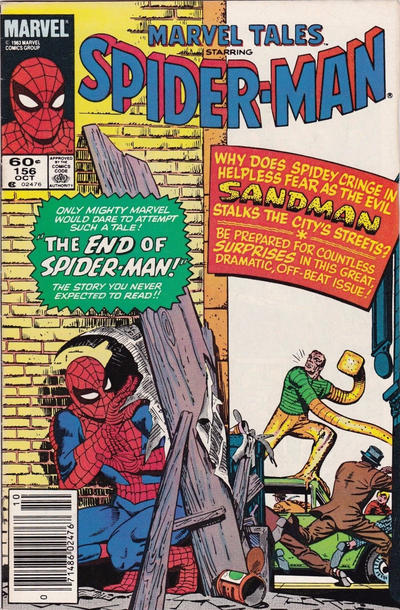
The 40 Years of Comics Project - Day 1228: Marvel Tales #156

https://www.comics.org/issue/1741388/

As I settled down to read Junk Culture #2 today, I found out that Steve Ditko had passed away. So I thought it fitting to read one of his comics today.

I've talked about Mr. Ditko before, (and, actually, as I look back for the link to his stuff in my project, I realize I've read quite a few of his comics here), and about my thoughts on him and his work. I've come to think of him as comics's version of Thomas Pynchon. A weird kind of outsider, no interest in the mainstream, writes or does whatever the hell they want, which subsequently changes the culture around them. And both seem to have been in their heyday in the 60s or so. This is how he's being eulogized at Marvel, as a cultural force, and it's a completely fair assessment. He helped create Spider-Man.

What I think gets me about his death is that I've known his art my whole life. In my very first review of his work, in the Creeper's 1st Issue Special, I noted that I've been reading him almost 40 years. Regardless of whether or not I've always enjoyed his work, it's been a presence in my life almost longer than I'm currently conscious of.

Also, he helped create Squirrel Girl, who is, these days, one of the greatest gifts to superhero fiction of all time. All. Time.

Oh, today's comic was pretty good. Spider-Man overcomes and existential crisis and decides to not quit being a superhero. I feel like he does this a lot.

More to come...


Nov 22, 2017

The 40 Years of Comics Project - Day 1001: The Spectacular Spider-Man Annual #4, 1988

https://www.comics.org/issue/43862/

And back to the Evolutionary War.

Considering Spider-Man has faced the High Evolutionary's forces three times now, this crossover is starting to feel like a Spider-Man story, rather than one that spans the Marvel Universe. But the stories are still only very loosely connected. Spidey himself admits he really has no idea what's going on. I think this is really what sets the crossover apart from others, and it's something I mentioned right at the very beginning of this story - unlike most crossovers, the heroes really have no idea what's going on. No one's discovered a secret cache of plans, no enemies have defected to the good guys' side because they disagree with the High Evolutionary's plan. From this point of view, the crossover is not playing into many of the tropes that we see in contemporary crossovers. Indeed, given the utter lack of awareness and information that the heroes have, I can't see how they'll end up stopping the Evolutionary's manipulations.

I guess we'll find out in tomorrow's Avengers annual, which will lead us nicely back into the last few issues of Walt Simonson's run. I should note that I didn't manage to find one part of this crossover, the West Coast Avengers annual, but I'll keep an eye out for it and fill in the gap when I can.

Today's issue had a couple of interesting points. First, Gwen Stacy is back. When will poor Peter be free of this burden? Well, as it turns out, at the end of this issue. The "clone" turns out to not be a clone, but rather a genetically altered woman, and that alteration is undone and she goes back to whatever life she has out there. Second, we have the Young Gods. This is a super team created way back in 1972 - ostensibly they're people chosen by various gods of Earth to become the next generation of deities. There are, however, some problems. First, though hailing from numerous different nations around the world, most of the characters are coloured Caucasian. A young Polynesian girl and an Indian man are probably the most egregious examples of this whitewashing, and I can only hope that it's a colouring problem from a technical standpoint, rather than a deliberate act. Another problem leapt out at me because I've been teaching Indigenous Literature and culture this week. One of the characters is a young white woman from 19th century Ottawa (misspelled in the comic) who is chosen by a member of the Algonquin pantheon to be a deity. This seems problematic to me, though we might be able to side-step the problem by claiming that the woman was simply the best choice for deification. However, given the horrendous under-representation of Indigenous Peoples in comics, having a settle chosen by an Indigenous god is just not okay.

But enough for now. We'll finish the war tomorrow.

To be continued.

Nov 20, 2017

The 40 Years of Comics Project - Day 999: Web of Spider-Man Annual #4, 1988

https://www.comics.org/issue/1027927/

I came home from work today and my son pointed at the comic sitting on the table. This comic. He said he'd been intrigued by the cover, and picked it up to have a look. And he then noted that the scene on the cover doesn't, in fact, even close to occur in the comic, and that The Slug, this wild new villain, appears on literally three pages in the whole comic.

Basically, this comic was just an excuse to let Steve Gerber tell one of his trademark weird Man-Thing stories that just happened to guest star Spider-Man. And there is absolutely nothing wrong with that. This issue comes out at the same time that Gerber has come back for his second go at Man-Thing. There's a serial that ran in the first volume of Marvel Comics Presents, and this story follows it. The nice thing about Man-Thing, when handled right, is that he's basically the background of the story - but because he's such a volatile and nigh-indestructible background, he manages to flavour the story in very specific ways. I love it.

I'll not say too much more about this issue, as I think I have some things I should say about it for my extremely delayed look at Gerber's work that I'm doing for Sequart. Suffice to say, I enjoyed this one more than any of the other annuals in this crossover thus far.

Tomorrow, a break for an auspicious occasion.

To be continued.

Nov 18, 2017

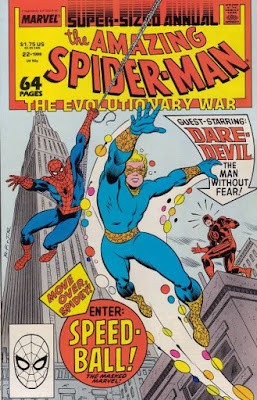
The 40 Years of Comics Project - Day 997: Amazing Spider-Man Annual #22, 1988

https://www.comics.org/issue/83359/

Kind of a "meh" comic today, but really, the whole of the crossover so far has felt that way. It's a little weird, because it's definitely top name creators, at least as far as Marvel in the 80s goes, but the stories are just okay, not awesome.

The team-up of Spider-Man and Daredevil is nicely handled, especially considering that Daredevil was well into his dark years at this point. It's nice to see that he's still capable of levity - when a character is darkened like he was, sometimes writers forget that there's another side to human experience that isn't quite so bleak. But, then again, we're only 2 years from the 90s in this issue, and we all know how bleak the beginning of that decade was.

I'm off to see about getting the last two issues of the crossover from a local shop, the last one I can think of nearby that carries back issues this old. But if I can't find them...then I can't find them. At some point I'll have to stop trying to complete series that I read, otherwise this'll be come the 80 Years of Comics Project - and I'm not sure I have that long left in me!

To be continued.

Oct 28, 2017

Very Brief Movie Reviews: Thinking about Spider-Man

I just watched Spider-Man: Homecoming for the first time. I remember when it came out there was a lot of kerfuffle about the reboot, how we'd just had Andrew Garfield's unfortunately aborted run at the hero, and why did we need a new one? But the thing is that this happens in the comics too - a new creative team takes over and inevitably retells the origin and then moves us into current continuity. This is what Homecoming had the foresight and ability to do.

It was a pretty great movie. Michael Keaton made me actually care about the Vulture for the first time since Jenkins and Buckingham in Peter Parker: Spider-Man #37 (you should go check that comic out - it's amazing).


Jul 13, 2017

The 40 Years of Comics Project - The Weekly Graphic Novel: Week 52 - Peter Parker: Spider-Man - One Small Break, 2002

https://www.comics.org/issue/545332/

I really love the Paul Jenkins/Mark Buckingham Spider-Man stories. They were well into their run on Peter Parker when I had my comic store, and I was always happy to read the next adventure of the wall-crawler. I haven't always been a big Spider-Man fan. He's not one of those superheroes who really spoke to me, though as a geeky, unpopular kid in high school, you'd think he would have. I occasionally see Peter Parker as a bit of a whiner, though. I got a lot of flack in high school for how I looked and who I was, but I never really wanted to read about someone else complaining about it. I wanted to see someone dealing with it and moving on. Add to that the fact that Peter was no longer in high school when I was, and it ends up being a case of wrong place, wrong time.

But Paul Jenkins and Mark Buckingham made me care about the character again, likely because he was dealing with personal and professional issues in his comic at the same time I was struggling through the same things as a result of opening my own business. Issues 35 and 37 (neither of which are actually in today's collection) are some of my favourite Spider-Man stories ever, with #37 being a particular favourite. Peter has a bad cold and is challenged, during a snowstorm, by the Vulture to a duel. Shenanigans ensue.

Today's graphic novel collects a couple of stories, and, in my not-so-humble opinion, they're not quite as good as the other issues I've mentioned. The characterization is still there (and I really think there's an excellent case to be made for Peter Parker suffering from clinical depression, but that's another post), as is the action and of course the art. But the heart of what I love about this creative team's tenure on the book is the way they portray Spider-Man as being someone that all of us could potentially be. He really is the everyMAN (in capitals because the sexism is right there in the name) superhero. Issue #35 tells of a young African-American child who envisions Spider-Man as a Black person, just like him. It raises interesting questions about the superheroes who wear full cover and those whose skin you can actually see. By covering as many marks of physicality as possible, does a superhero become more mythically representative of the culture they embody?

Onward.

May 1, 2017

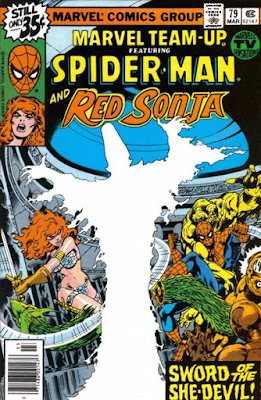
The 40 Years of Comics Project - Day 796: Marvel Team-Up #79, March 1979

https://www.comics.org/issue/33220/

One of the things I noticed this year at the con was a propensity for "mystery boxes." A couple of years back I bought one in the shape of a giant Lego figure head and it had some interesting stuff in it. This year, they were everywhere, in all shapes and sizes and patterns. And the comics people got in on the trend by offering mystery grab bags. This particular comic came out of a "15 comics for $10" grab bag, some of which was really cool, like today's comic, and some of which are probably going to be terrible. But I kind of love the terrible stuff in its own right anyway.

There's a great panel in this comic, very early on, at a Christmas party at the Daily Bugle. There's a bespectacled man in a blue suit chatting with Robbie Robertson, who says, "So tell me, ol' buddy. How does it feel to be a mild-mannered reporter for a great metropolitan TV network?" The man is quite obviously Clark Kent, who at this point in time was a news anchor on TV, rather than his traditional role as reporter. It's a nice touch, especially since the crossover between Supes and Spidey was only a couple of years off. This scene sets up a strange space in the Marvel and DC universes, as we're seeing a completely unmediated crossover (in that, there's no dimensional travel or anything) between the two comic book continua. And the DCU isn't even the only other fictional universe to cross into the Marvel U in this comic. While Conan and Red Sonja enjoyed a long run at Marvel, they were more often than not considered in their own fictional universe, yet there's a moment in this comic where Spider-Man notes the artifacts in the museum were recently discovered to "pre-date man's oldest recorded civilizations," thus suggesting that the Hyperborean age was somehow a precursor civilization to the Marvel superhero universe. Whether or not this ever became canonical I have no idea, but this blending of three very distinct universes into one story is quite a treat.

As I noted yesterday, I'll be reading some comics from the stuff I got at the con this weekend, probably a mixture of the old stuff that fills in the collection and the newer, indie stuff that I picked up in the Artist's Alley. Very exciting.

To be continued.

Mar 23, 2017

The 40 Years of Comics Project - The Weekly Graphic Novel: Week 39 - Superman and Spider-man, 1981

https://www.comics.org/issue/214728/

I have, amongst my graphic novels, a whole whack of little paperbacks that were the precursors to our current trade paperback reprints of comics. This week's graphic novel reprints an old tabloid-size co-publication, featuring a team-up between the most popular (at that time) characters from Marvel and DC. I suppose nowadays, it would be Batman and Wolverine.

Which wouldn't make a bad team-up.

This story goes about the blending of the universes in a way that I haven't seen before. Rather than doing the whole parallel dimensions thing, this story simply proceeds under the assumption that all of the Marvel and DC characters exist in the same universe, and always have. Spider-Man even makes a little joke about it, noting that Wonder Woman is based in New York, the same as him, but he never sees her around. It's a cool idea, and I'm sure that, in the structure of the multiverse that unacknowledgedly links the two fictional universes, this Earth has a designation and continues on its merry way.

It's not, however, my favourite thing I've read. First, the two heroes don't actually spend that much time together, and when they do, Superman's kind of a jerk to Spider-Man. Further, a good portion of the story is dedicated to Clark Kent going to work for the Daily Bugle and Peter Parker going to work for the Daily Planet, so the story even conspires to keep the two in separate cities. Their nemeses, Dr. Doom and the Parasite actually spend more time together, and accomplish more together, than the superheroes do. Spider-Man, in fact, spends almost as much time with Wonder Woman as he does with Superman, whereas Superman spends much more time with the Hulk than with his co-star. You'd think the point of a team-up entitled Superman and Spider-Man would be to see the two working together.

The second thing that throws me off is the breaking up of the comics page proper into the smaller page format. Though in some places it's rather expertly done, it completely disintegrates the spatiotopic design of Buscema's layouts. How much are we missing in that kind of a reading when the page has literally been cut apart and spliced back together in order to accommodate a format?

What we do have to acknowledge about this kind of a publication, though, is that it paves the way for the more recognizable trade paperback reprints. That aside, I am very glad that this isn't a format that remained popular.

To be continued.

Mar 7, 2017

The 40 Years of Comics Project - Day 741: Marvel Team-Up #135, November 1983

https://www.comics.org/issue/859876/

As I searched through my boxes for a comic to read this morning, I realized that Marvel Comics has named a lot of their comics after themselves. You'd think that the box up in the corner would tip people off to the fact that a comic features Spider-Man (he pulled a lot of guest appearances in the 80s. Transformers #3 is one of my favourites), but I guess branding is a thing in advertising, so there you have it.

I liked today's comic. Kitty Pryde was one of my first crushes as a young boy - I loved her in Uncanny X-Men, in her occasional appearances in The New Mutants, and in her transformation into ninja badass in the Wolverine & Kitty Pryde miniseries. For me, more than any of the other characters, Kitty was always the heart of the X-Men, that rebellious teenager who emblematized the rebelliousness inherent in the X-Men. It broke my heart when Joss Whedon did what he did (which I won't mention in the service of SPOILERS), though, as with all comics characters, she recovered. So putting her in the situation of having to babysit a couple of obnoxious kids, and then end up teaming up with Spider-Man to fend off some strangely technologically-advanced Morlocks fed so much of my inner adolescent. Not that he's hungry very often.

The art is standard 80s Marvel art, which means, again, the nostalgia factor kicks in for me. Though this comic was perhaps a year or so old by the time I started collecting comics, Ron Frenz's art is just how I remember those first comics I picked up from the House of Ideas: West Coast Avengers, Secret Wars, Avengers. These were my introduction to the world(s) of superheroes, so whenever I read something that resembles those titles, the thrill of discovering, or its memory, hits me again.

To be continued.