For information on stopping the spread of COVID-19, and on what to do if you are quarantined, have a look at the World Health Organization site.
Thoughts, reviews, rants, laments, and general chatting about the wonderful world(s) of comic books.
Nov 25, 2020
Nov 5, 2020
The 40 Years of Comics Project - Day 2080: Conan the Barbarian #10, October 1971
For information on stopping the spread of COVID-19, and on what to do if you are quarantined, have a look at the World Health Organization site.
We enter the Bronze Age with a tale of the Iron Age, or one of them at least. My exposure/knowledge of Conan can be summed up in hazy memories of Arnold Schwarzenegger's turn in the roll. I've read a bit of Robert Howard's stuff, but mainly his Lovecraft-inspired mythos tales. The Conan stuff never really did it for me. I think I also must have read a few of his stories when I was first getting into Cerebus, if only for context. And today's comic offers that as well.
Barry Windsor-Smith is a fantastic artist. He stands out to me alongside someone like P. Craig Russell for having come out of the 70s with an art style unlike anyone else producing comics at the time. Marvel's Bronze Age, I think, is characterized by their house style with superheroes, but in the non-continuity, non-superhero titles, there was a little more wiggle room for differing aesthetic choices. Russell's Killraven and Windsor-Smith's Conan are wonderful examples of this.
Storywise, not bad. I think I enjoyed the Black Knight story that is sandwiched between barbarians in this comic, a reprint from a comic of the 50s. Sir Percy is an interesting character, effecting what really seems to me to be a medieval version of Clark Kent to keep suspicion away from his identity as the Black Knight. A fun little story, borrowing liberally from the Robin Hood tales.
More to follow.
May 25, 2020
The 40 Years of Comics Project - Day 1916: King Classics: The Prince and the Pauper, 1978
Sep 23, 2019
The 40 Years of Comics Project - Day 1672: Time Bandits, 1982 (Movie Adaptation Week)
The last of my film adaptations for this week comes from a movie I loved (LOVED) as a child. I haven't watched it in many years, so I'm not sure how it holds up, but anything from the pens of Terry Gilliam and Michael Palin, produced by George Harrison, has to have something going for it. Those who've never seen it, I recommend it. Imagine Monty Python doing science fiction, and you'll have some idea of what the film is like.
This adaptation is one of the few this week that I can actually compare to the movie, since I've actually seen the movie. And it's a pretty good version. The likenesses to the actors is good, though perhaps not great, but the narrative follows the film pretty faithfully. The static nature of the medium keeps some of the physically-comedic notes from coming across fully, but the puns and satire are there.
Adaptations are a tricky business. They're always going to be compared, be it favourably or no, to the source material, whether film or screenplay. And when they're adapted from the screenplay, sometimes there will be vast differences between what eventually ends up on the screen and what we see in the comic. Over the weekend I read the adaptation of the Howard the Duck film, and the creatures at the end are actually supposed to be monstrous ducks, rather than the insectoid creatures we see in the final film. Sometimes these differences are good, and highlight the freedom that drawing a story affords artists, but sometimes the differences are bad, and one can see why, in the final film, they would have been changed. I think the monster ducks were a change that needed to happen.
Not sure where we're heading tomorrow, but I'm sure it'll be interesting.
"And for the loser...a soggy death by drowning in a giant bowl of warm custard! Isn't that a scream?!"
Sep 19, 2019
The 40 Years of Comics Project - Day 1668: Planet of the Apes, 2001 (Movie Adaptation Week)
I remember watching the original Planet of the Apes series when City TV would do marathons of them over the course of a day. Spending a whole Saturday on the couch watching this bizarre future history unfold was a lovely way to pass some of my adolescent time. But, as with the other movie adaptations I've reviewed this week, I've never actually seen this one.
I think perhaps that's a good thing - this way I can judge the piece on its own merits, rather than in comparison with its source material. And on that topic, you'll note that the cover says "Based on the motion picture screenplay," rather than being based on the film itself. I read a synopsis of the film, and the comic actually removes the "twist ending" from the film. Or rather, I think the film added something to the screenplay. Either ending didn't make a whole lot of sense to me. In the comic, it seems our hero Leo is going to go back in time and completely erase the future he's just helped to save, and no one seems to have a problem with this. And in the film ending, how the hell did the apes Leo defeated manage to travel back in time? Though, really, I ought to see the film before bashing it too much.
The edition I read today was signed and numbered by writer Scott Allie. I likely picked this up as a premium comic to sell at my store, though the lack of success of the film meant that the comic adaptation didn't really have a huge audience. Which brings me to an interesting question: who exactly is the audience for a movie adaptation? I suppose in the days of no streaming services or Internet, it was a way to relive a film that you might not have easy access to. But does something like this film, which would have hit home media very quickly, really need an adaptation? I suppose it speaks to people who would rather read a comic, or novelization, than sit and watch the film. And it's more portable, I suppose?
Anyway, it wasn't very good, all things considered. There was a strange propensity for the captioning to switch between past and present tense, which simply reinforces my idea that all comics publishers should be hiring ex-English academics as their editors. We do not miss stuff like that.
"Daena also knows that this she-ape wants more from Leo than a rescue."
Sep 18, 2019
The 40 Years of Comics Project - Day 1667: Marvel Super Special #20, 1981 (Movie Adaptation Week)
I'm reasonably sure I've seen this film, though there really is a good chance that I haven't. I have vague impressions of it, though I would only have been 7 when it came out.
Maybe I haven't seen this film.
I'd really like to, though, because this was a pretty great story. While I'm concerned that the special effects may not have aged particularly well, the tale that's told is pretty solid. There's lots of cool twists, some very mythic stuff going on, especially the bits that touch on Christianity. It's a story that really feels like it could have happened in our world. Though I can't really say why without spoiling one of the coolest parts, IMHO, of the story.
Apprentice wizard Galen has to face off against the last dragon. That's all I'll say. It sounds like a pretty standard fantasy story, but, as I mentioned, there's neat twists that definitely set it apart from the usual bunch. Though I grew up on a pretty steady diet of Dragonlance in my early teens, I've never really been a huge fan of the genre. Given my penchant for Dungeons & Dragons, that's a bit odd, but I think I've always taken from superheroes the same sort of escapism that fantasy brings. We geeks, we sometimes focus on one genre to the virtual exclusion of all others. So it's worth noting, for me at least, when a fantasy story does resonate. This one did.
Denny O'Neil adapts the screenplay, and Marie Severin and John Tartaglione handle the art. One of my planned theme weeks will feature Ms. Severin and a couple of other female artists from the early days of Marvel. The likenesses to the cast of the film are well done. I can't imagine having to draw a story in which you had an actual real-life original that could be compared to your work on pretty much every page.
The back half of the magazine is given over to "making of" features. There is, of course, one that focusses on the creation of Vermithrax Perjorative ("The Worm of Thrace Which Makes Things Worse") - the titular dragon. One particular part of that article jumped out at me in the first description in the article: "...it is the last of the great dragons, a four-hundred year old androgyne, a fire-breathing monstrosity" (emphasis mine). There's no other mention of this in the entire magazine, but I find the idea that the dragon is non-binary very interesting. On the one hand, the creature is squarely conceived as an evil force outside of nature, contrary to humanity and it's perceived binary of male/female. From this perspective, the dragon represents something contrary to Christian binary worldview. On the other hand, Christianity is not well-presented in this story, particularly, and even the ending hints at a hidden way of perceiving magic within the Christian framework that comes to dominate the world. But the dragon is still (SPOILER in case you missed the title of the comic!) slain, and the magic, and androgyny, they represented is hidden. I'm perhaps making too much of this, but I'm fascinated by the appearance of gender identities that are becoming more widely recognized in older works of literature.It tells us a lot about cultural attitudes toward such things through history.
(Of course I've just realized that the main female lead in the story begins in drag, so as to avoid the lottery of maidens sacrificed to the dragon, but "comes out" partway through the story. Maybe I need to think more about this one.)
"You can't stop me. After all, I've been a man longer than you have."
Sep 17, 2019
The 40 Years of Comics Project - Day 1666: Marvel Spring Special #1, 1988 (Movie Adaptation Week)
In an effort to get back to regular updates, I'm doing some theme weeks. This week we'll be looking at film adaptations. Like novelizations of films, these are always a bit of a dodgy prospect. The comic can't deviate too far from the source material, though there are instances where the comic was created from an earlier draft of a script and features things not in the film. I imagine that artists would also try as hard as possible to give the characters in the comic as much resemblance to the actors as possible, but in a stylized art form, that's not always easy. As such, adaptations can disappoint for not cleaving quite so photo-realistically to the film they adapt.
I've never seen the Elvira, Mistress of the Dark film. Or if I have, there's no recollection of it in my brain. I know of Elvira, mainly because of her prominent cleavage that was in the background of my adolescence, but I don't think I ever watched any of her television shows. For those not in the know, Cassandra Peterson plays Elvira as a late-night horror film host, sort of a sexy version of the Crypt Keeper. She's also featured in comics where she plays a similar role. At some point her popularity must have crested and she got her own feature film. The story is somewhat akin to Footloose, though with a slinky goth/valley girl in the role of agitator rather than Kevin Bacon. The sultry Elvira inspires the youth of the town to overthrow the restrictive laws of the older generation.
One thing that I'm curious about is whether or not each discreet scene in the comic follows the film. I suppose this would hinge on whether or not the artists were able to see the film prior to creating the comic. If not, I imagine that Colon made decisions for each scene that might have been substantially different from the choices director James Signorelli made. I am not, however, going to sit through the film just for the sake of comparison, I'm afraid. The story just wasn't that good.
Join me at the movies again tomorrow, won't you?
"Hey! I've seen "The People's Court"! I'm entitled to one phone call and a strip search!"
Sep 30, 2018
The 40 Years of Comics Project - Day 1313: The Real Ghostbusters #7, January 1988
Another cleverly-scripted issue of this series. I'm now wondering if I need to rethink all those times that I skipped over the series in the quarter bins. It seems that ghosts are possessing mobsters in order to live the good life. The Ghostbusters pose as a rival mob and take them down. But there's some hinting about larger stories going on, which I find very interesting. It's one of the things that often draws people to film-adaptation comics - the opportunity to flesh out the fiction. A film has to do a number of things very quickly in order to keep its audience entertained. Very often, there's little room for establishing the world of a film, especially back in the old days before extended series of films were even a thing. So a comic gives writers a chance to do so. The old DC Star Trek comic is a perfect example, really, as is this comic. Although the likenesses are very unlike, we get a glimpse into some of the other cases the Ghostbusters have faced, rather than simply the world-shattering ones we get in the movies. A comic like this provides a much more solid foundation for the characters and conundrums presented in the films.
More to come...
Sep 29, 2018
The 40 Years of Comics Project - Day 1312: Married...With Children: Kelly Bundy Special #3, October 1992
Although this post is dated the 29th, I wrote it on the 30th. Yesterday, for the first time in 1311 days, I forgot to read a comic for the project. I've had days where I haven't blogged on time, but I haven't, before now, forgotten to read anything at all. I must be getting old.
So, here it is, the comic I'd meant to read on the 29th. It is pretty thoroughly unremarkable. Mildly amusing, in the same way the the televisual source material is.
More to come.
Sep 28, 2018
The 40 Years of Comics Project - Day 1311: The Real Ghostbusters #28, February 1990
A thoroughly entertaining take on the possessed by an evil ancestor trope, definitely much more amusing than Charles Dexter Ward. Throw in some ghostly time travel, and you've got me hooked. Unfortunately this is the last issue of the series - perhaps a wonderful last hurrah?
And I'm very tired tonight, so that's all for now. More to come...
Sep 27, 2018
The 40 Years of Comics Project - Day 1310: Married...with Children - Kelly Bundy Special #1, August 1992
I was never a fan of Married...with Children. It just seemed overly crass to me. I was such a sensitive teen ;P
This comic is exactly what you would expect an adaptation of that show to be. Crass, silly, lots of bouncing boobs, and Al Bundy, the world's worst husband and father. The story is funny, but not really funny.
What this comic has reminded me of is how much I like Christina Applegate. She's a very funny lady who managed to not be typecast after playing Kelly Bundy, which is quite a feat.
More to come...
Aug 27, 2018
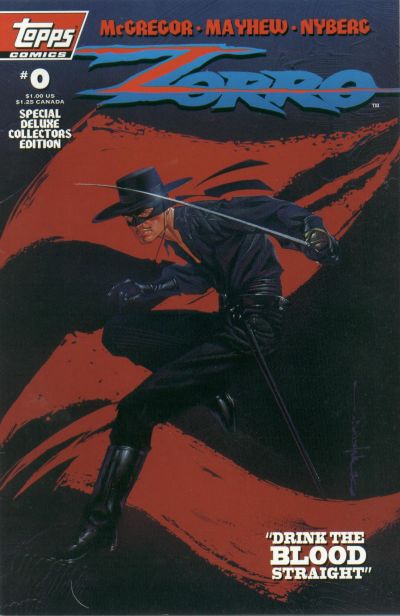
The 40 Years of Comics Project - Day 1279: Zorro #0, November 1993
It's like a 19th century version of Deliverance.
There was a brief time when I thought I might try to track down all of Don McGregor's stuff, around the same time I was really discovering Steve Gerber's work. I did do some work in finding his works, but they didn't speak to me the same way Mr. Gerber's did. In some cases it was genre, in others simply that I'm not a huge fan of his chosen way of telling comics stories. The predominance of caption boxes is just not my thing. I'm more interested in elucidation through context, rather than exposition. Mr. McGregor sees comics a bit differently.
This is a very bloody comic. There's a poor beaver that spends its entire existence in the story gnawing its leg off to escape a trap. And Zorro has to take out a giant, crazed mountain man.
Now that I've written it, perhaps Zorro wandered into Alberta.
More to come...
May 10, 2017
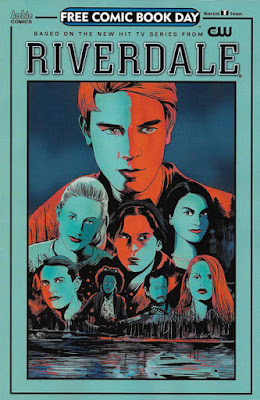
The 40 Years of Comics Project - Day 805: Riverdale One-Shot, FCBD edition, may 2017
I think every Free Comic Book Day for the last few years, I've lamented the days when I used to be able to come home with a stack of 20 comics that were all pretty fantastic, and spend a week or so pouring through them for the inevitable treasures. These days, FCBD is little more than another way for comic shops to make money, and not from side-purchases when one goes to get the free stuff.
Anyway, today's comic is really pretty good. I think Riverdale surprised everyone by being not only very, very cheesy, but also very, very compelling. I've been trying to figure out how much of that is based on prior knowledge of the characters and the shock value of seeing them put through this kind of story, but the fact that people who have little or no exposure to the long history of Archie comics also love this show really just means that it's doing something right. With the new Twin Peaks mere days away, and shows like Sense8 telling strange stories that we need to see, there's a new propensity in television for the strange, and Riverdale is giving us our teen-angst dose of that strangeness.
Some nice background bits in today's comic, though nothing that we actually haven't been made aware of from the show. With one possible exception: Hiram Lodge's desire to not have Veronica witness his downfall. It's pretty clear (SPOILER ALERT) that we're going to see Hiram soon in the series, if not in the final episode of the first season then at some point in the second. All we've heard of him in the TV series so far paints a very grim picture. But there's one panel in this issue in which he demonstrates some shame over his predicament, shame associated with his daughter maintaining a particular image of him. That's a very humanizing quality for a character that could have come in and been a stereotypical mustache-twirling villain. And that, I think, is what Riverdale has managed to do which distinguishes it from a lot of the other angst-y shows with which is shares an ostensible genre. It takes the stereotype and adds to it a dash of difference, just enough that we are left guessing, rather than knowing full well what a character is likely to do in a given situation. Further, given that Roberto Aguirre-Sacasa helmed this issue and helms the show, that little aspect of Hiram is very likely to carry over.
Though, honestly, I'd put up with a less well-rendered show if Mr. Aguirre-Sacasa woud just grace us with another issue of Afterlife and Chilling Adventures. Those comics are fucking mad!
To be continued.
Jan 16, 2017
The 40 Years of Comics Project - Day 691: Battlestar Galactica #1, March 1979
We really should all thank our lucky stars for Ronald D. Moore. Though he starts out with a good idea, the original execution of Battlestar Galactica was just bad. Even here, in the comics adaptation, it's bad. Galactica tried too hard to be the next Star Wars when it was so much better suited to the kind of intelligent social commentary the reimagined series gave us in the early 2000s.
But televisual execution isn't all that's damaging this comic. Though drawn by Ernie Colon, an excellent illustrator, the arrangement of panels and speech bubbles, the indistinguishability of some of the main characters, even the colour palate, all work together to make a really uninspiring comic. There are some fine moments. The destruction of the Battlestar Atlantia is well-depicted. But a few nice panels can't save this comic from being confusing and disappointing.
Now, this is not to say that the comics adaptations of the 2000s series were much better. I was never able to get into them, despite loving the show. Perhaps some stories are simply better suited to the medium of their creation.
Onward.
Oct 10, 2016
The 40 Years of Comics Project - Day 593: Master of the Universe The Motion Picture #1, 1987
A few weeks back I read through Paul Chadwick's Concrete: Fragile Creature mini-series, in which the title character assists on a film set for Rulers of the Omniverse, a movie based on a children's toy line. I thought it would be amusing, and slightly metatextual, to review the comics adaptation of the movie that Chadwick apes in his story.
I was a huge fan of the Masters of the Universe toy line - my brothers and I had the figures, the castles and playsets, the vehicles. I even collected the comic well after I'd lost interest in the toys and cartoons, and the final couple of issues of the Marvel series, a dystopian possible future story for Eternia, are just excellent. On top of this, I remember fondly the movie coming out, though it only slightly captured the feel and strangeness of the toy. (Also, Courtney Cox, well before Friends, and a little after Misfits of Science, starred, and I've always liked her.)
It's that capturing of the strangeness of the toys that I'd like to focus on. The designs of this comic are much more in line with the toys, cartoons, and comics for MOTU, much more so than the actual movie. Now, partially I'm sure, this is because Dolph Lundgren would have looked ridiculous in He-Man's costume - I'm teaching my students Michael Chabon's "Secret Skin" tomorrow, and in he talks about attempts to realize superhero costumes in our own physical reality, and the failure of such ventures. I think the furry-shorted He-Man might suffer a similar problem. But that the comics adaptation went with the original designs allows it to fit more properly with the stories that were being told in the comics. It's for reasons like this that I continue to wonder where the series would have gone had it been able to continue after the cancellation of the toy line. Today's comic reads much like a finale to the whole He-Man versus Skeletor story, with Skeletor finally victorious, and a few of the last Eternian heroes rallying to defeat him. It's a pity we don't see more of the other heroes, but the three major players are present. The comic also plays down the magical aspect of Eternia significantly, making everything much more science fictional than the source material, and replacing the annoying Orko with the equally annoying Gwildor.
One thing that I find odd is that Beastman, a staple of the toys and cartoons and comics, and one of the more recognizable of the villains, is illustrated in this comic in his film version, rather than his toy version, unlike every other character in the comic. It's an odd choice, especially since Beastman's original clown-meets-bear design is quite strange and intimidating.
So, not a terrible comic, but not a great one. Probably a better story as a comic than it was as a movie, but nostalgia cleanses so many sins from our memories.
Onward!
Sep 30, 2016
The 40 Years of Comics Project - Day 583: The Outer Limits #17, October 1968
There's a strange disconnect in this comic. As we're all aware, comics can be a remarkable example of creative collaboration. Claremont and Byrne. Ellis and Cassaday. Morrison and Quitely. The proper team can create magic. Unfortunately, the opposite can often be true, too. Since this is a particularly old comic, there's no listing for the writer, and I only know Jack Sparling is the artist from the GCD, but it really seems that these two creators were just not communicating properly. The script says one thing, the pictures another. A "strange, gleaming metallic building" is depicted as what honestly looks like a child's version of the sun coming up over the hills. A sound weapon that "quivers like a tuning fork, vibrating faster and faster till the sound shreds [the gun] to pieces and pulverizes it into harmless dust" becomes a heat ray, and the guns melt, rather than disintegrate. Of course, it's hard to say what came first, the script or the art, but it really does seem that one of the creators involved just didn't like what the other did, and changed it.
This makes for a very off-putting reading experience. On the one hand, we can consider it from the above point of view, that there was a disconnect between the creators involved. If we want to be slightly more optimistic about it, this could be a perfect example of unreliable narration, both linguistic and pictorial, in comics. Something happened, but neither version of events lines up with the other, and so we can't really tell what happened. Similarly, the aliens in the story are only ever referred to as "the monsters" by the verbal narration - their depiction is simply one person's attempt at parsing that term.
Old science fiction is always interesting - so much less space opera, so much more hard sci fi. Onward!
Aug 15, 2016
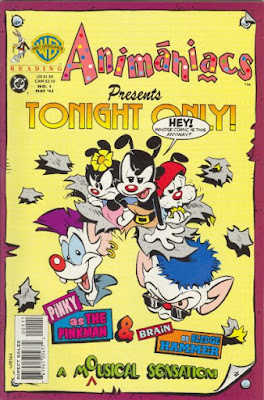
The 40 Years of Comics Project - Day 537: Animaniacs #1, May 1995
After reading this comic this morning, I decided to have a quick look at the history of the Animaniacs television show. It's credited with being a part of something called the "animation renaissance" of the late 80s and early 90s, that time when television started realizing the potential that the animated medium has. It might seem obvious to us now, as with comics, that this medium has the ability to tell complex and satisfying stories, but it hasn't always been so.
I've loved Animaniacs, and specifically Pinky and the Brain, for longer than I've been a father, and about as long as I've been married. I realized that this comic is actually 21 years old this year, which I find stunning. The lead story features my favourite genetically altered lab mice, and, lack of cellphones and Facebook references aside, it's a remarkably fresh tale. The comic takes after its cartoon predecessor in offering not only amusing sight-gags that might appeal to a younger demographic, but also intelligent comedy for those of us who enjoy a bit of satire and wit in their anthropomorphic animal stories. The Warner siblings tale that follows is a bit more on the nose, but still enjoyable. The only sticking point I had with this comic is the last tale, a historical piece starring the Warners and Christopher Columbus. While these historical insertions were a staple of the series, the utter lack of critique of Columbus' role in the "discovery" of the Americas really does point to a certain agedness of the comic. But, as with the horrendous racism of Barks' otherwise brilliant Duck comics, we have to use moments like this to recognize the absences and abuses that have dogged the history of the North American continent.
Quite a different read from my Batman stuff of the last few months. Can't wait to see what tomorrow brings! Onward.
Jun 3, 2016
The 40 Years of Comics Project - Day 465: Avengers Assemble - Hulked-Out Heroes, 2015
Another micro-comic based on the Avengers Assemble cartoon and comic series. Before I get to the story, here's the other stuff that came in the package with it.
Yep, that stuff's pretty neat. The story in the comic is very silly. Somehow all of the Avengers, with the exception of Black Widow, are Gamma-irradiated and become Hulks. Bruce Banner, as a far more articulate Hulk than his film or mainstream comic counterpart, comes up with a device that cures them, but he, strangely, decides not to use it on himself.
Yeah, silly. But sometimes, that's a good thing. Onward.
Apr 25, 2016
The 40 Years of Comics Project - Day 426: True Love #1, January 1986 ("Wuv, twue wuv" Week, Day 6)
As with yesterday's comic, this one is a reprint of old romance stories, though without the re-scripting. A collection of tales from Standard Comics in the 1950s, featuring some of the luminaries of the industry, these stories are a welcome break from the heart-wrenching, angst-filled stories of teenage heartache. These are stories of what comes next, of the "happily ever after," and how it can oftentimes be just as difficult as early romantic entanglements. Which is probably, as someone whose been married for 20 years, why this comic appealed to me more than most I've read this week. As someone who understands the kind of daily work involved in being in love, and loving, it's nice to see such subjects given a good treatment.
Even more, one of the stories in this issue features a woman who can fix a car, and doesn't take shit from a mopey man with whom she has a relationship. There's even a gentle-yet-heavy-handed exploration of PTSD in the wake of the Korean war, which offers an interesting perspective form which to start thinking about these sorts of romance comics. Industry creators have, for a long time, claimed that one can tell grown up stories using a medium that is far too often associated with children's literature, and these stories offer evidence. Instead of relegating the medium to one that is only useful for action stories, we see from this sampling that creators were trying to tell stories about the things that move us, and that we are moved by, in our daily lives - not unlike most serious, literary authors. True Love shows us that there are romance stories for grown-ups, even if the cultural mores of the 1950s leak through a little too prevalently sometimes.
Also as with yesterday's comic, I read the opening text feature, which revealed where these comics had originally appeared. It was nice to see acknowledgement of the fact that most of these stories were written by men for women, and that that opens up the stories to a slew of critical problems, but I found that, by and large, they treated women with far more respect and interest than the teen romances I've been reading this week. True Love was a 2-issue mini-series, and I think I'll be looking for the second issue for another sampling of these thoughtful stories.
One last thing - the cover does not have anything to do with the interior. It's beautiful, as is most of Dave Stevens' work, but it's actually the promotional blurb on the inside front cover that I find amusing. It calls this work "An unmistakable gem of a cover." Noting the pink hair of the lady on the poster, I can only imagine it's a shout-out to Jem and the Holograms, which was first airing around the time this comic came out. Eclipse always was a clever comics publisher.
Last day, tomorrow, and something a little different. See you then.
Apr 24, 2016
The 40 Years of Comics Project - Day 425: Last Kiss #2, August, 2001 ("Wuv, twue wuv" Week, Day 5)
You should go to John Lustig's "Last Kiss" site and read his comics.
I'll make an admission: I don't usually read text pieces in the comics I blog. I'll have a peep at "Stan's Soapbox" every now and again, or let my eyes wander over a letters page or two, but generally I'm more interested in the comics stories themselves. But with this comic, I thought maybe getting some context would be helpful. Let me explain.
Last Kiss is a romance comic, to be sure, but it's a romance comic with a twist (and that's a bit twisted!). John Lustig, apparently, bought the rights to a Charlton romance comic called First Kiss, and subsequently started re-scripting and manipulating them and making them into ironic 21st century parodies of the original pieces. This is not to say that he is not reverent of the source material - in some ways, in order to really skewer something, you have to love it a lot. This issue featured work by renowned inker Dick Giordano, even including an original piece scripted and drawn for this issue. The jewel in the crown that is this comic, though, is an interview with Giordano about his time working on romance comics for Charlton. He offers a rather wonderful articulation of the differences between drawing a superhero story and a romance story, and why, as an artist, he finds them interesting. I'd never really put together that there are different artistic vocabularies depending on the genre one is working in. Giordano notes that a romance comic is about subtlety and emotion, rather than action and hyperbole. It's one of those things that, of course, makes sense after the fact, but that I'd never thought of before.
So, much as the comics sections of this issue were funny, and I enjoyed them, the interview with Giordano was the best bit. Perhaps I'll have to start paying a bit more attention to text pieces in future.
Moving on, almost done our week of romance. Onward!