Pages

Showing posts with label 1940s. Show all posts

Nov 13, 2020

The 40 Years of Comics Project - Day 2088: Famous 1st Editions F-7, June-July 1975


 I can't imagine how exciting it must have been to see all of these characters gathering together in one place for early fans of the superhero. The story inside, therefore, may have been a bit disappointing. Rather than a team adventure, we basically get the guys sitting around and telling stories of their solo exploits. And while the stories are good, the Hawkman and Spectre tales in particular, it's hardly what we've come to expect from a team-up book. The closest we get to any action involving everyone is when Johnny Thunder accidentally unleashes his thunderbolt.

But...

It was a cool look at the Golden Age of superheroes, an age I don't pay a lot of attention to because I think I've only seen the mediocre stuff. There's a style we associate with the Golden Age, one that gets picked up by such titles as Big Bang or Supreme, but the variety of art styles presented in this comic show that that iconic style is only a part of what was going on. The art on the Spectre tale, in particular, with its mixture of superhero and storybook, was fabulous.

More to follow.

Nov 3, 2020

The 40 Years of Comics Project - Day 2078: Famous 1st Edition F-8, September 1975

 For information on stopping the spread of COVID-19, and on what to do if you are quarantined, have a look at the World Health Organization site.

Where was I?

After having sold a few comics at Purple Gorilla, I picked up some nice vintage-y stuff in exchange, including a couple of Famous First Edition Golden Age reprints and some cool Silver Age superhero stuff. I thought, as I try to wade back into daily writing (the pain has gotten much better in the last little bit), I'd do a comic from each of the major "Ages," one a day, for a while.

The delineation of ages I use comes from www.keycollectorcomics.com, and breaks down thus: Golden Age - (1934-1955),


Dec 21, 2019

The 40 Years of Comics Project - Day 1760: Tip Top Comics #107, June 1945

https://www.comics.org/issue/206121/

Picked this up today from Purple Gorilla Comics - it's easily one of the oldest comics in the collection now, and is in incredible shape for its age. The Bushmiller "Nancy" stuff was good - it's a surprisingly surreal strip. The other stuff was pretty tame fare - mostly newspaper reprints, I think.

I've long wanted a proper Golden Age comic in the collection, and this one certainly qualifies. The way comic publication dates work, the comic was published in March-April of 1945, a few months before the end of the Second World War. This is alluded to in some of the content referring to the War as being ongoing. It's chilling to think of what was going on in Europe and the Pacific when this comic came out. I wonder what I'll think 20 years from now when I muse upon the comics that came out over the last few years...

I'm tired and we've just finished moving, but I have some other thoughts about the other strips in this comic. I'll get back to you.


"Hey, Bushmiller! -- Wake up and finish this drawing!"

Nov 11, 2018

The 40 Years of Comics Project - Day 1355: Moon Girl #3, Spring 1948 (Flashback Replica #9)


Yeah, I got hooked. But at the price these comics command, I'm going to have to stretch things out.

We get a nice mix of tales today, and even a visit back to Moon Girl's home country, Sarkomand. It isn't, as I'd first thought, a female-only society, a la Themyscira, but is a matriarchal society. Moon Girl, or Princess Luna's mother, the Queen, is caught up in a coup, and the Prince and Princess return home to lend a hand.

Satana shows up again, firing missiles at various targets all over the US for reasons. The final story is a classic twist story: we see a splash page of Moon Girl as criminal (shocking!), and follow the exploits of a villainous double until the real hero shows up and all is explained. I think that one thing that gets overlooked here is that, without prosthetics or make-up, there was literally someone who looked exactly like Moon Girl, just with blonde hair. How weird would that be? Then again, this is a superhero world. Stuff like that just happens.

From what I can tell, Canton Street Press published seven issues of Moon Girl. These two are all my local comic store had, so it looks like cons or the Internet next. But not until I've saved up my pennies.

More to come...

Nov 8, 2018

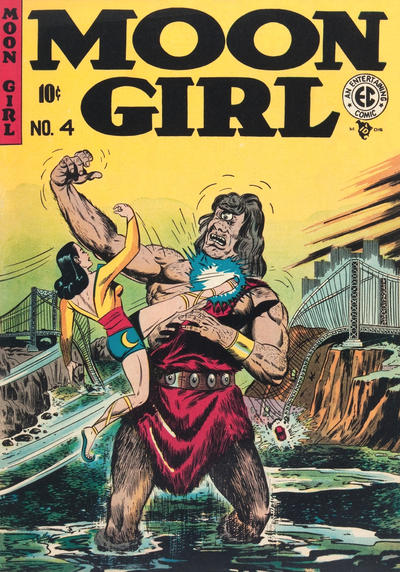
The 40 Years of Comics Project - Day 1352: Moon Girl #4 (Flashback Replica #11), 1948

https://www.comics.org/issue/6828/

As I was discovering the wonders that are pre-Code horror and science fiction titles, two things happened in succession. First, I finally read Jon Morris's amazing The League of Regrettable Superheroes, a wonderful look at some of the strange heroes of the early days of comics. Moon Girl is one of them. Second, as I was picking up a reprint collection, I noted that they had replica editions of some comics at my local comic shop. Moon Girl was one of them.

As EC's only costumed hero, I was intrigued, and the reprints from Canton Street Press are super-cool. And I've been talking about adding depth to the collection. The replica is slightly different than the reprint in that the comic in its entirety is reprinted. We don't often get this in reprint volumes. Indeed, the ads from 1948 are chilling - one invites you to purchase, through the mail, a proper .22 caliber rifle for $11.95. I know that was a lot then, but it's the mail order aspect I find bizarre.

Moon Girl's adventures are cool, and I think I might pick up a couple more of the replicas, though they are a bit more expensive than your average comic. What these editions do bring nicely to the books is the materials from which they're made, far superior to the original editions. There was definitely something a little magical in reading a comic that, aside from its newness, was exactly the same as the original, read by some forgotten fan 70 years ago. Literature forges connection.

(Edit: I totally forgot to mention that the last story is an incredible one about crooks trying to stir up racial unrest in order to buy up property and make a lot of money. Remember, 1948 - things haven't changed much in the last 70 years.)

More to come...

Feb 25, 2017

The 40 Years of Comics Project - Day 731: Giggle Comics #38, February 1947

https://www.comics.org/issue/215054/

And so it begins!

(I taught my class about hyperbole the other day. But in the case of kicking off the third year of my project, it seems mildly appropriate.)

A less than auspicious start to Year 3 of the 40 Years of Comics Project. While Giggle Comics#38 is by far the oldest comic in the collection, it is also, bar none, the most racist comic I have ever read. The sole human protagonist of the first story, "Superkatt," is a prime example of the "Mammy" stereotype of African-American women that pervaded popular culture at the time. It is a very difficult visual depiction to look at page after page. One positive that we might draw from this depiction, though, is the laying down of dialogue in dialect. With the recognition of African American Vernacular English as a dialect of the English language common in the United States, the "Superkatt" story can actually serve as a comics-related record of the way that dialect was considered in the mid-Twentieth century.

I'm looking for the silver linings here. Can you tell?

There are some intervening stories that are harmless. A ghost and his house owner set up an spiritual entertainment show, with ghosts performing tricks rather than scaring people. A wolf and a rabbit solve silly crimes. It's all very funny animal/friendly ghost kind of shenanigans, almost enough to make you forget the difficulty of the first story.

Until, of course, we get to the last one. If the depiction of African-American people in the first story is mildly recuperable from a linguistic stance, the final story, "Northern Nonsense," has no such saving grace. The tale of an Inuit father teaching his son to paddle a canoe, this is simply a blatantly stereotyped comedy, laughing at the practices and appearances of Northern Native Canadians. Really, just awful.

But I suppose this is something that we, as comics scholars and fans, have to accept about our beloved medium: It's a product of popular culture, and sometimes (or rather, many times), popular culture is a less-than-savoury reflection of the society at large. The best we can do with such works as Giggle Comics is look to see how far we've come, and recognize how far we have to go.

Welcome, then, to Year 3. To be continued.