Thoughts, reviews, rants, laments, and general chatting about the wonderful world(s) of comic books.
Showing posts with label X-Factor. Show all posts
Jun 23, 2019
The 40 Years of Comics Project - Day 1580: X-Factor #10, November 1986
Sorry for the pause. Went camping for a couple of days. I find it very therapeutic.
A commenter on my Instagram mentioned how much they enjoy this crossover, and I have to agree. Basically what we have is the original X-Men and the current team stumbling back from some serious beatdown into the middle of a massacre. Someone is just outright slaughtering the Morlocks. And, as of this issue, they've had their asses handed to them again and again, and only just escaped death themselves, so they're picking everyone they can and getting the hell out! Both teams! In contrast to so many of the crossovers we see now, this one is pretty tiny. The surface world would be affected in no way. But the fashion now is for the heroes to throw themselves at it, whatever the magnitude, and just trust that they'll win. I kind of appreciate seeing one where the heroes are thinking "Fuck! This is insane. We gotta rescue who we can and get the fuck out!" We don't see nearly enough of that.
The other great thing about the crossover is that it works. It's a wonderful meshing of stories, there are a mere 5 crossover issues, and only 3 in each main series are given to the story. The first X-Men and X-Factor titles are really more epilogues to their previous stories, the massacre itself only happening on the last page or two. Two of the five crossover issues are actually not completely pertinent to the plot, offering more a view of the consequences, rather than the action, of the events of the main story. Regardless, it's a neatly told story, and I think serves as a template for these kinds of "Events." Rather than involve everyone, make them more intimate. This story is claustrophobic and unpleasant, and is super-effective, much more than the yearly get together to save the universe.
I have discovered of late that there is an issue that crosses over that isn't on the map in the back of the comics, Daredevil #238. Off to the shops I go!
"It'll take more than that to stop me, little piggies..."
Nov 13, 2017
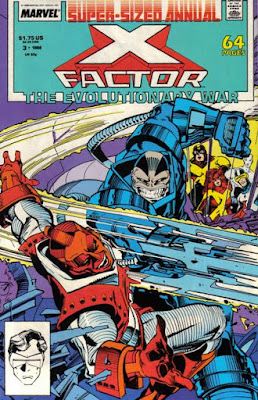
The 40 Years of Comics Project - Day 992: X-Factor Annual #3, 1988
"The Evolutionary War" was the first cross-Annual crossover, a notion that became par for the course in the early 90s. We don't see Annuals much anymore, which is kind of a pity and kind of good. Annuals were always nice for the longer format stories, but those stories weren't always of the highest caliber.
Being that it's the first Annual crossover, it begins in medias res, with the High Evolutionary's forces well underway in their quest to exterminate evolutionary dead ends. You get the sense that a lot of this extermination/sterilization has taken place under the radar of the dominant human species, which adds a fairly chilling aspect to this story. The High Evolutionary, much as he keeps telling himself he's doing good, is really quite fascistic. He's an evolutionary fascist? Which makes his conversation in today's comic with the uber-Darwinian Apocalypse so interesting. I feel like, had this conversation been written about 20 years later, it would have been really quite poignant. Here, it skims the surface, and really offers a nice look at two opposing villainous impetuses that seem to be attempting similar goals.
X-Factor themselves are kind of incidental. And I really would like to know what happens to the mutant Moloid (Va-Lor) after this issue. We probably never see him again.
Dear gods, I have to read The Punisher tomorrow. I'm not a fan.
To be continued.
Aug 24, 2015
The 40 Years of Comics Project - Day 181: Factor X #2, April 1995
After the explosive climax of the previous issue, this one is more about picking up the pieces. We're re-introduced to Lorna Dane, aka Polaris, who somehow seems to know this universe's version of Havok. I'm sure that will be explained down the line, aside from the casual reference to her being mentally unstable in this issue.
I was right, however, about Cyclops' noble nature taking over, as he assists the aforementioned Ms. Dane in escaping the slave pens in which uncooperative mutants find themselves. Sadly, at the end of this issue, his betrayal is witnessed by Havok. I'm sure fraternal hi jinks will ensue in the next issue! This particular iteration of the Summers brothers relationship really casts an interesting light on Havok, who has always felt overshadowed by Cyclops, though there have been the brief occasions in which he seems to have come into his own. Perhaps what we're seeing here is a situation in which both characters have come into their own, but are confined to a stifling milieu in which only one of them can actually flourish. The two always do best when they're on separate teams, where the competitive spirit isn't given a chance to blossom completely into vitriol. That we have the "Bedlam Brothers" as a contrast in this comic makes the Cyclops/Havok relationship all the more tragic.
A note before I end this very short review. I've started up a Twitter account linked to this blog. I don't know if it's even remotely worthwhile, but I guess we'll see. I'll tweet the daily comics and weekly graphic novels, and any other articles I happen to post. And then once I'm more comfortable with the format, maybe other bits and pieces of news and such.
We'll move on to another portion of the AoA tomorrow with X-Man #1. See you then.
Aug 23, 2015
The 40 Years of Comics Project - Day 180: Factor X #1, March 1995
My first real foray into the X-universe, lo these many years ago, was X-Factor #1, following the revelation of Jean Grey's survival in the pages of Fantastic Four and Avengers. I had some prior knowledge of the team, probably from the original Secret Wars series, but X-Factor was my first full immersion. Not long after I started reading Uncanny X-Men, a habit I continued until my break with comics in the late eighties.
It's nice to see that, a good 10 years after X-Factor #1, Factor X #1 maintains the same level of overblown drama as its progenitors. Not that this is necessarily a bad thing. As I noted yesterday, Scott Summers is one of the more noble characters in the Marvel U, so to see him wrestling with a morally questionable position and society necessitates some overblown drama. Recent iterations of the character have placed him in a far more central, universal role, especially in his handling of the Phoenix, a role that elevates him in the Marvel U to the level of characters like Mr. Fantastic or Captain America. In many ways these characters become archetypes within their universe, indicative of a fundamental force or idea in the fictional construct. Cyclops has always balanced vast destructive power with an unerring sense of the right to life and equality for all beings. In many ways he is representative of the opposing yet complimentary attributes we see in many revolutionary movements. In the most successful, or most laudable, of those movements, we see the same kind of balance that is emblematized in Scott Summers.
Another character in this series who is quite fascinating is Mr. Sinister. I'll admit to knowing very little of this character, as he came to prominence during my aforementioned break with comics. I recall him as the architect of the Mutant Massacre, but that's about it. He stands in as a father figure for Summers here, replacing the deceased Charles Xavier, and the two represent two ends of the philosophical aspects of this civil rights metaphor. Both are extremely powerful, but Xavier falls on the egalitarian side, whereas Sinister is far more the elitist. Cyclops, in contrast, sees all as both equal and elite, and puts his power to the purpose of demonstrating that.
We'll see how this plays out over the course of the series. Already, in a couple of the preludes, his nobility has shone through. But survival in an Apocalyptian Darwinism means not only strength of body, but of mind as well, and a part of that strength is knowing which battles can be won, and which cannot. Will Cyclops be able to tell the difference? We'll find out tomorrow.
Aug 2, 2015
The 40 Years of Comics Project - Day 159: X-Factor #109, December 1994
From A to X? And what happened to that promised enormous run of Alpha Flight?
I feel sure that, at some point in my ramblings, I've noted that particular crossover series are alphabetized according to crossover, rather than having the various titles dispersed throughout the collection. In my Active collection, the original "Inferno" crossover is categorized this way (which is why I picked up the Inferno Secret Wars series, but I was pretty disappointed...anyway). The case is the same in the Storage collection, and before the aforementioned Alpha Flight run, we come to the epic X-crossover known as "The Age of Apocalypse."
A few initial thoughts before I hit the meat of this first comic: When this comic came out, it had probably been about 5 years since I'd seriously read comics, and would be a few more before I got back into them upon discovering Gaiman's The Sandman and Morrison's The Invisibles. My era of X-comics ended with the Claremont/Silvestri stuff where the team was living in the Australian Outback, so I missed Age of Apocalypse (AoA) in its initial run. I only picked it up in the early 2000s while working at a used book store and needing something to read. Looking back to my own X-universe experiences, I guess there were still a fair amount of titles chronicling the mutants (Uncanny, X-Factor, New Mutants, Excalibur), but the difference was that these were all individual titles telling the stories of individual teams, rather than, as I see it now, and in the time of AoA, individual titles telling the stories of a single group of characters. I may be wrong about that, but it's certainly what's kept me from reading X-titles for almost 2 decades. The final thing I'd like to address before hitting the comic is the reading order I'm going to be using. This particular issue isn't an official part of the crossover, but it's the crossover that leads into the crossover (90s comics were so ridiculous). Following the "Legion Quest" story, I'll be reading AoA in publication order, rather than reading all four issues of a particular title at once. I think this sort of read gives a much better look at the scope of the crossover, that it fleshes out the new reality much more effectively, and that it'll keep me from getting bored with a single title. It's going to be a long run in this alternate reality (probably a month or two). Let's get going, shall we?
Okay, first the bad: Jan Duursema's art in this comic is fucking abysmal. In the first panel of the comic, Mystique is front and center, and her breasts resemble nothing less that cantaloupes glued to the front of what, I guess, is a very spindly female body. There's shades of Eric Larsen's art to it, but it's a thoroughly inferior version. This makes sense, as the Image artists had left Marvel and become superstars by this point, and this comic gives us a very good indication of that divide between superstar artists like those Image lads and their imitators. Like Duursema.
It's easier if I just show you:
I've pointed this out before, and I just can't wrap my head around it. It's not even well-stylized. It's just bad. And then there's this awkward fight scene"
I don't really know what's going on in that last panel.
So much for the bad. The good is this: Legion comes back with a vengeance. He's always been one of my favourite characters in the X-Universe. The Claremont/Sienkiewicz New Mutants stuff that he was in still rank as some of my favourite superhero comics, so to see a treatment of him that, as this prologue to AoA unfolds, really taps into his madness and his power is quite a treat. This particular era of X-Factor also interrogates, with some success, the problems of a government-run and sanctioned mutant police force. It's tough to say what we can take away from this treatment. If one places the X-Men as metaphors for civil rights throughout the twentieth century, what is the message of this segregated super-team. Mutants deal with mutant problems? I'm not sure that's sending the right message. That said, I've only read bits and pieces of this run, so perhaps that problem is dealt with. But even the original X-Factor team had a mandate to deal with solely mutant problems. I understand the fact that there are issues to deal with that only a person of that particular genetic make-up might understand, but it really does set up a very divisive sort of mentality.
Or perhaps I'm reading too much into a fluff comic from the nineteen nineties.
So that's that for today. I was very hard on this comic, and I'll try to reign that in as we go through the Age of Apocalypse. The early nineties were not a good time for comics, from a creative standpoint, so there's certain to be glaring faults. I'll try to see past them, to read in the time, so to speak. AoA has stuck with many readers as foundational (see the upcoming movie called "Age of Apocalypse"), so there's got to be something to it. Heck, even from a completely personal standpoint, it's one of the few X-titles, crossover or otherwise, that I've read from the early nineties, so there's good in there. It's just that it's mixed rather expertly with some really horrendous story-telling. So let's, together, explore just exactly what makes this crossover such a classic. I'll see you tomorrow.
Subscribe to:
Posts (Atom)