Thoughts, reviews, rants, laments, and general chatting about the wonderful world(s) of comic books.
Showing posts with label Bruce Jones. Show all posts
Nov 20, 2018
The 40 Years of Comics Project - Day 1364: Twisted Tales #3, June 1983
Damn, but Richard Corben draws some dark, dark shit.
What immediately struck me about this comic as I took it out of its bag was the amazing condition it's in. I've no record of where I got this issue, though due to the tag of "garage" in the notes in my database, I can tell that I've had it at least since 2008ish, if not longer. I'm always surprised to find a comic in this good shape and this old. It means that it's probably been stored properly since it was released, so it was probably part of a collection, or old stock from a store.
The stories are, of course, fantastic, though the cover story was a bit too narratively similar to a story from the previous issue. I can't imagine that this slipped by a writer like Jones, and perhaps the whole point of the series is to tell stories literally in the vein of the old ECs, and see what one could do with that format. It's a bit like when I read poets who mess about with the sonnet format. It's very rigid, but within that rigidity one can achieve amazing things. The 12-bar blues are a similar idea.
The other thing that really makes these comics quite different from those that inspired it is the amount of nudity. But the cool thing is it's not just female nudity. There's a shot in story "Off Key" in which a young lady slips her husband's jeans off and we get a full shot of a rather nicely-rendered bottom. It's a small thing, but what it allows, in this and in some of the other stories, is for us to see the nudity not as exploitative, as it would have been if only the women were unclothed, but as a part of the story. The couple in this story are having a private weekend away. I don't know about many of you, but when my wife and I have a private weekend away, there's very often nudity involved! I guess the short version is that the nudity and sexuality in these stories is there for verisimilitude, rather than simply to titillate. Which it also does, by the way.
More to come...
Nov 16, 2018
The 40 Years of Comics Project Friday Magazine 29: Eerie #109, February 1980
Since I've been doing some investigation of pre-Code horror, I thought I'd have a look at some of the horror magazine I picked up back when I got my Heavy Metal collection. At the time I thought that the HMs and the undergrounds in that purchase were the real treasures, and treasures they certainly are. But my unfamiliarity with the Warren magazines led me to overlook them, and that's a mistake.
When thinking about the tradition of EC horror comics, it is a tradition on two fronts. The first, of course, is the stories. They are, for the most part, amazing - artists and writers at the top of their games. The second front is the role it played in the crackdowns on comics in the 50s - EC becomes a metonym for the lost potential of the genre after the creation of the Comics Code. When I read Bruce Jones' series Twisted Tales a while ago, I saw him as one carrying on the tradition of these experimental tales of fear. But I neglected to note at that time that the Warren magazines of the 60s and 70s were also bearers of that torch. Mr. Jones, of course, contributes to these magazines before taking his tales to Pacific. Though they lose something in the black and white format (I've never been one of those fans who prefers B&W over colour. They both have their pros and cons.), the style is there, as is the desire to shock and amuse.
This was one of the first Eeries I've ever read, and it was okay. None of the stories wowed me. But the quality was certainly high enough that I can see why these mags are so revered. One thing that they add to the tradition, and perhaps this is inherited by Bruce Jones' later series, is women in varying states of undress. The EC comics got away with a lot in terms of their portrayals of women, but at least the ladies were clothed. The Warren magazines seem to want to equate horror and nudity, which is a strange connection to make (Eros and Thanatos, perhaps?). The question, I suppose, is does the tradition benefit from this addition?
Onward.
Labels:
#40YearsofComics,
1980s,
Bruce Jones,
Cary Bates,
Collecting,
criticism,
Doug Moench,
Eerie,
horror comics,
Larry Hama,
links,
magazine,
Pablo Marcos,
Paul Gulacy,
review,
Val Mayerik,
Warren Publishing
Nov 10, 2018
The 40 Years of Comics Project - Day 1354: Vault of Horror #2, October 1990
(I'm a bit behind. I read the comics, but I'm just getting them blogged now.)
Now that I have a bit of perspective, I can see where the kinds of stories Bruce Jones told in yesterday's comic come from. While I stand by my assertion that Mr. Jones is a master of the short story form, I also see now that he is upholding a venerable, and important, tradition in comics. Something I think is interesting about this is that his stories, like those in today's comic, do not suffer under the auspices of the Comics Code. And are therefore better.
I know that sounds like a sweeping statement, and some of the greatest comics I've read were produced under that governing body. But I also know that a number of the comics I've read in my life were significantly changed from the way that their creators originally envisioned them. In a well-told story, the parts aren't simply interchangeable. You can't swap out one climax for another. The parts work together as a gestalt. The trouble of censorship is that it ignores the holistic nature of storytelling and encourages a pattern instead. It may be a wide pattern, but it's a pattern nonetheless, which by its very nature occludes that which is not part of the pattern.
Anyway, the reason that these horror comics are so good is that they are allowed to think beyond the pattern. In fact, they were creating the medium from which, in this case, the pattern was born. I think I've already said that I recently read The League of Regrettable Superheroes, and one thing that Mr. Morris mentions in the introduction is that this early period of comics was one of unprecedented experimentation. Though they weren't always good, the ideas were very often strange and novel. The Comics Code discourages this kind of experimentation and encourages instead that writers pull from a large, but still limited, subset of medium's capability. It's publications like Jones' Twisted Tales, from an indie publisher, that keeps this experimental attitude alive until the mainstream catches up in the late 90s to early 2000s.
I've been struck over the last decade or so by the amazing variety of really, really good comics that are out there. It's impossible to read them all, and across the board, all genres, all (most?) publishers, are telling some fantastic stories. I think in part the dissolution of the Comics Code in recent times has allowed writers to tell stories they want to tell in much greater range, and in mainstream vehicles. Rather than the subset, they have access to the Source. I mean, if the Code were still around, there's no way we'd have the Bat Penis.
And that is all you will ever see me say about that most stupid of recent comics phenomena.
More to come...
Labels:
#40YearsofComics,
1950s,
1990s,
Bruce Jones,
Collecting,
criticism,
EC Comics,
Gladstone Publishing,
horror comics,
Jack Davis,
Johnny Craig,
links,
reprint,
review,
Twisted Tales,
Vault of Horror
Nov 9, 2018
The 40 Years of Comics Project - Day 1353: Twisted Tales #2, April 1983
I have waxed lyrical about Bruce Jones' ability to tell a great short story while I was reading the sister title to today's comic, Alien Worlds. The stories in today's comic are a little darker, and much more brutal, and really, really remind me of the EC horror stuff I've been reading over the last little while. I get the suspicion that the similarities aren't coincidental. Mr. Jones and his collaborators are definitely of the age that they would have know much more about the pre-Code horror titles than someone of my generation. I didn't recognize the influence when I was reading the science fiction comic, but now that I'm a little more elucidated, the influence is clear.
I can't even decide on a favourite story in today's issue. The lead tale, illustrated by Mike Ploog, has an excellent ending that I didn't see coming. The final tale, drawn by the fabulous Rand Holmes presages Crash (the one about sex in cars) by quite some time. I think, really, only the Ken Steacy-illustrated "Nightwatch" fell a bit flat for me. A neat little tale, but I feel like I've seen it all before.
More of this tomorrow, perhaps. I always balk at reading horror comics so early in the morning. I worry that it's going to inflect my day.
More to come...
Feb 4, 2017
The 40 Years of Comics Project - Day 710: 3-D Alien Terror #1, June 1986
Reading this first thing in the morning may not have been my best idea ever. Not that the stories were bad at all. But trying to get sleep-fogged eyes to focus on that red/blue 3D effect is slightly nauseating. Not a good combination with breakfast.
Once I got over that, however, the stories were awesome. The lead is a cool little send-up of EC Comics and The Twilight Zone that was just wonderful. The next story, 3 pages, was utterly fucking chilling. And the two that round out the collection were nicely creepy. The horror and sci-fi stuff coming out of Eclipse at this time, mostly from the pen of Bruce Jones, was amazing. I love all the titles he produced for them, and I'll definitely go out of my way to get them. I was very lucky that this one showed up in my quarter bin haul.
If you're looking for a nice collection of horror and science fiction short stories, Jones' Twisted Tales, Twisted Tales of Bruce Jones, and Alien Worlds are really and truly excellent.
To be continued.
(I'm trying out something new.)
May 1, 2016
The 40 Years of Comics Project - Day 432: Alien Worlds #5, December 1983 (Little Tiny Break in "War Week" Day One More!)
Okay, one more. The first comic I blogged from the Edmonton Con last year was a copy of Alien Worlds, so I thought this was fitting. Bruce Jones tells creepy little stories. If you're a fan of The Twilight Zone, this is the sci-fi comic for you. And what's great is that Jones and his collaborators are equally comfortable with 3-page dialogueless stories or longer, complex, and quite verbose narratives. The lead story in this one, "Lip Service," offers a viewpoint of life from the compound eyes of a Praying Mantis. I'm not sure if these stories have ever been reprinted, but they'd be amazing in a genre-literature course in an English program.
So, tomorrow, seriously, I'll get back to the war comics. Promise. Onward!
Oct 6, 2015
The 40 Years of Comics Project - Day 224: Alien Worlds #7, April 1984
A slight error in yesterday's post: this issue, number seven, is the last one under Pacific Comics. Numbers eight and nine are from Eclipse.
Thus far, Bruce Jones has unequivocally been the guiding creative force behind Alien Worlds. As of this issue, though, noted science fiction author William F. Nolan (Logan's Run) is brought on board. Considering the fact that the title passes over to Eclipse in the next issue, following Pacific Comics' dissolution, perhaps the move to get Nolan in was one geared toward making the title seem desirable to whomever was going to take over publication. Though that's the pessimistic view. Comics have a long history of attracting writers from other media, and this could simply be a case of a fan wanting to branch out into comics.
Though this does bring up something that's always bothered me. The cover of this comic prominently features Nolan's name, though none of the previous comics have featured Jones's. When Kevin Smith was secured by Marvel to write Daredevil, it was giant news. China Mieville getting a "New 52" title - also big news. Neil Gaiman's triumphant return to comics with 1602, huge. I'm trying to imagine a moment where the same thing would happen in reverse. Grant Morrison's done video game and film treatments, but these were not hailed as huge coups for either industry. Fans have been crying out for Steven Moffat to get Morrison or Moore to do a Doctor Who episode, but it hasn't happened yet. Comics like to advertise when people from outside the industry decide to write or draw a comic. In some ways it's a way of celebrating the attraction of the medium, but I sometimes think it's also a way of saying "Hey! Look at us! We're a valid medium after all, because these people have deigned to write for us." In this particular issue, Jones's story "Ride the Blue Bus" is head and shoulders above Nolan's story, which reads like a golden age M. Night Shyamalan film. It's good, but not nearly as moving as the tragic little tale Jones and George Perez weave to finish off this issue.
I know this comic came out in the eighties, and comics weren't nearly as well-thought of as they are now, but it still irks me when publishers feel the need to trumpet the fact that someone outside of the comics world has come to write or draw something. Comics creators account for some of my favourite writers and artists of all time, and I think that some of these creators deserve the same sorts of accolades that any creator in any other industry receives, critically and popularly. How is it that Alan Moore and Eddie Campbell's From Hell is not considered a postmodern literary masterwork?
Well, because it's a comic book.
Had not meant to rant this morning. Probably a reaction to the ridiculous amount of work I have to get done today, so I'd better get on with it. Not sure what's on for tomorrow. I have one more issue of Alien Worlds, but I reviewed it almost 200 days ago. It's here if you'd like to check it out. I've also got a prestige-format special of the series, but I might save that for the much-delayed Weekly Graphic Novel (fell by the wayside due to school pressures, I'm afraid). So it'll be something new. See you tomorrow!
Oct 5, 2015
The 40 Years of Comics Project - Day 223: Alien Worlds #6, February 1984
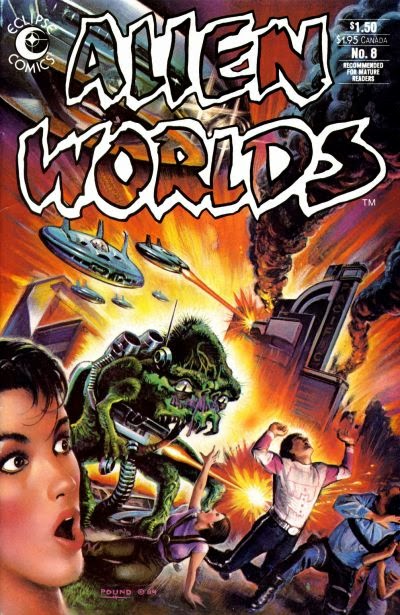
I wonder what the reaction of comic shop owners was when they opened their boxes and saw that they'd have to try to display that cover somewhere on the shelves.
As I mentioned previously, I've been trying to figure out whether the glut of naked women in the pages of Alien Worlds is simply the male-centric world of comics rearing its beardy, ugly head, or if there's something a little more ironically nostalgic going on. The curvaceous lady on the cover there is the main character from a long-ish tale at the end of the comic. She, when questioned about the scanty nature of what she terms a "combat uniform" claims it was inspired by the clothing of Dejah Thoris, of Burrough's John Carter series of novels. So there is this call-back to the golden age of science fiction. And her term for her almost-complete-lack-of-clothing, a "combat uniform," is interestingly supported by the fact that she describes the uniform as giving her an advantage over opponents not only in martial combat, but also in navigating the bureaucracy of the colony she inhabits. So there there is a tiny irony, a redefinition of the term combat. I'm still not completely convinced that it's not simply sensationalism, but it's starting to appear to be something more.
The stories in this issue were quite good, better than yesterday's. The final, long story read almost like an old Prince Valiant story. There was very little dialogue, most of the internal action happening in caption boxes. There was far less attention paid to the robots that have been ubiquitous through the rest of the series. The concentration was instead focussed on different species and the ways we might interact with them, manufacture them, and become them. There's a bit more of the posthuman here, a little less of the singularity. Oh, and it ends with strange alien monster sex. How's that for a selling point?
I'll be moving on to issue #7 tomorrow, the first one to bear the Eclipse Comics trade dress. It'll be interesting to see if the content substantially changes with the change in publisher. But now I'm off to mainline some Rick and Morty with my son. See you tomorrow!
Oct 4, 2015
The 40 Years of Comics Project - Day 222: Alien Worlds #4, September 1983
I was excited to get back to Alien Worlds. It's been a really long time since I've read some science fiction I've enjoyed. I'm not sure why I went off it, but I did, so it's nice to be able to dip my toes back in.
The cool thing is that last weekend, at the Edmonton Comic Expo, I found a special, published about 3 years after the series ended, all written by Bruce Jones and his various original co-creators. I think this series is moving out of the Storage collection, and into Active rotation. I need to think about it further.
That said, I did not enjoy this issue nearly as much as I have the prior 3. The stories are still good, a nice range of comic to tragic, and the art is wonderful. The dialogue is as snappy and interesting as the previous issues. But there was just something missing. Maybe it's that in each of the previous issues, there's been one story that's really resonated, that's really stood above the rest. In this issue, there's no superlative story. Not that the stories are bad; they're good. But none of them are great. No worries, though. Not every single comic can be a good one, and I've been very lucky in the quality of comics I've read over the last little while.
One story does deserve mention, however. The short piece "One Day In Ohio" is a tragic little story of a servant robot that doesn't realize it's family has died in a holocaust of some sort. It eventually rescues a chimp from the local zoo, treating it as the family child, until it overheats one day and explodes. The chimp, touchingly, tries it's best to take care of the ruined machine. And that's it.
Maybe there was a great story in this issue.
We'll continue along tomorrow, I was unable to find some of the missing issues for this series at the con. I'll be poking about in local comic stores, but it's (not) surprising (at all) how few comic shops carry Pacific Comics back issues from the 1980s. We'll muddle through somehow.
Sep 26, 2015
The 40 Years of Comics Project - Day 214: Alien Worlds #1, December 1982
Second post from the road, and I did manage to find an issue of Alien Worlds that I didn't have (and one that I didn't know existed, which is pretty great!). This issue is pretty exactly in keeping with everything I've said about the previous (though actually subsequent) ones. Jones has an amazing handle on how to craft a satisfying story in a very few pages, and his choices of collaborators is consistently brilliant. A theme that I begin to see emerging in these comics is the relationship of the human to the non-human, but, as with all great science fiction, using the non-human as a reflection of ourselves. There's a lot of looking at the ways in which humans and robots might interact, especially once the robots become virtually indistinguishable from us. Of particular note is Jones' concern with how we will treat robots in the guise of children, something that prefigures the film A.I.
We also see a hearkening back to the golden age of science fiction paperbacks with the depictions of the female form, both on the covers and in the interior pages. Pacific Comics was certainly geared toward a more mature audience than its mainstream competitors, and it took advantage of (I'm assuming) a Comics Code free existence to fill this book with heaving bosoms and pert bottoms. While this is certainly a problematic depiction of women, who aside from this play only small supporting roles in the stories thus far, there's also a nostalgic quality to the art, looking back to a time when such objectifying was accepted (not, I'll point out, that that made it right), and also to a time when science fiction did look to the future, was speculative, rather than the space opera fantasy epics that science fiction had become by the time of this comic's publication.
What I'm trying to figure out is if the depictions of women in these comics is in any way meant to be ironic, an acknowledgment of the oppressed role given to most women in early science fiction novels. Jones and his artistic collaborators are smart guys, and they're working for a publisher that's just one step or so removed from the undergrounds that had proven so subversive a decade or so before. Perhaps I'm being too optimistic, but the hyper-sexualization of the female form is so prevalent in these comics that I feel like it's more parody, or gently satirized homage, than out and out sexism. It's hard to say, to I'll just look at it from my optimistic standpoint, and invite you to do so as well.
I was unable on my first go through the con to fill in all the holes in my Alien Worlds run, but I'll try again tomorrow. Failing that, there's more sitting at home in the collection, so we'll continue on with them.
Sep 25, 2015
The 40 Years of Comics Project - Day 213: Alien Worlds #3, July 1983
Posting from the road, in a hotel in Edmonton, excited for the comic con tomorrow, the panel on Let's Play videos I'll be co-presenting, and getting my hands on some issues to fill in my spaces.
There are, in the annals of literature, those writers who are considered to be the epitome of particular forms. In the case of the short story, names like Edgar Allen Poe, Raymond Carver, Jorge Luis Borges are lauded as being amongst those writers who understand the short story form in the most sublime of ways. I think we can make the argument that, in the case of comics, Bruce Jones is a master of the short-form sequential story. Short stories are, more often than not, moments in a life, where novels and other long form works are, again more often than not, lives in and of themselves. The short story narrates moments rather than series of moments. Jones' stories do this in such perfect, succinct form, building entire worlds and back stories but telling pointed and brilliant little tales in the space of 6 or 7 pages. He's assisted by this amazing array of artists, of whom the standout in this issue is Scott Hampton, with a story about dolphins that would make Douglas Adams proud. I feel like if I just wax lyrical about this comic, it will come off as disingenuous, and certainly less than critically rigorous, but Jones' scripts and the artists who collaborate on them are all just great. If you're looking for a series that perfects the short, sequential science fiction story, this is the one.
While I'd love to post tomorrow about another issue of this comic (and I might, if I can find the ones I'm looking for at the con), I only brought the single issue with me. I'll blog one of my finds from the reams at the convention tomorrow. See you then!
Sep 24, 2015
The 40 Years of Comics Project - Day 212: Alien Worlds #2, May 1983
And here I was worried about what I was going to read after Age of Apocalypse. There, sitting behind the AoA section of the collection was the Bruce Jones-scripted anthology title Alien Worlds. I really like this title, and its horror cousin Twisted Tales. Jones has got a great knack for telling a short, spooky, quirky story, a la the old Steve Ditko tales that were reprinted in my Doctor Who Weeklys, and the amazing array of artists he gets to join him is a treat. Dave Stevens' art on the cover story is just...well, how about I let it speak for itself? Aurora is really something.
Now, the nice thing about the character is that, after this single cheesecake-y shot, she dons her action suit and proceeds to be something of a badass for the rest of the story. I'm hoping that it's a story that continues, because I'm kind of intrigued by the premise. The other two stories in the book are emblematic of Jones' style on this and Twisted, in that they're fairly straightforward sci-fi tales, though entertaining and well-wrought ones to be sure, with a twist at the end. Could it be that Jones is the M. Night Shyamalan of comics, though far less-maligned? A question for another day.
According to the GCD, the series ran 7 issues at Pacific and a further 2 at Eclipse. I don't have all of them, but as I'm heading up to the Edmonton Comic Con this weekend, perhaps I'll track them down. This era of speculative fiction in comics is pretty great. At this point, Heavy Metal's only a few years old, Warren's 1984 is still a fresh memory, and Epic Illustrated is in full swing, not to mention the "ground-level" comics that skewed heavily toward fantasy and science fiction. I wonder what it was about the early 80s that made so many writers and artists embrace these genres across so many levels (and, to be fair, qualities) of publishers? Backlash against the stagnation many perceived in superhero comics, perhaps. Recall, Crisis on Infinite Earths, Watchmen, and Dark Knight were a few years off at this point. Early 80 superhero comics were good, but in that amusing, campy way, still escaping the influence of the 60s Batman television show. Sci Fi and Fantasy were perhaps a good place to go if you wanted to tell intelligent and interesting stories.
First post-Age of Apocalypse comic. Feeling pretty good. Only missing the X-Men slightely. More Alien Worlds tomorrow. See you then!
(Edit: After writing this, I found out that Dave Stevens died a few years ago. His official site is still up and is well worth an hour or so of your time.)
Apr 2, 2015
The 40 Years of Comics Project - Day 37: Alien Worlds #8, November 1984
Taking a suggestion from reader Martin de la Iglesia, today's comic will be reviewing a comic that was reviewed here by Aaron Kashtan at The Ogre's Feathers. Because my Web-Fu is not strong, I have no idea how to link directly to the place on the page where the review is. It's about a third of the way down the page.
The comic grabbed me from the moment I opened the cover solely because the title of the lead story is a line from one of my all-time favourite pieces of poetry, Robert Frost's "Stopping By the Woods on a Snowy Evening." The story offers a couple of other interesting things to think about. First, it's set in 2022. Yep. Captain Murdock is diagnosed with a terminal alien disease on some incredible alien planet and (spoiler spoiler spoiler) a mere 7 years from now. Even when the comic was published, which I'm assuming was well after Nolan originally penned the story, 2022 was only 38 years. Ah, the optimism of the speculative fictionist. The other interesting notion is whether or not Nolan himself adapted the story from his short story. The credits list Nolan as the writer, but, from a glance at the original story, it's hard to tell if he adapted it, or if artist Al Williamson handled that chore.
Moving on, I would agree whole-heartedly with Aaron's review that praises the artwork in the stories, though I'd add Ken Steacy's work to the list, because I really like his work, and it captures a particular aesthetic from the 60s and 70s of which I'm particularly fond. I've got a bunch of his stuff spread throughout the collection, much of it from indie comics like this one, and the "ground level" comics represented by titles like Star*Reach and Quack!. Shall I move on to a week of Steacy? Perhaps...
As Aaron's review notes, the stories here are all "shock-ending" stories (and I agree, in 1984, the declaration of love between two men probably was considered shocking), and they get me thinking, as I did before, of the sometimes needed gap of a month or so between issues of a comic. I had mentioned yesterday that Louapre's stories, at least the early ones, read very similarly, so the publication space gives one a bit of breathing room. I imagine, with a title like this, that reading them one after the other would have a wearying effect, always expecting that twist ending.
One last thing is a parallel that might make an interesting comparison: these stories are, in their execution and subject matter, very similar to the "Future Shocks" and "Time Twisters" short stories from 2000 A.D. A comparison of the two would be neat, if only to see it there are intrinsically national qualities to these tiny science fiction stories.
Thanks again to Martin for the suggestion. That was fun. See you tomorrow.
Subscribe to:
Posts (Atom)