Thoughts, reviews, rants, laments, and general chatting about the wonderful world(s) of comic books.
Showing posts with label Archie's Girls Betty and Veronica. Show all posts
May 20, 2017
The 40 Years of Comics Project - Day 815: Archie's Girls Betty and Veronica #217, January 1974
A girl is accused of indulging in the dirty Hippy lifestyle, but it turns out she's actually just poor. Three years before yesterday's comic, and the social commentary is a bit more pointedly conservative. It's interesting to see the evolution of the comic from actively promoting a very conservative version of middle America to implicitly doing it with its mediocre stories. And that's the crux. The stories in this issue are far more expertly crafted, even if the subject matter is a lot more problematic. In the first tale, the girls of Riverdale decide to take some of their power back by preying on the local boys and assaulting them with kisses and hugs. The reason for this seems to be a worrying propensity for the boys in town to sexually assault the women whenever they want. Of course, the boys are completely open to this kissing accostment, and so the girls' power is taken from them once more. Betty is spotted with a basket, rushing to a nursery, and everyone assumes it's a baby, and that, of course, Betty will make a wonderful caregiver. Let's leave aside the fact that she's a teenager in high school. A baby was left on her doorstep - surely she must give up her education to become a mother!
This said, the stories play out in a much more satisfying manner than the later ones. There's equal parts drama and comedy in some of the stories, and better character development in a lot of ways. Perhaps this is what the comics of the later Seventies don't do quite as well - they rely far too much on the archetype of the character, rather than using that as a foundation upon which to enrich the character. Though perhaps this is also a natural swing of the pendulum for Archie comics. Using the same characters over and over for such a long time, perhaps the stories can fall afoul of the producers of the content resting on their laurels for a while, until they realize that the characters need more than simply reiteration of the same old stories. Is this where we are now with these characters? And will they return to their formulaic tales in a couple of years? It'll be interesting to watch.
Enough Archie comics for now. I'll bounce back into them soon, I'm sure. But tomorrow we'll start looking at one of the superhero runs I have that I have only now been able to properly access since rearranging my comic boxes: Iron Man.
To be continued.
May 19, 2017
The 40 Years of Comics Project - Day 814: Archie's Girls Betty and Veronica #253, January 1977
Betty does construction. Veronica shuns her rich relatives. And Reggie gets schooled in the errors of his dominant male ways.
This one's a little more egalitarian than most the Betty and Veronica comics I've read this week. The only one that falls slightly short is the first story, in which the Archie and Jug are planning a fishing trip, and the girls are obviously too delicate to handle the rigours (?!) of camping.
Having camped with a number of women, I have to say that they're often far better at it and far better prepared than I ever am.
The stories in the latter bits of the Seventies might be less sexist (slightly), but they're also slightly less entertaining. The punchlines just seem a little....meh. Like the one on the cover there. While it might be hearkening back to The Archies' heyday with "Sugar Sugar," the punch line on the cover is forced. I had to read it a couple of times to understand he was talking about the sweetness of the girls, though that doesn't ring true for at least one of "Archie's Girls." Sweetness is not exactly a character trait we associate with Veronica. Indeed, in this issue, when Betty tries to construct a play area in a local park for some children, Veronica has it stopped purely out of her own self-interest. Even in the final story, in which Reggie demonstrates some remarkably troubling male behaviours, Veronica teaches him a lesson that is not sweet at all.
I'm sure people who've thought about it much longer and harder than I can identify the golden ages of the Archie comics. I think the late Seventies is a bit of a downswing. The Eighties stuff I remember growing up on was quite good, but then in the later Eighties and early Nineties, things flounder again. Once I've finally read all of my Archie comics, in 37 years or so, I'll be in a better position to judge.
To be continued.
May 18, 2017
The 40 Years of Comics Project - Day 813: Archie's Girls Betty and Veronica #246, June 1976
Today's comic veers off from the trend of domestic adventure for these two young ladies, and actually addresses class difference in a couple of its stories. Veronica has always been a wonderful touchstone for questions of class. Sometimes she's a positive representation and sometimes a negative one. More often than not, at least in the comics I've been looking at lately, Veronica uses her privilege as a weapon rather than a tool, and today's comic is no exception. In "The Outspoken Word," Veronica uses her self-perception of superiority to offer outspoken criticisms of everyone she comes across, until she meets someone as outspoken as she herself who turns the tables. "Fit to be Tied" sees Veronica give Betty an entire wardrobe of clothes that have had the size tags changed, in order to convince Betty that she has put on weight. This is a really awful story, as we witness Betty refusing to eat and exercising what we would now consider a very unhealthy amount, all because she doesn't fit into the clothes Veronica has given her. Of course, the story turns it around, and Betty becomes a champion athlete out of the deal, but Veronica's deception is never revealed, and Betty's worry about her weight is never addressed.
I was teaching my class about what we call the "Generalized Other" in communications theory today. It's the mores and narratives that we are provided by the greater society we inhabit. The key to these narratives is recognizing that the stories the generalized other tells us about ourselves is not necessarily the story that we should inhabit. The problem is that it's hard to inhabit other stories if we're not made aware that they're possible. Hence, representation. The female narratives presented by these Betty and Veronica stories in the 70s offer little in the way of non-normative behaviours. It's surprising to see Betty excel at sports in the one story, as she's usually relegated to winning over the hearts and minds of her peers with her domestic skills. And I'm not even sure what the narrative that's presented through Veronica is. Every now and again she shows some self-awareness, but more often than not her comeuppance is experienced only by herself, perhaps suggesting that the rich will get what they deserve, but never in view of those they've wronged. Which might assuage the concerns of those wronged, but is, as far as I can tell, not entirely true to life.
I'm finding these comics cool in that they're provoking in me a lot more rigorous thinking than some of the others I've read. Perhaps it's that distance of time that allows for a more critical view of things. What's lovely is that they're providing a touchstone on how far we have actually come in the last 40 years. What will things look like 40 years from now?
To be continued.
May 17, 2017
The 40 Years of Comics Project - Day 812: Archie's Girls Betty and Veronica #196, April 1972
In the vain hope of finding something slightly less sexist, I picked out this issue, which seems to be pointing in the right direction.
That is, if you ignore the perhaps-missed irony of the title of the series when compared to the sentiment below, or Archie's diminishing of the importance of the protest the girls are a part of. In fact, it's tough to tell what the actual thrust of this comic is. Are we meant to be laughing at the girls who think that they deserve equal treatment, or at the boys who obviously aren't even aware of their privilege? Who was the target audience for this comic when it was published? Perhaps considering the stories within will help unravel this question.
Story 1: A woman, unable to support her baby, leaves the child on the Lodge's front step for Betty and Veronica to find. The girls automatically believe that the mother is unfit and cruel.
Story 2: Veronice attempts to be self-sufficient by baby-sitting, but is unable to cope, so she has the hired help come and assist her. The punchline of the story is Veronica saying this: "You're asking me to give up my career --- my self-respect! Sigh! But for you, Daddykins, I'll do anything!" Mr. Lodge promptly returns her credit cards.
Story 3: During a blizzard of epic proportions, Betty dangerously makes her way to Archie's house, where she cooks a snack for him while they watch television.
That answers the question, I think.
To be continued.
May 16, 2017
The 40 Years of Comics Project - Day 811: Archie's Girls Betty and Veronica #230, February 1975
Today's comic did not produce the kind of ire yesterday's did, that's for sure. This is not to say that there aren't problems with the stories, but there's only one tale within the comic that hinges on the presentation of the female body to the male gaze, and the self-image that is associated with that gaze.
Now, what we do need to recognize is that each story actually revolves around domesticity. It's almost as if Betty and Veronica are not able to have adventures in the 70s that have anything to do with something other than the keeping of house. Betty is shown to be baking pies as a way of winning Archie's heart. Veronica shows her self-sufficiency by making breakfast for her parents (who end up being too busy, so Jughead is her begrudging default food disposal unit). The final story actually breaks slightly from the domesticity trope, in that Veronica is tasked with using the Lodges' new leaf vacuum, but once she notices a cute boy watching her, the manual labour becomes a fashion show. Rather than rely on her skill or the fact that she is doing something useful, Veronica's self-worth is wrapped up in how she looks.
There is another story in this issue that is kind of intriguing. After seeing an infomercial that asks a housewife to replace her one reliable cleaner with 12 competing brands, Veronica has a dream about Christmas being replaced by 12 holidays of her own choosing. Where Betty and Archie decline this exchange, based on the "meaning" surrounding Christmas, Veronica and Reggie get greedy and take the 12 holidays. But when Christmas roles around, it looks like they want to participate, but won't be able to. I say "looks like" because the center pages of the comic are missing. I find this is a common occurrence with the Archie comics I procure. They're not the sort of thing that people buy and keep safely stored in bags, boarded and boxed. Rather, they're the fleeting bits of entertainment that get left at a cottage, or shoved under a bed, that get read and re-read so many times that, eventually, the flimsy paper gives up and lets go of its stainless steel bonds. The missing pages are a sign of a comic being care-worn.
But it's annoying to miss the end of a story. (If anyone has this issue, and feels like sending me scans of the center pages, that'd be awesome!)
To be continued.
May 15, 2017
The 40 Years of Comics Project - Day 810: Archie's Girls Betty and Veronica #237, September 1975
One of the worst things about recovering from my nose surgery, which I've probably mentioned, is that allergy season started literally the day after. I haven't had a decent night's sleep in about 3 weeks, and it's starting to wear on me. That's probably why I'm going to be so harsh on today's comic. Just so you're warned.
In the story "Club Pro," Betty decides to take a golf elective at school in order to be around Archie. At one point, after finding out she has absolutely no facility for the sport, her mother gives her some advice, which Betty articulates thus: "Mumsy taught me the natural way!...Think of something I'm used to --- feel comfortable with --- gonna clean the rug --- grab the ol' vacuum! Hands fall right into place --- so natural ---." At which point she becomes the best shot in the class.
Because vacuuming and mopping the floor (another activity she uses to become a good golfer) are "natural" for her.
Jesus. Fucking. Christ.
To be continued.
May 14, 2017
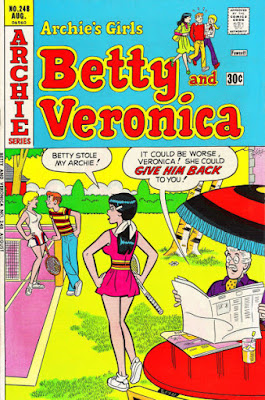
The 40 Years of Comics Project - Day 809: Archie's Girls Betty and Veronica #248, August 1976
So we're going to have a week of the most sexist-ly titled comic of all. Well, I'm sure that's not entirely true. I've seen some of the porn comics out there. But for an all-ages, ostensibly all-American mainstream comic, the title of this one is pretty egregious. Not unlike the state of gender politics in the U.S. now, actually.
Archie comics are a wonderful lens through which to observe changes in the American cultural landscape over the last 80 or so years. They deal with issues like Women's Lib, homosexuality, the Occupy movement...and lots of tennis, strangely. Every now and again I wonder if David Foster Wallace was a secret writer for these comics. The problem with these depictions of social forces is that, by and large, they're written and drawn by men. And, even though this is a comic about two young ladies, they seem to be written and drawn for men. These comics of the 70s tend to paint the girls as bumbling and headstrong, and things always backfire for them. This isn't a surprise when it comes to tales about Archie himself - that's kind of his jam. But for Betty and Veronica, the usual voices of...well, not reason, but not quite Archie-level shenanigans, it's a bit odd to see them played as the clowns.
Especially as the brunt of that clownishness is very often at the expense of their gender.
Like many young men, I assume, Betty and Veronica were amongst the first representations of women in popular culture that I found alluring in a way that I wasn't even really previously aware. Even now there's a little bit of an adolescent thrill when I pick up one of these comics from the 70s and early 80s. But reading them now, a little older and (I like to think) wiser, the problems the stories in many ways eclipse the aesthetic concerns that I once found so pervasive. In today's comic, for example, each story is about Veronica and/or Betty vying for Archie's affection, usually by either looking prettier than the other, or by using domesticity as an enticement for affection. Be a good sewer, and your man will stick with you. Show a lot of leg, and you'll get the man you want. I occasionally give these comics to my wife to read, as she grew up reading them as well, and she's appalled at the attitudes in their pages. If nothing else, these old comics explain in the plainest of terms how we've come to the state of affairs within which we find ourselves. These comics, these ostensibly most innocent of childhood entertainments, reinforce the most crippling of gender stereotypes and disguise it as all-ages comedy.
Now, this is not to say that there are not things to enjoy in the comic. The Archie artists are remarkably good at what they do, and the physicality of their humour is matched only by the most expert of draughtspeople in the industry. But these old comics...they don't age well. Which is likely to be a trend for the week, I think.
To be continued.
Subscribe to:
Posts (Atom)