Pages

Showing posts with label Blackthorne Publishing. Show all posts

Nov 6, 2020

The 40 Years of Comics Project - Day 2081: Crow of the Bear Clan #2, December 1986

   For information on stopping the spread of COVID-19, and on what to do if you are quarantined, have a look at the World Health Organization site.


 The Copper Age is less than a decade long, spanning the time between DC's seminal Crisis on Infinite Earths and the exodus of the Image partners from Marvel, which heralds the current Modern Age. For me, the Copper Age is emblematized by nothing moreso than the vast proliferation of independent publishers that sprang up in the 80s. I never really used to give Blackthorne much thought, but having read a number of their titles now, I can see where they fit into the landscape, alongside Eclipse, Fantagraphics, Pacific, First, and any of the other indies of the time. Perhaps indie is the wrong term, though. I feel as though these publishers owe a fair bit to the undergrounds, and to the "ground level" comics (Star*Reach, Vortex, etc.) that followed them. Whereas the independent market, characterized by Fantagraphics or Drawn & Quarterly, tend toward the dramatic and biographical, publishers of Blackthorne's ilk attempted to bring genres other than the superhero to a wider audience. Thus, Crow, a spiritual successor to yesterday's Conan. Albeit, an anthropomorphic animal.

A quick bit of research tells me that this series ran only 6 issues, and I definitely see it on a regular basis in discount bins, so I might actually have to pick it up. A cool story about a conflict between the Saurans, evolved dinosaurs, and the Bear Clan, anthropomorphic bears. Nicely written and illustrated, and definitely has a lot of thought given to the background and the world. I was pleasantly surprised by this comic.

More to follow.

Jun 14, 2020

The 40 Years of Comics Project - Day 1936: Midnite the Rebel Skunk, January 1987

For information on stopping the spread of COVID-19, and on what to do if you are quarantined, have a look at the World Health Organization site.
 
https://www.comics.org/issue/341496/

Milton Knight's work is just amazing. I love his revamp of early cartoon aesthetics, both the visual and social aspects. Midnite, our eponymous heroine, takes aim at her detractors and enemies, but also at the overtly racist tone of the cartoons that inspire her adventures.

Early Looney Tunes and Merrie Melodies cartoons play fast and loose with physics, both of the world surrounding the characters and of the characters themselves. It's as if the characters and the environment are in a constant state of movement, which can be a difficult thing to portray in a static comic image, but Mr. Knight's art manages it wonderfully. Characters will expand with rage to fill a panel as they move through a world that seems to shift and change with each panel. But Mr. Knight's work also draws on the comic strips of the era as well, with small cartoon characters hanging about the edges of each panel offering commentary or little jokes.

A similar thing happens with the writing of H.P. Lovecraft - stick with me here. Lovecraft himself was an awfully racist human being, an aspect of his thought that, once realized, presents itself quite blatantly in his work. But contemporary writers have taken Lovecraft out of the works, as much as possible, and made his stories much more accessible. We can't ignore the fact that the early 20th century was an overtly and damagingly racist time, but what we can do is take the nostalgic lens through which we often view these older eras and smash it, making room for conversations about what it was really like, and for fantasies like Mr. Knight's that suggest what it might have been like had the era not been so steeped in racially-motivated oppression.

More to follow.

Further Reading and Related Posts

Blackthorne's output has turned out to be much more interesting than I thought it was.

Jan 6, 2018

The 40 Years of Comics Project - Day 1046: Atomic Man Comics #2, February 1987

https://www.comics.org/issue/42438/

(Sorry, totally slacking. Here's a fill-in entry. This collection reorganization is taking a lot of my time!)

I feel like just about every time I've reviewed a comic from Blackthorne Publishing here, I've gushed about how good they actually are, despite their humble origins. I'm going to have to stop, and just admit that Blackthorne had a pretty great little stable of titles that are totally worth tracking down.

Their style is somewhere just this side of the underground, a bit more irreverent than the so-called "ground level" comics of the early 80s. There is still something of the comix to them. In today's issue, most especially in the final sequence, a dream that Atomic Man has one night. Is it prophecy, or just some seriously fucked up subconscious shenanigans? Who knows? It was weird and kind of messed up.

I'll be tracking down the other two issues of this series as soon as I can. It's really quite good, and gave me an experience I was not expecting from the cover. I know, I know: books, covers, all that stuff. But that's just how comics tend to work.

To be continued.

Apr 28, 2017

The 40 Years of Comics Project - Day 793: Failed Universe #1, December 1986

https://www.comics.org/issue/321027/

(Contingency comic today. I'm still feeling crappy.)

I've often said that I think I must be one of the few fans of Marvel's early attempt at a new narrative universe, creatively referred to as the New Universe. In my defense, I was only 12 when it came out, and it was completely different from the Avengers and X-Men comics I was mainlining at the time. Or it felt like it was, anyway.

Older eyes saw something, well, not quite as different, as this comic attests. As with most of the Blackthorne parody comics (most, but not all), it relies on the Mad Magazine-esque style of humour, lots of crass jokes, and a complete disparagement of the idea that there might have been something of merit behind the New Universe.

I guess, once I get to it in the project, we'll find out for ourselves.

To be continued.

Apr 27, 2017

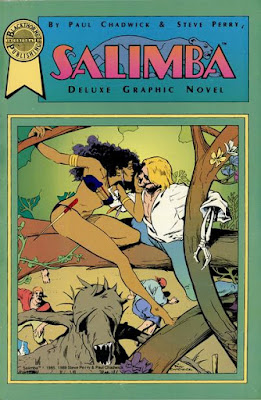
The 40 Years of Comics Project - The Weekly Graphic Novel: Week 44 - Salimba, 1989

https://www.comics.org/issue/347285/

As with today's comic, I'm just not feeling up to writing much today for this graphic novel. But it's an interesting piece, so I'll make a bit of effort.

Salimba is a pretty cool pulp-fiction jungle girl comic, made up of three different stories about the title character. Over the course of the book she moves from simply a jungle girl to being something far more eternal and mythic. Also, in the last story, there's these weird worm boys who look like giant uncircumcised penises with faces. Which, I think, is actually what they're meant to be.

There's some problematic essentializing going on in the story, it being set in an undisclosed jungle location where everyone is of African descent. This is always going to be difficult with jungle-based works though, at least up until a certain point where writers and artists became (or, more pessimistically, become) more sensitive to cultural stereotyping. But, as I note, Salimba moves out of stereotype and into myth, which is not a long journey in many ways, so there's definitely something there worth exploring. And the cleaving to the tenets of pulp-y writing is really handled quite nicely.

Okay. Sorry. That's all I've got.

Onward!

Apr 16, 2017

The 40 Years of Comics Project - Day 781: Midnite #1, November 1986

https://www.comics.org/issue/307338/

Today's comic comes from a publisher that I had at one point written off as simply another of the independents that sprung up in the early 80s and produced pretty bad comics. There were a lot of them. But as I read more of Blackthorne's output from this era, I'm beginning to see that they occupied a pretty important place in the comics culture of the time, and produced some really excellent comics.

Today's piece is by Milton Knight, who was, I had no idea, also involved in my favourite run of Mighty Mouse, the Marvel series of the 90s, doing some of their covers and "Bat-bat" back-up features. Today's comic is really great. A comic from an indie publisher of the 80s that hearkens back to the Golden Age of Betty Boop and the Fleischer Superman. What's great though is the fact that Knight, as a Black creator, is taking this traditionally quite racist era and redefining it. There's definitely an element of Black culture coming through this comic, one that feels like it's taking place some time during the Harlem Renaissance. This could be because I've just finished reading Zora Neale Hurston's Spunk, and the same kind of slang Hurston deploys in her writing is spouting from the mouths of many of these cartoon characters in Knight's comic. Not only is it funny, but it's sending a very clear message that the Golden Age aesthetic is being cleaned up and made welcoming to all, rather than to the casual racism of the Barks duck comics, or the very early superhero pieces.

As I say, Blackthorne is starting to really stand out to me, as are many of the indie publishers of the era, mostly thanks to the dollar bin boxes I've picked up in the last little while. But Midnite is definitely a title I'm going to track down more of, as well as more if Mr. Knight's work. It's quirky and cute, but has an edge you wouldn't want to be on the wrong side of.

Onward!

Oct 4, 2016

The 40 Years of Comics Project - Day 587: Street Wolf #3, December 1986

http://www.comics.org/issue/321000/

Our last little look at hot, fresh, and mature. I don't think I'll ever get tired of that.

One of the things I really appreciate about this series is that the whole thing has an in media res feel to it. The Wolf has been doing what we've seen him do over the course of these three issues for quite some time, and at the end of the series we get the feeling that he'll continue to do so, though his relationship with the police becomes quite strained. We've seen treatments of child prostitution, drug abuse, and gang violence as the "main" foci of the stories, though the stories have also touched on mental illness, racial discrimination, and PTSD. One of the threads that I was particularly intrigued by that doesn't get picked up again is the criminal nature of Doreen's father, and the lack of treatment of this paints a stark picture of the difference between street crime and white collar crime. The Wolf has no power when it comes to corruption in the upper echelons. All he can do is address the violence he perceives on the streets.

The series ends with the Wolf's life being saved by two cops who descend into the subway station he's being attacked in and open fire on the gang members. When the Wolf asks the police afterward about the slaughter, he is told that the killing was justified, and that none of the men involved deserved any mercy. To which the Wolf reacts by punching one of the cops and walking away. More so than the beatings he suffers in this issue, this moment is particularly destructive for someone who, though not an official officer of the law, respects the institution of the law.

There are intimations throughout the series that Harris intended to continue the Wolf's story, but for whatever reason, this never happened. It's a pity, as the series tackles some difficult issues, and features people of colour as lead characters, demonstrating that the format can deal with societal problems and tell an entertaining story at the same time.

Sooo.... back to the Smurfs tomorrow, perhaps. Onward.

Oct 3, 2016

The 40 Years of Comics Project - Day 586: Street Wolf #2, September 1986

http://www.comics.org/issue/320999/

I did say a few days ago that I was going to keep reading Smurfs, didn't I? Street Wolf is really about as far from Smurfs as it is possible to be.

The inside cover editorial in this issue demonstrates the heavy-handedness that many overtly socially relevant comics fall into. While the message is essentially laudatory (stay away from crack), it buys into the "Just Say No" rhetoric that lumps all drugs into the same category. If you use them, any of them, you will become a psychotic serial-killing gang member, and eventually die.

*sigh* (Thanks so much, Nancy Reagan.)

This story, as far as dealing with social issues, was not quite as adept as the previous issue. There was nuance in the previous issue, but here it seems the creators heaped problem upon problem onto the one major antagonist, Ed Graves. Even after the villain's death, after being depicted as a drug addict, as a sociopath, as victim of childhood abuses, as attempting to kill his own brother, even after all this, in the final caption box dealing with the character, he's also revealed to have been a necrophiliac. This adds no real depth to the story, but makes the antagonist just that much more despicable. It was a bit much, I thought.

But the really interesting thing about this comic, and something that Harris notes in his editorial at the back, is that Nathan Blackhorse plays only a tangential role in the story. Harris lets us know that the series isn't just about the Wolf, but about the people with whom he interacts, even if only briefly. It's an excellent set-up for a series, and one that Mr. Harris seems to anticipate in the editorial (promising that the character will not be solely relegated to these three issues), but, unfortunately, does not seem to have come to fruition.

We'll finish this series off tomorrow, and then perhaps move back to the Smurfs. I've a feeling I'll need to after whatever transpires in Street Wolf #3. Onward!

Oct 2, 2016

The 40 Years of Comics Project - Day 585: Street Wolf #1, July 1986

http://www.comics.org/issue/320998/

*sigh* Before I begin talking about Street Wolf, which is a very serious comic, can we all just take a moment and dwell on that tag line. "It's Hot, it's Fresh, and it's Mature." That is one hundred percent the tag line for a porn site now, I'm sure. But Street Wolf is 30 years old this year, and exists in a simpler, Internet-free time.

Alright, enough nostalgia. remember a few months back when Ta-Nehisi Coates' Black Panther dropped, and the rhetoric of representation was fierce? Well, the creators of Street Wolf were well ahead of the curve. This comic features, in the three main roles, three people of colour - two African-American characters and the titular character, Nathan Blackhorse, a Native American. And, quite wonderfully, their particular ethnic backgrounds don't matter one bit to the story. There's even an exchange in which Joyce Prescott evinces shock that Nathan doesn't know which Native American nation he belongs to, to which he replies that he's American, and does she know which African country her descendants are from. It's a bit heavy-handed, but makes a point that can easily be applied to our contemporary moment, the thought that what you look like doesn't necessarily equate to some kind of national or ethnic fidelity.

Issues of race are always hard to talk about, but should be (both hard and talked about, that is). What's quite lovely about this comic is that it only very briefly addresses the ethnicities of the characters, and then moves on to the story - this one involving runaway children and child prostitution. I did mention that Street Wolf is a very serious comic, right? Mark Wayne Harris and Dennis Francis handle this awful and delicate subject with some real skill and tact. I'll admit that when I picked the comic up, I was fully expecting some overblown, hyperbolic 80s comics storytelling, but what I got instead was an affecting, moving, and disturbing piece of storytelling. The comic is old enough that there is still fallout in the American consciousness from Vietnam (I'm currently reading Tim O'Brien's The Things They Carried - you should go and read it), which is addressed in the comic, but it's also dealing with a problem that's frighteningly contemporary. Comics dealing with social issues are always a dodgy prospect, but Street Wolf, and its creators, manage it quite nicely.

Onward.