Pages

Showing posts with label Peter Milligan. Show all posts

Apr 23, 2019

The 40 Years of Comics Project - Day 1519: Vanguard Illustrated #3, March 1984


The opening editorial in issue #1 calls this series a try-out book. What this means is that it's a place where the publisher would give emerging writers and artists a chance to get some work published. DC did this with their New Talent Showcase, as have others, and the result is often a mixed bag, which really is the case with any anthology title. What I find a bit odd about it is that one of the emerging writers is David Campiti, but he has a story in every issue thus far. I'm not sure that's really in the spirit of a try-out book, but I wasn't there and don't know the circumstances.

Regardless, Campiti's story in today's issue is phenomenal. It's called "Be It What It Will, I'll Go To It Laughing," and tells the story of an alternate history in which human beings make it to Mars, and about the way Ray Bradbury inspired one young boy to get there. It has an excellent ending that actually gave me chills. That doesn't happen very often.

A bit of research on Mr. Campiti tells me that he's a prolific writer, or was, and is not working internationally with artists trying to establish themselves in various markets. He story today goes pretty close to the top of my list of comic book science fiction stories, and really just comic book stories in general. Beautifully illustrated by Tom Yeates, it's worth your while if you can find the comic.

"Stubbs from Moby-Dick. You'll want to read it someday."

Apr 22, 2019

The 40 Years of Comics Project - Day 1518: Vanguard Illustrated #2, January 1984


I've said it before, I do love me some Dave Stevens artwork. I mean, he appears to exist in a world where every woman is a pin-up model, which seems to me a bit boring, but he's really good at showing us scenes from that world. That cover up there is amazing.

One thing I neglected to mention yesterday is that there's a serial in here called "Freakwave" and it's written by Peter Milligan, whose work I've been tracking down over the last little while. I had no idea he was in this series. To make matters even better, "Freakwave" is illustrated by Brendan McCarthy, whose Zaucer of Zilk I read a few weeks back. It's not quite the psychedelic festival that McCarthy's later work becomes, but you can definitely see flashes. What's also interesting about this serial is that it really, really resembles the film Waterworld. In fact, it resembles the film so much that when that film was released in 1995, 10 years after "Freakwave," the creators made some attempt at taking legal action. It doesn't seem to have amounted to much, but I will say that when I started reading this serial, I was really shocked at the similarities.

But what's the old saw? There's only 2 or 3 stories to tell, really. Everything else is just variations.

"Before the cumbersome Mickey Death can launch another attack, Tia and Drifter race across the cabin and..."

Apr 21, 2019

The 40 Years of Comics Project - Day 1517: Vanguard Illustrated #1, November 1983


I've had this series completed and ready to read for about a year now, I think. I've noted before in my reviews of anthology titles that the problem with them is that the quality between stories is often quite variable. This title, a self-proclaimed "new talent book," runs that risk of variable quality not only because it's an anthology, but because it's new writers. Regardless of how talented a creator is, their first few forays are not going to be stellar, with a few exceptions of course. Even Alan Moore's Maxwell the Magic Cat is good, but it's no Watchmen.

That said, I quite enjoyed this issue. It's definitely pulling on the old pulp science fiction traditions of the pre-comic book days. Nowhere is this more clear than the covers, most presenting a scantily-clad (or unclad, in today's case) woman in a strange science fiction setting. When I was reading old pre-code horror stuff, I came across comics published by Avon, a paperback publisher. Rather than using comic artists, the covers were apparently (this according to Tales Too Terrible To Tell) done by paperback artists, and you can tell. There's a different design aesthetic to them. The reason I bring this up is that Vanguard Illustrated does a nice job of taking the elements of old sci-fi covers and rather than simply giving up a paperback cover, uses those elements in the mold of a comic cover.

It's a subtle thing, and probably one of those things that only someone like me notices. Comics, cover-wise, have to ride that fine line between magazine copy and book copy, and it's a line that is not always successfully walked.

"You done made a bad choice, bro! Tha's cannibal country for sure!"

Jun 22, 2018

The 40 Years of Comics Project - Day 1213: Enigma #8, October 1993

https://www.comics.org/issue/240553/

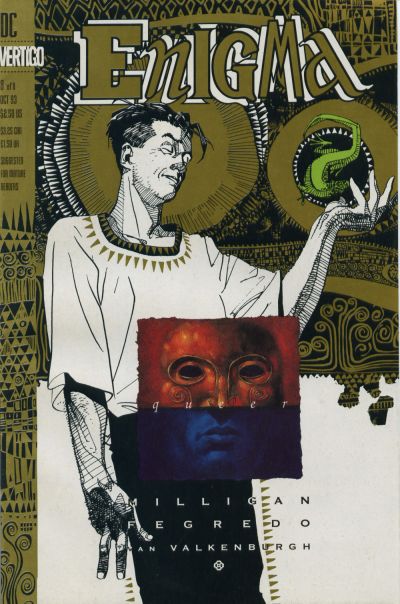
Yep, today's issue is titled "Queer." Guess what the story is about?

Narratively, this is a very interesting issue. The final, apocalyptic confrontation with the Enigma's mother approaches (I can't give all the details - just go read it!), and Titus, Michael, and the Enigma spend much of this issue preparing for her arrival. Michael and Titus retread the confrontation from issue 2, in light of Michael's recent conversion.

And it is recent. We find out in this issue that the Enigma manipulated Michael's mind to turn him gay, in order that the Enigma might have someone to fall in love with, and prove his humanity. At first Michael is angry, but then he relents, and when the Enigma offers to turn him back, Michael refuses. He notes that regardless of the origin of his identification, he's happier now than he had ever been, and he can't see going back as being a good move. Now, conservative critics might point to this as evidence of the idea of gay men "corrupting" and "turning" young straight men - you know, the gay agenda and all. But we can also see in this the Enigma having removed the toxic programming from Michael that results in such outbursts as the one with Titus earlier in the series. Michael has been queered, but that queering has removed from him something that channels emotion into violence.

I mentioned the narrator of this story earlier on. I don't want to give too much away, as the identity of the narrator is both wonderful and horrifying all at the same time. And I'm still trying to figure out the nature of the metaphor that Milligan and Fegredo are using in this narrator. I think, however, that's a much longer conversation, and one that can only happen if we've all read the series. Briefly, what the series considers is whether or not a narrator should be allowed to follow the whole story, of if they are simply a tool for part of the story, but not the whole thing. Or something like that.

More to come...

Jun 21, 2018

The 40 Years of Comics Project - Day 1212: Enigma #7, September 1993

https://www.comics.org/issue/240552/

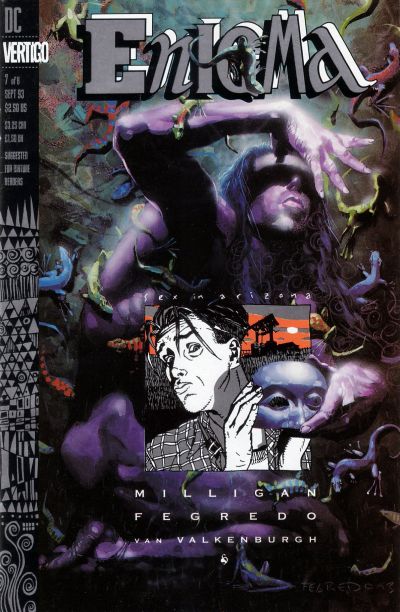
Today's issue opens with Michael Smith curled up in the Enigma's arms, post-coitus. The narrator tells us "[t]hese are two men redrawing the maps of themselves. Actually, you should have seen it. You really missed something." I'll bet. And the two men spend the next three pages lounging around in the nude, chatting. It's probably the most bared male queer flesh in mainstream comics up to the point of publication. In fact, I imagine it's got to be one of the first full-frontal (so to speak) scenes of gay men together in any mainstream comic.

Early Vertigo, and the British Invasion that heralds it, is a great place to find early mainstream queer comics. This series, 2020 Visions, Sandman Mystery Theatre, Doom Patrol, Sandman, all of these seminal Nineties Vertigo series feature wonderful treatments of queerness. I noted in my previous review of Sandman Mystery Theatre Dian's reaction upon witnessing two women having sex for the first time. Held in contrast to Michael's reaction to Titus a few issues ago, we're seeing a nice range of reactions to, and within, queerness, and a good deal of critical interrogation of all of them. Before all my rainbow readers go stalking off and tracking this stuff down, bear in mind that Vertigo was basically a horror imprint, so you're getting into some dark and bloody territory. But very often the representations of queer people in these stories is not the point of the story - it's just an aspect of one of the characters.

During his conversation with the Enigma, Michael echoes in this story what I suggested yesterday. Again, the narrator lets us know that as he dozes, Michael is thinking "how everything has changed, how even his own body feels different." The title of the previous issue was "The End of the World" - I suppose what we witness in the opening pages of this issue are the first moments of the new world.

More to come...

Jun 20, 2018

The 40 Years of Comics Project - Day 1211: Enigma #6, July 1993

https://www.comics.org/issue/240551/

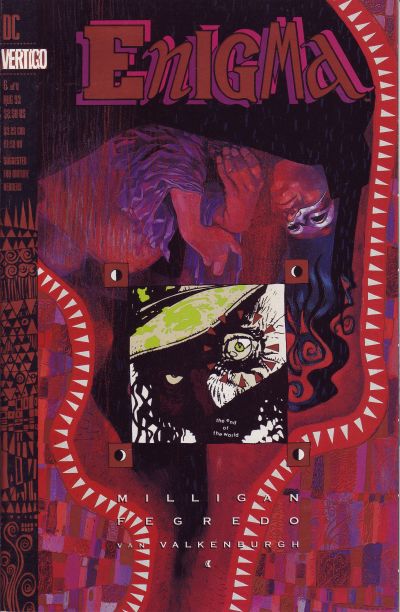
You know how all superheroes seem to have really brutal, violent back stories? The Enigma is no exception. And we're only getting some of it. Just wait 'til the rest is revealed.

Things are heating up, but Michael is starting to take more control of matters. He stops the Enigma from killing Envelope Girl, and manages to find the mysterious man's secret lair. Of course, what they do once Michael gets there probably comes as a surprise. But, from the last few panels of today's comic, it's a nice surprise.

The title of this chapter is "The End of the World." And it really is. Not necessarily in the narrative sense it's meant, speaking about the Enigma's world, more on which next issue. But it's also about Michael's world. I teach my students that language can actually change the world, and nowhere is this more apparent than in one's own understanding of oneself. Once you have a way of describing yourself, you know yourself better. And without such language to name oneself, a person can spend a lot of time searching for a better world. Once you find it, once you find that name for yourself, your old world ends, and a new one begins. It'll be just as hard, but you might not feel so uncomfortable in it.

Maybe.

More to come...

Jun 19, 2018

The 40 Years of Comics Project - Day 1210: Enigma #5, July 1993

https://www.comics.org/issue/240550/

I think we're just gonna leave this one here. It's been a busy week, and as I noted right back at the beginning of the project, some days are going to have to be brief.

Seriously, it's a great comic. Just go read it.

More to come...

Jun 17, 2018

The 40 Years of Comics Project - Day 1208: Enigma #4, June 1993

https://www.comics.org/issue/240549/

Michael confronts The Truth. Not the actual truth, but the villain The Truth, who looks into Michael's eyes and sees something horrific.

And then the comic starts talking to us.

Have I mentioned how strange a comic Enigma is? It was one of the inaugural titles in the Vertigo Comics imprint, and was coming off the heels of the British Invasion of the late 80s. A lot of criticism looks at these comics in light of the fact that they were coming from Brits who had grown up during Margaret Thatcher's reign, and were speaking back to her and her conservative policies. And it's a culture that produced a good deal of strangeness. Mr. Milligan accompanies Messrs. Gaiman, Moore, Morrison, and Delano across the Atlantic and revitalizes American comics in a way that we are still (literally in the current Doomsday Clock series) dealing with. They were kind of like the continental philosophy of the mainstream comics scene. We can't seem to leave them behind.

So, yes, the comic starts talking to us, and the voice of the narrator becomes increasingly important through this series.

Oh, and Michael has a dream of the Enigma dressed in the skimpiest of bondage gear. Throughout the comic, through the narrator, we hear Michael asking the questions: "What is the truth?" "What is he so afraid of?" When I started teaching queer theory to my classes, I found a version of the initialism that included the idea of Questioning as a queer identity. I think that Michael is going through a version of this identity in today's comic, though it's one inflected by the vitriolic rhetoric of early 90s America. Mr. Milligan is doing a really nice job of portraying a person wrestling with an emotional identity versus a rational identity, in that the rational identity is the one speaking with the voice of culture, but the emotional identity speaks from Michael's heart. When he picks up one of Titus Bird's (the writer of The Enigma and outspoken homosexual!) bondage mags, he is appalled at the way his balls tighten, calling them traitors. His emotional, or physical, identity attempts to assert itself.

More to come...

Jun 16, 2018

The 40 Years of Comics Project - Day 1207: Enigma #3, May 1993

https://www.comics.org/issue/240548/

There is one scene in today's comic that stands out. Michael is at a bar with the man who originally wrote the Enigma comic, the fictional one that Michael read as a child. After a heartfelt conversation, the writer suggests that he and Michael return to Michael's motel room. Not understanding, Michael asks why, and the writer places his hand on Michael's thigh. Michael's response is to punch the writer, and immediately question why there had been an assumption of homosexuality.

This anger at even the suggestion that one might fall outside of heteronormativity comes from fear. And it's not even necessarily fear of being gay. But it is fear of how being gay will fundamentally change the way that you can live your life. I was teaching my students about the ways that self-loathing can manifest in queer people, through the use of language that teaches us that we are flawed somehow. Michael's reaction isn't justified, but perhaps it's understandable. Had he grown recognizing queerness as a perfectly normal thing, his reaction this may have been shock at the forwardness, but certainly not anger(fear) at the suggestion.

More to come...

Jun 15, 2018

The 40 Years of Comics Project - Day 1206: Enigma #2, April 1993

https://www.comics.org/issue/240547/

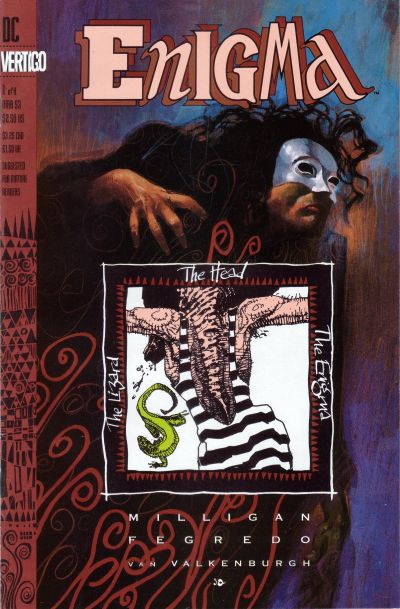
Enigma is, occasionally, an allegory. We have characters called The Enigma, The Head, and, in today's issue, The Truth. Granted, as is revealed in this issue, these are in fact characters from an old short-run comic from the Seventies, but in that cosmic time, just about everything was an allegory. I suppose the question becomes what is Enigma an allegory for? What is the truth, what is the mystery?

This isn't an easy comic. Unlike other metaphysical forays into the superhero genre (thinking here of something like Man-Thing, maybe, back in the Gerber days), this one embraces post-modernity head on, not even remotely denying its awareness of itself as a construct. Everything in this story is construct, and, in true Baudrillardian fashion, we're not entirely certain if there is an original lurking anywhere in the depths of the narrative. And just wait 'til we find out who's narrating the story. Honestly, this is one of those works that needs a really good, solid critical reading. Peter Milligan is a very, very smart writer.

We've not, to this point, seen much to convince us that Enigma is worth including in my month of queer comics. Not to worry. Things get explicit next issue. But then there's that question of what the allegory is trying to communicate. Is this an extended story of someone stepping out of the closet? Interesting idea.

More to come...

Jun 14, 2018

The 40 Years of Comics Project - Day 1205: Enigma #1, March 1993

https://www.comics.org/issue/240546/

I hope you'll forgive a shortish post today. My brain is tired. And we're going to be spending the next 7 days with Enigma, so we'll have plenty of time to talk about it.

I've actually only recently re-read this series, as I've started (re)discovering the works of Peter Milligan. I read his early Batman stories a few weeks back and was really quite taken with his work. Enigma is a very different kind of superhero story. I first read Mr. Milligan in his follow-up to Grant Morrison's Animal Man, a short (7 issues, I think) little tale about a very strange alternate reality. And his turn on Shade, the Changing Man ranks as one of my favourite comics ever. So I figured it's about time I checked out some of his other work.

Today's issue is very much set-up. We meet Michael Smith and his very normal life, described by one character as so normal that it's weird. Which is a fair assessment, actually. But things cease to be normal very quickly. The Head appears on the scene, sucking out peoples' brains, and a strange masked man is seen around the crime scenes, a man that Michael is sure he used to dream of as a child.

More to come...

May 31, 2018

Pride Month at the Giant Box of Comics and the 40 Years of Comics Project!


At an Ally Conference workshop a few weeks ago, the question was asked how one can make it known that a space is safe for Trans people, and more generally for queer people. The response was "We look for rainbows." Hence the flag up there.

I recently went to the opening night of the Fairytales Queer Film Festival here in Calgary. My good friend James heads the team that runs this festival, and it's an amazing, week-long celebration and remembrance of all things queer. The highlight, I think, of this year's festival, is a film that was produced by the festival itself called Outliers: Calgary's Queer History, a fantastic documentary chronicling the struggles of the community from the 1960s through to the 2010s. James, in introducing this film, rightly called those interviewed, some of whom were in attendance, heroes of the community. And I was struck by the appropriateness of that label. I think a lot about heroes, how we not only define who is or is not a hero, but why we do it, what need it fills within us to see individuals as somehow bigger than life. Perhaps it's that we like to imagine that in the right circumstances, we could all rise to be heroes. Much as these people did over the last 50 years.

Leaving the theater, I was inspired. The result (or one of them) is this month-long project of reading, thinking about, and blogging, some comics that either explicitly or implicitly explore ideas of queerness. I was chatting with my wife yesterday about the ways our criteria for attractiveness are formed by media exposure (you know, just a breezy little afternoon chat), and we at some point started talking about queerness, and how we can think about the process of queering. I tried to boil it down to the deconstructive practice of dismantling binaries. And though the term queer is most often associated with ideas surrounding non-heteronormative practices, we can queer just about anything. It's all about that deconstruction of binary opposition, and the introduction of ideas and practices outside of that dichotomy. So this is how I'm approaching the comics I'll be reading this month - as comics that introduce a queerness to an art form that has become a very important vehicle nowadays for queer voices.

The oldest comic I'll be looking at this month is an issue of Real Girl from 1992. We'll start in the indies, where there's a much longer history of queerness, but then get straight (see what I did there?) into the mainstream of the 90s, a moment when explorations of gender and sexuality were being presented in a fairly high-quality format. Peter Milligan and Duncan Fegredo's Enigma, from Vertigo Comics in 1993 and also on the reading list this month, is a great example of this. Grant Morrison's Doom Patrol, and his glorious follow-up The Invisibles, are explicitly queer, bringing this perspective, through Doom Patrol, to the larger DCU, though it would take a couple more decades for this queerness to touch much more than the DP's strange corner. And we also shouldn't forget the tale of Northstar, a gay man right from the get go, but one who was not only closeted in his narrative, but also narratively closeted, in that the story never explicity says "Northstar is Gay!" At least, not for about 100 issues of Alpha Flight.

Time allowing, I'm also hoping to get a few other bits of writing up this month that aren't specifically reviews for the 40 Years project. I'm not sure what they'll be about yet. Perhaps just some thoughts on my own experiences of queer comics, how they've inflected and changed my own collecting and reading practices. But Summer is Summer, and it is always very busy. No promises!

I went back through the entries of my "40 Years of Comics Project" to look at the previous posts that have touched on ideas of queerness. Given the scope of the collection, there's not that many, though perhaps more than I might have expected. You can have a look at them all here, though fair warning that some of the posts only touch on the queerness in the comic briefly. In my posts this month, I'll attempt to be more eloquent.

And if you have any thoughts on what you read here, I'd love to hear from you. Talking about comics is absolutely one of my favourite things in the world to do (my superpower is stating the obvious), so please, chime in if you'd like.

Happy Pride, all. Let's read some comics.


May 6, 2018

The 40 Years of Comics Project - Day 1166: Detective Comics #643, April 1992

https://www.comics.org/issue/51155/

This issue marks the last Peter Milligan script and the last Jim Aparo art on this title. Well, for the time being, anyway. A nice little story that was creepy and interesting, and eschewed the more mystical side of Gotham that Milligan's run has expressed. This is simply a short story of obsession gone awry. And, in a few ways, it's a critique of those who focus their study too much on the minutiae. Not like anyone I know, certainly.

I've enjoyed Mr. Milligan's early Batman stuff. It's an interesting read when considering he was writing Shade at the same time - the subject matter of the two runs interweaves without ever actually connecting. But it would be mad to think that Shade and the Idiot never met one another. Or that the madness that overtakes the killer in today's comic couldn't have sprung full-formed from the forehead of the American Scream. Aside from an occasional cameo, Shade steers clear of the DCU proper, so these Batman stories could be seen to fill in the ways in which Shade's adventures across the US affect Gotham City.

What was that about paying too much attention to the minutiae?

More to come...

May 5, 2018

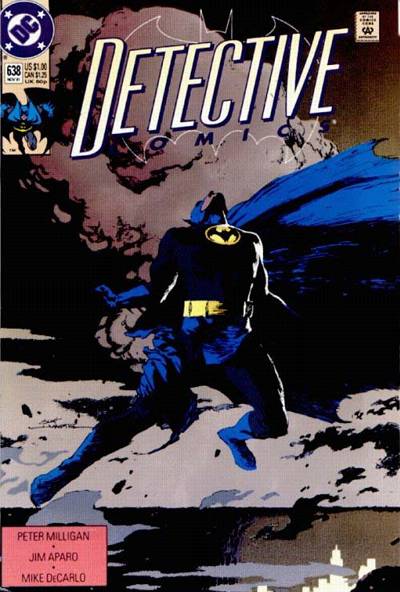
The 40 Years of Comics Project - Day 1165: Detective Comics #640, January 1992

https://www.comics.org/issue/50807/

The Idiot and his root wind down in a fairly typical Batman style, I think. Were this a weirder comic, things wouldn't have wrapped up quite so nicely but, again, that's what Milligan is doing over in Shade. I'm curious as to whether or not The Idiot ever shows up again - the ending is left fairly open.

I really am convinced that Mr. Milligan was working out in this story what would happen if Shade gave in to the baser instincts of the body he inhabits in this particular era - that of a convicted murderer. The body does take over once or twice in the series. More that that, though, I could see this as a view of how Shade might move through bodies were he to care little about who or what he inhabits.

One more Milligan 'Tec (that's what the fans call it) tomorrow, and then on to something pretty different.

More to come...

May 4, 2018

The 40 Years of Comics Project - Day 1164: Batman #473, January 1992

https://www.comics.org/issue/50736/

Basically, this story is Batman versus Shade. The Idiot is a hallucinogenic nightmare that inhabits "The Idiot Zone," which must be a neighbour of the Madness Zone that powers Shade's vest. Shade, which Mr. Milligan is writing at the same time he's writing this. Now, I can't imagine Shade eating the minds of children to gain a foothold in reality, but it wouldn't be the weirdest thing he's done. And he usually finds a way to put it right in the end.

How will Batman put things right? Find out tomorrow.

More to come...

May 3, 2018

The 40 Years of Comics Project - Day 1163: Detective Comics #639, December 1991

https://www.comics.org/issue/50522/

Back with a proper entry finally.

Peter Milligan and company continue an excellent run on the Bat-titles, this time crossing over between the two books to tell a weird little story about "The Idiot."

A few years back I picked up a set of books that were all writings about the Arctic and the Antarctic. The Antarctic is a very interesting case in literature, as it's a continent, a landmass, that has no native literature. Unless there's something buried deep beneath the ice, there's never been a literature-producing society there. So all we have are writings by people from outside of the area, unlike just about everywhere else on the planet. One of the writings that really took me, the author of which I can't remember at the moment, told the tale of a "Third Man" out on the ice with two explorers. It wasn't that there was actually someone there, but the isolation and desolation of the endeavour created such a synergy between the two men that it seemed as if a third person, or personality, was accompanying them on the ice. The piece is very clear that this really felt like another presence to both of them.

"The Idiot Root" appears to be relating a similar story, except that the third man is a fifth man, and the first four aren't Antarctic explorers, but four people who have suffered severe mental trauma. Unlike, perhaps, the gestalt entity of the explorers, however, the Idiot (derived from Id) wants to be real, and isn't afraid to kill to get there.

Batman has other ideas. There's a wonderful moment in today's comic wherein Batman is attacked by young followers of the Idiot and there's almost panic in the internal monologue as he tries to figure out how he, of all people, can fight children without hurting them.

I should note that this comic actually contains another comic, a Sonic the Hedgehog story as a 20-page insert attached in the middle of the comic. Strange choice of placement, given the remarkably dark nature of today's issue, but it is interesting in that I think it must be the very first Sonic comic. Sonic now is a venerable institution at Archie Comics, but this one is accompanied by an ad for the very first Sonic game, back before the nightmare of Sonic '06. That said, I didn't read it, as it wasn't the comic I had selected for today. I will note that there is another comic in there, though, and I'll read it at a later date.

More to come...

May 2, 2018

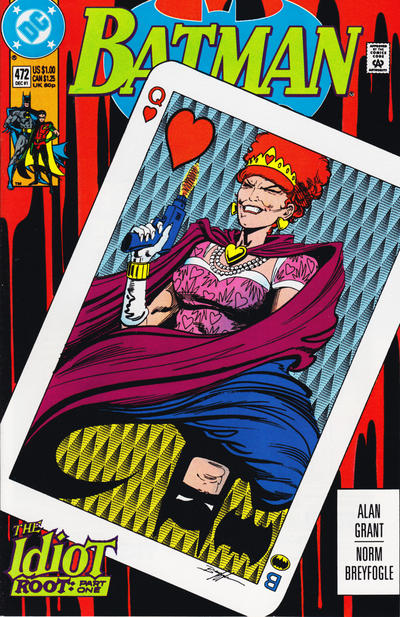
The 40 Years of Comics Project - Day 1162: Batman #472, December 1991

https://www.comics.org/issue/50445/

Same story as yesterday, I'm afraid. Busy day with the 'rents and work. But I'm digging this new story. The Queen of Hearts is great, as is The Idiot.

More to come...

Apr 23, 2018

The 40 Years of Comics Project - Day 1153: Detective Comics #633, August 1991

https://www.comics.org/issue/1766125/

We come to a break in Mr. Milligan's Bat-works now, with a cool little story that, unlike the previous ones, actually involves someone with superpowers. The mistaken identity trope is played out in a very novel way in this tale. I've no idea if the pro/antagonist of this piece has any other appearances, or if he was created just for this story, but it was a neat device.

I'm still not sold on Batman. I don't know what it is, but he's just too goddamn grim, I think. Like, lighten up, just a bit, every now and again. Isn't that why there is a Robin? So that there's a little light in the Dark Knight's world? But we see that so rarely, I think. Perhaps it's just that I haven't been reading sustained runs of the title. And these are guest-written stories as well, meaning that they're not likely to have any of the character development stuff that the regular creative team would probably handle.

I was mentioning how little interest I have in Batman to a local comic shop owner the other day, and noting how happy I was to find Milligan's stuff, as it's a bit different from the usual Bat stuff. He looked at me and said that with 80 years to choose from, there's bound to be something to enjoy in there. Which makes so much sense.

More to come...

Apr 22, 2018

The 40 Years of Comics Project - Day 1152: Detective Comics #632, July 1991

https://www.comics.org/issue/49899/

There's a wonderful twist in today's comic that very nicely deals with an aspect of the generational trauma of the Holocaust in a way that I've not seen done in comics, though I'm sure it has. The trauma I'm speaking of is the trauma of the collaborator. While there might be those who say that this trauma is deserved, it's difficult to say unless one is in a particular situation whether or not one would break. The character in this story is revealed to have betrayed a resistance group to the Nazis under torture, and has tortured himself for 50 years since.

In our present time, we're seeing a lot of men revealing, or having revealed, damning behaviours for which they are, rightly, being called to account for. The conversation I'm not hearing, and maybe it needs to not happen for a little while, is how do these men, should they truly want to, recuperate their lives and reputations? How do they make amends? Today's comic raises a similar question: how long should someone punish themselves, or be punished, and what constitutes the kind of restitution that is required?

I'm sure I could have articulated that more clearly, but it's late and I'm tired. One more Peter Milligan Detective tomorrow.

More to come...