Pages

Showing posts with label Dark Horse Comics. Show all posts

Dec 8, 2020

The 40 Years of Comics Project - Day 2113: Next Men #7, September 1992

 For information on stopping the spread of COVID-19, and on what to do if you are quarantined, have a look at the World Health Organization site.


Well, almost made it. I'll finish off my look at Next Men with today's issue, which really is kicking off the next section of the storyline, but is also the last consecutive issue I have. I may hold off from reading the rest of them, as I'm intrigued enough to track down what I'm missing. I recently read that Byrne has had the whole story planned out ahead of time, so I'm curious to see the end.

That said, my wrists have been bad this week. Briefly, this series is totally worth tracking down and reading. Excellent take on super-powered beings and how they work in "the real world."

More to follow.

Dec 5, 2020

The 40 Years of Comics Project - Day 2110: Next Men #4, May 1992

 For information on stopping the spread of COVID-19, and on what to do if you are quarantined, have a look at the World Health Organization site.


Okay, I'm in. This is a very cool story, and there's some really dark shit going on. A few days ago I noted that this series appears around the same time as the Image revolution, one that used the trappings of darkness to make their products seem cool without having, really, much substance. Byrne is going the other direction here, offering us a series that, because he drew it, hearkens back to the Copper Age stories, with some drama and some darkness, but that, substantially, seems to have a very grim back story. The discovery by Jazz and Bethany of a cave full of skeletons gives us a taste of the two aesthetics coming together, but there's a twist when the weird alien that we assume is responsible for the skeletons starts speaking and recognized the women.

As I say, I'm in. Byrne obviously has this story plotted in his head, and it shows in the consistency of not only the art but also the story. The beats are arranged very well, giving just the right combinations of intrigue, action, and relaxation. I'm excited to see what happens tomorrow.

More to follow.

Dec 4, 2020

The 40 Years of Comics Project - Day 2109: Next Men #3, April 1992

 For information on stopping the spread of COVID-19, and on what to do if you are quarantined, have a look at the World Health Organization site.


 The chaos surrounding the Next Men has an outcome at the end of today's comic that I think I would have liked to see play out in our reality some time in the last four years. The final page of the issue has the Vice President of the US on a plane heading...somewhere...when all of a sudden, with no explanation, the plane blows up and he dies. If only Mike Pence had suffered a similar fate. I try not to wish death on people. I think that's a pretty karmically dodgy thing to do. But the current, and outgoing, American administration was, in my opinion, simply evil, demonstrating everything that is bad about the US, Capitalism, and organized religion, all useful ideas if deployed with kindness and generosity. The people in charge now don't know what those words mean

More to follow.


Dec 3, 2020

The 40 Years of Comics Project - Day 2108: Next Men #2, March 1992

 For information on stopping the spread of COVID-19, and on what to do if you are quarantined, have a look at the World Health Organization site.


I'm having to rethink my relationship with John Byrne. I've often found the arrogance I've perceived in interviews as very off-putting, a case of an artist buying their own hype, as I've noted before. And I do think that there's some of that there. On the other hand, again as I've noted, Byrne is a fantastic artist, and given the space that a creator-owned book allows, his writing's not too shabby either. I'm definitely on my way to being sucked into this story.

One thing I'm really appreciating is the Next Mens' inability to accept that the world they find themselves in is, in fact, the more real one. And this isn't communicated in exposition, but rather in the characters attempting something odd that, from their reactions, you can tell worked during their time in The Greenery.

There's also a much larger story going on, which is kind of cool. Often you'll have origin stories like this and then the characters just fuck off and become superheroes. This story is starting to read a lot less like superhero fiction and more like science fiction, so we'll see where things go as we progress. I've been surprised to this point. Hopefully that will continue.

More to follow.

Dec 2, 2020

The 40 Years of Comics Project - Day 2107: Next Men #1, February 1992

 For information on stopping the spread of COVID-19, and on what to do if you are quarantined, have a look at the World Health Organization site.


Okay. Today's comic actually came from the recent collection I bought. There's not a lot more information revealed in today's comic. It's more a continuation of the escape that ends the previous issue. We're still somewhat in the dark about who the Next Men are and what and how they can do things. Having lived in a virtual reality all their lives, there are moments where the differences between the real world and the virtual world are pointed out. At one point Danny, the speedster, has to stop because he has blisters on his feet that he's never had there before. And Jack tries to "make" a weapon like the guns being used against the group out of thin air, perhaps suggesting that there was an aspect of wish fulfillment in The Greenery, their virtual prison.

Once again, brilliant layout work, and, given the era, a very different take on superheroes. It's worth remembering that this is the time of Liefeld and McFarlane over at Marvel and then Image, so Byrne's work here is not only reacting to that, but demonstrating, at least to me, a different way superheroes went during a traditionally pretty silly era.

I have the first 8 issues consecutively, so I'll probably make my way through those this week. More to follow.

Dec 1, 2020

The 40 Years of Comics Project - Day 2106: Next Men #0, February 1992.

 For information on stopping the spread of COVID-19, and on what to do if you are quarantined, have a look at the World Health Organization site.


 I don't know if I mentioned it a few weeks back, but I bought a small collection from a seller on Kijiji. I allowed myself half of it and divided the rest up into three chunks that I'm "gifting" myself over the next few months. Today was the first chunk, and it contains a nice run of this comic. Except the issue I'm reading today is from my collection, and has been awhile. It reprints the preludes to the Next Men ongoing series from Dark Horse Presents.

I didn't know this when I sat down to read issue number one this afternoon. I was very confused by the events of the comic. Thank goodness the dark recesses of my brain managed to recall that I had a zero issue of the series, or I thought I did, and lo and behold, it appeared.

I've not been kind to John Byrne on this blog, but I have to give credit where credit is due. He's a really, really good comics artist. I just think he's one of those people, and you have them in every industry, who thinks he's more important than he actually is. He did some spectacular runs on some of the biggest superheroes, but that doesn't mean that his voice ought to be counted for more than newer, or less famous, voices. This is always the sense I get from him when I've read interviews. I really should just avoid reading interview.

The end of Byrne's Fantastic Four was one of the first Marvel comics I collected. Before I read Jonathan Hickman's run on the team, I always thought that Byrne got the super-family dynamic just right, though I'll admit it's been a while since I've read it. I'm curious to see how this particular team of Next Men (and Women) evolves. Given the artist's huge successes with team books prior to writing this one, I wonder if we'll see things that are familiar from Byrne's earlier team books, but refined through the lens of experience.

More to follow.

Nov 28, 2020

Nov 17, 2020

Sep 19, 2019

The 40 Years of Comics Project - Day 1668: Planet of the Apes, 2001 (Movie Adaptation Week)


I remember watching the original Planet of the Apes series when City TV would do marathons of them over the course of a day. Spending a whole Saturday on the couch watching this bizarre future history unfold was a lovely way to pass some of my adolescent time. But, as with the other movie adaptations I've reviewed this week, I've never actually seen this one.

I think perhaps that's a good thing - this way I can judge the piece on its own merits, rather than in comparison with its source material. And on that topic, you'll note that the cover says "Based on the motion picture screenplay," rather than being based on the film itself. I read a synopsis of the film, and the comic actually removes the "twist ending" from the film. Or rather, I think the film added something to the screenplay. Either ending didn't make a whole lot of sense to me. In the comic, it seems our hero Leo is going to go back in time and completely erase the future he's just helped to save, and no one seems to have a problem with this. And in the film ending, how the hell did the apes Leo defeated manage to travel back in time? Though, really, I ought to see the film before bashing it too much.

The edition I read today was signed and numbered by writer Scott Allie. I likely picked this up as a premium comic to sell at my store, though the lack of success of the film meant that the comic adaptation didn't really have a huge audience. Which brings me to an interesting question: who exactly is the audience for a movie adaptation? I suppose in the days of no streaming services or Internet, it was a way to relive a film that you might not have easy access to. But does something like this film, which would have hit home media very quickly, really need an adaptation? I suppose it speaks to people who would rather read a comic, or novelization, than sit and watch the film. And it's more portable, I suppose?

Anyway, it wasn't very good, all things considered. There was a strange propensity for the captioning to switch between past and present tense, which simply reinforces my idea that all comics publishers should be hiring ex-English academics as their editors. We do not miss stuff like that.

"Daena also knows that this she-ape wants more from Leo than a rescue."

May 19, 2019

The 40 Years of Comics Project - Day 1545: Cud Comics #1, November 1995


I was, I'll admit, very disparaging of Terry LaBan's The Unseen Hand, a series I reviewed earlier this month. I just didn't think it was very good, but that's just my opinion. I was intrigued, however, by the mention in Mr. LaBan's biography of his "Archie meets underground" series Cud Comics. That very weekend, the always-reliable Purple Gorilla Comics had this lovely example hanging on the wall. Of course I snatched it up.

Of course I did.

And now I'll have to track down every issue, because I love Eno and Plum. LaBan is telling stories here of people who were my age in the mid-90s, in their early-20s trying to figure shit out. I think Generation X had a bit of a crisis around this point. We had that youthful optimism that generations have, that we could effect real change, but we were also realizing that we were a small generation. A lot of pop culture from the 90s is very grim, and I think it's from a recognition of not being able to change things. Cud Comics is an extreme reaction to that, moving from anger to irony, trying to find the humour in a feeling of ineffectualness.

Damn. Sorry. That was a downer.

Eno and Plum are great characters, and I cannot wait to read more about them.

"If we have sex, it'll lower my sperm count!"

Dec 4, 2018

The 40 Years of Comics Project - Day 1378: Cannon God Exaxxion #2, December 2001


Okay. I think maybe it's time to get back to it. This has been a brutal week, and I'd be kidding myself if I thought that I was even remotely better. But I work in an industry that sadly cares little for its employees, as far as I can tell, so it's time to bundle all that misery and pain back down into the little (okay, not so little) ball I've been storing it in for the last couple of decades.

Yesterday I decided I wanted to read some light-hearted manga, and this series seemed a good fit. There's a ton of fan service, which I just don't get (well, I do, but I don't, if you see what I mean), but it also seems to be telling what looks to be an intriguing alien invasion story. The drag is that I thought I had a good long run of the series, and I do, all 8 issues of the first arc - with the exception of issues 3 and 4. *sigh*

This won't stop me from reading them. I've got to get out of the habit of wanting to complete these series before reading them. If my dream of a comics research library is ever achieved, then I'll try to complete them. But for now, fragments will have to do.

More to come...

Jun 23, 2018

The 40 Years of Comics Project - Day 1214: Buffy the Vampire Slayer: Willow, December 2009

https://www.comics.org/issue/695344/

Back to Buffy for a bit. This issue was published as part of the Season 8 revival, but is set just after the end of the television series. Willow is moving past the loss of Tara, finding some respite in Kennedy's arms, and is still trying to figure out what kind of a witch she actually is. Lots of people seem to be very scared of her, so she goes on a vision quest of sorts to find guidance.

What's great is that this is a predominantly female comic - I think there's only one male character, and he's solely in the background. The ethereal council of witches that Willow encounters are all women, and it's the sexy serpent lady on the cover who eventually becomes her guide. We've seen this character before, in flashback, but this is the first time we get to see the genesis of Willow's relationship with her. It's definitely a queer relationship, too, as you might guess from the cover.

As with the many of the mainstream comics I've looked at this month, Willow's affectional orientation is given about as much attention as a heterosexual orientation would be. We see some affectionate words exchanged between her and Kennedy, and the odd comment directing us away from heteronormativity. There's an interesting shift that appears to happen in the decade or so between the Vertigo titles I've looked at and the later stuff like this issue or Detective Comics - the stories move away from dealing with the fact of being queer, and into the world with queer as simply another way of being human. Which, in a fantasy or superhero setting, is an interesting conversation to be having.

More to come...

Jun 8, 2018

The 40 Years of Comics Project - Day 1199: Buffy the Vampire Slayer - Willow & Tara: Wilderness #1, July 2002

https://www.comics.org/issue/102204/

I should admit, right off the bat, that I've never been a fan of the Buffy comics universe. It seems like a no-brainer for me. I love the show. Like, love love the show. But the comic has always simply left me cold. Even when the story was "officially" continued in Season 8, it was never at the top of my list. As I consider it now, I think that the comic never quite embraces the level of camp that the television show, as a result of effects technology, had to. The comic doesn't have to worry about its effects budget, and this would usually be a pro as far as adaptation goes. But Buffy the Vampire Slayer, right from the title, embraces its ridiculousness, its campiness. It's a similar problem that I see in contemporary superhero films, Deadpool and Ragnarok aside, perhaps, that refusal to embrace the silliness of the superhero.

But that's beside the point for our purposes today. Let's talk about the iconic relationship that is Willow and Tara. One of the first out and proud lesbian relationships I ever saw on television. Two badass women who took no shit from anyone, loved each other soooo much, and were imperfect, flawed, and human. Today's comic takes place, I think, just before Buffy returns in season six, and Willow and Tara are in their best Moms mode with Dawn. I have to say it's my favourite period for the couple. They've stopped being awkward, both with each other and to the rest of the world, they trust each other implicitly, and, Buffy's death aside, life seems to be going pretty well.

As with Batwoman's story, Willow and Tara's queerness is not central to the plot of today's comic, and really is only evident in a few panels. And the expression on Willow's face when the ladies decide to save their naked witch dancing for later, to save Dawn the embarrassment, is really all you need to see to understand their relationship. They just love each other. But the expression of that love is almost a throwaway moment - it's deployed to set up the punchline of the naked dancing later euphemism. Not that this is a bad thing. Really, it's the type of joke that any relationship can, and often is, used to set up. The knowing wink and the "We'll have dessert later" exchanged between husband and wife in a sitcom, for example. So having this kind of simple humour set up by a queer relationship is, in some ways, a wonderful example of mainstreaming or normalizing.

Willow and Tara. Leading the pack again.

More to come...

Sep 21, 2017

The 40 Years of Comics Project - The Weekly Graphic Novel: Week 57 - Beasts of Burden: Animal Rites, June 2010

https://www.darkhorse.com/Books/14-755/Beasts-of-Burden-Animal-Rites-HC

I was very fortunate to find this in a thrift shop a while back - a beautiful hardcover collection of some of Jill Thompson's most inspired art, in my never humble opinion. I'd read a Beasts short in one of the Dark Horse collections I have (I think), and the whole premise just spoke to me.

Now, here's a warning: just because it's about a bunch of animals investigating the occult, and just because they look kind of cute, does not mean this is a comic for kids. Well, not for all kids. Those dark ones, that're not only hurt but also kind of fascinated when they cut themselves, they'll probably love the shit out of this book.

I did, anyway. The short stories have some slight connective tissue, but otherwise they're lovely little bits of suburban horror as seen through the eyes of a group of mystical dogs (and 2 cats). They put me in mind of the very early Hellboy shorts in the Wake the Devil  and The Chained Coffin collections, and they're very obviously inspired by Mignola's wonderful sense of atmosphere. This book actually lets us in on that secret life that we're all sure our pets have when we're at work, or asleep. And, honestly, they can have it. Some of the stuff in this book is super-creepy.

Worth a read, if you can track down any of the issues. Onward.

May 9, 2017

The 40 Years of Comics Project - Day 804: Lone Wolf 2100 #2, June 2002

https://www.comics.org/issue/264899/


In preparation for blogging this comic, I decided to read a bit of the original Lone Wolf and Cub, a comic that, as with many of the critically-acclaimed pieces from the Eighties, I was aware of but had no real experience with. I was fortunate enough to come across the first two omnibus editions from Dark Horse, so I've plenty to read...and I'm going to, because it's amazing and captivated me almost from the first page. I managed to get through the first chapter with breakfast this morning, and that was more than enough to give me a sense of what the series was about, and how today's comic takes both the story and aesthetic and projects it into the future.

The first question I always ask of such works, though, is why are so many of our futures dystopian? We, as imaginative creatures, seem to have a very pessimistic view of where the species is heading. In the Interpersonal Relationships and Communications class I'm currently teaching there is a section that deals with self-fulfilling prophecies, and I can't help but be concerned that our propensity for dystopias might well be such a thing. It's one of the reasons I really love the television series Sense8, as it's an almost unfailingly optimistic piece of writing - even at those places where we've been trained by popular media to expect the worst, it's a series that delivers the best of what humanity can be. Well, so far, anyway.

The set-up of today's comic is the journey of an assassin robot and his small human charge. I don't have the first issue, so I'm not sure why this robot is travelling with the little girl, but the desire to protect is evident in this issue, as are the questions as to why a robot created for the purpose of killing is devoting so much of its energy to this small child. Indeed, the more salient question is not so much why, but how, given the violence inherent in the robot's programming. And this is a nice hearkening back to the original series. The Lone Wolf of the original is a masterless samurai who works as an assassin, but who is devoted to the Cub he travels with. What we're getting, in both stories, is a consideration of the ostensibly opposite impetuses of killing and nurturing, and how we might recognize and reconcile these qualities in a single character. The same sort of conversation is taking place in the Arrow television series at the moment. As with the propensity for dystopia, this is a theme I find to be somewhat overwhelming in fictions, this reconciliation of violence and love, really. Is it because we see so much of the former, but wish for so much of the latter? I think perhaps it is. We want to believe that we're nurturing creatures, but the evidence of our senses, or of our virtual and mediated senses anyway, is that we're not. Fictions like Lone Wolf 2100 offer us a way of parsing the two, of seeing in a character designed for killing an ability to love, in the hopes that this, somehow, can be applied to our species as well.

To be continued.


Apr 19, 2017

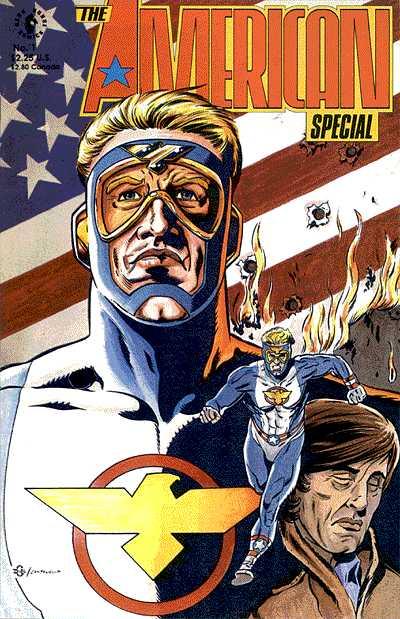
The 40 Years of Comics Project - Day 784: The American Special #1, 1990

https://www.comics.org/issue/48910/

Nothing like coming in literally at the end of a story to promote confusion and discomfort in the morning.

That said, I'm intrigued by The American, a story of a government-produced line of superheroes-as-propaganda that ends in tragedy. This issue follows the tale of the last American and the journalist who exposed the program, one that cost most of the individuals wearing The American costume their lives. The comic, and the series, come at around the same time as the realistic superhero stories of the 80s were having their most profound effect, and deals with many of the same issues: how does a world like our own, one that is twisted and difficult to navigate, suffer the existence of the far simpler ideal of the superhero. Not well, by the looks of things.

Today's featured creator is Doug Braithwaite. I know his name, and I've got some of his stuff in the collection, but I can't for the life of me recall any of it off the top of my head. I do know he pencilled issue #25 of Morrison's Doom Patrol, a story starring Josh Clay and Dorothy Spinner, but today's comic is my first considered experience of his work. It's very superhero. And that's a good thing in terms of the comic we're looking at. The set up of The American is that a flashy superhero is created by the American military as a propaganda tool, though those who wear the costume are also trained soldiers, so The American participates in numerous battles in hotspots around the world. As such, the character, and his world, should look like a superhero comic, but shouldn't necessarily read like a superhero comic - which is exactly what Verheiden, Braithwaite, and company do. The characters look one way and behave another. It raises the interesting notion of a superheroic aesthetic that somehow transmits that notion of a simpler world visually, though the characters might be acting and interacting in much more complex ways. This again puts me in mind of something like Watchmen, which is unsurprising. The juxtaposition has also made me want to read the rest of the series (8 issues prior, 4 following), just to see exactly how it's all pulled off. Calgary Fan Expo is coming up. I'll have to keep my eyes open.

To be continued.

(I forgot to add that this comic does something awesome that I love - at the end of the issue, we get a few pages of what the comics that would have been published in-continuity would look like featuring different versions of the The American throughout history. Alan Moore's Supreme pulls this off to perfection, and I always enjoy seeing these kinds of takes on characters that are also a part of the fiction.)

Mar 24, 2017

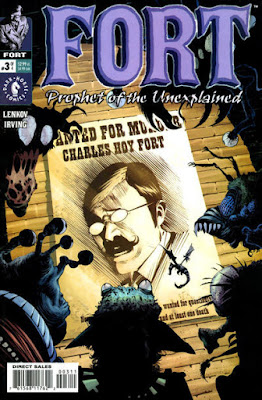
The 40 Years of Comics Project - Day 758: Fort - Prophet of the Unexplained #4, September 2002

https://www.comics.org/issue/713341/

And so things wrap up for Charles and Yhir. Actually, they wrap up pretty darned quickly, like within the first 5 or 6 pages. The feeling I get is that the Fort series really is more properly a graphic novel, or rather a complete work rather than a periodical publication. Or it should have been. Much of this final issue is aftermath and epilogue, though there is, in true horror movie fashion, a return of the baddie in the final pages. What we see, though, and this is significant for those who know of Fort's work, is his rededication to his work of chronicling "the Damned," the occurrences and people that simply cannot be explained by science.

This was a good series. I almost see it as a prequel to Irving and Rennie's Necronauts (did I already say that? Having deja vu). The young Mr. Lovecraft, Fort's child sidekick so to speak, begins writing after the confrontation with the alien virus, and I could see him growing up to become the same character that takes part in the Necronauts' adventure.

I think that was my first series for this year. What next?

To be continued.

Mar 23, 2017

The 40 Years of Comics Project - Day 757: Fort - Prophet of the Unexplained #3, August 2002

https://www.comics.org/issue/713340/

Charles Fort is a study in contradictions in this issue. Though he makes his way around New York on a horse-drawn bookmobile, he also manages to go full-on action hero in this issue, actually engaging in a controlled slide down the Statue of Liberty, then chasing a giant alien virus into a sewer with a flashlight taped to a rifle. It's a wonderful reconception (I'm assuming this. Perhaps the real Fort actually was an adventurer) of a historical character. I'm going to be talking with my class about this next week, the notion of taking real people or places and fitting them into a fiction. My argument at the end of class today was that history is more often made up of events than of people. Even when we do recognize people as historically significant, it's because they are somehow attached to an event of historical significance. What the kind of fictionalization that Fort traffics in does is remind us that the people involved in those historical events, be they the fundamental figures or simply faces in the crowd, are, or were, each individuals with their own personalities, ideas, and dreams. As I teach Natalie Asplund's Redcoat West, and then teach factual accounts of the Northwest Mounted Police, I ask my students to notice what fiction is doing for us. It humanizes the historical. Biography and autobiography can also serve the same purpose, as long as we recognize that these, too, are forms of fiction. There's no such thing as an objective record of human experience, as far as I can tell.

Of course, some fictionalizations are more...real...than others. The one in Fort leaps over the cliff of the real and into complete fantasy, but it still reminds us that the real Charles Fort, the one who compiled the wonderful books that serve as his legacy, was a human being, perhaps even an adventurous one. And wouldn't it be just lovely if he actually did save New York from an alien virus from the back of a horse-drawn bookmobile?

To be continued.