One of the things I've been talking with my therapist about with regard to my ADHD is, of course, tools to help one muddle through with this kind of mind. One thing that works for me, though I rail against it, is a schedule. I once joked to my wife that I had driven myself crazy by loving chaos but actually requiring structure.
This blog was one such, and I think it's important for me to make it so again. So, a catch-up, and then I'll start blogging again.
This week's theme was "Brown." I typed it into my database, and these were some of the comics that it suggested.
Thoughts, reviews, rants, laments, and general chatting about the wonderful world(s) of comic books.
Showing posts with label Daredevil. Show all posts
Oct 29, 2019
The 40 Years of Comics Project - Day 1702 - 1707: Catching Up
Labels:
#40YearsofComics,
1950s,
1990s,
2000s,
2010s,
Big Bang Comics,
Boom! Studios,
Daredevil,
Dell Four Color,
Dell Publishing,
FCBD,
Harris Comics,
links,
Marvel Comics,
Top Shelf Productions,
Top Shelf Tales,
Vampirella
Aug 10, 2017
The 40 Years of Comics Project - Day 897: Fantastic Four v.1 #255, June 1983
Off we go on a slight detour into John Byrne's Fantastic Four which, as I mentioned yesterday, is one of that artists few major runs that I quite enjoy. We'll get into my problems with Byrne some time, but not today.
We're in media res today, with the FF stranded in the Negative Zone and Annihilus in the Baxter Building, attempting to tear down the barriers between his universe and the Marvel U in order to destroy both. That whole cataclysmic destruction angle of villainy has always mystified me. Were I a super villain, I don't think I'd just want to blow everything up. I, by definition, am a part of everything. The nice thing in this situation is that Annihilus' very existence is built around the destruction of everything. He is the most nihilistic of nihilists, and certainly has a pure belief in the perfection of nothingness. It's a wonderful way to articulate the alienness of the Negative Zone, and of one of it's most powerful inhabitants.
But more to the point for us, a strange wall of force has been erected in downtown Manhattan - Daredevil slams into it in the early pages of today's comic in much the same way the Avengers discovered it in yesterday's. Neither the Man Without Fear nor the World's Mightiest Heroes know what it is, or what it portends, but I imagine as the crossover continues, the seriousness of the situation will make itself known.
Will our heroes triumph? (Yes, certainly). Will they suffer losses? (Yep, though not permanent ones. This is superhero comics after all). Will it be a cool story to read? Of course. To be continued.
Oct 18, 2016
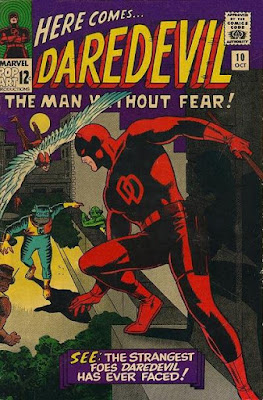
The 40 Years of Comics Project - Day 601: Daredevil #10, October 1965
Time to reach back into the relatively deep past of Marvel Comics, or, at least, the deep past of one of their more contemporaneously popular characters. It kind of floors me that this comic is over 50 years old. And it shows. This is not to say that it shows in the story (though the use of women as solely simpering love interests or femme fatales is a bit troubling), but more in the physical condition of the comic itself. One can often expect comics of this age to be showing their years in some ways, unless they were stored properly from day one, but this one's been mistreated. At some point the owner of this comic decided that burning particular images out of the pages would be a good idea. I'd thought at first that it might have been accidental, from a cigarette or other smokable substance, until I realized that the tiny holes on the cover were actually the eyes of each character depicted. The more I consider it, the more I think this might have been done using the magnifying glass and the sun trick. Fortunately, aside from a large chunk of the first page having been destroyed, the rest of the charred intrusions don't interfere too much with the story.
It's an interesting story, for a couple of reasons. First, it marks the first appearance of the Ani-Men, a B-list villain group who continue to pop up every now and again, often in completely different incarnations and with different characters. I quite like this iteration of the team - they're not mutated animals or experimental super-criminals - they're low-rent thieves who are given costumes with marginally impressive enhancements. And, unlike most thugs for hire, they evince at least a modicum of intelligence and self-preservation instinct. The second reason this story is cool is that it was both drawn and written by comics legend Wally Wood. The opening page states that Stan Lee has graciously given Wood the chance to write a story (though apparently Lee finishes the story next issue), but one has to wonder if Lee was simply spread too thin, and needed someone to pick up the slack for him.
It's an interesting contrast to read this comic after the last few days of pseudo-realistic art in the Jim Lee X-Men comics. Wood's figures move in a realistic manner, but are lacking the detail that denies the 90s superhero comics the kind of iconicity we associate with early Marvel. Perhaps I'll attempt to read and blog some more 60s comics for the rest of the week.
Onward.
Jul 1, 2015
Giant Box of Television: The Cape
As a part of my comics-collecting mania, I've amassed a fairly substantial Video/DVD/Blu-Ray collection of comic book-based films and television shows, erring mostly on the side of superheroes. Some are quite substantial (i.e., all 10 seasons of Smallville), but some are less so. As I finish a collection, be it season or series, I'll offer a few thoughts on the show, why it works, why it doesn't, and what it does for superheroes in general.
I discovered The Cape through Community. The Community rallying cry of "#SixSeasonsandaMovie" hails from an episode where Abed Nadir, pop culture enthusiast/obsessive, becomes enamoured with The Cape television show, claiming that it'll last for 6 seasons and a movie.
Abed was wrong.
There are 10 extant episodes of The Cape, collected onto a double-DVD collection. I picked it up on a whim, having found it for a good cheap price, and having seen the references to it on Community. It made up a good chunk of my post-exam television-watching, and having completed the series, I cannot for the life of me, especially in the wake of the success of The Flash television show this year, understand why it was not more successful. The Cape offers all the crazy, ridiculous, nonsensical logic of a comic book superhero universe. But more than just that, it recognizes the craziness, the ridiculousness, and embraces it, celebrates it. It's a remarkably self-aware series, something built directly into the fabric of the series as a result of the main character, Vince Faraday, taking on the identity of his son's favourite comic book superhero in order to clear his sullied name. What makes it a remarkable metatext for a superhero series is that there is little to no reference to more well-know superheroes in the series. The Cape, the character, draws strikingly obvious visual hallmarks from Batman. His origin, in some ways, is a reverse, or revamp, of Batman's origin, this time with the father of the family ostensibly dying while the son and wife attempt to continue on.
I shouldn't, perhaps, say that the series doesn't reference its more famous predecessors so quickly, though. Faraday/The Cape's powers and training are provided by a group that call themselves "The Carnival of Crime," hearkening back to Marvel's Ringmaster-led "Circus of Crime." But we're in a world where there are no superpowers to speak of, thus no Princess Pythons, etc. This carnival is composed of people who have become really good at their chosen skill, be it acrobat or hypnotist, and have applied those skills to less-than-altruistic goals. This is one of the really fascinating aspects of the show. The Cape is ostensibly a good guy, a former cop, a devoted father and husband, yet he teams up with a completely morally-ambiguous group of miscreants. And it's not like they hide their activities from him. We see here a prioritizing of crimes that begs deeper investigation. Faraday is attempting to expose the super-villainy of main antagonist Peter Fleming, a.k.a. Chess, a man who not only framed him, but is in the process of taking over the city in order to fund his criminal activities. He bears a striking resemblance to Wilson Fisk, actually, though that may be because I was watching the Netflix Daredevil series at the same time as The Cape. They are very similar series, though Daredevil errs a little more on the dark side than The Cape.
I'm going to revise that statement, actually, and I think the revision might offer a little insight as to why this series wasn't as successful as, in my opinion, it should have been. Let me just jump back to Community for a second. In one of the season finale's, Abed Nadir is transported to "The Darkest Timeline," a version of the show in which all of the main characters have been corrupted almost to the point of super-villainy. The alternate Abed has reformed, however, and, in passing while trying to stop an invasion of the prime timeline, mentions that The Cape was retooled for cable television, and became amazing. Had this actually happened, then the dark superherodom of Daredevil would have been preceded by, maybe even heralded by, The Cape. I noted above that the series embraces the ridiculousness of the superhero genre, but does so affectionately. At the same time, however, it looks to the noir-ish superheroes, Bendis and Maleev's Daredevil being a good example, for inspiration also. I wonder if the problem is that the two don't necessarily mesh particularly well? I've knocked this idea about before, but I'm trying to figure out how a superhero series, be it print or film, can balance itself between the celebratory and the deconstructive. The term I'm starting to bandy about for this process is the notion of an "ironically reconstructionist" viewpoint, in that we're in the celebratory mode, the reconstruction of the myth and fantasy of the superhero, but we're viewing that reconstruction from an ironic vantage, realizing the inherent flaws of these kinds of fictional constructions, but acknowledging that the flaws are an intrinsic part of the myth itself. One of the most common complaints I've heard about Superman is that he is too strong, too perfect. How can there be any suspense, any uncertainty, with a character who is that capable? From an ironic reconstructionist point of view, which I assert is the POV of a work like All-Star Superman, we recognize the flaw of his perfection but accept it as part of the myth. The trick is to tell stories about such a character that embrace this recognition without taking it completely apart.
So what does that have to do with The Cape?
Superhero television/film properties have not been as prominent as the same sorts of properties in comics. Obviously. In comics, we've had almost 80 years of being able to take the superhero apart, place it back together, understand what makes the archetype function, what makes the specific heroes remarkable, what makes them flawed. We've worked through celebratory fervor (think Superman during World War II, or Batman during the 60s television show boom), and, somewhat notoriously, through the deconstructive moment of the late 80s and early 90s (thank you, Alan Moore.) In comics studies, we've had time to assimilate those points of view, and refashion them into what I'm calling ironic reconstructivism. The televisual incarnations of these characters/character-types have not had the same benefit of time. In fact, looking to the DC films and the Marvel films, it's almost like we're working through those two modes at the same time. Nolan's Batman series, and the subsequent DC properties, are deconstructive almost to a fault, whereas the Marvel films are all about spectacle, with, if I'm to be honest, very little substance beneath the flash. Neither of these approaches is wrong, and both have very fruitful applications to the way we can think about superheroes. But a show like The Cape, where the two are being fused, rather expertly, I might add, suffers for the want of time to assimilate these viewpoints. Comic book superhero fans are still working through the ramifications of the Dark Knight/Watchmen treatment of superheroes, and we like to think we've got a handle on what that kind of treatment means for our mythic heroes (we don't, though, just to make things clear). The wider popular audience that a superhero television show is attempting to appeal to hasn't had that luxury of years of discussion and thought to lead us to an ironic reconstructionist text like All-Star Superman. Nolan's version of Batman was revelatory for many people, and so was Whedon's The Avengers, in vastly different ways, and I'm not sure that a film that attempted to fuse, or bridge, the aesthetic/rhetorical visions of the two would have been even remotely as successful as the two films were independently. Though Mad Max: Fury Road comes close. That's a conversation for another time.
Thus, The Cape is cancelled. And not gently, either. Shortened from a 13-episode order to a 10-episode order, we are left at the conclusion of the series with questions that, it seems, will go unanswered forever. The difficult part is that you could see the showrunners getting ready to conclude the storyline, moving us into the endgame that has been coming between The Cape and Chess from the very first episode. Had the series been allowed the last three episodes, had it been allowed to finish the story, or one of the stories, that it had to tell, we might have seen the cable revamp that Dark Abed hints at. The Cape concealed within itself the potential for a superhero series that allowed us to question what makes a hero, what are the lengths to which one might go in order to serve justice, as opposed to law? At the same time, it allowed us to embrace wonder, to see that the superhero really does reside within us, and that it's function is not simply the vengeful path of Batman or Wolverine, but the ascending path of Superman, the celebration of the powers we carry within us and the ways they can benefit the world. It's a wonderful conversation to be having, but perhaps The Cape just started the discussion slightly before it should have.
One note to anyone who might check the series out: there is a comic book called The Cape, published by IDW, that has nothing to do with the television series. I was so excited to see that it had been continued in the medium of its genesis, and to see that I might actually have a chance to at least see the conclusion to the story being told in season 1. Alas, such was not the case. I still hold out hope, though. This series deserves a look from superhero fans. It's speaking to our beloved genre in some interesting ways. It also deserves a second chance, especially now, during the superheroic media golden age within which we find ourselves. Vince Faraday, Peter Fleming, the Carnival of Crime, they are wonderful creations. And once created, it's hard to keep a good superhero narrative down.
Here's an interview with Creator Tom Wheeler, in which he is quite optimistic about the show's future. Someday, perhaps.
Nov 24, 2009
Crisis on Earth H: Superheroes, Fruit Pies, and Iterations of Myth
A short paper written for my Contemporary Popular Culture course. With thanks to Dr. Julian Holland for making this abstract topic seem....well....not necessarily clear, but a little less abstract, perhaps. Ahhh, cultural studies ;D.
Crisis on Earth-H: Superheroes, Fruit Pies, and Iterations of Myth
In the mid- to late seventies, a parallel world, affectionately dubbed “Earth-H” or "Earth-Hostess" by comic fans, appeared in the form of one-page advertisements in many popular comics (see examples in Appendix). Each ad reads like a comic story, but instead of defeating the villain through ingenuity or super-powers, the hero is victorious by judicious application of Hostess products, be it fruit pies or Twinkies. Analysis of the Earth-H texts shows that the contemporary way of engaging with our myths involves the need for repeated tellings in different forms and for tangible evidence of those myths.
The adoption of the comic book format to sell these products is a form of commodification, though one with some interesting attributes. The comic book itself was commodified in its early years, the first actual magazine format comics being "free" with the weekend newspaper. Once it was realized that children were willing to pay for their comics, publishers birthed the modern periodical medium. If commodification is indeed "[r]endering any artifact, action, object, or idea into something that can be bought"(O'Brien 354), the Hostess ads would seem to have commodified a commodity. Or rather, they have commodified the art that constitutes the commodity. However, rather than assuming "that through commodification things lose their implicit value" (354), the comic community has embraced the "Earth-Hostess" comics as a valid, if somewhat ridiculous, part of the accepted comic book lore. While the use of sequential art to sell snack foods is commodification, the very fantastical nature of the medium, this concept of parallel worlds where anything can happen, envelopes and legitimates all uses of comic book concepts.
The Hostess ads illustrate a somewhat less-positive aspect of popular culture, the inclination to standardization. A look at the two examples in the appendix reveals a striking number of similarities. In figure 1, "The Spider-Man and the Fly!", Spider-Man has been captured by a villain, just awakening in chains. Figure 2 shows Daredevil swinging through the city, musing on "all these problems [that] are the work of one man"(“Daredevil”). The stories begin in media res, as if the ad is a continuation of some longer story, functioning to insert the ads into the ongoing narrative of the characters. This enables, as will be discussed later, the use of the characters mythological resonances to lend credence to the advertisement. Further into the "story," each character seems to gain the upper hand, only to have their respective advantages stolen away at the last moment. In a standard comic book story, this might be the moment when something fundamental goes wrong with the villain's plan, or when the hero calls on previously unknown reserves to triumph. Following this seeming defeat, of course, is the denouement of the piece, the defeat of the villain by the use of Hostess brand desserts. These tropes are standard throughout the Hostess snack ads; all that is really changed from ad to ad is the super-hero and super-villain involved. While the artwork for each piece is unique, the stories are standardized, giving the parallel world of "Earth -Hostess" a predictable series of stories.
The super-hero is, it may be argued, a modern Western interpretation of such figures as the Native American trickster gods, or the Greek demi-god heroes, or even, in the case of someone like Superman, the messianic figures of Christian mythology. While the advertisements do use standard comic book devices to lure in unwary readers, it is not solely the use of the comic book format that makes the ads effective. One must also consider the content of the narratives, most especially their use of super-heroes. A super-hero is an embodiment of certain values and assumptions. Each one stands for different things, though most share the betterment of humankind as a core value. While the surface of a character like Spider-Man portrays his wise-cracking personality and fantastic powers, he also represents ideas, or ideals, that the Hostess ads rely upon for veracity. Spider-Man, is the hero who tries to do good, regardless of the hardships he must suffer, or the lack of accolades that come his way. He is in many ways the martyr archetype, the Christ-like figure of suffering for the good of the many. Myths come about "in response to a great many different social and psychological needs"(Grant vii). Spider-Man has long be thought of as the everyman with a heart of gold, the tragic hero who knows that "[w]ith great power there must also come -- great responsibility" (Lee 11), and it is these ideas that his depictions in any form carry with them. Thus, it can be argued that while defeating the dastardly Fly with Hostess Twinkies, Spider-Man is demonstrating this responsibility, and that someone who wants to emulate Spider-Man's noble qualities must necessarily use Twinkies as a means to his or her ends, too. Patently ridiculous, perhaps, but definitely what the company paying for the advertising is counting on.
These three meditations on aspects of the Hostess snack ads point to some interesting facets of contemporary culture. While many decry commodification as a denigration of "authentic cultural forms" (O'Brien 354), there is, in our consumer-driven society, a desire to somehow be attached to the heroes we revere. In this case, it involves eating the same snack foods that Daredevil and his enemies just cannot resist, but it could as easily be a pair of costume glasses that look just like Harry Potter's. Commodification helps us to make concrete links with our ephemeral mythologies. These links then, these concrete proofs of our heroes, become representative of the ideals that lie behind those heroes. In our contemporary setting, we like to be able to hold onto our myths. For this reason, it seems, many of our myths are interchangeable. The stories that are told of modern morals have standard pieces that parallel one another. While this is apparent in the two examples of the Hostess ads, one can apply these tropes to any popular cultural myth, and to any advertising that co-opts these myths.
In “The Production and Reproduction of Legitimate Language,” Pierre Bourdieu draws the distinction between “competence adequate to produce sentences that are understood...[and ones] that are listened to” (55). Successful advertisers are adept at gaining this mythological linguistic capital. Could Hostess have anticipated the envelopment of the world of their ads into the canon of comic book lore? It seems unlikely, but the Hostess ads demonstrate a company that not only understands the technical language of the comic book, but the mythological language that underlies it. While the argument can be made that these pieces are simply iterations of the course of myth through society, when myth is being commodified and standardized by a company trying to turn a profit, caution and criticism must be exercised in the stories we consume.
The examples of the Hostess snack comic book ads demonstrate a shift in the relationship the modern consumer has with myth. No longer is it acceptable to simply hear a story - we must now hold it in our hands. However, the standardization of these myths is not solely the realm of advertising. The sitcom always has a moment when the hero is at a low point, only to be rescued by some freak circumstance. The same goes for the crime drama. Many cherished cultural heroes share the same values of loyalty, selflessness, and wit. This interchangeability perhaps suggests that there really is only one myth, and we tell it over and over with different versions of the same pieces, and hold onto it with different versions of the same concrete proofs.
Appendix: Adventures from Earth-H!
Fig. 1 “The Spider-Man and the Fly.” from Omega the Unknown #5 (Marvel Comics, 1976).
Fig. 2. “McBrain's Brain Drain” from The Avengers #177 (Marvel Comics, 1978).
Works Cited
Note: The citations for individual comic books are based on an article online found at http://www.comicsresearch.org/CAC/cite.html. It is a work in progress, as there is no official MLA guide for citing comic books.
Bourdieu, Pierre. Language and Symbolic Power. Harvard University Press, 1995.
“Daredevil in McBrain's Brain Drain.” The Avengers #177 (November 1978), Marvel Comics.
Grant, Michael and John Hazel. “Introduction.” Who's Who in Classical Mythology. London: Routledge, 1999. vii – x.
Lee, Stan (w), and Steve Ditko (p). “Spider-Man!” The 100 Greatest Marvels of All Time (December 2001), Marvel Comics.
O'Brien, Susie and Imre Szeman. Popular Culture: A User's Guide. Toronto: Nelson Education Ltd., 2010.
“Spider-Man! in The Spider-Man and the Fly!” Omega the Unknown #5 (November 1976), Marvel Comics.
Crisis on Earth-H: Superheroes, Fruit Pies, and Iterations of Myth
In the mid- to late seventies, a parallel world, affectionately dubbed “Earth-H” or "Earth-Hostess" by comic fans, appeared in the form of one-page advertisements in many popular comics (see examples in Appendix). Each ad reads like a comic story, but instead of defeating the villain through ingenuity or super-powers, the hero is victorious by judicious application of Hostess products, be it fruit pies or Twinkies. Analysis of the Earth-H texts shows that the contemporary way of engaging with our myths involves the need for repeated tellings in different forms and for tangible evidence of those myths.
The adoption of the comic book format to sell these products is a form of commodification, though one with some interesting attributes. The comic book itself was commodified in its early years, the first actual magazine format comics being "free" with the weekend newspaper. Once it was realized that children were willing to pay for their comics, publishers birthed the modern periodical medium. If commodification is indeed "[r]endering any artifact, action, object, or idea into something that can be bought"(O'Brien 354), the Hostess ads would seem to have commodified a commodity. Or rather, they have commodified the art that constitutes the commodity. However, rather than assuming "that through commodification things lose their implicit value" (354), the comic community has embraced the "Earth-Hostess" comics as a valid, if somewhat ridiculous, part of the accepted comic book lore. While the use of sequential art to sell snack foods is commodification, the very fantastical nature of the medium, this concept of parallel worlds where anything can happen, envelopes and legitimates all uses of comic book concepts.
The Hostess ads illustrate a somewhat less-positive aspect of popular culture, the inclination to standardization. A look at the two examples in the appendix reveals a striking number of similarities. In figure 1, "The Spider-Man and the Fly!", Spider-Man has been captured by a villain, just awakening in chains. Figure 2 shows Daredevil swinging through the city, musing on "all these problems [that] are the work of one man"(“Daredevil”). The stories begin in media res, as if the ad is a continuation of some longer story, functioning to insert the ads into the ongoing narrative of the characters. This enables, as will be discussed later, the use of the characters mythological resonances to lend credence to the advertisement. Further into the "story," each character seems to gain the upper hand, only to have their respective advantages stolen away at the last moment. In a standard comic book story, this might be the moment when something fundamental goes wrong with the villain's plan, or when the hero calls on previously unknown reserves to triumph. Following this seeming defeat, of course, is the denouement of the piece, the defeat of the villain by the use of Hostess brand desserts. These tropes are standard throughout the Hostess snack ads; all that is really changed from ad to ad is the super-hero and super-villain involved. While the artwork for each piece is unique, the stories are standardized, giving the parallel world of "Earth -Hostess" a predictable series of stories.
The super-hero is, it may be argued, a modern Western interpretation of such figures as the Native American trickster gods, or the Greek demi-god heroes, or even, in the case of someone like Superman, the messianic figures of Christian mythology. While the advertisements do use standard comic book devices to lure in unwary readers, it is not solely the use of the comic book format that makes the ads effective. One must also consider the content of the narratives, most especially their use of super-heroes. A super-hero is an embodiment of certain values and assumptions. Each one stands for different things, though most share the betterment of humankind as a core value. While the surface of a character like Spider-Man portrays his wise-cracking personality and fantastic powers, he also represents ideas, or ideals, that the Hostess ads rely upon for veracity. Spider-Man, is the hero who tries to do good, regardless of the hardships he must suffer, or the lack of accolades that come his way. He is in many ways the martyr archetype, the Christ-like figure of suffering for the good of the many. Myths come about "in response to a great many different social and psychological needs"(Grant vii). Spider-Man has long be thought of as the everyman with a heart of gold, the tragic hero who knows that "[w]ith great power there must also come -- great responsibility" (Lee 11), and it is these ideas that his depictions in any form carry with them. Thus, it can be argued that while defeating the dastardly Fly with Hostess Twinkies, Spider-Man is demonstrating this responsibility, and that someone who wants to emulate Spider-Man's noble qualities must necessarily use Twinkies as a means to his or her ends, too. Patently ridiculous, perhaps, but definitely what the company paying for the advertising is counting on.
These three meditations on aspects of the Hostess snack ads point to some interesting facets of contemporary culture. While many decry commodification as a denigration of "authentic cultural forms" (O'Brien 354), there is, in our consumer-driven society, a desire to somehow be attached to the heroes we revere. In this case, it involves eating the same snack foods that Daredevil and his enemies just cannot resist, but it could as easily be a pair of costume glasses that look just like Harry Potter's. Commodification helps us to make concrete links with our ephemeral mythologies. These links then, these concrete proofs of our heroes, become representative of the ideals that lie behind those heroes. In our contemporary setting, we like to be able to hold onto our myths. For this reason, it seems, many of our myths are interchangeable. The stories that are told of modern morals have standard pieces that parallel one another. While this is apparent in the two examples of the Hostess ads, one can apply these tropes to any popular cultural myth, and to any advertising that co-opts these myths.
In “The Production and Reproduction of Legitimate Language,” Pierre Bourdieu draws the distinction between “competence adequate to produce sentences that are understood...[and ones] that are listened to” (55). Successful advertisers are adept at gaining this mythological linguistic capital. Could Hostess have anticipated the envelopment of the world of their ads into the canon of comic book lore? It seems unlikely, but the Hostess ads demonstrate a company that not only understands the technical language of the comic book, but the mythological language that underlies it. While the argument can be made that these pieces are simply iterations of the course of myth through society, when myth is being commodified and standardized by a company trying to turn a profit, caution and criticism must be exercised in the stories we consume.
The examples of the Hostess snack comic book ads demonstrate a shift in the relationship the modern consumer has with myth. No longer is it acceptable to simply hear a story - we must now hold it in our hands. However, the standardization of these myths is not solely the realm of advertising. The sitcom always has a moment when the hero is at a low point, only to be rescued by some freak circumstance. The same goes for the crime drama. Many cherished cultural heroes share the same values of loyalty, selflessness, and wit. This interchangeability perhaps suggests that there really is only one myth, and we tell it over and over with different versions of the same pieces, and hold onto it with different versions of the same concrete proofs.
Appendix: Adventures from Earth-H!
Fig. 1 “The Spider-Man and the Fly.” from Omega the Unknown #5 (Marvel Comics, 1976).
Fig. 2. “McBrain's Brain Drain” from The Avengers #177 (Marvel Comics, 1978).
Works Cited
Note: The citations for individual comic books are based on an article online found at http://www.comicsresearch.org/CAC/cite.html. It is a work in progress, as there is no official MLA guide for citing comic books.
Bourdieu, Pierre. Language and Symbolic Power. Harvard University Press, 1995.
“Daredevil in McBrain's Brain Drain.” The Avengers #177 (November 1978), Marvel Comics.
Grant, Michael and John Hazel. “Introduction.” Who's Who in Classical Mythology. London: Routledge, 1999. vii – x.
Lee, Stan (w), and Steve Ditko (p). “Spider-Man!” The 100 Greatest Marvels of All Time (December 2001), Marvel Comics.
O'Brien, Susie and Imre Szeman. Popular Culture: A User's Guide. Toronto: Nelson Education Ltd., 2010.
“Spider-Man! in The Spider-Man and the Fly!” Omega the Unknown #5 (November 1976), Marvel Comics.
Subscribe to:
Posts (Atom)