Pages

Showing posts with label Carlos Pacheco. Show all posts

Jun 15, 2016

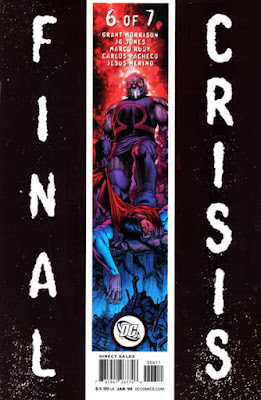
The 40 Years of Comics Project - Day 477: Final Crisis #6, January 2009

http://www.comics.org/issue/528860/

The coming season of the Arrowverse television shows fills me with the hope that we're going to see some really cool crossovers between the series. At the end of Legends of Tomorrow, I realized that the overall aesthetic for the series really was the line-wide crossover, but now with four shows to draw on (plus, with luck, Constantine if NBC are cool about it), we might actually see some shared narrative storytelling going on. I'm imagining a line-wide crisis of some sort that we see discretely through the lens of each show, but that is a larger picture when seen through the lens of all four. And if the writers could swing it so that, unlike many crossovers, we didn't need to watch each show, but would be richer for having done so, that would be amazing.

The reason I bring this up is that today's comic is that fourth act, the one where everything seems to completely fall apart. The world is spiraling down a singularity created around the incarnated Darkseid. The Green Lanterns are trapped in the event horizon, the Earth-bound superheroes fall to anti-life, one by one. Checkmate and S.H.A.D.E. are preparing to tunnel into a parallel universe to evacuate the world. And in the midst of it all, the man we've been following, that guy who dresses up like a bat, confronts the physical manifestation of universal totalitarian control in his own throne room.

When Superman finally returns to the pages of this series, it is as an exploding sun of grief and rage. He demonstrates exactly how powerful he is, bursting through the armies and shields of the New Gods as if they weren't even there. And he does this because his friend, the Batman, is dead. But it's not just friendship (that would be enough, but that's not all there is to it). Superman is invested in humanity becoming its better self. That's the tale we get hit over the head with in any other pop culture version of the character, the Jesus/Moses/Buddha/prophet of you choice metaphor. Hey, I'm not innocent of it either. As I never tire of saying, that idea was the seed from which my thesis grew. So then let's look back at yesterday's comic, where dark, animalistic gods find out that there is a human being, unpowered, driven by grief and rage, who turns the darkest of human emotions and experiences into weapons of light, tools to combat the manifestations of the worst of humanity (because, really, that's kind of what these dark gods are). For Superman, seeing this person die is seeing an aspect of humanity die that is all too rare: the strength to take what has damaged us almost beyond repair and turn it back against itself, to turn anguish and despair into strength and resilience. And love. Always love. I am reminded of this recent letter composed by the victim of the horrendous attack at Stanford. A warning - I could not get through this whole piece of writing. It is one of the most blatantly traumatic things I have ever read. But this young woman takes this event, this moment in her life that will colour everything for the rest of her life, and aims it back at the culture through which it is perpetuated. She speaks, turning her unbearable pain into a moment of love and support for everyone who has not been able to find this strength, standing as a paragon, as an example of how we can take in hate, take in the things that are meant to break us irreparably, and use those things to stop the very sources of our misery. She is a hero in every single sense of the term. And sometimes, just sometimes, all it takes to become that hero is to stand and use your voice. If only we all could find such courage.

Jun 11, 2016

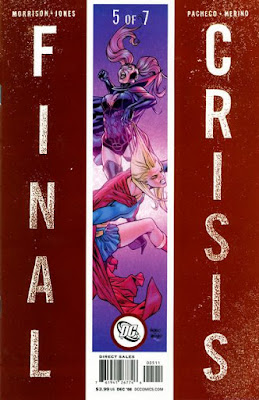
The 40 Years of Comics Project - Day 473: Final Crisis #5, December 2008

http://www.comics.org/issue/528859/

"They have only ever face the idea of a god before. Now is god incarnate come among them!"

I have a couple of board games based on the writings of H.P. Lovecraft - Arkham Horror and Eldritch Horror. In each of them, one of the Great Old Ones, main enemies in the game, that one can face is Azathoth, the nuclear chaos at the center of creation. When (if) he awakens, unlike the other Old Ones that are options as enemies, the game immediately ends. Unlike the others, he (it) is a GOD, all-caps, unbeatable - its will is creation and destruction themselves. For the majority of the game, the players are facing the influence of the god, the idea of it, but not the god itself. When that happens, the world ends.

So what does it say of the heroes of the DCU, from A-list to Z-list, that they do indeed stand against not simply the idea of Darkseid, but against the god himself? I have been, unsurprisingly, thinking about this a lot over the last few weeks, as I prepare to write the book that might be my dissertation, but that might simply be a book, about the incarnation of the mythic in reality. In the DCU, it is an actual presence, thinking, moving, living, that incarnates as Darkseid, an idea become flesh in two dimensions. But the DC heroes (and, as we'll see, villains) stand against this incarnated idea, proving themselves if not gods then mythic figures at the least. And if that's the case, if these are mythic figures, ideas, stories, how do they incarnate in our lived reality? I have what I think are the beginnings of answers to that question. I'll keep you apprised.

There is, in one panel, in one speech bubble, of this issue mention of Batman. Remember him? How we were reading through his final days? Tomorrow we'll see exactly what happened, what it means that the "Batman psycho-merge killed the clone army" that Mokkari and Simyan were trying to build.

To be continued.

Jun 10, 2016

The 40 Years of Comics Project - Day 472: Final Crisis #4, November 2008

http://www.comics.org/issue/528858/

There's a lovely moment in this issue where The Ray is outlining a plan to transport his fellows to the JLA satellite by becoming a teleport carrier wave, and the Tattooed Man questions the sanity of the plan, to which Ray replies "Seriously. I thought you were a super-hero, like the rest of us." The Tattooed Man is taken aback, to have been considered by this young hero to be "one of them." It's a nice continuation of the sentiment that Mark Richards' wife expresses at the end of yesterday's comic, though, unfortunately, my research into Richards' subsequent appearances shows that he was used simply as a low-level villain after this, with one or two attacks of conscience for good measure.

I don't have much more to say about this issue, though. It's a bridge, really, between the world that was and the world that becomes. The fall of Dan Turpin is absolutely heart-breaking, as he realizes that trying to fight Darkseid's influence is, as he notes, like trying to stop the ocean, and, in the end, all he can do is give in. I think this gives us a good, if distant, impression of the effect of anti-life: all you can do is give in. There is no choice, no hope. Only submission. Turpin's first-person narrative of his journey toward a choice that is not a choice is beautifully told. The heroes manage to communicate, briefly, Green Lantern Alan Scott offering a rallying cry to the anti-life survivors at the worldwide watchtowers, but the end of the issue, the incarnation of Darkseid, lets us know that the brief, green flame of hope that is offered is not going to be nearly enough. With Wonder Woman corrupted, Batman missing, and Superman absent as well, the DCU heroes are without their own gods.

To be continued...?

May 25, 2016

The 40 Years of Comics Project - The Weekly Graphic Novel: Week 8 - Ultimate Comics Thor, 2011

http://www.comics.org/series/52654/

As much as I would consider myself a rabid fan of Jonathan Hickman's writing, there's a substantial chunk of it that I haven't read as yet. His work in Marvel's "Ultimate Universe" makes up a significant portion of that chunk, and this is mainly due to having heard that, in contrast to his Earth-616 Marvel work, it's not that good.

But let me back up a moment.

The other thing keeping me from exploring this series, and others in the Ultimate U that Hickman has written, is my lack of knowledge about, and my dislike for, this particular version of the Marvel Universe. I've railed on about the grittiness of the current crop of DC films, and Marvel's Ultimate U, though it's genesis in Ultimate Spider-Man was less so, emblematizes this proclivity for gritty superheroes. And, honestly, I thought we'd had enough of that in the 90s. I've never really understood why realism seems to have to equal darkness. And that's how I've long perceived the Ultimate U. I'm happy to be proven wrong, but I'm pretty sure I'm hitting the target dead center here.

That said, Ultimate Thor is actually pretty good. It's still dark, it's still bloody, but it also tells an interesting tale spanning millennia, establishing the place of Asgard and the Norse mythos in the Ultimate U, and, in a nice twist, linking Ragnarok with the Second World War. I especially enjoyed the notion of gods being reborn as mortals, and having to deal with losing the power they once understood as intrinsic. Carlos Pacheco's art in this book is lovely, and in the sections near the end where we're seeing a different perspective on the events of the first run of The Ultimates, his style nicely apes/meshes with the Hitch/Neary widescreen action of that series. But there's where I have to become a bit critical. I'm not sure how much the end of this series would have made sense had I not read The Ultimates all those years ago when it came out. The supposed impetus for the Ultimate Universe was to allow readers who had not followed 35-40 years of continuity to enjoy the stories of the Marvel characters they were beginning to see in the movies. I distinctly recall the rhetoric surrounding the project, claiming that someone with no knowledge of any of the Marvel characters could pick up an Ultimate comic and not feel lost.

I can't imagine that this would be the case with the Thor series. But that's a small thing, really, especially considering that this series came out about a decade after the inception of the Ultimate universe. And a fictional universe with a decade-long history is going to have to have some expectations of continuity.

In the end, though, it's true: this series is not nearly as good as Hickman's work in the regular Marvel universe. It seems to lack the grandeur that, I have to say, is present in pretty much all of his other work that I've read. And seeing as how this is a story about gods, it should be pretty grand.

Jan 9, 2016

The 40 Years of Comics Project - Day 319: Age of Ultron #10, August 2013


Bendis does something quite lovely here in returning the tale right back to where it began in Avengers 16.1. After the insanity of the previous 10+ issues, it's nice to see Ultron get what's coming to him. What's interesting, though, is that we experience this cathartic moment, this, and I won't be shy about it, vengeful moment, for something that Ultron has not yet, nor ever will do.

It's a very interesting facet of fiction, and particularly of time travel fiction, that our linear perspective of the narrative is not the same perspective of the characters that we've read the linear narrative about. Ultron perpetuates one of the most brutal genocides the Marvel U has ever seen, and we, you and I, witness it first hand, follow the adventurers through their attempts to fix this, only to wind up back at the start, before all these events, which is also the end.

Now, that said, the original iteration of 16.1 does not feature the defeat of Ultron, so we're left with the notion that there was an "original" timeline that was rewritten - in many ways this mirrors the set-up of DCs crisis-rewritten universes. There's always some holdover, someone or thing that remember the previous continuity, serving the function of keeping all those old stories in continuity, but also of acknowledging the long-time reader's emotional investment in those stories.

All this is to say that Ultron gets his ass handed to him, which he deserves, and everyone gets to live. I'm curious as to whether or not anyone's ever dealt with Wolverine and the Invisible Woman having lived through and remembered all of the events of AoU. You'd think that those two, at least, would be suffering some serious PTSD. But, as with many shattering events in superhero universes, they likely let it slide from their shoulders and their minds, and get on with their lives. Their abilities to cope with trauma are also super, it appears.

I know I said this was the end of the AoU, but there's actually an epilogue comic, written by none other than Mark Waid, and I happened to find it today while I was out comic hunting. So we'll actually finish up Age of Ultron tomorrow, and then get on to some quarter bin treasures. See you then.

Jan 8, 2016

The 40 Years of Comics Project - Day 318: Age of Ultron #9, August 2013


There are two moments that really stand out for me in this comic. The first is the opening splash page depicting the result of two Starkguard helicarriers crashing into New York City:


That there is some rampant destruction.

The second is Wolverines'(s) decision to kill himself.


That third panel there, where a Logan who's experienced two different ends of his world stares at the sun (rising or setting), and, without movement or voice, makes peace with the fact of his death. I'm fairly outspoken about my opinion that Wolverine is one of the most over-used characters in the Marvel U, but this is a moment where he is utilized brilliantly, and the character shines through the grimness of the story. Wolverine very rarely considers himself heroic. I think that he is here.

I don't want to say anything more today. These two sequences are amazing, and there's that whole pictures:words ratio thing. We'll finish up the Age of Ultron tomorrow.

Jan 5, 2016

The 40 Years of Comics Project - Day 315: Age of Ultron #8, July 2013


Before I get to today's comic, I just wanted to mention another one I read while having breakfast. I picked up a box of comics at a flea market this weekend (which I'll write up a post about shortly), and it had a relatively large run of Marvel Two-In-One in it. Issue #86 was utterly great. The team-up is the ubiquitous Thing and Cain Marko, aka The Sandman. The two are usually at each others throats, but this time they sit at a bar and have a beer while Marko tells the Thing his life story. I can't help but wonder if this is the comic where the Sandman turns things around and becomes a good guy, though I feel like I've seen him taking on Spider-Man much later than the 1982 cover date on the comic.

Anyway, that's a much more pleasant situation than Wolverine and the Invisible Woman find themselves in in AoU. Much of this issue is devoted to the interrogation of these two, to see if they're clones sent to infiltrate Tony Stark's security force on behalf of Morgana Le Fey. You had to know that things wouldn't be even remotely okay once Hank Pym was killed. An interesting moment occurs when Stark has accessed their memories of the previous timeline, and he notes that it will take him his entire life to sort it all out. His primary concern is not the apocalypse of Ultron that he sees, but the fact that Wolverine and Sue have gone back and "broken" the timeline.

Emma Frost points out to him that they're all alive, instead of being dead, which one really ought to see as a bonus, but that futurist in Tony Stark is more than likely looking ahead to try and figure out exactly what ramifications this reset of the timeline will have.

What's interesting is that it's not the first time Le Fey has been involved in this kind of reset. The opening of the Busiek/Perez Avengers run puts her in command of the world, or much of it, as well. In fact, off the top of my head, aside from Ultron and Apocalypse (well, and Doom in Secret Wars, I guess), I can't think of too many other super villains whose plans for world domination have actually succeeded, if only for a little while. One wonders why she isn't considered in the ranks of those same villains more often, though perhaps its the relative importance we, as a culture, place on the scientific rather than the irrational. The other three use technology, though vastly advanced, to cement their place at the top. Le Fey uses magic, and we just don't cleave to that kind of thinking much anymore.

Alright. The next couple of days will look into the world of the Stark/Le Fey war. I'm curious to get a broader (even a slightly broader) look at this timeline. See you tomorrow.

Jan 3, 2016

The 40 Years of Comics Project - Day 313: Age of Ultron #7, July 2013

http://www.comics.org/issue/1108078/

Okay, sorry, but it's going to be a short one today,  regardless of the fact that there's some interestingly complex time travel stuff going on here. I'll deal with it a bit more tomorrow perhaps.

Wolverine and the Invisible Woman return to the present, only to find it substantially changed. Inevitably, they get into a fight with their former teammates who don't know who they are.

Shenanigans ensue?

More tomorrow.

Jan 2, 2016

The 40 Years of Comics Project - Day 312: Age of Ultron #6, June 2013


One team in the future, trying to defeat Ultron. One team in the past, trying to kill Hank Pym.

What I'm finding quite interesting is that the plans of the two greatest tactical minds in the Marvel U (being Captain America and Nick Fury) are complete failures that end up getting some beloved heroes killed.

And if you've ever had an inkling to see Captain America beheaded, this is your comic.

I think that the fact that it's Wolverine's plan that ultimately has the most success (though we'll have to see how that all goes in the next issue) really says something about our superheroes. It's the same conundrum I was faced with when I watched Man of Steel. There's something in the zeitgeist these days that wants to bring our heroes, our gods, down to our own level, which somehow always comes around to killing. It's sad to me to see our heroes reduced to our level - having fictions in which the characters were opposed to killing was really one of the things that brought me into comics in the first place, to have something that somehow escapes the savagery of our bloodlust.

I don't think this murderousness of our superheroes is a long-term problem. We just live in a time when it seems the only way out of lots of our real world problems is the taking of lives. I look forward to a time when our superheroes return to showing us why that's not the final solution.

More tomorrow. It'll probably be pretty dark.