Pages

Showing posts with label Jack Kirby. Show all posts

Aug 5, 2020

The 40 Years of Comics Project - Day 1988: Marvel's Greatest Comics #57, July 1975

For information on stopping the spread of COVID-19, and on what to do if you are quarantined, have a look at the World Health Organization site.


https://www.comics.org/issue/28793/#187161


I can't remember which book I read it in, though it might have been Ronin Ro's Tales to Astonish, in which was discussed the fact that in the mid-Seventies, after Jack Kirby had left the company, that Marvel reprinted a lot of his old work without giving him any remuneration. I think today's comic is one of these, as the series appears to reprint much of the original run of FF.

I've read a couple of things by scripted by Stan Lee over the last little while, and I think the thing that gets me about his writing is that he seems to lack faith in the abilities of both the artist and the reader. So much of his captioning is simply a character explaining what actions have just taken place, even though, through either visual clues or context, a reader really ought to have been able to figure it out themselves. "I've been thrown from the cavern" shouts a character, for example, even as in the previous panel we've seen them hurtling toward the cavern opening, and in the panel in which they're speaking, we seek them being thrown from the cavern. Any time that there's dialogue during action sequences, it's pretty much all description of what the artist has just shown us. And the artist is Jack-frickin'-Kirby, so we don't really need someone holding our hand through the action. Kirby is pretty good at communicating visually.

That said, the melodramatic dialogue outside of battle, the soliloquy-style thought bubbles, these are all excellent examples of where Lee is actually a pretty great writer. He elevates simple interactions to the level of icon, reminding us that the people we're reading about, despite Marvel's attempts to place their heroes on a much closer level than their Distinguished Competition, are in fact operating at iconic levels. These are gods in human guise who just don't realize that they're gods. I think Lee's scripting brilliance lies in that aspect. He knows that superheroes are role models, and that they operate in a much simpler reality than we do. So the hyperbolic language offers a similar tool as ancient Greek tragedies did, albeit in a much different format and millieu. I've spoken before about how when we read a Wolverine comic, the lesson is not that we should go and slice our enemies into little bits. It's that we should, and can, react to problems with the same resolve, sometimes the same savagery, but not with the same actions - at least in the case of the very violent actions we see in superhero comics. Instead, it's the passion, the placing of such importance on situations, that we should be taking away. If we apply ourselves to our own problems with the strength that Ben Grimm applies himself in this issue, we may find those problems, metaphorically, are flung away into the ocean, much like the Thing's enemies in this story.

I've avoided a lot of the early FF, mainly because I've always found Lee's writing off-putting. But I may give it another go from this perspective. Add to this iconic level of storytelling the fact that the four members of the team are elemental proxies, and all of a sudden the importance of these stories is amplified. We mock Lee's bombastic dialoguing, but what he's actually doing is channeling a different level of storytelling into a popular medium.

More to follow.

Further Reading and Related Posts

I had a lot of people ask me about Stan Lee when he died. Here's a post I wrote that says some things.

And, hilariously, here's a post from just over a year ago where I use almost the exact same opening line as I did in today's post. I need to be more original.

Jul 17, 2019

The 40 Years of Comics Project - Day 1604: Where Monsters Dwell #31, October 1974


I can't remember where I read it. It might have been Ronin Ro's Tales to Astonish, a chronicle of the fraught history of Stan Lee, Jack Kirby, and Marvel Comics. In the mid-70s, Marvel decided to capitalize on all of the old stories that they owned, all of the original artwork that they owned, and put out reprint series that didn't pay out to the original artists on the stories. This is a murky part of comics history, and is told differently by everyone who was involved, but I have to think that, given the nature of corporate and capitalist thinking, that Ro's account is pretty close to the truth. So I feel slightly guilty when I'm reading a series like this one, as I know that, in part at least, it was a way to squeeze more money out of artists who had already been well-squeezed. Recall, at this time, Kirby had left Marvel and was getting his New Gods stuff up and running at DC. Reprint series like this one were likely a part of the problem.

That said, the series does offer reprints of stories that might not actually have been reprinted elsewhere. According to its GCD entry, none of the stories reprinted herein have been reprinted elsewhere, meaning that this comic is one of two places that the story is available. And the other places (comics) are older, and likely more expensive. As much as I wish the production of the comic hadn't been so mercenary, and so detrimental to the artists involved, I'm glad to have it, because the stories are pretty cool.

Kirby's story is good, but really a very basic alien invasion plot, similar to many of the older Marvel sci-fi tales. The other stories, though, are 1950s reprints, and definitely have that aesthetic. My favourite was definitely "Fifty-Fifty!," originally from 1953, in which a put-upon husband takes the splitting of property to Solomon levels when he divorces his gold digger wife. Perhaps I need to take a closer look at old Marvel horror properties. Though it'll likely be through reprint series like this one, rather than the originals.

I'm enjoying these random bits and pieces from my Marvel collection. I hope you are too.

"Yes, I do, Ricky! So I'm taking the top half...of you!"

Nov 18, 2018

The 40 Years of Comics Project - Day 1362: The Sandman (1974), September 1975


Reading this comic makes me want to go back and read the entirety of Neil Gaiman's The Sandman, especially since these characters show up in the series, and their appearance there makes much more sense now that I've read an issue of their series. Of course, in true proto-Vertigo, 1980s fashion, the characters are changed and twisted into something much more monstrous and depressing than what we see in this whimsical Kirby silliness, but that's actually a pretty nice way of thinking through the ways that comics have matured. This story reads very much like the fantasy of a child, one of escape and heroism, one that is very much in line with the tenor of comics at the time. But Mr. Gaiman's take on the story asks the question of what it is exactly that young Jed is trying to escape in these Nemo-esque adventures? The answer is awful. I mean, really well-written and conceived, but awful nonetheless.

What we get here in a nice bit of inflectionary reading. Mr. Gaiman's series was much more popular than Mr. Kirby's, and continues to hold a good deal of influence over comics. So we can read this as innocent adventure comic from the Sixties, or we can read it as representation of the fantasy that Jed has to tell himself in order to avoid the abusive situation in which he finds himself. Both are valid readings, and there's good arguments for each. Which might sound nebulous and smacks of fence-sitting, but really that's what good writing does: it invites and support multiple readings. When we add in the fact of vast temporal distance and completely different creative teams, then the unintentional aspect of inflection makes itself apparent. Kirby could not have known of Gaiman's eventual rethinking of his story. Whether or not Gaiman's inflection of terror into these whimsical stories was intentional or not is much harder to say, but it happens nonetheless. Well, if you choose to read that way, I suppose.

More to come...

Apr 30, 2018

The 40 Years of Comics Project - Day 1160: New Gods #6, November 1984

https://www.comics.org/issue/39262/

I really, really, really was not expecting this series to end the way that it does. In the earlier issues, there are some editorials by Mark Evanier, and I think it's there that the idea of an alternate history of the New Gods is suggested. One is the primary timeline, the one that continues to this day, and that is made possible by the cancellation of the Fourth World titles before the conclusion of the tale. In this timeline, Steve Gerber gets to write Mister Miracle, and Grant Morrison tells what I feel is the best New Gods story in Final Crisis. The other timeline is the one that is enabled by today's comic, published with an entirely new conclusion to the saga, one that leads into the Hunger Dogs graphic novel. It's this timeline that is collected in the recent Fourth World omnibuses, and it's one that couldn't really be incorporated into the main DCU continuity.

Unless there's some great resurrection tech available on New Genesis...which there probably is...

Anyway, here we go, SPOILER ALERT!!!!


Since the beginning of this series, we've seen Orion barrelling headlong through battles and conversations, always with his eye on the prize of halting Darkseid and restoring peace to the universe. An interesting motivation for an ostensible god of war. But what we get at the end of the issue is the denouement of that headlong rush that was unexpected. We're trained, especially in comics, to expect the hero to win, even if it ends up costing a lot in blood, sweat, and tears. Instead in Kirby's opus, Orion is struck down on the second last page, his quest unfulfilled, and his enemy still alive and well. I'm dying with curiosity to see how The Hunger Dogs continues the tale, though I think I may be right out of luck finding a reprint of it. I was reminded of Final Crisis, in that the tag line for the series was The Day Evil Won, and it really seems like that's what's happened in New Gods. Who will stop Darkseid's conquest of Earth now? What I really need to do is go back and read Mister Miracle now as well. That way I will have read the clash of the New Gods from the perspectives of both of the switched sons. I wonder if his story is wrapped up in the graphic novel as well.

Back to Milligan and Batman tomorrow. More to come...

Apr 28, 2018

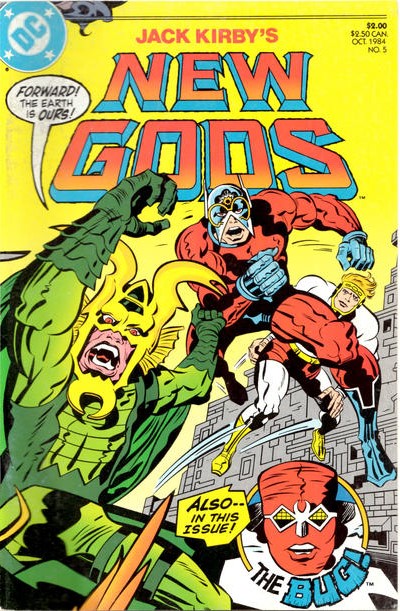
The 40 Years of Comics Project - Day 1158: New Gods #5, October 1984

https://www.comics.org/issue/39159/

An interesting element is added in today's issue in the bug civilization.

But my Mum and Dad arrived today, and I'm tired, so I'll fill you in on this tomorrow.

(A couple of days later...)

I'm fascinated by the idea that there is another sentient civilization living on New Genesis, though I suppose the same can be said of Apokolips and its Hunger Dogs. But that the "Eternals" of New Genesis see these creatures as vermin is a bit odd. Aren't the New Genesis gods supposed to be the magnanimous ones? But as far as I can tell, they're happy to exterminate the bugs, even though they appear to have a relatively advanced civilization. And then there's the problem of The Bug, or Forager as he's called in the issue. It turns out that he's not actually a bug, but a New God, but although this is revealed to him and to Orion and Lightray in this issue, no one tries to figure out how one of the young of New Genesis ended up being raised by the bugs.

The thing is, it's because that's not really that important to Kirby's story. I've been looking at this series as a very basic myth. Not too many bells and whistles, very direct, so the story of Forager's origin, assuming it is of no consequence to the larger tale, is unimportant. What is important is the role he plays in warning of the bug invasion of Earth. None of the characters do anything or are involved in anything that does not drive the plot forward. Perhaps it's a bit off-putting in that in contemporary media we're often exposed to an A-plot and a B-plot. Kirby has no B-plot in this series. Everything is A-plot. This is deployed in a very self-conscious manner. In fact, the final panel of today's issue seems to speak directly to the reader, as if the gods themselves, and not their writer, were telling us that they're here, on the pages of a comic book, but never too far away:


I think that Orion's statement there is as good an articulation of what I get from Kirby's cosmic superhero work (New Gods, Eternals, maybe even Thor) as anything. Note that even as Orion is talking about reflections, we are looking directly into his eyes, as if staring into a mirror.

More to come...

Apr 27, 2018

The 40 Years of Comics Project - Day 1157: New Gods #4, September 1984

https://www.comics.org/issue/39066/

When I think of Dan Turpin, all I can think of is the utter tragedy of his transformation in Final Crisis. It is a very intense sequence to read, seeing a personality recognize it's own demise as a foreign, and immensely powerful, entity takes control of the body.

So I have to admit, it was kind of nice seeing him stand up to Kalibak in today's issue. I still don't understand his dislike of the heroes, though the destruction that follows them around is kind of obnoxious. Do Damage Control do cross-dimensional work?

The first story in this issue is a flashback that reveals the origins of the war between New Genesis and Apokolips, and also the origins of both Mister Miracle and Orion. I hadn't realized this had been a secret. Having gained exposure to the New Gods through much later tales, I always just assumed that Orion's and Scott's lineages were common knowledge. There was something that bothered me in this otherwise excellent tale of the rise of Darkseid and the redemption of Highfather. In the beginning (words used purposefully, btw), Izaya's wife Avia is killed by Darkseid's uncle, Steppenwolf. That is literally her purpose in this story. 3 or 4 panels, and then dead, and it turns into Izaya's tragedy. I know we call this the "Women in Refrigerators" trope, but today's story was published about 20 years before that issue of Green Lantern. I'm coming to realize that Kirby's myth, at least this part of it, is pretty sexist. Though, perhaps we could also read it, given the cover, as an indictment of masculinity gone mad? I think this is one of those moments where I'm just too optimistic in my critical readings.

More to come...

Apr 26, 2018

The 40 Years of Comics Project - Day 1156: New Gods #3, August 1984

https://www.comics.org/issue/38953/

So. Good, mad, full-on New Gods vs. Apokolips action in today's issue! The giant pink whale monster that the Deep Six create is really pretty amazing, especially it's battering ram growing from beneath its jaw.

But there's also a weird little subplot about a man and his two children who are caught up in this conflict. The son is a conscientious objector, the father a conservative military man, and the daughter is...well, kind of whiny and useless, actually. I'm seeing this as a trend in New Gods. None of the female characters are really very necessary. This subplot plays out as one might expect, as the son eventually sacrifices his life to save father and sister, and the father sees that war really does have horrible consequences, and maybe his son wasn't so wrong after all. But the weirdest part is that in the end, literally the final panel of the comic, after the Deep Six have been defeated, as has the whale monster, and Orion and Lightray have left, the father is still there, tied to the mast of what used be his yacht. And he's left there, wondering about all that he believed and all he lost.

The End.

I was not expecting an ending like this, but as I think more on it, it fits with the mythic tenor of the series. The gods leave the man there because they know that on a symbolic, archetypic, level, it's the place that he's meant to be. It's almost like they're aware of the way in which they themselves, as icons in a comic book, must move and act in order to tell the kind of story they need to tell.

More to come...

Apr 25, 2018

The 40 Years of Comics Project - Day 1155: New Gods #2, July 1984


Well.

Notice how the character on the cover is dressed in red, blue, and yellow? He's dressed that way throughout the issue.

But his name is "Black Racer."

And, partway through the story, the Racer chooses another avatar to take on his role who is, surprise surprise, a Black man.

Kind of like Black Panther, or Black Lightning, or Black Goliath, I guess. At the time, I think this may have been seen as a progressive attitude, the presentation of diverse ethnicities in superhero comics, but the addition to the beginning of each name of "Black" simply serves to divide a community from the one that is ostensibly trying to curb such division.

There's also some problems with the idea that the only (thus far) character of colour in the series is one that literally everyone in the issue is afraid of - "Don't Let Him Touch You" the cover proclaims. Again, not really the message one wants to send about a Person of Colour, now or when it was originally published. This issue originally came out less than a decade after the signing of the Civil Rights Act, and racial tensions were worse then than they are now. Imagine instead of Ms. Marvel, she was called the Muslim Marvel.

How about we just refer to him as the Racer from now on?

More to come...

Apr 24, 2018

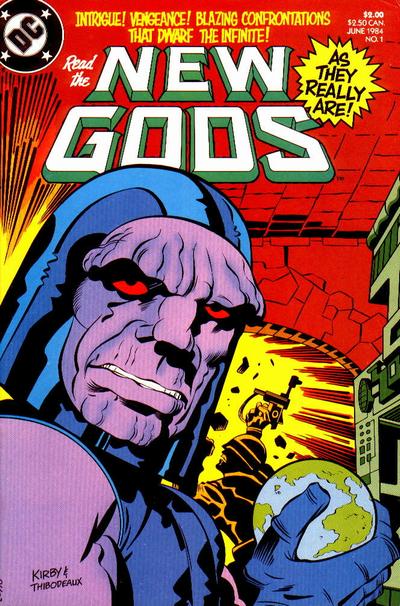
The 40 Years of Comics Project - Day 1154: New Gods #1, June 1984

https://www.comics.org/issue/38741/

I thought it was time I read this. I've always been intrigued by this story. Whenever I read it, all I can think about is just how far it could be taken, a warring society of gods played out as a war between archetypal patterns generated by the collective consciousness of...the Earth? The Universe? That is one thing I've never been too clear about - just whose gods are these anyway? Do different species see them in different forms, like when Martian Manhunter encounters Morpheus in the early Sandman issues?

I would really love to write stories using these characters.

Kirby's writing and art are Kirby's writing and art. I don't know what I could say about them that hasn't been said by hundreds, if not thousands, of more articulate scholars and fans than I. When we think about superhero universes operating more simply than our own, it is Kirby's that operate at almost the simplest level. His dialogue is stilted and choppy. But everything in this world is an event. His art cries this louder than anything else. And not just an "event," but an EVENT. In this kind of context, the staccato of the speech in the stories makes a certain kind of sense.

Now, while this is a cool way to tell a story, there are reasons that most of our stories that are mythically inflected add a dash of nuance to the bombast. I think this is why Kirby's stories are sometimes difficult to take. At the level of myth where the hero is superior to both environment and peers (or, indeed, has no peers), it's difficult to tell stories that are anything but kerygmatic. This kind of teaching text is not necessarily what one wants in a superhero comic, though it's really in all of them. So does that mean that Kirby is trying to teach us anything with this comic? I think, through most of his work, he actually is. He's offering perspectives on our relationship with the divine. If you think about it, the vast majority of his work looks to this, be it the incarnation of the divine in the superhero (Fantastic Four, elemental avatars, springs to mind) or straight up divinity itself, like today's comic.

That said, reading a comic in which everything is a SUPER-MYTHIC EVENT AEONS IN THE MAKING!!!! is exhausting. Hence nuance. If we can hold a less mythic story up in comparison, or in conflation, both are cast in new lights.

More to come...

Feb 6, 2018

From the Depths of Marvel: Exiles

Inevitably, this comes from the pen of The King. Kirby might have been a wizard, but even wizards have off days.


Allies of the Red Skull? That's plausible - interesting, even. But a Russian strong man named Krushki? Damn, man. That's the opposite of creativity.

Here's the man himself:


Oct 30, 2017

The 40 Years of Comics Project - Day 978: Jack Kirby's Secret City Saga #0, April 1993

https://www.comics.org/issue/52859/

Standby.
Normal transmission will resume tomorrow.


I'd like to make an admission.

(And as I write this, I feel like I've already made this admission before.)

Sometimes, I just don't get the hoopla surrounding Jack Kirby.

I think that we have literally seen developed every idea the man had over the course of his life. Very often they involve cities made out of trees. And underground complexes. In fact, were we to put the vast majority of Kirby's ideas onto the same planet, we would be living on a giant ball of Swiss cheese.

When I feel like this, I have to remind myself of my experience reading Judith Butler's Gender Trouble. As I made my way through that...dense...tome, I kept shaking my head and wondering why this was so important. She would come to a conclusion of some sort, and I'd sort of nod my head and say "Yep, how is this news?" Until I realized that, before her, no one was saying these things. In some ways, Kirby is the same. Before him, there was no Marvel Universe. And, yes, his art is amazing and dynamic and all of the other superlatives one likes to use. But does this mean we need to keep mining little notes and ideas and sketches and attaching his name to them to make more comics?

All this said, I found today's comic to be quite enjoyable. There's an old saw that is often repeated by comics people that Kirby was amazing, yes, but he needed an editor more than most. What we see in today's comic is just that. Roy Thomas, editor (amongst other things) extraordinaire guides the interconnected Secret City Saga, and it reads so much more naturally than, say, Captain Victory. In fact, I'm intrigued enough to see about tracking it down (through dollar bins, of course). A secret civilization, the "Ninth Men, in an age fifteen millennia before our own," whose time is over. A few individuals stash themselves away in life support pods, and hope for the best.

I can only assume a few of them come out in the next issue.

To be continued.

Sep 28, 2016

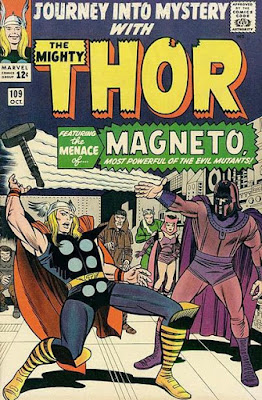
The 40 Years of Comics Project - Day 581: Journey Into Mystery #109, October 1964

http://www.comics.org/issue/18695/

My understanding is that this is one of the very first times that a villain from one Marvel property crosses over into another. While I'm not always a fan of Stan Lee's writing (as much of it as is his, anyway), this story is interesting as Thor really stumbles into the middle of an X-Men adventure, and, by the end of the story, admits that he's not really sure what just went on. The X-Men themselves appear off-panel, an optic blast here, a freak blizzard there. One of the most intriguing parts of the story is the single line we are given by The Scarlet Witch, in which she laments having to work for someone so evil as Magneto. I'm not sure how long after this she and her brother join the Avengers, but it really does look like a story line that may have been in the works for some time.

I'm not overly familiar with Thor's body of writings, so I was quite surprised to see Jane Foster as his nurse in the Donald Blake secret identity. Though Marvel has gone through numerous reality-shifts since this story was published, can it be that this is the same woman who now bears the mantel of Thor? She's not quite the physicist we've come to know from Natalie Portman's portrayal in the MCU, but I could see her desire to take care of the sickly Donald Blake translating nicely into a desire to take care of a sickly world in her superheroic guise.

Where will we go tomorrow? Suggestions?

Onward.

Jun 1, 2016

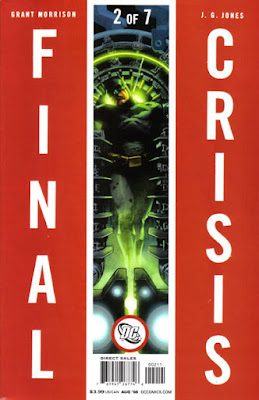
The 40 Years of Comics Project - Day 463: Final Crisis #3, September 2008

http://www.comics.org/issue/528857/

Many superhero event comics focus on the efforts of the human and superhuman communities to stop the end of the world, or the universe, or the multiverse. It's usually a race against time and circumstance to stop a villainous plan that would see the end of everything. But with Final Crisis, the tag line "The Day Evil Won" rings very true, and sets things apart somewhat. This isn't about stopping the end of the world, but about bringing the world back once it's ended. The only other crossover I can think of that does something like this is the Bendis-penned Age of Ultron, but even that series relies on time travel to stop the problem before it starts. No such luck here, even though we've got a few time travelling Flashes on the stage.

So by the end of this issue, a few weeks into the future from where we started with Batman at the end of "R.I.P.," the world has ended, evil has won, and Darkseid has unleashed the anti-life equation on the population of Earth. Superman has been given a chance to save Lois' life, but only if he leaves her bedside, and leaves the problems of the world behind. We'll follow him into the Superman Beyond mini-series next week. Batman, last we saw, was strapped into an Apokaliptian machine. What's become of him is unsure.

This isn't the first time Morrison has played with this idea, and it might be interesting, once FC is done, to go back and re-read his "Rock of Ages" story in JLA, in which he envisions another iteration of the dark New Gods taking over the planet. There's certainly parallels, though I think FC is a bit darker. It's easy, perhaps, to envision what this event would be like at some undetermined future date, but to envision it contemporaneously makes the horror of it much more visceral.

As I noted earlier, I'll be taking a brief break from this read-through. Got to take vacations when you can in this life. And it's a good place to hang from a cliff - Wonder Woman and her Furies are about to attack Flashes West and Allen, anti-life appears to have consumed the planet, and Superman's nowhere (or everywhere) to be seen. Onward.

May 31, 2016

The 40 Years of Comics Project - Day 462: Final Crisis #2, August 2008

http://www.comics.org/issue/528856/

"Did you think that the Gods would tread lightly when they came among you?"

Shouted/hissed from the mouth of Alpha Lantern Kraken, host to Granny Goodness, this sentence really sums up the kind of Crisis the DCU is facing now. In many instances, these crossover events hinge upon powerful yet equally-fallible beings, whether from Earth or some other planet, and it is this fallibility, this mortality, that proves their undoing. They operate at levels of power that, for the most part, can be understood and conceived, even if they can't always be combatted to begin with. Such is not the case with Darkseid and the New Gods. They're Gods. They represent fundamental cosmic forces, evil ones, unfortunately, but fighting them is like fighting the laws of physics.

Morrison and Jones are very good at bringing this across in the series. The extremely unpleasant scene with Det. Turpin and the Mad Hatter highlights the primal change Terrible Turpin is undergoing. The ease with which the possessed Alpha Lantern incapacitates Batman (who always has a plan...maybe?) helps us to understand exactly how unprepared a world would have to be for the incarnation of Gods on its face. Something like Final Crisis could very easily be used at an end for the DCU, a horrible and unpleasant one, but an end nonetheless. And, really, it would be, if not for the fact that this fictional universe has been gestating a God of its own. It's during the Final Crisis that we begin to see what he might one day become.

Onward.

May 30, 2016

The 40 Years of Comics Project - Day 461: Final Crisis #1, July 2008

http://www.comics.org/issue/528855/

First, an admission - according to the reading order that I linked to the other day, DC Universe 0 takes place before this issue. It's penned by Morrison, amongst others, and does tie directly in to the events of Final Crisis, but it's also one of those comics that functions far more as advertisement than intrinsic story moment. And since I'm reading Final Crisis through the lens of Batman, and he's not, as far as I recall, in DCU0, I'm going to skip it. Maybe when I get around to reading the FC graphic novel one day, I'll read that comic first.

My favourite image in this issue is the second one, a double-page splash of Metron and Anthro. It has a real Fingerprints of the Gods kind of feel to it, something at once ludicrous and sacred - which, if you really think about it, is an excellent way of describing most religious beliefs. (That is not a denigration, btw. As I tell my students, critiquing something does not mean you don't love it, just that you don't accept its infallibility.)

So what do we do with this initial chapter? Vast, dark, terrible things happen, but it's almost subtle, understated somehow. The Gods have fallen to Earth and one has been murdered, replaying an archetype as old as religious belief. The Guardians have dispatched Alpha Lanterns (one day we'll read through the Geoff Johns Green Lantern run, one of the few places I feel he's really shone as a writer - the Alpha Lanterns are trouble), the Justice League is on the case, and Dan "Terrible" Turpin has wandered into something he's not even remotely prepared for. Though, in some ways, he's being prepared for something far more awful.

Jack Kirby's "Fourth World" saga has its ups and downs. It's not always great, but sometimes it's transcendent. I've never quite understood Darkseid's end goal, but leave it to Grant Morrison to show us. The ad rhetoric surrounding this series was that it was the final part of a trilogy. Looking back, though, I have a hard time placing Infinite Crisis on the same level as the first or the Final. The convoluted storylines made it hard to understand what was at stake, but with this series, and the first Crisis, it was clear: everything. Everything is at stake. And, though we know it's going to work out in the end, like watching a Shakespearean play, adapted from earlier texts, it's how things get to the end, how the story is told, that is important, that resonates.

Onward.

Dec 23, 2015

The 40 Years of Comics Project - Day 302: 1st Issue Special #1, April 1975


Oh, Jack Kirby. Will you ever be done mining the past for the future?

Say what you will about Kirby, he understands the superhero. His dialogue may be shaky. His plots might verge on the adolescent. Every now and again, he's kind of racist and sexist. (I'm really selling you on him, right?) But his artwork is always, always, gorgeous, and his conception of the superhero as god is sophisticated and beautiful, if occasionally naive.

After finishing this comic, I looked to see where the story continues, and it turns out that it doesn't. I had a quick look through the 1st Issue Special entries at the GCD, and from the looks of things not many of them got a second glance. I'm surprised that this Kirby creation didn't, but the mid-Seventies is moving into his more grounded Marvel work, so perhaps the gods were being put on hold in that decade. Considering that Howard the Duck makes his debut not to much later into the decade perhaps upholds this notion.

The other thing that may have kept the series from continuing is its "meh" factor. There's nothing new here, even for a comic that is drawing on mythology. We have a child, orphaned by evil raiders. We have a quest for vengeance, pursued by a heroic altruist. We have a lizard-like antagonist. Kirby seems to me to have been a champion of the Platonic notion of the outer appearance reflecting the inner nature of a person. His villains are always ugly and disgusting, his heroes always 50s movie star pretty. Frye notes that myth, in its underlying of literature, is akin to geometrical objects as underlying visual art - I think the problem with this story is that the underlying geometry is just too obvious, and the flourishes that one desires in these mythic variations are too thin to conceal the foundation upon which the story is built.

That does it for my recent dollar bin finds. Some Christmas stuff for the next few days. See you then.

Nov 18, 2015

The 40 Years of Comics Project - Day 267: Tales of Suspense #67, July 1965


I really am going to have to start doing these posts earlier in the day. I'm very tired right now, and, unfortunately, Stan Lee's dialogue is not exactly the sort of thing to keep one awake.

There's some really great moments in both of the stories in this issue. Don Heck and Jack Kirby are obviously very talented artists, so there's a dynamism to the art that simply isn't reflected in the prose attached to it. It makes for a bit of a jarring read.

That said, it's cool to see a period piece for Captain America, and to get to see Bucky in action. Having just finished reading The Amazing Adventures of Kavalier & Clay, it was lovely to see a crazed Hitler in the issue, and lots of beating on Nazis. Bucky's even a bit bloodthirsty, in that he kills a remarkable amount of soldiers in this issue. The influence on Chabon's novel of these comics is undeniable.

Sorry, that's it for today. I'm beat and I'm going to bed. I'll try to get to the comic earlier tomorrow, and actually have something interesting to say. Sweet dreams!

Jul 22, 2015

Artists to Check Out

Marhahering - gorgeous art style. Also, this particular picture reminds me strongly of a very good friend, and it's a lovely picture of her.


Natalie Hall - Ms. Hall has an amazing array of fox-headed women. There's something just remarkably liquid about her drawings. But my personal favourite is this picture of Titania and Bottom. What I wouldn't give to see her do an adaptation of A Midsummer Night's Dream.


What If Kirby - an amazing gallery of Jack Kirby originals. If I'm going to hype the new artists I find amazing, I should probably hype the forerunners as well. Kirby gets flack for his writing, and sometimes art, style, but he's an original. Few have managed to have the same impact on comics that he achieved.


Jul 9, 2015

The 40 Years of Comics Project - Day 135: Challengers of the Unknown #6, August 1991


I'm not particularly familiar with the Challengers of the Unknown. They've always struck me as more testosterone inflected version of the Fantastic Four. Kirby's creation of the two teams seems to vaguely support that. This series is interesting, though, as it is refashioning the Challengers' history, taking them out of the explorers of strange phenomena paradigm that they've been in since the 50s, and seemingly placing them more definitively within a superheroic universe.

Of course, that's what I get from reading a single issue three quarters of the way through a series. So I could be completely wrong, but I don't think so.

The Jeph Loeb/Tim Sale team has been quite a critical darling since their early work (of which this is a good example), though I occasionally find that I don't really like Tim Sale's art. I'm not entirely certain why, and I think perhaps it comes down to that ephemeral notion of taste. It's just not to my taste is all. Loeb's writing is not bad, kind of middle of the road superhero storytelling, though I've really appreciated his work on television series that I've watched. He does manage to bring his comic book sensibility to those shows, which works nicely for serialized, and often fantasy-based, television shows.

That's all for today. See you tomorrow.

Jul 7, 2015

The 40 Years of Comics Project - Day 133: Rawhide Kid #134, July 1976


I'm on this ongoing quest sort of thing to try to figure out why western comics were such a big deal. I just don't get it.

This issue of Rawhide Kid was okay, but nothing special. I'm interested in the sorts of comics that would exist in a world where superheroes are real. Alan Moore and Dave Gibbons famously suggest that pirate comics take the place of the superhero, but at one time westerns were more popular than superheroes, so I have to wonder if westerns might not have been a more realistic choice.

Still, I didn't really get this. But on the other hand, let's call it a celebration of Stampede! See you tomorrow.