Pages

Showing posts with label Michael Fleisher. Show all posts

Nov 18, 2018

The 40 Years of Comics Project - Day 1362: The Sandman (1974), September 1975


Reading this comic makes me want to go back and read the entirety of Neil Gaiman's The Sandman, especially since these characters show up in the series, and their appearance there makes much more sense now that I've read an issue of their series. Of course, in true proto-Vertigo, 1980s fashion, the characters are changed and twisted into something much more monstrous and depressing than what we see in this whimsical Kirby silliness, but that's actually a pretty nice way of thinking through the ways that comics have matured. This story reads very much like the fantasy of a child, one of escape and heroism, one that is very much in line with the tenor of comics at the time. But Mr. Gaiman's take on the story asks the question of what it is exactly that young Jed is trying to escape in these Nemo-esque adventures? The answer is awful. I mean, really well-written and conceived, but awful nonetheless.

What we get here in a nice bit of inflectionary reading. Mr. Gaiman's series was much more popular than Mr. Kirby's, and continues to hold a good deal of influence over comics. So we can read this as innocent adventure comic from the Sixties, or we can read it as representation of the fantasy that Jed has to tell himself in order to avoid the abusive situation in which he finds himself. Both are valid readings, and there's good arguments for each. Which might sound nebulous and smacks of fence-sitting, but really that's what good writing does: it invites and support multiple readings. When we add in the fact of vast temporal distance and completely different creative teams, then the unintentional aspect of inflection makes itself apparent. Kirby could not have known of Gaiman's eventual rethinking of his story. Whether or not Gaiman's inflection of terror into these whimsical stories was intentional or not is much harder to say, but it happens nonetheless. Well, if you choose to read that way, I suppose.

More to come...

Sep 5, 2016

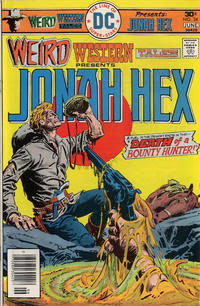
The 40 Years of Comics Project - Day 558: Weird Western Tales #34, May-June 1976 (Western Week, Day 1)

http://www.comics.org/issue/29819/

Sorry. Promise I'll catch up some time in the next couple of days. But welcome to Western Week!

I'm not entirely certain what was Weird about this story. It was a pretty straight forward tale, reading in a lot of ways like a short passage from Blood Meridian, though with less profanity and brutality. Hex runs afoul of a dishonest bounty hunter, and gets his revenge.

That's it.

I've noted many times before this that Westerns are not my favourite genre of storytelling, but I'm trying this week to keep an open mind. What's kind of cool about this issue is that it was written by Michael Fleisher, the person responsible for the excellent DC Encyclopedia series from the seventies. Though, I have to say it, perhaps he's a better archivist of comics than composer of them. That, however, is a judgment I should suspend until I've actually read a few more of his stories.

This one, though, was kind of meh. A slow start to Western Week, I guess. Onward!

Jun 3, 2015

The 40 Years of Comics Project - Day 99: Adventure Comics #435, September-October 1974


Coincidentally, this issue's Spectre story is also written by Michael Fleisher. I hadn't realized this until I took the comic out to read it and opened to the first page. I like it when coincidence like that occurs.

The artwork in the first story ("The Man Who Stalked the Spectre") is by Jim Aparo, and is, unsurprisingly, really amazing. The off-kilter angles, the supremely-expressive faces, the dynamism of both characters and backgrounds. I'm slightly reminded of Ditko's frenetically-moving panel constructions, but this is more refined, less jumbled, perhaps. The motion of Aparo's panels is less roller coaster and more ghost train.

The story, set in New York (which is a bit of a rarity in the DCU) is pretty run of the mill, and honestly seems like it is taking place in a non-Gotham/Metropolis/Central City version of the DCU. There's a single reference to Superman, but this is only to accuse a reporter of looking like Clark Kent (which he really does). In fact, it's hard to say what might distinguish the story as being a "Spectre" story instead of simply a story about a vengeance-seeking ghost. We see the action from the focal viewpoint of the Kent-esque reporter, and in doing so get none of Jim Corrigan's internal thoughts on being the Spectre, which might have elevated the story from ghost story to Spectre story. It's an interesting choice to make, for sure, but in some ways moves us into the sort of frame of reference that has worked really well for Kurt Busiek in Astro City, but is less-successful in this particular tale.

The second feature, an Aquaman story, is really bad. Black Manta is poaching from farms surrounding Atlantis. Aquaman beats him up and then turns him back over to his flunkies, warning them never to come back. Aside from the Mike Grell art, which was really actually lackluster, there's little to recommend this story.

Sometimes comics that are old are just that - old. Not all of them can be nostalgic celebrations of the earlier eras of the superhero. Some of them are simply mediocre comics that happened between some really good ones. I get the inkling that more were mediocre than not, and that we see the older stuff through rose-coloured glasses sometimes. I've had a similar conversation about Barry Allen and Hal Jordan as Flash and Green Lantern, and how so many people revere them, but that they really only achieve any kind of iconicity after they've died and been replaced. We get swept up in the reverence that their replacements have for them and are tricked into thinking that we had that reverence too. Wally West will always be a better Flash than Barry Allen. Anyone watching the current series knows they're actually telling Wally's story, not Barry's. Barry functions to inspire the character of Wally, but it is Wally that makes the Flash into a top-level hero. Much of Barry's career was relatively mediocre.

Inflammatory words if ever there were any. See you tomorrow for day 100. Now I have to figure out what special comic is going to get the treatment.

Jun 2, 2015

The 40 Years of Comics Project - Day 98: Advanced Dungeons & Dragons #4, March 1989


(A note: while writing this, the Grand Comics Database is down, so this is a lower quality picture, and lacks a link to the statistics page. I'll fix this once the GCD is back up.)

The epic conclusion to the first storyline, which has actually been an origin story for a couple of the characters. What I noted about Duursema's art the other day has ceased to be a problem. There were no moments in this issue in which I felt like I was looking at statues rather than golems, if you'll pardon the referential humour. Even the dialogue has ceased to spell out (I did it again) every movement and action, so, overall, this was a really satisfying read. I notice from the cover date that I was 15, almost, when this comic came out, and I still for the life of me can't understand why I would have given this series up when I did (as I did 3 issues from now). It really seems to sum up just about everything I was interested in at the time. (This was, of course, one year before I discovered sex, drugs, and rock'n'roll.)

I am a little concerned about the series moving forward, as the writing chores are relinquished by Fleisher and handed to Dan Mishkin (whose name appears on this cover, but who is not the scripter of this issue). As with Duursema, I've relatively little work by Mishkin that's not fantasy or sci-fi, two very under-represented genres in my collection and, let's be honest, in North American comics in general. But perhaps that means the he'll have a good grasp of how a fantasy story based on a table-top role-playing game should read.

(I have to note, again, what good shape this comic is in. I must have read it maybe once and then never touched it again. It doesn't even have those little tiny creases along the spine that would earn it a "Very Fine" rating.)

As far as moving forward with this series, I'm enjoying it immensely. The whole run only lasted 36 issues, though, as I've noted, I stopped well short of that number. I only have 3 issues of the next story arc, but I think this is the first series I've come across in this project that I'd like to finish collecting. So before galloping with Timoth into "The Spirit of Myrrth" (a lighter-hearted story, as you might glean from the title) part one, I'll have to find part four first. I do so like a challenge.

See you tomorrow with.....I have no idea.

Jun 1, 2015

The 40 Years of Comics Project - Day 97: Advanced Dungeons & Dragons #3, February 1989


The thing that really struck me about this particular issue of the series is that it's in such good condition. Considering that it's been a part of my collection since the late eighties, it's worn its time in the boxes well. This is either a function of how well I take care of my comics, or how little I've actually read this series since it was published. Let's be honest and err on the side of the latter.

I've similar criticisms of this issue as I've had so far of the whole series. I get why Cybriana might have to cry "Magic Missile!" when casting the spell of the same name, but I never imagined that the verbal casting components of a magical spell involved simply shouting the name of the spell. I think I'm more a fan of the idea of making up linguistic-looking pictograms that represent the spell, rather than this name-dropping. I wonder if it'll peter out a bit as the series matures, though Fleisher leaves as writer after this arc, which unfortunately means that a new writer will have to familiarize him- or herself with the characters and the world.

I'm on the fence so far with regard to Jan Duursema's artwork. Sometimes it's quite lovely, other times remarkably awkward. Interestingly, I've got him doing very little superhero work in my collection, the only other major presences being the DC sorcery title Arion, and the Star Wars Episode II adaptation. I'm not sure what it is. His facial close-ups are sometimes really lovely (mostly with Cybriana), and then sometimes really heavy-handed. What occurs to me is that it's not simply a writer who needs to get used to working with characters, but artists too. In television shows it's often obvious in a first season that the writers are still trying to sort out characters and motivations, no more or less so that the actors are attempting the same thing. In comics, the artist is all of the actors, and as such must figure out mannerisms, important visual features, and even something so simple as size differentiations not only for the character he or she plays, as with an actor, but with all the characters. Duursema is the regular artist on the whole run of this title, so hopefully the art will become more consistent as he familiarizes himself with the characters and the world within which they live.

This issue's most interesting feature is the back story we receive about Imgig Zu (the bad guy), and his interactions with Selune, goddess of the Moon. There's a couple of action scenes that are a bit bland compared to the battles in the last couple of issues, but I think this is the issue where we get a real understanding of what's going on. Cybriana fills in for us her odd backstory (she has a twin, a Drow, who was actually an evil growth on her body that appeared when she was born and was cast out by mages and is now working with Imgig Zu....I think), and is promptly kidnapped (again). Fleisher seems to be also developing future stories for subsequent writers with the introduction of Connor and a small child who don't seem to have much to do with the quest of our focal adventurers. I know they start to play a larger role in the next arc, but can't quite remember what it is.

We'll get there eventually, I guess. See you tomorrow.

May 31, 2015

The 40 Years of Comics Project - Day 96: Advanced Dungeons & Dragons #2, January 1989


The epic quest trucks right along, new plot threads are introduced. There's definitely a campaign quality to this series, in that each issue is a minor adventure that contributes to the larger story being told. The characters are not fleshed out quite as much as one might hope. We get a bit more of Vajra Valmeyjar's (the Fighter) back story, and Agrivar's character is fleshed out somewhat. Eyesbright continues to be interesting and a study in contradictions, being a vicious fighter and very soft-hearted adventurer. This leaves Onyx, the dwarf, and Cybriana, the elven mage, as very one-dimensional characters thus far. I know, in the hazy mists of my memory, that Onyx receives a bit more development in the next story arc, but I can't put a finger on Cybriana's character yet. I don't know, nor can I remember, what her arc is like.

One of the things I really appreciated about these comics at the time was that the back matter of each consisted of stats for characters, monsters, and magic items one could use in the game. This one, for example, has Vajra's stats (7th level Fighter), the stats for the Greater Basilisk, one of the beasts the heroes face in the issue, and stats for The Lockstone, a magic item that is also encountered in the issue. While this certainly demonstrates an acknowledgment of the most likely audience for the series, one wonders what people who read this comic and were completely unfamiliar with the game might have thought about the arcane formulas and statistics in the back pages. This, of course, assumes that anyone reading this comic was not a gamer. Unlikely, I think.

Moving on with our quest tomorrow, more adventures from the Forgotten Realms. There's a lovely nostalgic quality to these comics for me. I hold that time of intense gaming very close to my heart, and am still best friends with all of the members of our gaming group. It gave us a chance to be heroes, something we were categorically told we could not be in the beastial pit of high school.

See you tomorrow.

The 40 Years of Comics Project - Day 95: Advanced Dungeons & Dragons #1, December 1988


I remember buying this comic when it came out. I was well into my AD&D phase, playing 3 or 4 times a week with my best friends, weaving epic adventures and pathetic (in the best sense of the term) soap operas. So when this series was released, I was very excited. I collected it only for about 8 months or so, then let it go, and thinking back to the time, this might have been because I let all my comics lapse for about 6 years over the course of high school and then just after. The final issues I collected of this series seem to coincide with the last issues of Animal Man that I collected at the time, which is what I use to gauge when this lapse occurred.

Going back to the series now, I can certainly see the flaws. It seems to me a failing of this kind of adaptation comic that they feel they need to spell out (that pun will work soooo much better in a second) all the direct references to their source material that happen over the course of the story. Monsters are referred to by their proper names always, as are spells (see?), which occasionally makes the dialogue of the characters sound like it's being read from the Player's Handbook or the Monster Manual. Which, if we consider the characters in the comic as avatars of people playing a game of AD&D, makes sense. But if we're considering them as characters in a story set in the world of the Forgotten Realms, the manual-speak sounds a bit stilted.

That said, it's a pretty good story so far. Interesting characters, and a nice range of classes (for those familiar with the game). So far, in the first issue, Agrivar, the disgraced Paladin, is the most well-developed of the characters, the rest falling into stereotypes associated with their varied classes/races (i.e., the grumpy dwarf rogue, the tough-as-nails human fighter, the willowy elf mage). The centaur character (Timoth Eyesbright) is also interesting, in that his class is not immediately apparent, and as character race Centaurs were not allowed in first edition AD&D.

The series is divided up into discrete 4-issue arcs, so there's plenty of time to develop both characters and story, and, really, an adventure in-game always ends up taking much longer than it should because of the waffling associated with RPGers.

Writer Michael Fleisher is an interesting dude. In the 70s he wrote three volumes of The Encyclopedia of Comic Book Heroes, one each on Batman, Wonder Woman, and Superman. Though they're old, and horrendously out of date, I've used them in critical works to figure out first appearances of particular facets of a character's mythology. They're really handy for anyone who wants comprehensive coverage of the first 30 or so years of each of those character's histories. I'm not sure how easy they are to find nowadays, but they were reprinted a few years back, which is when I got them, so they may still be kicking around the dusty corners of your local store.

Anyway, a bit more AD&D tomorrow. See you then.

Mar 22, 2015

The 40 Years of Comics Project - Day 26: Shade, The Changing Man v.1 #2, August-September 1977


The second issue of Shade continues the manic pacing and style laid down by the introductory issue. Ditko is obviously interested in telling a lightning-fast story about a man trying to prove his own innocence in a very limited amount of time. This gives the comic a very cinematic feel, as if we're looking at the first act or two of a film. It would be a very weird film.

I'm impressed by Fleisher's dialogue. According to the introductory writings at the end of the comic, Fleisher "reads over Steve's carefully prepared plots and puts in the actual words into the mouths" of the various characters. I'm fairly certain this is what was once referred to as "The Marvel Method." What I'm curious about is whether or not Fleisher saw any of the layouts or sketches before putting in the dialogue. I suppose he must have. If Ditko plotted the book, he likely drew it and then sent it to be dialogued. It's an interesting way of creating, as it really puts someone who would traditionally be called the writer of the work on a significantly lower level that the person who would traditionally be called the artist. Fleisher doesn't have a great deal of creative freedom in the project. Yet his dialogue is smooth and natural. It's a 70s comic, so it does suffer from "Claremontitis," i.e., ridiculous amounts of exposition ensconced in thought bubbles, but even that seems a lot less stilted than Colossus' internal monologues of the 80s Uncanny X-Men.

One strange quirk of the book is that, so far, on the covers Shade is seen wearing only his M-Vest, yet within the pages of the comic, he tends to wear the vest under street clothes. I'm assuming this is because the vest resembles a superhero costume, and that superhero fans are the demographic at which the book was aimed. But it certainly doesn't read like a superhero book. Shade is on the run, playing mobsters against one another in order to clear his name, and really only tangentially saving anybody. As a DC comic in the 1970s, one would have expected a guest appearance by Superman or Batman at the least by now, but Shade and his antagonists seem to exist in a world all their own. I'm curious as to whether we'll see him enter the DCU proper within Ditko's truncated run on the book, or if he was simply pasted into the DCU after his own book was cancelled. Answers forthcoming, either way, I guess.