Pages

Showing posts with label Chris Bachalo. Show all posts

Sep 23, 2020

The 40 Years of Comics Project - Day 2037: Generation X #19, September 1996

 For information on stopping the spread of COVID-19, and on what to do if you are quarantined, have a look at the World Health Organization site.


I find it appropriate that I return to blogging (after a fucking month!) with a series of which I'm quite overly fond. I loved The New Mutants, and Generation X was a fantastic follow-up to the tales of young mutants that I grew up with. While the whole mutant metaphor is very useful for telling stories about marginalized groups, the onset of mutation, in puberty, also makes it a perfect vehicle for telling stories about growing up.

 So, a month off, and my wrists and thumbs are slightly better, but not much. The job I'm doing now is not super great for my pain, but it's a worthwhile endeavour, and I've had so many people tell me how appreciative they are for my efforts. Who knew that delivering groceries would be so fulfilling?

 That said, we're well into the Onslaught crossover here. I don't have all of the parts, but I figured I had enough to finally sit down and read a good, multi-title event. I think I probably got most of the parts of this crossover from my initial purchase of a comic collection from Cover to Cover Books when I was in the process of opening up my comic store. I started getting back into comics around the time that this crossover was happening, but I was much more into DC at the time.

The crossover itself is pretty great, and though there were subsequent problems, the Image-led reboots of The Avengers, The Fantastic Four, Iron Man, and Captain America were not terrible. Once Liefeld left, anyway. My Marvel re-introduction actually came from one of the series that spins out of this crossover, the amazing, fantastic Thunderbolts. I'll say a bit more about the actual Onslaught event tomorrow.

I love Generation X, particularly this initial Scott Lobdell/Chris Bachalo run. Mr. Bachalo's sense of panel layout and composition is just amazing. He and Mr. Lobdell seem unafraid to be very explicit about the materiality of their medium, breaking the fourth wall constantly and placing a sometimes Greek Chorus-level of exposition and commentary outside of the action of the comic. It's hard to describe, but today's comic is introduced by a talking toad whom we follow from event to event through the comic. Have I mentioned at all that this is actually a very strange comic, quite unlike the rest of the X-titles from the same era? Probably why I like it so much.

So, I'm back, hopefully. We'll see if I can keep it up.

More to follow.

Further Reading and Related Posts

A few more pieces on Chris Bachalo.

Sep 15, 2015

The 40 Years of Comics Project - Day 203: Generation Next #4, June 1995


So we finally reach the end of the story that started off the Age of Apocalypse proper (after all that prefatory matter, I mean). Generation Next is a creepy comic. The villains in it are truly repulsive and, what's more, so are some of the heroes. This series does a spectacular job of making Kitty Pryde and Colossus two of the most unlikable characters in the X-universe, AoA-style. The main title from which this series derives has a similar sort of feeling to it, but nothing quite as nihilistically bleak as what happens in this series.

As we know, the next generation of X-Men have been tasked with rescuing the time-travel capable Illyana Rasputin. What this comic suggests is that this next generation will also face a next generation of villainous mutants. In the beginning, characters like Toad and The Blob were pretty repulsive, or meant to be. So as the newer mutants become more and more edgy, for lack of a better term (think Chamber's blown-apart chest, or Husk's ripping off of her flesh), so too will their enemies evolve with them. It's like that suggestion the Joker makes in Nolan's The Dark Knight. One's villains and oneself are not always so far apart.

But let's get back to the Kitty and Piotr thing. I've suggested in earlier posts that there are certain characters whose representations are moving iconically through the different iterations of the universe. Cyclops is the one who springs to mind, his heroism, his seemingly unerring sense of right versus wrong. Do Shadowcat and Colossus have that? Something that does carry through in the characters and, aside from their powers, really the only recognizable thing about them, is their love. They love each other. You can see it. That's not to say that they seem to like each other very much. But they love each other. So while I was, in some places, disgusted with Colossus' behaviour, I could see shades of the individual he could be in the "proper" universe.

I will miss reading the Lobdell/Bachalo corner of the X-universe, AoA or no. As I noted earlier, it's really like this little chunk of the X-Men franchise broke away and fell in with those Vertigo ne'erdowells and brought a little bit of that charm back to the House of Ideas. I'll get to the Generation X series eventually, but perhaps not for some time.

We'll move on to another pre-Finale finale tomorrow with X-Calibre #4. See you then.

Sep 1, 2015

The 40 Years of Comics Project - Day 189: Generation Next #3, May 1995


I've spent a lot of time in my Generation Next reviews heaping praise upon Chris Bachalo (and this issue is no exception. He's brilliant), and not looking too closely at the scripting and dialoguing of the comic. I find this to be one of the difficulties of writing critically about comics, especially those that are composed by two or more creators. There seems (or maybe it's just me) to be a propensity for focussing on one creator, often the one deemed the most talented. Which, I suppose, is fair in some ways. Today, though, I want to mention Scott Lobdell.

Lobdell has had a tough time in comics writing. His era of the X-Men is categorized as hyperbolic in the extreme, a symptom of having to try to keep up with the over the top antics of the Image Comics creators. I think I can safely say that I've only passably enjoyed most of the comics of his that I've read. He's got a decent grasp of superheroics, of dialogue and of plot, but, really, it's all pretty mediocre.

Except for Generation X.

I've run into this problem before. After finishing James Robinson's utterly, utterly brilliant Starman, I decided I should read anything else he's written. And, sadly, for the most part it was mediocre. We've even discussed this in the comics class I took last year, considering Art Spiegelman. Maus was a big hit for him, but has anything else that he's written come even remotely close to being as good? No. I think Lobdell falls into this categoy. His work, with Chris Bachalo, is a confluence of perfect conditions to create one of the most original titles in the X-stable. As I've noted with Bachalo, it's like looking at the X-Men through a Vertigo lens. Lobdell's scripts take all of the best elements of the wonderful early New Mutants stuff (and, actually, the art owes a lot to Bill Sienkiewicz's amazing run on that title), updates it for the nineties, and then heads off full tilt into amazing-ness. How's that for hyperbolic? I'm looking forward to getting to the regular Generation X comic at some point in the future. When I discovered it, around the time that the reigns were briefly passed over to Warren Ellis, it was the first time I'd actively pursued an X-title in almost 2 decades. I loved the characters, I loved the setting, I loved the art. Like all ongoing series, it goes through its down phases, but all of the writers on the title managed to maintain the integrity of the characters, if not the plot, which kept me interested. It's a shame the "Counter-X" stuff at the end didn't get a chance to flourish. It might have been great.

But that's getting ahead of myself. This brief foray into the Age of Apocalypse also highlights a character who gets very little play in the main title: Mondo. I'm not really sure what happened with him in Generation X. He gets introduced and then, seemingly, forgotten. At least, that's how I remember it. In Generation Next, however, he's fundamental to the rescue plan and, in this issue, is the one who ultimately carries it off. His role in the regular title is tangential, and I think he's ultimately taken over by a villain and killed. Again, this seems to be bringing some Vertigo sensibility to the X-universe. In a lot of ways the early Gen X is a precursor to the direction the Marvel Knights imprint would eventually take. Perhaps it just happened too early to be successful in that endeavour.

Continuing on on the morrow! See you then.

Aug 31, 2015

The 40 Years of Comics Project - Day 188: Generation Next #2, April 1995


Okay. Back on track.

First, as I'll probably do with any of the issues in this series, I have to say that reading a comic illustrated by Chris Bachalo after having read some of the more typical superhero art in the prior comics is an absolute treat. His sense of page composition and aesthetic is unparalleled in superhero comics of the nineties. It's obvious that he came out of the Vertigo renaissance, but the fact that Marvel were willing to take someone whose aesthetic was so completely different to anything else being published in the mainstream at the time and let him loose on an X-comic is pretty amazing.

I admit, I'd forgotten all about the "let's rescue Illyana because she might be able to time travel" story. As much as I love the regular Generation X series, I found this particular iteration of the team a bit forgettable. It might be because they take my beloved Kitty Pryde and make her into an unlikable character. More likely is that there's been precious little reference to this thread in any of the other crossovers titles so far. Most of them, to this point, have at least, in passing, referenced the events of other comics in the crossover, enough to keep said threads embedded in one's consciousness. I think, if I'm remembering right, there's been maybe one reference to the rescue attempt in any of the other comics. I'm not sure why this might be, but I'm almost certain it's why the rescue was not even in the back of my head while reading the other series.

Far from being a bad thing, though, this actually works in the narrative's favour. It's obviously a deeply covert affair, as we see from the heist-like nature of the plot in this issue. So to keep the narrative not only quiet in its own title, but in the rest of the crossover, highlights the absolute need for secrecy about this mission. In many ways, this is the lynch pin to the whole plot. In order to reset the timeline, there is a need for time travel, and Illyana seems the best choice for such power. If they can't rescue her, then it's all for naught. So while there are the more overt missions, the rescue of Chicago, the assist to the human evacuation, they are simply distractions to keep the more secretive missions from popping up on the radar of Apocalypse's security systems.

I'm probably reading far too much into that, but that's what this particular story, and reading order, have facilitated for me, so I'm going to go with it. Reading really is as much about what we bring and it is what's set before us.

We'll continue on with this covert mission tomorrow. See you then.

Aug 16, 2015

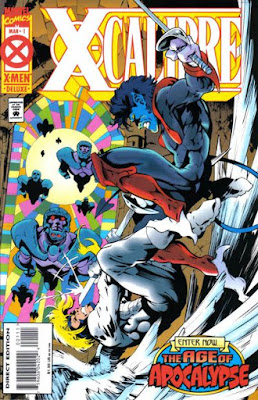
The 40 Years of Comics Project - Day 173: X-Calibre #1, March 1995


It is interesting to watch this series unfold from the vantage point of Magneto's master plan. I have to applaud the characterization of the X-Men's leader by all of the writers and artists involved. They really have captured something fundamental about this character, something that is present in all of his incarnations. Arrogance, perhaps? But in service of the greater good. When suggesting epic Magneto stories, there are certain ones that are always brought up, the trial in Uncanny X-Men #200, or his tenure in the Xavier School as Xorn during Grant Morrison's New X-Men, but I think the Age of Apocalypse crossover is really a story about Magneto and the kinds of decisions that someone of his caliber (see what I did there?) is expected to make.

Today's comic represents an interesting moment for this crossover, because it is scripted by one of the second (or is it third) wave of British writers to have made a huge impact on North American comics. Warren Ellis is definitely amongst my favourite writers, though his propensity for falling back on a particular kind of characterization and dialogue more and more puts him, at least to my mind, in the same kind of place as Jack Kirby's archaic cleaving to outdated slang in order to characterize the youth. I stopped reading Ellis for a long while because it seemed to me that, after Transmetropolitan, every character he wrote was some derivative of Spider Jerusalem. That's probably an unfair thing to say (mostly), but that's how it seemed. It could very well be that after Transmet, I just needed a break from Ellis, as that series was very purely him.

Of course, X-Calibre comes before Transmet, and still there's shades of Spider. Nightcrawler is not a nice guy in this comic. There's a text piece at the end of each of the first issues of the mini-series that asks how each hero or villain might turn out in this world without Xavier, whether or not they would retain their roles from the prime timeline. Nightcrawler certainly has not, and his transformation is deftly handled by Ellis and Lashley. The same goes for the monk Cain, this world's take on Juggernaut. While many of the changes are, as with the whole crossover, due to the absence of Charles Xavier, these interesting reinterpretations beg us to consider what happened in each of these characters' lives to engender such a switch in personality. Actually, I can see Nightcrawler being far more angry and violent if he was not rescued by Professor X, but what made Juggernaut into a monk? I don't know if I'll get the answers I seek, but I can imagine.

My last thought for today is a comparative one. There's a reason Ellis is known as one of the better comics writers of the last couple of decades. His writing smacks of a certain attention to craft and detail, of the importance given to words as language itself, rather than simply as a vehicle for conveying narrative. It's interesting to be able to make this kind of comparison in such a tightly-knit crossover. One can absolutely see what it is that defines a good writer and what defines a great one. I think that I'll try paying attention to the artists in the same way. Generation Next's Chris Bachalo is definitely a great artist. What is it that separates him from someone like Lashley, on X-Calibre, whose art is good, but somehow lacking? I'll think more on this. See you tomorrow.

Aug 14, 2015

The 40 Years of Comics Project - Day 171: Generation Next #1, March 1995


One of the things I have to catch myself at when I'm talking about comics is that I don't pay nearly enough attention to the artwork and the story it's telling, not in the same way that I pay attention to the words on the page, or the story in the narrative. It's one of the reasons that it's often argued that comics studies does not belong in English departments. We're too wrapped up in the words to really spend a lot of time on the pictures. The shift from seeing the pictures as illustrations to seeing them as a language, with patterns and metaphors all its own, is a difficult one to make for scholars reared on written or spoken language. Drawn language is still language though.

I only bring this up because with Generation Next and its parent title Generation X, it is the art that initially drew me. Chris Bachalo is, in my opinion, one of the real originals that came out of the late 80s and early 90s mainstream comics. His work on Neil Gaiman's Death series is amazing, and his Gen X stuff is fantastic. I'm still not quite sure of the way his style changes a few years after the AoA, though perhaps it's less a change and more an evolution. Either way, his art does two things rather nicely that comics art should always do: it's dynamic, communicating a wild array of action in an ostensibly static medium, and it's innovative. Not so much in this issue, but in his Gen X work in general, his panel layouts and the ways he moves the story across the page is wonderful. There are only one or two artists I'll go out of my way to check out, the Quitelys or Cassadays of the industry. Bachalo is on that list too.

Storywise, it's nice to actually get into the mini-series that constitute the proper AoA itself. What's interesting about this issue is that even right from the very beginning, the over-arching problem of the crossover is fixing the timeline, saving Charles Xavier. This raises some important ontological questions, I think. I'm not sure that if someone came along and told me that a particular timeline was somehow more valid, or "the proper timeline," that I would necessarily take action to fix said timeline. What makes any one timeline more valid than any other? I guess this is where the notion of a multiverse comes in handy, in that all timelines are valid expressions of the principle of existence, and AoA is an early bastion of the Multiverse in the Marvel U. It's returned to numerous times over the years subsequent to its publication, and even interacts with the main timeline in some ways. Of course, the morality of re-writing history for a more favourable outcome is an underlying theme of the whole crossover, one that is dealt with slightly less prominently than it might have been had the crossover happened 10 years later. These ontological questions, that have become fashionable to explore in recent superhero history, made a nice background to the AoA. But it's the action, the more concrete problems facing the characters we love, but only sort of know, that is the focus of the crossover.

After all the histories, it's great to see the action swing into full force. We hit the ground running in Generation Next, and I've the feeling that things aren't going to let up now until we slide into home at X-Men: Omega. Prepare for a wild ride, and I'll see you tomorrow.