Pages

Showing posts with label Sal Buscema. Show all posts

Jul 15, 2019

The 40 Years of Comics Project - Day 1598 - 1602: The Amazing Spider-Man #153 - #157, February - June, 1976


I was rearranging my Marvel collection yesterday, putting some things away, making space in the boxes, and I decided to just pull out random stuff and read it. I haven't done that with this project for a while. Up first is a run of five issues of Amazing Spider-Man from the 70s. I've under-represented the wall-crawler in the project, so it's time to remedy that. But I was away all weekend, so we're going to do them all together.

Let's do the art first, because it's handled by two of Marvel's famed old guard, Sal Buscema and Ross Andru. These are guys who defined the 70s house style for Marvel, a style that only significantly changes once the McFarlanes and Silvestris of the world joined the bullpen in the late 80s. Rather than the heavily-stylized depictions we start seeing in the lead-up to the great Image exodus, characters in this era of comics tend to move much more like actual human beings would in superheroic situations. There's a couple of ways to consider this. First, our heroes are human beings, so it makes sense that they would move like we do. Spider-Man may have the proportional strength, etc., etc., of a spider, but he utilizes these powers like a human would. Perhaps this helps us to place ourselves in his shoes when we see a pose that we, ourselves, could potentially strike had we the ability to stick to the side of a building or balance on a flag pole without fear of losing our balance. But I have to admit that it sometimes looks awkward, despite the talents of the artists involved. The other way to consider this is that Spider-Man, and other heroes, are enhanced, changed, or mutated human beings, so it stands to reason that their bodies wouldn't work the same way a base line human's does. Hence, when McFarlane comes along, Spider-Man's body starts acting more like a spider-inflected human, crouching a lot, flinging limbs about, and being a lot more crawly. That said, the over-stylization can be off-putting, especially for that identification we all love to have so much with our heroes.

I prefer, however, to think that what this is demonstrating, unwittingly, is Peter Parker becoming more comfortable with his powers and with the ways that those powers make his body want to move. Perhaps that's why he sometimes looks a bit stiff - he's fighting a more spider-like inclination that his body may be instinctually having. Once we get to the late 80s and 90s, we can pretend that he's had these powers for however long - ah, Marvel chronology - and has started listening to not only the obvious changes to his physiology (sticking to buildings, heightened strength, etc.) but also to the subtle changes that allow his body to use the powers to their fullest extent.

That aside, I enjoyed these comics. Writer Len Wein is really pretty great, and the stories are tightly-scripted and told, giving us all the requisite action and angst that one would expect from a 1970s Spider-Man comic.

"Mr. Osborn, I could kiss you."

Jun 25, 2019

The 40 Years of Comics Project - Day 1582: Thor #373, November 1986


Earlier on in my reading of this crossover, I noted that there were issues that were not necessary for enjoyment of the story. I'm going to revise this statement. As I read through, I've noticed that each issue is telling an important part of this tale, with one or two possible exceptions. Today's issue, much like yesterday's tells an integral part of the Massacre storyline, specifically its impact on X-Factor and on Angel. This issue has got to mark one of the very last appearances, at least for a few decades, of the traditional Warren Worthington III as Angel. Shortly after the events of the crossover, Angel is "recruited" by Apocalypse and becomes Archangel, a look and character revision that sticks around for quite some time, and heralds the beginnings of Marvel's attempt to become grittier in the late 80s and early 90s.

I've been very much enjoying the Thor comics I've been reading over the last little while. I've heard fabulous things about Walt Simonson's run on the title, though I only have a few issues of it. I'm sure it's been reprinted, so perhaps I'll have to save up my pennies.

Thor's involvement in this crossover speaks to his commitment to Earth and its people, including the disenfranchised beneath the streets of New York. Thor is often compared to Superman, favourably, in comparisons of the various heroes and teams in their respective universes. Though much of this has to do with Thor's extremely high power levels, it also has to do with his desire to connect with humanity, and to serve them as best he can. I've written extensively about this relationship between humanity and divinity from the Superman perspective. I'm curious how Thor's relationships and narratives speak to this idea, considering that rather than being an original hero, these stories are meant to be continuations of a much longer mythic history. Fodder for the next degree, perhaps?

"I think my old friend Puddlegulp has recognized me even though I...I was not wearing a beard when last we met."

Nov 14, 2018

The 40 Years of Comics Project - Day 1358: Marvel Super Action #33, July 1981


The Clint Barton/Goliath era of the Avengers is one with which I have little familiarity. What I have read from the 70s is mostly the horror stuff, and strange titles like Man-Thing and Howard the Duck. I've not spent much time with the superheroes in this era. Today's story was pretty good, though I was definitely coming in a little late in the tale. The make-up of the team was a bit off-putting, in that the Wasp was the sole female representation in the book. And the dialogue was a little stilted for my tastes. The designs of the Zodiac villains is pretty great, and utterly ridiculous, considering how sinister they're played off.

Also, although he appears to be in the battle with the Avengers, Captain Marvel never actually materializes in the story.

I know that reprint series like this one were simply a way for the company to cash in on previously published material, but I am glad for them. They offer a nice cheap alternative to the more expensive original publications.

All in all, not a bad read. Better than yesterday's Batman/Mr. Miracle debacle, though some of Hawke...I mean, Goliath's dialogue was almost as cringe-worthy. Clint really only comes into his own once he heads up the West Coast division.

More to come...

Jul 25, 2018

The 40 Years of Comics Project - Day 1246: Marvel Treasury Edition #12, 1976

https://www.comics.org/issue/29394/

As I went to read my issue of Howard the Duck this morning, I saw that the opening page was the aftermath of an adventure with the Defenders, and I realized I'd forgotten an important part of Howard's story - the Marvel Treasury Edition. It's tabloid sized and much longer than a typical comic.

I will admit I didn't read the whole thing. Part of the book is a reprint of Howard's first issue, and also of the Man-Frog story from Giant-Size Man-Thing. Instead I only read the main story, a team-up with the Defenders, the pages reprinted from Man-Thing #1 and from Giant-Size #5. They were all well-wrought. The main story serves to remind us that Howard does exist in the mainstream Marvel universe, albeit more often than not on the very fringes. That's where the Defenders like to think they live, but they don't really. At least, not until Mr. Gerber gets his hands on them.

Back to Howard's presidential bid tomorrow. More to come...

Aug 4, 2017

The 40 Years of Comics Project - Day 891: Avengers v.1 #227, January 1983

https://www.comics.org/issue/37042/

The title of today's comic is apt: "Testing...1...2...3!" Roger Stern debuts as not only plotter but also scripter of The Avengers with the induction of a new and untrained member to the team (Monica Rambeau, aka Captain Marvel), with Hank Pym in prison (where he offers a succinct history of the Avengers while chatting with a psychiatrist), and with the Wasp as team leader, prompting a sexist response from Hawkeye. Now, the comic's from the early 80s, so I'm not expecting too much equity, but we're seeing a female-led team with 3 of 7 members also female, including two of the team's strongest members in She-Hulk and Captain Marvel. Though the new Captain doesn't really realize how powerful she is quite yet.

Another strangely contemporary-feeling part of the comic, given that it's 34 years old, is Hank Pym's frank account of his battle with mental illness. Though in the series prior to this issue he's in many ways treated as a crazed villain, Stern's recap of his recent troubles highlights Pym's ups and downs from the perspective of someone who is unwell, rather than someone who is evil. Hank's admission right at the end of this section that he's not trying to get better to get Janet (the Wasp) back, but to get his dignity back, is quite moving.

All in all an auspicious beginning to a wonderful run of comics. Mr. Stern notes that he's been involved with The Avengers in some manner ever since he started at Marvel Comics, so now it's time to see him shine. And he really, really does.

To be continued.

Jun 3, 2017

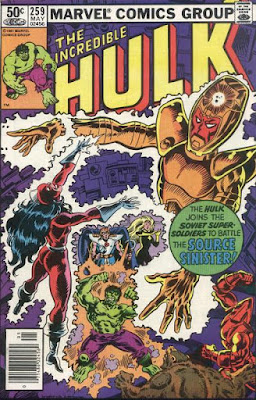
The 40 Years of Comics Project - Day 829: Incredible Hulk #259, May 1981

https://www.comics.org/issue/1557193/

Read this today. Will offer some final thoughts on the Hulk (for now!) tomorrow.

Alright, let's finish off this week of The Incredible Hulk.

Only a partial story in today's offering, though it involves some of the more interesting characters in the Marvel U of the 1980s: The Soviet Super-Soldiers. This is an odd crew of mutants and misfits, some of whom serve the state willingly, and some of whom question the totalitarian tactics of the USSR (for those who are very young, that's what Russia used to be). Though seemingly not as numerous as the super-people of the US, there are Russian superhumans, and they fight to support the Communist state. At best, they're portrayed as conflicted heroes whose orders are often at odds with their personal feelings, and at worst they're simply mouthpieces for anti-Communist propaganda (in that they say the things that Americans thought the Russians would say). I find the conflicted portrayal of them almost as problematic as the propagandistic. I teach the creation of the self through communication from what we call "the generalized other," the voice of our respective cultures. This voice imbues in us the cultural attitudes and mores that we consider "natural." So to have these people who have been raised into Soviet culture outright questioning the rightness of their orders rings, to me, a bit false. Perhaps if one of them did, I could see it as an outlier, but when all of them do, we begin to see the notion that the "good" way of thinking, which in this case is very often the American way, is "natural," only overlaid somehow by the corrupted lessons of the Soviet state.

Which, really, is not how these things work. Ever.

Anyway, I think I'm done with the Hulk for a little while, though I'll get back to his series some time in the near future. Not sure where we're heading tomorrow, but it'll be neat.

To be continued.

Jun 2, 2017

The 40 Years of Comics Project - Day 828: Incredible Hulk #238, August 1979

https://www.comics.org/issue/33602/

An epilogue issue today - very little action, aside from the Hulk destroying a Saskatchewan farmer's truck and scaring the crap out of his daughter. Oh, yeah, the Hulk somehow landed in Canada after Machine Man's anti-gravity ride, the circumstances of which are apparently depicted in the 1979 annual. I most certainly do not have it, but I am curious as to how the Hulk made it all the way from the West Coast to the middle of Canada. Machine Man's anti-gravity ride must have been pretty impressive.

The epilogue comic is always a nice touch, though I imagine sometimes that they work better when read as part of a run on comics, as I've done this week, rather than on a monthly basis. Waiting a whole month to see the Hulk smash a car and fall asleep on top of Mount Rushmore must have been a bit of a let down for some. There's a bit of set up for the next story line, but not much else really happens. There's a depiction of then-President Jimmy Carter, though my unfamiliarity with his in real life keeps me from being able to tell if it's a flattering one or not.

What I will say about this comic, especially as tomorrow's jumps a number of issues, is that it cements for me the fact that Roger Stern is one of the best writers to have come out of late 70s, early 80s Marvel. His Avengers run still ranks as one of my favourites, and if he can make me enjoy a Hulk comic, then he must have magic fingers. He only wrote 25 issues of the series, so maybe they'd be worth tracking down somehow. We'll see.

One last little bit of Hulk tomorrow, then maybe we'll head on over to the DCU for a bit. Got some Green Lantern and old school Justice League staring at me from the collection, begging to be read.

To be continued.

Jun 1, 2017

The 40 Years of Comics Project - Day 827: Incredible Hulk #237, July 1979

https://www.comics.org/issue/894465/

The Hulk's battle with Machine Man and the Corporation ends with rampant destruction and, if I read the last couple of panels right, Hulk being cast into outer space. This seems to be a common remedy to the problem of the big, green rage monster. It's a weird dichotomy. On the one hand, the people who write his adventures seem to understand that the character is so difficult to fit into the shared universe that launching him off-planet appears to be the sanest response. On the other hand, the character, and presumably his adventures on Earth, are so popular that he's one of the few Marvel characters who's been in print basically continuously since his inception in the 60s.

Why? I'm coming to the end of this week of reading Hulk stories, and I still don't understand his allure. In fact, I see him more as antagonist, and functioning more smoothly as antagonist, than I do as protagonist. Again, this is why Bruce Jones' run on the title in the early 2000s was so interesting to me, in that it was actually the story of Bruce Banner fighting against his alter ego, rather than treating the Hulk as a hero. Attempting to depict the character as somehow heroic is troublingly apologist. In today's issue, the Hulk has been responsible, in part, for the destruction of an entire suburb, and he finishes off the issue by completely destroying a skyscraper in the middle of a major urban center. The story gestures to the idea that, somehow, no one dies in the destruction, due to superlative evacuation procedures, but, and this might seem a weird thing to say, this rings far too unrealistic. Given the amount of property damage that seems to follow the Hulk around, the idea that there are no casualties in his wake is patently ridiculous.

Though if the Hulk was killing people left, right, and center, chances are the comic wouldn't be quite as popular. So is this the key to his popularity? The Hulk depicts a world in which we can lose complete control of our most negative emotions but in which no one is hurt by this loss of control? That kind of brings the character into focus for me, I think.

To be continued.

May 31, 2017

The 40 Years of Comics Project - Day 826: Incredible Hulk #236, June 1979

https://www.comics.org/issue/33449/

The Hulk continues to beat the crap out of Machine Man in what is basically an issue-long battle that destroys a good portion of the suburb they're in and causes a minor earthquake in nearby Central City (where's the Flash when you need him?).

It's a decent battle comic though lacks a bit on the narrative front. What I found the most interesting about it is that this storyline is Machine Man's first appearance following the cancellation of his eponymous title penned and drawn by Jack Kirby. Which might also mean it's his first entrance into the Marvel Universe proper. Machine Man comes about in the last few issues of Kirby's 2001:A Space Odyssey (issues I didn't actually read when I blogged the comic for the project), and subsequently transitions into his own title. But both 2001 and Machine Man have very little connection to the Marvel U proper, until perhaps this comic. A bit of research turns up the fact that after this appearance, Machine Man's title is revived, without Kirby, and the character is subsumed fully into the Marvel U.

Machine Man offers an interesting bit of linkage in the Marvel U. He comes out of a series exploring the ramifications of Kubrick and Clarke's 2001, and thus brings with him into Marvel continuity the idea of the Monolith, which also become attached to both the Watchers and the Celestials. It's a little known or acknowledged bit of Marvel trivia, mainly given that the future(s) depicted in 2001 bear little resemblance to anything in Marvel continuity, but aspects of the film continue to crop up from time to time.

What does this have to do with the Hulk? Next to nothing, really. But Machine Man's appearance in this story arc is where this link becomes explicit, so I thought it was worth noting.

To be continued.

May 30, 2017

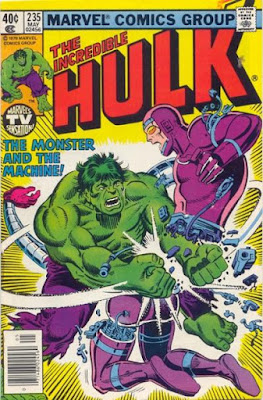
The 40 Years of Comics Project - Day 825: Incredible Hulk #235, May 1979

https://www.comics.org/issue/33369/

And then all of a sudden the Hulk has some cognitive and rational abilities?

I think this is the problem I've always had with the Hulk, and probably the problem that most writers have with him - just how much intellect is this creature supposed to have? As a product of rage, how much rationalization should he be allowed? Should he care about the fates of those he interacts with, or should he simply feed whatever need is fueling him and then move on? In today's comic, he is pursuing a perceived kidnapper, hoping to rescue a young lady friend. I just don't see the Hulk doing this. Or rather, it's not a behaviour I associate with the Hulk, which could also be why I've never really understood how we place this character in a superhero universe.

The version of the Hulk in this issue is far more superheroic, but only because he is managed by an outside force. This was traditionally the purview of Rick Jones, but if this is going to be the case, is the story really about the Hulk, or about those who direct his strength. Which, actually, could be a really cool take on the character.

Not much else to say about today's issue. Nice to see Kirby-era Machine Man. Makes me want to go back and read his stories.

To be continued.