Thoughts, reviews, rants, laments, and general chatting about the wonderful world(s) of comic books.
Showing posts with label BIONICLE. Show all posts
Oct 13, 2016
The 40 Years of Comics Project - The Weekly Graphic Novel: Week 25 - Bionicle: Battle of the Mask Makers, 2016
Sorry for the graphic novel break, but we're back.
I was not terribly kind when I reviewed the previous volume in this series. I think my conclusion was flat art meets flat writing. It's definitely a problem, and one that I struggle with in my considerations of writing, be it comics, television, film, what have you, that is ostensibly geared toward children. I think one of the major problems members of the Bionicle fandom had with the recent revamp is that it simplified the story - while this was seen as a bad move by many, it's a move that's understandable given who the toy line and its concomitant media were aimed toward. AFOLs (Adult Fan of Lego) sometimes think that their favourites should grow with them, and forget that Lego is a toy, and remains locked onto a particular demographic for its bread and butter.
That said, I found this volume of the series (likely the last) to be quite a bit better than the previous one. The story is that of Ekimu and Makuta, the mask makers, and is primarily told through the focal lens of one of the ancient Protectors. This characterization of secondary characters is really rather lovely. In the online comics and those in the magazines, the Protectors are silent characters who seem, sadly, to not be very good at their job of protecting - hence the appearance of the Toa. But Agarak, ancient Protector of Jungle, is given both voice and personality, and offers a glimpse into Okotan life that is very satisfying. This is the kind of depth and complexity of narrative that fans of the line have bemoaned as being absent, so it's a pity that the series was cancelled before we could properly be introduced to and drawn in by these characters.
Onward!
Jun 12, 2016
The 40 Years of Comics Project - Day 474: Hero Factory #6, July 2011
Heavy night of drinking last night, and I'm far too hung over to attempt a reading of Batman #682. We'll get back to it tomorrow.
My other regularly updated blog stands as a testament to my love of Lego's Bionicle series. That line of toys lasted from 2001 to 2010. Over the course of Bionicle's evolution, the elements that made up the toys evolved and became quite versatile for building. Following the closing of the story line in 2010, Lego tried a few different variations on the theme, including a number of licensed properties (Ben 10, Toy Story, Marvel/DC Superheroes), but one of the things that made Bionicle so good was that it was a proprietary property. In an effort to replace Bionicle, and its transmedia potential, Lego introduced Hero Factory the same year that Bionicle folded. While the story is quite different (a factory produces robotic heroes to defend the world against threats), the general premise of robotic heroes and villains whose elements are interchangeable remains.
Bionicle also produced a long-running series of comics, and it seems that Lego tried to continue that trend with Hero Factory as well. Though I picked this issue up in a thrift shop, the discoloured strip along its back tells me that it was included in a Lego Club magazine, much as the Bionicle comics were. It's an aspect of Lego's promotion of Bionicle that I liked, and had I been a fan of Hero Factory, I probably would have liked these too. What's strange is that the series only ran 7 issues, and did not encompass the entirety of Hero Factory's evolution. This particular comic introduces the third wave of Heroes, but I can't imagine that the following issue did much more than finish off this story. The toy series continued for 4 years after this issue, but apparently the comics didn't.
The comic itself is well-realized. The heroes are distinct enough, both in appearance and personality, that one can connect with at least one of the focal characters. The setting is neat, a jungle planet, and the villain, a rogue doctor from the Hero Factory, is creepy-looking. An overall pretty good comic.
I never collected Hero Factory the same way that I did, and do, Bionicle, but I do buy the parts when I find them at garage sales or thrift shops. They're good for building, and many of the elements have made their way into the generation 2 Bionicle series that started last year. One of my complaints about Hero Factory was that it made the builds far too simple, whereas Bionicle, though less and less over its history, retained some of the technical aspects of its Lego Technic beginnings. But this is not the place to discuss this. That's on that other blog I mentioned above. Gotta keep my obsessions compartmentalized.
Onward.
Apr 3, 2016
The 40 Years of Comics Project - Day 404: BIONICLE: Toa Nuva, 2002
To cap off this stretch of BIONICLE, I'll have a look at the promo comic that came with the 2002 release of the Toa Nuva. I will admit, I was guilty of misjudging this short comic for a moment or two. It consists of 4 pages of wordless story, 6 pages of pictures of the new toys, and 4 pages of ads for other Lego products. And, I was certain, the comic was lifted from BIONICLE #8, specifically the defeat of the Bahrag and the transformation of the Toa. Had it actually been the case, I would have been far more critical of this piece than I'm going to be. It was around 2002 - 2003, very early on, that the BIONICLE toy line began the practice of releasing "clone" sets. The Bohrok were all basically the same model, just coloured differently. The practice is decried in fan communities these days. Had the comic, too, been a clone, that would have been unsurprising.
But it wasn't.
I'm pretty sure, though there's no credits, that this is Carlos D'Anda and Randy Elliot doing the art. It does retell that particular part of the BIONICLE saga, but from completely different angles. It's almost as if the panels of this mini-comic could fit between the panels of the original. If I find myself with a bit of free time, maybe I'll attempt it.
Anyway, I think we'll move back over to Alpha Flight tomorrow. I'm curious to see what's been happening in 1980s Canada. Onward!
Apr 2, 2016
The 40 Years of Comics Project - Day 403: BIONICLE #9, 2002
Comes the inevitable split. The Toa have never really been one of those groups that works particularly well together for very long. I think it comes from being made up of of leaders. Each team of Toa is made up of the very best of their kind, the Matoran. Of course they're all going to feel like they can handle everything on their own. And it certainly offers a nice look at how actual political relationships work - the various Toa, representing their regions, come together and prove greater than the sum of their parts, but individual interests always come back to the surface. There's a lot going on on Mata Nui.
That's the last full comic for this bit of the BIONICLE series. They title this "The Bohrok Saga Part 6 of 6," which I find a bit weird because it ends on a cliffhanger, and the story continues with more, albeit different, Bohrok in the next issue. Though there's a good chance that issue didn't come for a few months as the toys would have to be released early in 2003 first.
We'll get to those later. Onward.
Apr 1, 2016
The 40 Years of Comics Project - Day 402: BIONICLE #8, September 2002
This cover plays on a particular trope of mainstream comics that irks me slightly. Of course it's not the end of the Toa - how could that possibly be, especially in a comic that is, for the most part, an ad for the toys of the Toa? But though it irks me, I also have to respect it, if only slightly. Such hyperbole is endemic of the popular comics genres, a cleaving to the sensational that comics seem to have contracted from film advertising. Though I think, in this case at least, rather than offering the possibility of an "END," to advertise the fact of the Toas' transformation into Toa Nuva could have been just as exciting, and would have seemed less disingenuous.
Enough for today. I'm very tired. Onward!
Mar 31, 2016
The 40 Years of Comics Project - Day 401: BIONICLE #7, July 2002
The descent into the depths of Mata Nui to face the queens of the Bohrok swarm turns up....power armour? Isn't this a nice little fantasy comic? Where'd the power armour come from?
One of the things I've always loved about the BIONICLE series is that it straddles that line between fantasy and science fiction really, really well. Even at this point, very early in the series, and still very much steeped in the mystical aspects of the story, we're seeing bits and pieces of technology, small clues as to the apocalyptic tale that is to unfold. This is, of course, not to say that the mystical side of the story gets completely eclipsed or erased - as I say, the story straddles the line, and, for the most part, stays there. There's no reason, really, that science fiction and fantasy can't exist in the same continuum.
Enough for now. More tomorrow.
Mar 30, 2016
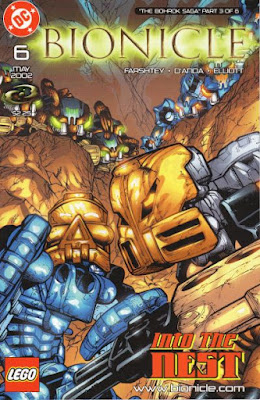
The 40 Years of Comics Project - Day 400: BIONICLE #6, May 2002
I feel like, having hit 400 straight days of writing about comics, I should have something important or profound to say. But my first thought upon opening this document was that I didn't have much to say so this would be a short post. Let's call that Morrissettian irony.
I have applied to take a leave of absence from my grad program. My supervisor has a very lax notion of what supervision means, and my dissertation committee recently told me of their opinion of the irrelevance of just about every text I'm hoping to write about. It has disheartened me. I was under the naive assumption that a university English department would be a place where innovation of thought would be encouraged - unfortunately it seems that if you don't toe the party line, your contribution to literary scholarship is dissuaded. I'm not certain how we're supposed to innovate if no one in a department is interested in innovation.
So, instead, this year I'll keep writing here. Comics have a vast amount of important information to convey to us, be it through the narratives they contain or through the ways they communicate information to us, ways that are unique to this medium. As foundational elements in fan-driven franchises, they're also vitally important to transmedial storytelling, which is something I'm becoming more and more invested in - it seems to me that there's a conflation to be made between the transmedial and the mythic. And, in the end, I don't need to be in a university department, nor do I need the approval of the close-minded, to disseminate ideas that I think are important and interesting.
Oh. Today's BIONICLE comic was pretty badass - the Toa learn to work as a team, to value one another's input. Also, the Matoran make awesome battle mechs and kick biomechanical butt.
Mar 29, 2016
The 40 Years of Comics Project - Day 399: BIONICLE #5, April 2002
The nice thing about this particular run of BIONICLE is that it's a more sustained story than the previous introductory arc. There's development of situations, continuity between issues, and, hopefully, a resolution to the story at the end. This issue also continues the idea that the invasion of the Bohrok is a phenomenon that has to take place in the natural order of things - the trouble is that Makuta has used this natural phenomenon for his own sinister purposes. Of course, this offers us an interesting perspective on the Toa, as they now have to combat something that is emblematic of part of their creed - the Destiny part of "Unity, Duty, Destiny." I'm reminded of the efforts of the Illuminati in Jonathan Hickman's Secret Wars and it's lead ups, this notion of combating something that is unbeatable. Why fight against something that is not only inevitable, but natural? And so BIONICLE asks us one of the fundamental questions of human nature.
Is it any wonder that I love this series so?
Onward.
Mar 28, 2016
The 40 Years of Comics Project - Day 398: BIONICLE #4, January 2002
Following on from our brief introduction to them yesterday, the Bohrok begin their clearing of the island of Mata Nui in today's issue. I've been cheating a bit and going to BioSector01 to do some background reading on the storyline. As I noted yesterday, the narrative takes place over numerous media, so keeping up with it is sometimes challenging. According to the lore of the series, the purpose of the Bohrok is to cleanse the island, though to what purpose, I'm not sure yet. What's interesting, though, is that, although the Bohrok are awakened prematurely by Makuta as a way of challenging the Toa, the confrontation is really a misunderstanding. The Bohrok are doing work set out as part of the plan for the Matoran universe by the Great Beings. When, or if, we find this out in the official media, I have no idea. But knowing it does make for an interesting take on the current story.
This arc is six issues long, so we'll make our way through that, and then perhaps pop back into the Great White North of Alpha Flight. I'm hoping to get a few of my non-40 Years articles up again soon, though the end of term is coming, and that's always a busy time.
I noticed in today's issue that D'Anda's art is becoming a bit more easy with the restrictions of the toys that he has to deal with. At one point Lewa is holding his axe just below the head, which would be impossible to do with the toy. The series undergoes a number of interesting shifts like this. As I've previously mentioned, the art becomes more and more stylized as the series progresses, and the story itself goes from mystical island adventure to post-apocalyptic adventure, and does so far more smoothly than a lot of stories that take this path. D'Anda finishes his run on the series after "The Bohrok Saga," and I'm curious to note how radically things shift when Randy Elliott takes over. But that'll be in a couple of weeks. Let's live in the now.
Onward.
Mar 27, 2016
The 40 Years of Comics Project - Day 397: BIONICLE: Swarm, 2002
Another promotional comic today, this one included with the six Bohrok figures released during BIONICLE's second wave in 2002. I'm finding the comparison of comics distributed with toys and comics about toys very interesting. I have a fair number of toy inserts, and more often than not they're there to provide scant story and increase excitement about actually playing with the toy. In contrast, the toy comics distributed through the comics market are more about establishing character than form, I guess.
The early run of BIONICLE comics was sparse, and the story skips over bits and pieces that are told through flash animations online or, later into 2003, a film. The story really does exemplify the idea of a transmedial fiction, in that canonical parts of the story are told through different media, but not reproduced separately in each of those distinct media. To get the whole story, you need to experience each of the different media. There's a fantastic project called The BioMedia Project, that actually preserves the various online and print content that was released around the toy line from 2001 to 2010, and continues to archive the current revival content. I'm certain that one day, when the genesis of such transmedial fictions becomes something people are interested in, this project will shed some fascinating light on a very early incarnation of the phenomenon.
So, to get us up to speed, after the meetings that took place in the last four comics, the Toa meet and defeat (sort of) Makuta, who appears in a flash animation in my favourite of his incarnations, a corrupted version of the islanders that the Toa are meant to protect. But upon his defeat, the Makuta sends a signal to the Bohrok swarms, who waken from their canisters with one simple goal: the clearing of the island of Mata Nui.
More tomorrow.
Mar 26, 2016
The 40 Years of Comics Project - Day 396: BIONICLE: Challenge of the Rahi, November 2001
Back to BIONICLE! I've been a fan since just about day one for this series. Today's comic comes from a series of McDonald's "Happy Meals" that featured the series in late 2001. I would travel from restaurant to restaurant to make sure I got one of each character - the original six Toa aside, these figures are probably the oldest in my collection.
There's an interesting dichotomy evident in this comic (as there is in so many toy-based properties). On the one hand, the characters need to look like the physical objects they're advertising. Unlike a comic based on a purely intellectual property, there are actually objective appearances and structures for these characters. If you want to use the comic to sell toys, the characters have to look like the toys so that someone playing can insert themselves into the narrative.
(A side note - I hurt my back really badly yesterday, so I'm a bit hopped up on painkillers right now. Just in case something doesn't make a lot of sense.)
On the other hand, the figures themselves are not particularly articulated, so an artist has to take some license with how the character can move in the virtual world of the comic book. D'Anda, of all the artists on BIONICLE, strives to create a bridge between characterization and cleaving to the toys. His characters do look like their toys, even down to the connectors that stand in for hands on the early models - however, their arms bend, their necks twist, in ways that the toys, this early in the line, cannot do. Later artists offer far more stylized versions of these characters, perhaps speaking to the popularity of the line in that it no longer had to look like the toys in order to sell them.
D'Anda continues for quite some time, so it'll be interesting to see if his depictions of the characters become more stylized too as we get further and further into the story. With that, more BIONICLE tomorrow!
Mar 15, 2016
The 40 Years of Comics Project - Day 385: BIONICLE #3, November 2001
I feel like I cheaped out a bit on yesterday's post, so I'll try to make it up today.
This issue is told from the point of view of Makuta, the main villain of the Bionicle series, and it's a point of view that offers some problems in the narrative. I imagine they're problems that will be addressed, but from my particular re-reading perspective, I have questions.
Without wanting to spoil too much, the story the Turaga tell, of Mata Nui and his "brother" Makuta and their battle, isn't actually how things went down in "the time before time." Now, from a purely practical framework, this is fine. No one knew, at the time, how long Bionicle would last, so why worry about internal consistency of narrative? What I find odd, though, is that the story veers from this spiritual battle of deities to science fiction narrative of giant robots and genetic (biomechanic?) experimentation. Not that I dislike the story, but I'm curious as to why the spiritual comes to take a back seat to the scientific. It's a similar consternation I had with Battlestar Galactica - the spiritual story, which was really the best part of the show, got lost in an attempt to rationalize events of the series, which just produced a bit of a mess by the series end. Hopefully the Bionicle story is slightly more coherent, regardless of its irrational to rational move.
One really cool thing about this issue is the disembodiment of Makuta. He's famous for popping up in all kinds of different bodies throughout the series, so it's neat that our first proper introduction to the character comes solely through caption boxes. I think what I like about this early version of the character is that it's virtually impossible to combat him in the physical realm - he's a force of nature, rather than an embodiment of force. This changes, eventually, but right now the thrust of the series is for the Toa to figure out how they can combat such an antagonist - their powers are elementally, and therefore physically, based. How does one deploy such things against a disembodied god?
We'll find out eventually, but we'll head back to Big City and the 7 Guys of Justice tomorrow. Onward!
Mar 14, 2016
The 40 Years of Comics Project - Day 384: BIONICLE #2, July 2001
A short post today - it's my birthday, and I'm very tired now. It's been a lovely day, but increasingly feeling like a long one.
Once more, the characterizations, both visual and verbal, of the Toa are so very much in line with pulp fantasy heroes. Look how badass Lewa looks on that cover.
Okay, number 3 tomorrow. See you then.
Mar 13, 2016
The 40 Years of Comics Project - Day 383: BIONICLE #1, June 2001
Ostensibly in preparation to use it as a case study in my dissertation, I'm reading through all of the print and digital media surrounding the first generation of BIONICLE. I love these toys and this story almost as much as I love comics.
Almost.
This first issue would have been shipped not long after I bought my first BIONICLE, I think. I had started to buy both this series and the Star Wars Lego based on the original trilogy and the then-new Phantom Menace. But, Lego being Lego, I couldn't keep up with both lines, and BIONICLE won out. I still build the models to this day, and I've been performing a build-through over at my other blog (though it's gone on a bit of hiatus for the last little while. Life is difficult at the moment).
(There's also an excellent chance that a digest of these posts will appear over at that blog soonish. Recycling'll save the world, don'tcha know?)
This comic is really pretty great. The new generation of Bionicle has taken a bit more of a cartoon-y aspect in it's sequential representation, but the shots of Kopaka in this comic make him look more like a fantasy hero like Conan, or my current fave, the Warlord. And this is suitable. One of the contentions I've always made about this series is that it moves from mystical fantasy to post-apocalyptic science fiction in a remarkably smooth manner. We're given a history tens of thousands of years long, and a take on reality that is remarkably novel. And, most importantly, we're asked to play along.
One of the nice things about this series is that it's also told in novels, but it's always slightly different. It's like you're reading different translations of the same legend - and in some ways, given the verbal/visual semiotics of comics, you are. Again, though, there's an element of legendary fantasy about this story, so to read differing accounts of virtually the same events lends it that feel of the ancient myths.
In this account, then, Kopaka and Pohatu, Toa of Ice and Stone respectively, meet, retrieve one of the great masks, and make contact with the other four members of their team.
Another interesting thing to note about this comic is that it was a promotional one attached to the Lego Magazine. Every BIONICLE comic was distributed this way, the stories only making their way into comics shops in collected editions. We'll continue on with the first arc tomorrow, focussing on the adventures of two more of our heroes. Onward!
Dec 28, 2015
The 40 Years of Comics Project - The Weekly Graphic Novel: Week 5 - BIONICLE: Gathering of the Toa
As the revamped title notes, the graphic novel portion of my project is no longer (was it ever?) going to be weekly. The graphic novels will happen when they happen at this point. With the deadline for dissertation chapters looming, I'll be keeping the comics on a daily basis, but the other stuff will happen when time permits. Today, I'm sitting in a hotel room in Banff on the side of a mountain, so time has permitted.
I'm a huge fan of the Lego BIONICLE franchise, so when it was announced a couple of years ago that it would be returning from its 5-year hiatus, I was thrilled. The first new models came out about a year ago, and though the story of the Toa has been available on the website since the get go, it's only in the last couple of months that the print media associated with the series has also returned. The comics aspect of the BIONICLE tale originally appeared as inserts in the Lego Club Magazine. Though the art was of varying quality, it was a generally good comic, and the price (free!) was always right.
I wish I could say the same of this particular graphic novel.
I'm not familiar with writer Ryder Windham, but he's apparently a pretty big name in the Star Wars expanded universe writings. I find this encouraging, as BIONICLE has always had the potential to be a thoroughly epic piece of fiction - that subtle hints of connections to the prior storyline are being dropped in this comic is proof of that. What I'm a little more concerned about is the quality of the art. Caravan Studio is based out of Indonesia, and their website offers some examples of comics art from what look like Marvel comics, though whether these are simply examples or from actual comics, I'm not sure. Regardless, the art in Gathering of the Toa is terrible compared to the art on the website. One of the most distinctive aspects of the Toa are their masks, and the toys are beautifully-sculpted pieces. In this comic, the masks look completely flat. Indeed, all of the characters seem to be lacking in actual, physical depth. It's one of the problems of comics, that it's a two dimensional medium attempting to depict a three dimensional (well, four dimensional) world. Unfortunately, the characters in these stories look like they live in Flatland. There's also the issue of the placement of word balloons, either coming from the wrong character (unless Toa Kopaka refers to himself in the third person, in which case I apologize), or placed in such a way that the flow of action is not properly represented. I notice this kind of balloon placement a lot in comics from Image and its clones in the early 90s, and I think it speaks to an artist, or artists, with a lot of enthusiasm, but not necessarily a great handle on the medium.
My favourite of the short stories in the book, "Mountain Terror," features Pohatu, Master of Stone and some young wolf-like creatures he befriends. Sadly, Pohatu's probably the worst-depicted character in the book, but the action sequences and the sparse dialogue in this story are very effective.
It's a pity that the art is so...amateurish (?) really, as these are stories that haven't been told anywhere else, online or off, about the new iteration of the series. And the stories themselves are actually pretty good. Old fans will have some concerns about the characterization of the Toa, but we're not 100% sure that they're really the same characters we loved from the earlier version of the series. Yet. The comics are definitely geared toward a younger audience, but they offer to the older fan some elucidation about the Protectors, elemental guardians and summoners of the Toa, and some interesting moments on the island of Okoto. I just hope that the art gets better.
I'm a huge fan of the Lego BIONICLE franchise, so when it was announced a couple of years ago that it would be returning from its 5-year hiatus, I was thrilled. The first new models came out about a year ago, and though the story of the Toa has been available on the website since the get go, it's only in the last couple of months that the print media associated with the series has also returned. The comics aspect of the BIONICLE tale originally appeared as inserts in the Lego Club Magazine. Though the art was of varying quality, it was a generally good comic, and the price (free!) was always right.
I wish I could say the same of this particular graphic novel.
I'm not familiar with writer Ryder Windham, but he's apparently a pretty big name in the Star Wars expanded universe writings. I find this encouraging, as BIONICLE has always had the potential to be a thoroughly epic piece of fiction - that subtle hints of connections to the prior storyline are being dropped in this comic is proof of that. What I'm a little more concerned about is the quality of the art. Caravan Studio is based out of Indonesia, and their website offers some examples of comics art from what look like Marvel comics, though whether these are simply examples or from actual comics, I'm not sure. Regardless, the art in Gathering of the Toa is terrible compared to the art on the website. One of the most distinctive aspects of the Toa are their masks, and the toys are beautifully-sculpted pieces. In this comic, the masks look completely flat. Indeed, all of the characters seem to be lacking in actual, physical depth. It's one of the problems of comics, that it's a two dimensional medium attempting to depict a three dimensional (well, four dimensional) world. Unfortunately, the characters in these stories look like they live in Flatland. There's also the issue of the placement of word balloons, either coming from the wrong character (unless Toa Kopaka refers to himself in the third person, in which case I apologize), or placed in such a way that the flow of action is not properly represented. I notice this kind of balloon placement a lot in comics from Image and its clones in the early 90s, and I think it speaks to an artist, or artists, with a lot of enthusiasm, but not necessarily a great handle on the medium.
My favourite of the short stories in the book, "Mountain Terror," features Pohatu, Master of Stone and some young wolf-like creatures he befriends. Sadly, Pohatu's probably the worst-depicted character in the book, but the action sequences and the sparse dialogue in this story are very effective.
It's a pity that the art is so...amateurish (?) really, as these are stories that haven't been told anywhere else, online or off, about the new iteration of the series. And the stories themselves are actually pretty good. Old fans will have some concerns about the characterization of the Toa, but we're not 100% sure that they're really the same characters we loved from the earlier version of the series. Yet. The comics are definitely geared toward a younger audience, but they offer to the older fan some elucidation about the Protectors, elemental guardians and summoners of the Toa, and some interesting moments on the island of Okoto. I just hope that the art gets better.
Oct 13, 2015
News - A blog is revived!
A new post is live on my collecting blog "Speaking of Collecting."
For the foreseeable future, I'm going to be using this blog to consider my collection of Lego's "Bionicle" line, which will be making its way into my dissertation over the next couple of years.
For those who are interested:
The Building Chronicle - Building Through part 1.1 - 2001
For the foreseeable future, I'm going to be using this blog to consider my collection of Lego's "Bionicle" line, which will be making its way into my dissertation over the next couple of years.
For those who are interested:
The Building Chronicle - Building Through part 1.1 - 2001
Apr 29, 2015
Toy Stories
Let's call this one an irregular feature.
I used to be far more into toys than I am now. Moving across the country has taught me exactly how transportable all your stuff needs to be, and toys are not.
I do have one weakness when it comes to toys, though, and that's Lego's BIONICLE series.
I love this stuff.
I've been getting it since it debuted in 2001, hitting up garage sales and thrift shops after the line ended in 2010. The line made a return in 2015, which is wonderful.
I've only just (well, in the last year or so) taken the step of really using it creatively though. For a long while it was about collecting the official models in the series (it still is to a certain extent), or about building pieces that were basically just variations on those official models. But in the last little while I've come to see it not just as a building toy, but an artistic outlet. There are insane BIONICLE-based figures all over the Internet.
I also started trying to maintain a semi-critical look at the line at my collecting blog, but this one is taking up a lot of time lately (and, y'know, school). I'll get back to the BIONICLE blogging one of these days.
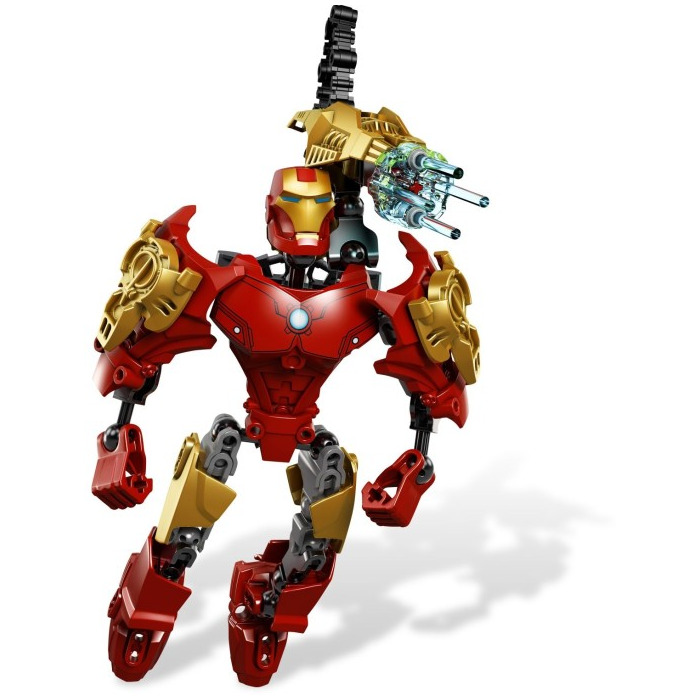
Now, when BIONICLE ended, and just as the Marvel Cinematic Universe was becoming a force to be reckoned with, Lego released a series of superheroes using simpler versions of the BIONICLE elements:
Lego released Iron Man, Captain America, and the Hulk from the Marvel U, and Batman, the Joker, and Green Lantern from the DCU (I've got pics of IM and GL here because they're the only two of the sets that I own).
I managed to snag a double of the Iron Man set, and began to wonder, with the myriad pieces I have, what kinds of Iron Men I could build. Eventually, I settled on an Iron Man with a kind of samurai aesthetic. As I've said, I'm seeing the BIONICLE elements as artistic medium now, so here's some of my superhero inspired art:
It's not immediately obvious in that last picture, but his jets at the back swing up into guns.
Here's a clearer picture of them, though the picture's less clear, if you see what I mean.
So, that's one of my other passions. I'm currently working on a Green Lantern one, and furiously searching for the other characters.
I'll do other, sporadic "Toy Stories." My supervisor, Bart, wrote a book called Comics vs. Art, and in parts of it he considers what we consider the limits of comics scholarship. Should it solely be about 2-dimensional sequential art strips, or can it be about the vast culture, material and otherwise, that has grown up around them too? What are "comics?"
I used to be far more into toys than I am now. Moving across the country has taught me exactly how transportable all your stuff needs to be, and toys are not.
I do have one weakness when it comes to toys, though, and that's Lego's BIONICLE series.
I love this stuff.
I've been getting it since it debuted in 2001, hitting up garage sales and thrift shops after the line ended in 2010. The line made a return in 2015, which is wonderful.
I've only just (well, in the last year or so) taken the step of really using it creatively though. For a long while it was about collecting the official models in the series (it still is to a certain extent), or about building pieces that were basically just variations on those official models. But in the last little while I've come to see it not just as a building toy, but an artistic outlet. There are insane BIONICLE-based figures all over the Internet.
I also started trying to maintain a semi-critical look at the line at my collecting blog, but this one is taking up a lot of time lately (and, y'know, school). I'll get back to the BIONICLE blogging one of these days.
Now, when BIONICLE ended, and just as the Marvel Cinematic Universe was becoming a force to be reckoned with, Lego released a series of superheroes using simpler versions of the BIONICLE elements:
Lego released Iron Man, Captain America, and the Hulk from the Marvel U, and Batman, the Joker, and Green Lantern from the DCU (I've got pics of IM and GL here because they're the only two of the sets that I own).
I managed to snag a double of the Iron Man set, and began to wonder, with the myriad pieces I have, what kinds of Iron Men I could build. Eventually, I settled on an Iron Man with a kind of samurai aesthetic. As I've said, I'm seeing the BIONICLE elements as artistic medium now, so here's some of my superhero inspired art:
It's not immediately obvious in that last picture, but his jets at the back swing up into guns.
Here's a clearer picture of them, though the picture's less clear, if you see what I mean.
So, that's one of my other passions. I'm currently working on a Green Lantern one, and furiously searching for the other characters.
I'll do other, sporadic "Toy Stories." My supervisor, Bart, wrote a book called Comics vs. Art, and in parts of it he considers what we consider the limits of comics scholarship. Should it solely be about 2-dimensional sequential art strips, or can it be about the vast culture, material and otherwise, that has grown up around them too? What are "comics?"
Subscribe to:
Posts (Atom)