Pages

Showing posts with label music. Show all posts

May 19, 2021

Well, Now What?

 It's pretty easy to slip into the habit of not writing. I hadn't considered that. I am still reading everything, but the writing is coming harder these days. Gotta do something about these hands.

That said, I've entered a song competition through our national broadcaster, the CBC. Voting closes tomorrow, but if you're able, I'd surely appreciate a click. Just follow the link and it should either take you to my page, or to the search page, where you can look for Tom Miller from Alberta. The song is called "Don't Walk on the Grass," written about my job meter reading many years ago.

I appreciate any and all support.

https://www.cbc.ca/music/searchlight/#/vote/tom_miller

Jul 21, 2019

The 40 Years of Comics Project - Day 1607 - 1608: Alice Cooper - The Last Temptation #2 - 3, August, December 1994


Our morality play ends as all morality plays do, with the protagonist having learned something that may not have made him happier, but that certainly made him wiser. The Showman is revealed to be a tempter, not necessarily The Devil, but a serpent, so make your own conclusions.

I am curious now about the Alice Cooper album that accompanied the series. I'll have to have a look next time I'm at the used CD place. Yep. I'm that kind of a dinosaur. I've liked, but not loved, Alice Cooper for a long while now. One of my treasured possessions is an original vinyl of his album From the Inside, on which each song is about an inmate in an asylum. The album features little cardboard doors to open behind which we have glimpses into the inmates' world. In retrospect, the album is definitely not doing any favours for the treatment or perception of people with mental health issues. It's more of a concept album version of One Flew Over the Cuckoo's Nest (the book, not the film), but with much less depth. Which is not meant as a disparagement, merely an acknowledgement of Alice Cooper's place in the canon of popular culture. He's more entertainer than philosopher, I think.

The end of the story has piqued in me a curiosity. In proper horror-villain fashion, the Showman fades away into the mist in the last few panels, promising to return one day and claim our hero's soul. My curiosity is when did our villains start returning like this? Does it go as far back as our early myths? Does Loki slink away, promising to return in the original Norse epics? Or is this a more recent phenomena, spurred by the increasing paranoia of society, or, more likely, by a view of history that shows us that our problems always come back and rear their ugly heads. We must simply have the courage to not let our worse selves win.

That got deep. Neil Gaiman fans will like this comic. Alice Cooper fans will like this comic.

"Did I tell that you'll be going crazy tomorrow?"

Other things you might like reading:

More thoughts on music and comics: A Different Kind of Album

Another really obscure Neil Gaiman comic: The 40 Years of Comics Project - Day 251: Elric #0 - One Life, 1996


Jul 19, 2019

The 40 Years of Comics Project - Day 1606: Alice Cooper - The Last Temptation #1, May 1994


I posted this image to Instagram this morning with the caption "Remember that time that Neil Gaiman, Alice Cooper, and Michael Zulli teamed up and made a comic together?"

I love that this is a thing that exists. It's even got a Dave McKean cover!

What we've got here is actually a cool little artifact that's one of the interesting places that music and comics crossover. The Last Temptation is both the title of this comic and of the album by Alice Cooper that was released around the same time. Gaiman and Cooper had worked on the story together. I think perhaps this gives us a nice idea of just how big Neil Gaiman was in some circles with the enormous success of The Sandman. It also, in that case, gives us a good idea of how good, and how influential, The Sandman really was.

The story, thus far, seems to be a fairly straightforward morality play told through a creepy theatre revue. Cooper appears as the host, guiding a young man on a creepy and thoroughly transparent metaphorical journey through his future. I don't want to sound like I'm being harsh, but the story is not that complex. And stories like this one, which are some of the oldest stories that we have, don't have to be. A moral tale is there specifically to teach us how to be moral people. Such stories can't really be that dense, or no one would ever read them, nor ever learn. I often think that this is one of the things traditional academics miss about the pop culture they often dismiss. Or maybe they don't. I really have to stop caring about what traditional academics would think. Fuck 'em.

Zulli's art is just brilliant, of course, though one or two panels struck me as a bit stilted and out of place. I wonder if it's harder to compose something like this when you have to be aware that one of the characters who appears on just about every page of the book has to look like someone from real life. And the likeness to Cooper is pretty amazing. Unsurprising, really.

It's a three-part story, so I'll fill you in on how things go tomorrow.

Aug 3, 2018

The 40 Years of Comics Project - Day 1255: Henry & Glenn Forever & Ever #2, 2013

https://microcosmpublishing.com/catalog/zines/4480

This comic is just wonderful. Just wonderfully wonderful.

For those not in the know, the Henry and Glenn of the title are Henry Rollins and Glenn Danzig, former frontmen for, respectively, Black Flag and The Misfits, notoriously angry early punk bands. Both went on the successful solo careers, and also are well-known as very buff individuals. The notion of them living in domestic bliss is insane, but it works so, so well.

But here's the thing. I picked this comic up a few days ago, based solely on the cover. I saw the title briefly, which reminded me of the logo of The Saga of Crystar, and I'd been looking to find a bit more queer content in my comics, and this just looked like a ridiculous gay fantasy comic. I didn't even click into who it was actually about until I opened up the comic this morning and started reading it! What a lovely surprise.

Anyway, it's great. I highly recommend that you click on the picture and order one. I laughed out loud a couple of times, and that a rarity in any media, I find. You definitely have to have had some exposure to both Rollins and Danzig in some form to appreciate the comic. I imagine it would still be amusing if you didn't know who they were, but it's just not the same.

Here, watch these, then order the comic: (Also, how does Rollins' "Liar" continue to be as relevant as it is, all these years later?)


More to come...

Oct 12, 2016

Still Another Different Kind of Album

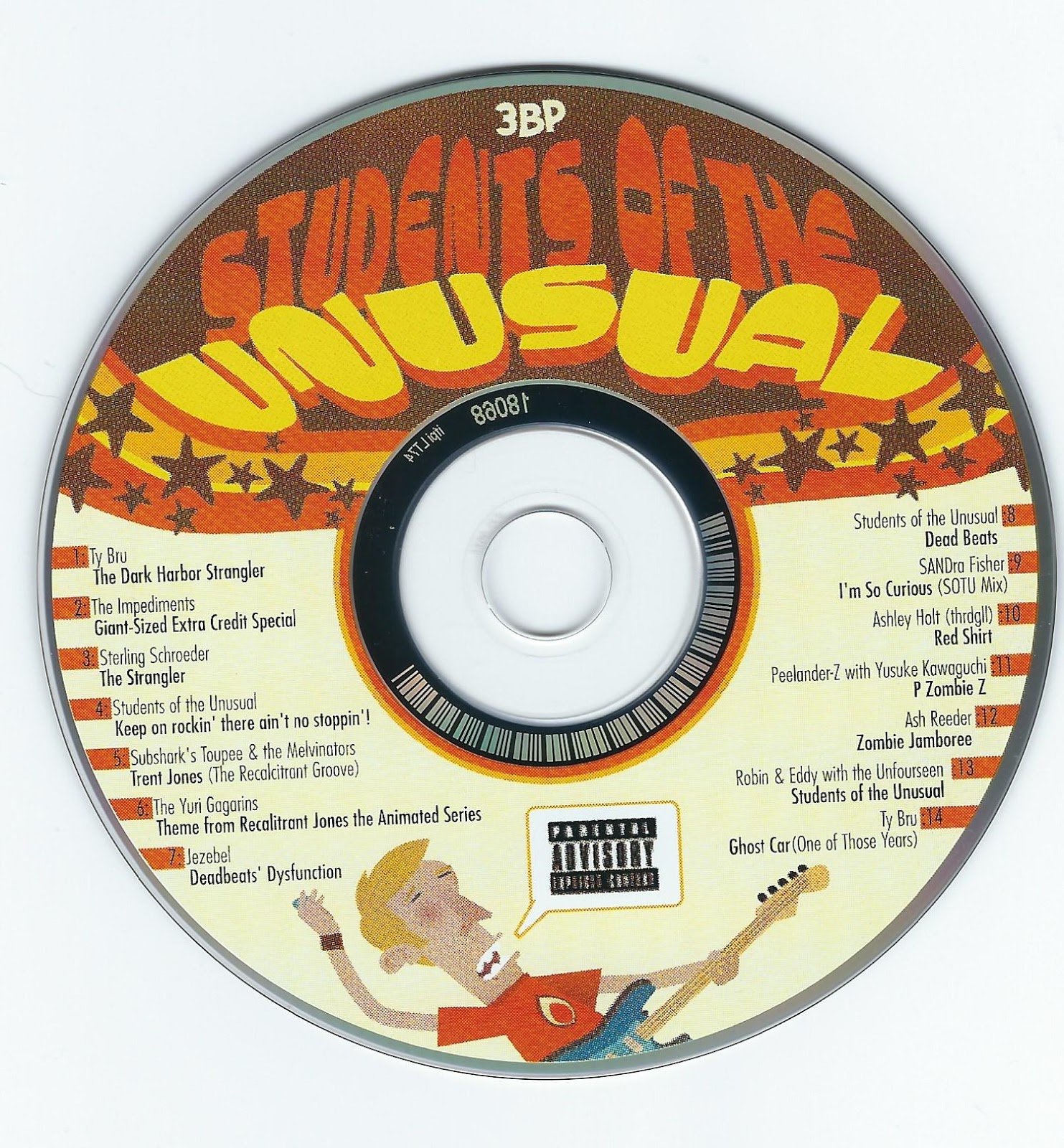
Is it wrong for me to admit that I only picked up the Students of the Unusual Music Special because it came with a free CD? It’s playing in the background as I compose this piece. If the following wanders a bit, it’s my mind wandering over to the music.

It’s been a long, long time since I wrote about the links between music and comics. Life happens, I suppose.


This package presents an interesting contrast to my first piece on the relationship between music and comics, specifically the notion that the comic is the secondary aesthetic vehicle if it's used as cover art - in this case, the comic is initially the secondary vehicle due to my primary interest in the music. Having read the comic and listened to the CD, the question I'm forced to ask is is that hierarchy still maintained?

Before I attempt to answer the question, let's look at the two pieces of this publication. Students of the Unusual is produced and published by 3 Boys Productions, (yep, IMDB is the most official site I could find for them) a South-Florida based comics studio. This particular issue comes after a series proper, so I'll admit that I was a little lost as far as who the characters were, what their motivations might be, and who it was that they were having a wake for. I'm getting more and more used to this kind of dissociation as I make my way through my collection. It would be impossible for me to fully immerse myself in every single ongoing story that intersects with every comic I will read over the next 40 years. And this comic has to rank amongst the most obscure that I have. This issue isn't even in the Grand Comics Database (which I'll be remedying shortly, I promise), which only lists the series proper. As such, the amount of understanding I leave this comic with stands as a testament to either the blatancy of a recap or the skill of a creator's use of the form how well one can come to understand a story which one is dropped into part way through.

As far as I can tell, the stories were well-crafted, both scripting and art, but how they compare to their predecessors, I've no idea.

The music in this package is remarkably interesting. The CD is a compilation of songs inspired by the series itself and written and performed by independent South Florida bands. As such, the whole package gives us a snapshot of a very particular subculture from a very particular time (i.e., around the time of the comic's publication).

Unlike Break the Chains, the stories contained herein are not standalones. Each is dependent completely on knowledge of the previous issue. The argument could be made that this is a mark of very bad comics storytelling. But, as I note above, the stories seemed to be well-told, even if I had no idea who anyone was and how they knew each other. So I don’t think it’s a question of the comics being bad – what I think is happening with this issue is that it’s being produced for a very, very specific demographic. Consider that the album features 12 different, talented bands who have written songs specifically for this obscure comic – a comic that therefore must have been quite popular in its formative space. And if a band, local or otherwise, that one enjoys demonstrates that kind of reverence for a piece of writing, one is inclined to look into it. It worked on me when I first listened to Rush’s 2112, and read Ayn Rand’s  Anthem. Rand gets a bad rap, perhaps deservedly, but it was one of the first philosophical texts I read and thought about, so I have a soft spot for it.

I think this is a package designed specifically for mid-2000s, Melbourne, Florida comics and indie music scene people.

What this does to my personal reading of both of the components of the text is to force me to use solely technical knowledge in my assessment of which is primary aesthetic vehicle and which is secondary aesthetic vehicle. But I’m not sure I can make that distinction without being able to perform a contextual analysis from my own personal perspective, my personal knowledge of the context of a comic’s production. And I have none, save that I bought the comic in a comic store. I can’t even make the claim that the fact that the comic was procured thousands of kilometers from South Florida, but none of those bands may have ever made it out of their own area, as I haven’t researched each and every band. Perhaps one did make it even further than this comic. To achieve a proper reading of this comic, I’d have to have either been from or have deep knowledge of South Florida in the mid-2000s, understanding which parts of which subculture fed off one another, what the pecking order was.

What I’d like to do is track down the other issues of the series, so that I can at least gain a narrative understanding of the series. And considering that a few of the songs on the album appear to be about specific events in the comics, it will be interesting to be able to contrast the comics version to the song version.

I’ve a couple of other pieces to look at in coming weeks. One is this Dr. Seuss-style adaptation of the Nick Cave and the Bad Seeds song “Red Right Hand.” Delineation of primary versus secondary aesthetic vehicle in this one is very similar to the Static X situation, dependent almost wholly on whether you bring with you a knowledge of Cage or of Seuss, or of both. The other album I’d like to look at is called Secret Broadcast, and came packaged with an issue of Oni Double Feature. But I don't think anything else that I look at in this series will come close to matching the Students of the Unusual Music Special for its obscurity, and that, in and of itself, is reason enough to pay attention to it.

Apr 24, 2016

In case you're new here....

...Hi! Thanks for taking a moment to stop in and see what I have to say. Here's a link to the beginning of the 40 Years Project, to let you know what it's all about, and a bit about who I am. But that's not all I do on the blog. I've been known to write about The Flash, both the show and the comic, the links between music and comics, the wondrous glory of the Dollar Bin (and, that joy of joys, the Quarter Bin), and other assorted things.

Have a poke about.

I've been known to bite only occasionally, and never very hard.

Aug 26, 2015

Another Different Kind of Album

I delved into the formal and structural links between specific pairings of comics and music here, where I started theorizing primary versus secondary aesthetic experiences based on how well album cover art in comics form meshed with the music for which the album is primarily a vehicle. Let's have a look at some other kinds of comics/music combinations to see if they help us understand the combination of a primarily audio medium with a primarily visual one.

We're going to look today at two variations on a theme: the packaging of music with comics.


Big Joe Krash - Who Am I?

1994's Break the Chain is a hip-hop comic in numerous senses of the words. Co-written by the inimitable Kyle Baker and Kris "KRS-One" Parker, the comic is packaged with a "cass-single" containing three short songs ostensibly produced by Big Joe Krash, one of the characters in the comic. The music is catchy and anthemic, and surprisingly, for a 90s hip-hop record, not completely foul-mouthed. The comic itself takes place in a stereotypically urban environment, though one that is unidentifiable as any one particular city. Thematically, the album and the comic tackle the problem of urban youth, specifically young African-American youth, being ignorant of their cultural history, of the vast empires that once covered the African continent, of the heritage that has been obscured by the spectre of slavery that haunts American culture. The comic and its musical companion, then, are pieces of protest literature, of the kind that hip-hop, in what we might call its truest form, emblematizes.


Big Joe Krash - Break the Chain!

But how does it hold up with regard to my thoughts on primary and secondary aesthetic experiences? Break the Chain is an interesting case study, and I must admit that I assumed that the comic would be the primary vehicle and the music a secondary, complementary one. This turns out to not be the case at all. While the comic is vibrantly constructed, demonstrating the remarkable creative flourishes for which Baker is known, the most moving moments in the narrative come when Big Joe Krash sings his songs and the words are transcribed, verbatim, from the album. As such, the sections between songs act more as bridges between these musical moments than they do fundamental narrative moments in and of themselves. Put more plainly, these bridging moments bring very little to the overt message of Big Joe Krash/KRS-One's message in the music, that is, the importance of Black culture, of education, and of standing up and grasping both of those things.


Big Joe Krash - So Much Greater

Had this story/album been packaged as a record (and there's some evidence that it was released as a 12" album), I would have decisively said that the primary aesthetic vehicle and experience was the music, about which Baker's narrative and art is wrapped. It's only because the comic was sold as a comic with a cassette included that I would even think about calling the comic the primary vehicle. What we can conclude from this particular comic is that the comic was marketed as the primary vehicle, by dint of its actual form, but once experienced, both visually and aurally, it becomes quite clear that it is the music, the audio element of the hybrid package, that carries the primary thrust of aesthetic experience and performance. Much like the comics that adorn the album covers in my previous column, Baker's work here is secondary. While nice to look at, its overall contribution to the aesthetic experience is negligible.

The case of 2002's Static-X, published by Chaos! Comics, is a little more difficult to parse. The comic comes with a CD containing audio and video music and interviews with this unfortunate (an appellation I'll address shortly) band. But where the primary and secondary aesthetic experiences fall is a difficult question to answer. 


Static-X - This Is Not
Static-X tells what is ostensibly an origin story for a group of freedom fighters, modelled on the band themselves, in the totalitarian society of 2072 A.D. The science fiction and thoroughly mechanized setting jibe nicely with the industrial sound of the band (even though they are more often associated with the "nu-metal" movement), though the comic suffers from something I'm coming to understand as the Chaos! Comics style.

(Chaos! is a bit of a conundrum for me. Their production values are very high, and they attracted some fairly large names in the industry, but their comics were always mediocre. I begin to wonder if they set out to be mediocre, and thus succeeded spectacularly, or if they wanted to be great, and failed. I'll ponder on that a bit more when I get to their oeuvre in the 40 Years of Comics Project.)

The plot hangs somewhat around the lyrics to the song "This is Not," and actually holds some promise of an interesting revolutionary narrative, one that has the potential to lift Static-X's music out of the depths of nu-metal and into consideration as protest music. Unfortunately, Chaos! folded shortly after the publication of this issue, so the second volume, advertised both within and on the back cover, never appeared. All this aside, this package offers a further consideration with regard to primary and secondary aesthetic vehicle and experience. As I come at the package from the point of view of a comics fan, it is the comic, its words, pictures, and overall narrative, that I privilege over the CD and the music that comes with it. However, I can imagine that from the point of view of a fan of the band, the comic would be secondary to the experience of the songs, videos, and interviews on the disc. Thus, here, we can propose a primacy of aesthetic vehicle and experience based upon the point of view from which one approaches the package. Such a claim cannot be made for the album covers from my last column, as their aesthetic value is markedly secondary to the music they accompany. Similarly, for Break the Chain, there is a decided primacy to the music, regardless of the perspective from which one approaches the package. Having read and listened to Break the Chain, one is able to see the primacy of the music. Having read and listened to Static-X, the hierarchy is far less clear.

Let me elaborate now on my characterization of the band as "unfortunate." I felt it behooved me to do a bit of research about the band before writing about this comic based upon them, and what I found was not happy. The band went through a prodigious amount of personnel changes, all revolving around frontman Wayne Static. Tripp Eisen, who is featured in this comic, and was lead guitarist when the comic was published, was arrested 3 years later on charges of sexual relations with a minor. He was subsequently booted from the band. And then last year, Static himself was found dead at the age of 48. So while I am still of the opinion that this comic was, at best, mediocre, there is a perspective from which it stands as a testament to a group of artists just before things went very badly wrong for them.

I was going to feature one more comic/CD package in this column, the Students of the Unusual Giant-Sized Music Special, but it's somewhat different from the two works I've addressed here, so I'll leave it until next time. In contrast to the previously discussed record albums, the works I've looked at here require deeper consideration before we can make any claims as the primary and secondary aesthetic vehicles/experiences that each provides. The albums use comics solely as art to enhance the primary experience of the music,even in the case that the one has little or nothing to do with the other. The comic/music packages I've looked at today require both media to be experienced before we can make the distinction. In the case of Break the Chain, I'd go so far as to say that even if the comic was read without the benefit of the music, it is the transcriptions of the music in the comic that would be the most influential portion of the experience, so even in absentia the music is the primary aesthetic vehicle and experience. In the case of Static-X, despite my misgivings about the quality of both the comic and the music, I think that the two complement each other quite well, and incorporate one another quite well. That the band existed prior to the comic might skew our decision as to the primary aesthetic vehicle/experience in favour of the music, but as I stated earlier, the perspective from which one approaches this package is more likely to inform that decision. The revolutionary message is inherent in both media equally, whereas in Break the Chain, it is predominantly encapsulated in the music and its transcription.

My next look at the combination of music and comics will address the aforementioned Students of the Unusual comic, which is packaged with a CD of music composed in tribute to the comic. This is a thoroughly interesting phenomenon, and I'm looking forward to seeing where it takes me.

Apr 19, 2015

The 40 Years of Comics Project - Day 54: 1602 #8, June 2004


And so we come to the conclusion of Gaiman's early modern superhero epic. I think I have to say that it was a little underwhelming. The best bits involved Reed Richards, and those only took place in the last two issues. In this issue, Richards outlines a taxonomy of the sciences based around the metaphor the the Knights of the Round Table, each equal and each a part of a whole. A cool (actually, very cool) metaphor, and one that scholars and academics could benefit from, I think.

The climax of this tale is a letdown, frankly. There's so much that could have been done with an early modern approach to the superhero, and Gaiman teases out some of the implications with the Inquisition, with Clea's return to her realm, with Doom as a power in Europe. But the ending comes down to a fairly standard superhero trope: heroes and villains join forces to fix a problem with the spacetime continuum. How many times have we seen this? On the one hand, I suppose, that's the whole point, that we have seen these things before, and that they are all a part of the fundamental stories that Richards muses upon in the previous issue. And, in many ways, this is how we can forgive 1602 it's flaws, by considering that it is simply a superhero story (are they ever simple?) wrapped in an early modern setting. I think that the problem with this explanation is that the world Gaiman and Kubert create is so intriguing that to wrap it up in a superhero story seems somehow to quash its potential as a vehicle for stories. I've not read any of the subsequent series that spun out of 1602, but the fact that there is no ongoing series based on these concepts currently extant means that the potential of the setting was not realized.

Writers and artists cannot, of course, always be historians and scholars. But had Gaiman sat down with such people, co-wrote with them even, then this could have been an amazing alternate history piece coupled with the myths of the Marvel superheroes. We would also have needed an ongoing, or at least longer than 8 issue, run on the title. What's happening on the African continent of this reality? And South America? The title is problematically Eurocentric, even as the contemporary comics are problematically North America-centric.

Ah well. A pleasant, if flawed, deviation from the usual superhero fare, an experiment with, I would argue, inconclusive results. The characters are going to show up in "Secret Wars," so perhaps we'll see something spin out of that eventually.

The promised song will have a link here some time today, but probably not until later this evening. Recording a song is a lengthy process.

I'm not sure what to move on to tomorrow. I actually have a cool idea, but I'm also getting my exam questions this week, so my cool idea may have to wait until I have sufficient time to devote to it. Either way, see you tomorrow.

Apr 5, 2015

Live-Post: Reorganizing my comic collection, Sunday, April 5, 2015 @ 18:07

Running out of room. And steam. Must be dinner time soon.

I've come across the old Epic "Shadowline Saga" stuff, which I mentioned in my first "Secret Wars" post. So, of course, they're out and ready to be read. I guess I don't have to limit everything to once a day. Just means I'll re-read them when I reach them in-project.

My music was so loud I almost didn't hear the alarm I've set. Moon Duo, Ween, Syd Barrett, Cream, MGMT...yeah, it's that kind of afternoon.

Live-Post: Reorganizing my comic collection, Sunday, April 5, 2015 @ 17:01

I was going to do this last night but I ran out of steam. Yeah, I know I should be using something like Twitter, but as I've said before, my Web Fu is poor. Gimme time.

I am re-organizing  my collection. I've gone through my active collection and pulled things that I don't foresee the immediate need of in the next year or two. They're going to be filed in the Storage collection.

So I decided I'd provide a running commentary. Strap in, it's likely to be really, really boring.

Problem one: I had a stack of dollar bin comics sitting on my coffee table that I hadn't read. I wasn't sure if I should keep them out and read them, since there's a good chance it'll be years before I come across them again, or if I should just file them. I chose the latter. They're in good company by way of comics I haven't read yet.

Problem two: Jeff Lemire's Trillium. Slated to be filed, I glimpsed it as I was alphabetizing the stuff to put away, and I remember how goddamned good it was. Look for that series to show up some time in the near future.

Problem three: I'm lacking in Storage collection space. I'd managed to leave 1-3 inches at the ends of about half of my longboxes, in order that I could flip through the boxes when I needed to. The rest of the boxes are jammed, so I'm creatively conjuring up space out of nothing. Which sounds easy, but is actually hard. Physics be damned!

Problem three point five: As I'm creating this space, I find things I want to read RIGHT NOW! Just discovered the first issue of Tim Conrad and Michael Davis' Etc. I found an ad for it in the back of one of the Beautiful Stories for Ugly Children, and it sounds nuts and fascinating. Watch for that one coming up too.

Ween are currently blasting from the speakers. "Fat Lenny" from their album GodWeenSatan: The Oneness. One of the greatest rock albums of all time.

Okay. Back to work. See ya in about 15 minutes.

Mar 31, 2015

A Different Kind of Album

The album, in comics parlance, is the format in which many European comics are published. Those hardcovers of Tintin, or Asterix, are albums. They're an elegant form, as far as I'm concerned, offering superior visual size and durability. I'm glad, however, that the monthly comics I collect aren't published in this format, or I'd be reading far fewer comics. The album is much closer to the North American "original graphic novel," though albums are often parts of larger serials, which our OGN's are not.

Anyway, this is a bit of writing about a different kind of album. A record album.

"What's a record album?" the youth amongst you ask.

A vinyl record, I reply. You know...those insanely expensive things they carry in trendy clothing/lifestyle stores (I'm looking at you, Urban Outfitters!). Oh, nevermind.

I have, of late, taken to pouring through old stacks of vinyl records in hope of discovering some bizarre and awesome music. It's worked wonders. Looking for some strange yet calming glitch music? I suggest Denzel + Huhn's Paraport. More in the mood for some strange Dutch psychedelic jazz-rock? Ekseption's Bingo is amazing.

Today I found Rumplestiltskin's self-titled debut album. Here's the cover:


(Sorry for the scan quality. I'll poke about for a better quality one.)

It's a comic. There's more on the back, but you get the idea. It's very odd, and involves singers and a singing giraffe, and a rotten businessman, and I haven't quite figured out if it has anything to do with the songs on the album. And to be honest, I only bought it because it's cover looks like this. It turns out that the music is early blues/prog rock from 1970, and it's really, really cool. I love when that happens.

But I think it's interesting to have a piece of comic book artwork as an album cover. Intrinsically, your audience is buying this product for the music. The cover is simply that, a cover. Why place a comic strip on it?
Further, the comic really doesn't seem to have anything to do with the music, which I think I'm going to call the main aesthetic vehicle of the piece as a whole. Thus the comic becomes a secondary aesthetic vehicle, and ostensibly one that is not simply a subset of the main aesthetic vehicle. An example of a subset of the main aesthetic vehicle would be something like the prose interjections on the liner notes of Rush's 2112, something apart from the music that comments upon, and offers elucidation, of the story of the main aesthetic vehicle. That said, scattered as it is, the comic "Rumplestiltskin" does tell what appears to be an internally self-consistent story, even if the story doesn't make a lot of sense. There are repeating characters, and continuation from scene to scene. Thus both the main and the secondary aesthetic vehicles communicate their own aesthetic...I don't know....experience, perhaps?

The combination of the two is a parallel relationship, and the import of each aesthetic experience can be gauged either separately or together, depending on the consumer of that experience.

Here's a very different example, also from my collection. This is a 12" single from Blutonium Boy and DJ Neo:

http://www.discogs.com/Blutonium-Boy-vs-DJ-Neo-Rockin-Hardstyle-Instructor-Part-3/release/593987

So, obviously, we have a Batman and Robin thing going on here, with Blutonium Boy taking on the Batman role, and DJ Neo the Robin role. The comic does not continue of the backside. The text is English, but only just, full of spelling and grammar errors, and seems to be a condemnation of promoters who only book "producers" from Germany, not "real DJs." But neither Blutonium Boy nor DJ Neo care, because they have their own "Blutonium Rocket."

Again, the music is obviously the main aesthetic vehicle, the comic the secondary. But the interesting question is whether or not it's a parallel aesthetic experience. The comic does indeed refer directly to the content of the primary aesthetic vehicle. But does it constitute an addition of any sort to the primary aesthetic experience? There are good arguments for both yes and no. On the yes side, one might read this comic and understand that, in some way, it seems to be a protest against the club scene of Germany in the early 2000s. Listening to the track from this perspective adds a layer to the aesthetic experience. Conversely, the dialogue could really be seen as a whiny reaction to not getting hired, and so inflect the song thus. On the no side, we could perhaps argue that the song itself, as a dance piece, does not have a narrative of its own, so to speak, or the narrative that it does have is more based around the kinesthetic experience of dancing than it is to understanding some signified, symbolic "story" to the music. And so adding the narrative element from the album cover means nothing to the enjoyment of the act of dancing to the music.

Album cover theory. Neat. I'll see how much farther I can push it with my next post. Which won't be until I find some more albums with comics covers. Stay tuned!