Pages

Showing posts with label reprint. Show all posts

Feb 8, 2022

The 40 Years of Comics Project - Day 2410: Two-Fisted Tales #7, April 1994

For information on stopping the spread of COVID-19, and on the importance of being vaccinated, have a look at the World Health Organization site.


Publisher: Russ Cochran

Writer: Harvey Kurtzman & Ed Rock

Artists: Harvey Kurtzman, Jack Davis, Wally Wood, Johnny Craig, John Severin

We're coming up to the end of Year 7, and, as I noted in the last post, this year has been difficult. Hell, the last couple of years have been difficult, but that's the same story that everyone has right now, so at least I'm not alone. But I've quit my delivery job, I'm having a go at writing full time, and I love it, and I want to get the project up and running again.

I don't read, or generally consume, media that has to do with war or crime. They're two human activities that I am pretty much against hallowing through art. Unless, that is, the art is decrying the darker natures that lead us to these pursuits. While I acknowledge that they're fertile places for stories to be told, the sometimes celebratory atmosphere of such tales makes me uncomfortable. But when Mike at the Purple Gorilla suggests something to me, I'd be a fool not to listen. And, of course, the tales in this comic don't celebrate war - they decry it and point to the horrible inequities and violence that grow from it.

That said, as much as the stories and art were fucking brilliant, it didn't resonate with me as much as the horror and sci-fi titles coming out of the company at the same time. I have a much easier time finding my metaphors in things that I can fully divorce from reality. In stories that take place in less-stylized settings, I sometimes have a hard time finding the piece of the tale that resonates with me. Perhaps that's something to keep in mind as I move on.

Onward.

Nov 9, 2020

The 40 Years of Comics Project - Day 2084: Adventure Comics #409, August 1971

     For information on stopping the spread of COVID-19, and on what to do if you are quarantined, have a look at the World Health Organization site.


 Late Silver Age finds us in an era of Supergirl that I really love, even though quite often the stories are kind of lame. One part of these tales that tickles me is that they dress the Maid of Steel in fan-submitted costumes, occasionally, like this crazy get-up on the cover. Now, it looks a bit crazy to us, but considering the fashions of the early 70s, it's not that far a stretch. Is it utilitarian? No. But in these stories, Supergirl often seems as concerned with looking good as she is with doing good.

Though there are some times that a writer gets their hands on the character and does something interesting. I spoke about a sort of neo-gothic sensibility in some Supergirl stories at the Fan Expo a few years back, but those cool tales are definitely interspersed in this era with some cheeseball romance stuff.

However, the backup story, a reprint from 1963, tells the story of Satan Girl, who claims to be the equal and enemy of Supergirl, and who incapacitates the female-identifying members of the Legion of Super-Heroes. Who turns out to be a Red Kryptonite duplicate of Supergirl who was trying to kill her way to retaining her existence, and who fades out and recombines with Supergirl at the end of the story! Fucking dark.

I love 1970s Supergirl. She's unfailingly good, interestingly flawed, and really sexy, as Kara or Linda, really. Worth checking out for an interesting perspective on the DC universe.

More to follow.

Nov 8, 2020

The 40 Years of Comics Project - Day 2083: Famous Funnies #213, September 1954

    For information on stopping the spread of COVID-19, and on what to do if you are quarantined, have a look at the World Health Organization site.


Back in time we go to the mid-50s, just before the return of The Flash and the advent of the Silver Age. Or rather, just before the destruction of the comics industry by Wertham and his cronies and the introduction of the Comics Code. Depends how full your glass is today.

My copy is coverless, and no wonder. That's a Frank Frazetta cover up there, and it's fucking gorgeous. I would be completely unsurprised to find that the cover to my copy ended up gracing a wall somewhere. Beautiful.

The stories inside are pretty good, a couple of nice adventure/drama/science fiction newspaper reprints and some odd 2-pagers about "real heroes" and the heroic things they did. A cool little glimpse back at the history of the medium and its origins in the Platinum Age.

Which I will read some stuff from, promise. Just gotta figure out what.

More to follow.

Nov 3, 2020

The 40 Years of Comics Project - Day 2078: Famous 1st Edition F-8, September 1975

 For information on stopping the spread of COVID-19, and on what to do if you are quarantined, have a look at the World Health Organization site.

Where was I?

After having sold a few comics at Purple Gorilla, I picked up some nice vintage-y stuff in exchange, including a couple of Famous First Edition Golden Age reprints and some cool Silver Age superhero stuff. I thought, as I try to wade back into daily writing (the pain has gotten much better in the last little bit), I'd do a comic from each of the major "Ages," one a day, for a while.

The delineation of ages I use comes from www.keycollectorcomics.com, and breaks down thus: Golden Age - (1934-1955),


Aug 17, 2020

The 40 Years of Comics Project - Day 2000: Wall of Flesh #1, 1992

 For information on stopping the spread of COVID-19, and on what to do if you are quarantined, have a look at the World Health Organization site.


Given that this comic is from the same company that have published Femforce for the last few decades, you might be forgive for thinking that this comic, especially based on its cover, might be a weird, slightly-horrific but more titillating comic than it actually is. There's one cheesecake-y moment, with a member of Femforce in a pin-up on the Wall of Flesh, but aside from that it's reprints of old horror comics, and was meant to be the first issue of many.
 
As with a large number of the old 50s horror comics, each of these stories is really, really good. Though the comic suffers from a lack of colour, the draftsmanship apparent in each tale reinforces just how talented these early comics artists were, and just what they could do without the restrictions of the Comics Code. Indeed, it's a testament to how good they were that they could produce some stellar material even under those restrictions, but such tales often pale compared to what was possible before that draconian set of rules was enforced.
 
All that said, this is my 2000th comic! That feels like a lot. I wondered, at the beginning of the project, at what point would I feel like I'd done a significant chunk of the collection, and this is it. 2000 comics. It's a number I can still sort of visualize. I'd considered at one point taking each of the comics I'd read for the project and separating them, so I would have the read and the unread collections. Though I ultimately decided that this would be a ridiculous way to organize my collection, it would have been interesting seeing the shift, slowly but surely, over the years.
 
But what a nightmare it would have been for accessing anything.
 
So it seems somewhat fitting to me that a comic celebrating the brilliant history of comics is my 2000th read. I cannot wait to see what the next 2000 bring.
 
More to follow.
 
Further Reading and Related Posts
 
A couple of other "anniversaries:"
My post on day 100 - I thought I'd read a lot at that point.

And my post on completing the first year - we're in Year 6 right now, for anyone keeping track.

Aug 6, 2020

The 40 Years of Comics Project - Day 1989: Spider-Man Interactive Comic Book, 1996

For information on stopping the spread of COVID-19, and on what to do if you are quarantined, have a look at the World Health Organization site.
 
 
https://www.comics.org/issue/999645/
 
 
I picked this comic up as part of an activity pack at a beach-side store while travelling down the Pacific Coast on vacation a few years ago. It's a reprint, as far as I can tell, of Spider-Man Adventures #7, based on the animated series from the 90s, and chronicles the first meeting of Spidey and Doc Ock. The "interactive" part of the comic is that some of the panels, or parts of panels, have been left uncoloured so that one might colour them. Now, I'm a fan of colouring. It's fun and relaxing, but I'm kind of waffling about this one. Colouring in a comic just seems....wrong.

The set that this was in came with some other stuff. There's a large poster of the web-slinger, with an uncoloured version of the picture on the back so that one can colour the poster as well. I've had some thoughts about making a super-psychedelic Spider-Man poster out of it. We'll see. There was also a strange little game, though, now that I'm thinking about it, I can't for the life of me remember where that stuff is. Probably amongst my superhero ephemera in storage in the basement.

The story itself was okay, as was the art. Definitely geared toward younger viewers and readers, but the think I find fascinating about it is the retelling of this first meeting. The two first come into conflict all the way back in Amazing Spider-Man #3 from July 1963, so there's a vast history to retell and revamp in this comic. I find that the animated versions of some superheroes are almost like compacted versions of their long histories. Both Felicia (Black Cat) Hardy and J. Jonah Jameson are involved in the adventure, bringing in characters who may not have been part of the original meeting, but who are vital to the Spider-Man mythos. I think there's something to be said about this compaction of myth - perhaps we see similar things in something like Disney's Hercules - in order to hit all of the salient marks in the mythology, we rearrange events and individuals into a more compact package. What I'd be very interested to know is what affect this has on those who might go ahead and read the originals (in the case of the comics, anyway) one day - will the compaction of the stories for younger audiences replace the original tales somehow? I think it happens with the MCU films now, so I could definitely see it happening with an entire generation of fans who grew up with the cartoon adaptations of so many Marvel characters in the 1990s.

That said, any exposure of superheroes (good exposure, that is) helps the hobby and the genre.

More to follow.

Further Reading and Related Posts

I did a week on children's comics a few years back, but failed to tag it all properly, apparently. Here's the first post of the week, on Mighty Mouse. There's some other cool issues if you're willing to click through.

Aug 5, 2020

The 40 Years of Comics Project - Day 1988: Marvel's Greatest Comics #57, July 1975

For information on stopping the spread of COVID-19, and on what to do if you are quarantined, have a look at the World Health Organization site.


https://www.comics.org/issue/28793/#187161


I can't remember which book I read it in, though it might have been Ronin Ro's Tales to Astonish, in which was discussed the fact that in the mid-Seventies, after Jack Kirby had left the company, that Marvel reprinted a lot of his old work without giving him any remuneration. I think today's comic is one of these, as the series appears to reprint much of the original run of FF.

I've read a couple of things by scripted by Stan Lee over the last little while, and I think the thing that gets me about his writing is that he seems to lack faith in the abilities of both the artist and the reader. So much of his captioning is simply a character explaining what actions have just taken place, even though, through either visual clues or context, a reader really ought to have been able to figure it out themselves. "I've been thrown from the cavern" shouts a character, for example, even as in the previous panel we've seen them hurtling toward the cavern opening, and in the panel in which they're speaking, we seek them being thrown from the cavern. Any time that there's dialogue during action sequences, it's pretty much all description of what the artist has just shown us. And the artist is Jack-frickin'-Kirby, so we don't really need someone holding our hand through the action. Kirby is pretty good at communicating visually.

That said, the melodramatic dialogue outside of battle, the soliloquy-style thought bubbles, these are all excellent examples of where Lee is actually a pretty great writer. He elevates simple interactions to the level of icon, reminding us that the people we're reading about, despite Marvel's attempts to place their heroes on a much closer level than their Distinguished Competition, are in fact operating at iconic levels. These are gods in human guise who just don't realize that they're gods. I think Lee's scripting brilliance lies in that aspect. He knows that superheroes are role models, and that they operate in a much simpler reality than we do. So the hyperbolic language offers a similar tool as ancient Greek tragedies did, albeit in a much different format and millieu. I've spoken before about how when we read a Wolverine comic, the lesson is not that we should go and slice our enemies into little bits. It's that we should, and can, react to problems with the same resolve, sometimes the same savagery, but not with the same actions - at least in the case of the very violent actions we see in superhero comics. Instead, it's the passion, the placing of such importance on situations, that we should be taking away. If we apply ourselves to our own problems with the strength that Ben Grimm applies himself in this issue, we may find those problems, metaphorically, are flung away into the ocean, much like the Thing's enemies in this story.

I've avoided a lot of the early FF, mainly because I've always found Lee's writing off-putting. But I may give it another go from this perspective. Add to this iconic level of storytelling the fact that the four members of the team are elemental proxies, and all of a sudden the importance of these stories is amplified. We mock Lee's bombastic dialoguing, but what he's actually doing is channeling a different level of storytelling into a popular medium.

More to follow.

Further Reading and Related Posts

I had a lot of people ask me about Stan Lee when he died. Here's a post I wrote that says some things.

And, hilariously, here's a post from just over a year ago where I use almost the exact same opening line as I did in today's post. I need to be more original.

Jan 3, 2019

The 40 Years of Comics Project - Day 1409: Doctor Who (1984) #1, October 1984


Doctor Who Weekly #19, from which part of today's comic is drawn, is perhaps the comic I have that is the one that I remember having read the longest. It came out in February of 1980, which means I very likely had it while I was still in England. "The Starbeast," the story featured in today's reprint comic, is permanently emblazoned in my brain, along with the Wrarth Warriors and the Meep. And, of course, Sharon, who I've just confirmed is the first POC companion in the series history. Only took 17 years :D.

What's kind of cool about this reprint is that it's been coloured. The original weeklies were all in black and white, so I've always envisioned the Meep as being white, but he's apparently blue. I suppose that makes sense, given that he's got green blood. White would not be a natural colour for him. I guess. I don't know why I'm trying to figure out alien physiology from a single re-coloured panel of a Doctor Who comic.

The other neat thing about this issue is that in the text feature that gives some background on the Doctor, there's an amazing picture of the fourth Doctor and the second Romana by Walt Simonson. It's a bit of a revelation for me, but I can't imagine a better-suited artist. Mr. Simonson's incredible command of movement in his panels would be a brilliant fit for the Doctor and his adventures. Sadly, these appear to be the only illustrations of the Time Lord that he's done, all reprinted from Marvel Premiere #60 (which I read yesterday).

More to come...

Nov 14, 2018

The 40 Years of Comics Project - Day 1358: Marvel Super Action #33, July 1981


The Clint Barton/Goliath era of the Avengers is one with which I have little familiarity. What I have read from the 70s is mostly the horror stuff, and strange titles like Man-Thing and Howard the Duck. I've not spent much time with the superheroes in this era. Today's story was pretty good, though I was definitely coming in a little late in the tale. The make-up of the team was a bit off-putting, in that the Wasp was the sole female representation in the book. And the dialogue was a little stilted for my tastes. The designs of the Zodiac villains is pretty great, and utterly ridiculous, considering how sinister they're played off.

Also, although he appears to be in the battle with the Avengers, Captain Marvel never actually materializes in the story.

I know that reprint series like this one were simply a way for the company to cash in on previously published material, but I am glad for them. They offer a nice cheap alternative to the more expensive original publications.

All in all, not a bad read. Better than yesterday's Batman/Mr. Miracle debacle, though some of Hawke...I mean, Goliath's dialogue was almost as cringe-worthy. Clint really only comes into his own once he heads up the West Coast division.

More to come...

Nov 10, 2018

The 40 Years of Comics Project - Day 1354: Vault of Horror #2, October 1990


(I'm a bit behind. I read the comics, but I'm just getting them blogged now.)

Now that I have a bit of perspective, I can see where the kinds of stories Bruce Jones told in yesterday's comic come from. While I stand by my assertion that Mr. Jones is a master of the short story form, I also see now that he is upholding a venerable, and important, tradition in comics. Something I think is interesting about this is that his stories, like those in today's comic, do not suffer under the auspices of the Comics Code. And are therefore better.

I know that sounds like a sweeping statement, and some of the greatest comics I've read were produced under that governing body. But I also know that a number of the comics I've read in my life were significantly changed from the way that their creators originally envisioned them. In a well-told story, the parts aren't simply interchangeable. You can't swap out one climax for another. The parts work together as a gestalt. The trouble of censorship is that it ignores the holistic nature of storytelling and encourages a pattern instead. It may be a wide pattern, but it's a pattern nonetheless, which by its very nature occludes that which is not part of the pattern.

Anyway, the reason that these horror comics are so good is that they are allowed to think beyond the pattern. In fact, they were creating the medium from which, in this case, the pattern was born. I think I've already said that I recently read The League of Regrettable Superheroes, and one thing that Mr. Morris mentions in the introduction is that this early period of comics was one of unprecedented experimentation. Though they weren't always good, the ideas were very often strange and novel. The Comics Code discourages this kind of experimentation and encourages instead that writers pull from a large, but still limited, subset of medium's capability. It's publications like Jones' Twisted Tales, from an indie publisher, that keeps this experimental attitude alive until the mainstream catches up in the late 90s to early 2000s.

I've been struck over the last decade or so by the amazing variety of really, really good comics that are out there. It's impossible to read them all, and across the board, all genres, all (most?) publishers, are telling some fantastic stories. I think in part the dissolution of the Comics Code in recent times has allowed writers to tell stories they want to tell in much greater range, and in mainstream vehicles. Rather than the subset, they have access to the Source. I mean, if the Code were still around, there's no way we'd have the Bat Penis.

And that is all you will ever see me say about that most stupid of recent comics phenomena.


More to come...

Oct 17, 2018

The 40 Years of Comics Project - The Bi-Weekly Graphic Novel Number 78 - Weird Fantasy Annual #1, 1994

https://www.comics.org/issue/134435/

Oh my goodness! What have I been thinking all these years avoiding reading these incredible comics?

All I can think is that I somehow needed to be in this particular place in my life in order to appreciate them fully (not sure what that means, but let's run with it).

These are gorgeous, amazing, thrilling stories. They raise genuine goose flesh occasionally, they entertain, every story, to a fault. The draughtsmanship from Feldstein, Kamen, Kurtzman, and Wood (primarily) is simply wonderful, in all it's catastrophic detail (that cover up there isn't the only story in the book in which the Earth gets destroyed. But it is the best one!)

I have had a few reprint comics in my collection for a while now, though some are mysteriously missing at the moment, but I've not really given them much thought. As I noted in my last look at a graphic novel, the Harvey Horrors book, I've quite taken to these pre-Code stories. The writers are telling really, really interesting tales. Though they may seem like run-of-the-mill twist-ending tales (and let's not forget that these were the comics that popularised that narrative structure), the endings are always either really well renedered, so as to be truly shocking, or are completely not what you expected, which I find is rare in a comic.

(And I'm having deja vu right now about having typed that sentence before.)

I've picked up a couple more of these reprint collections, so I'll make my way through them for a bit. But I definitely think that one of the expensive comics I'm going to have to put on the "One Day" list is an old, pre-Code EC horror comic. That would be a very cool thing to own.

Onward...

Sep 21, 2018

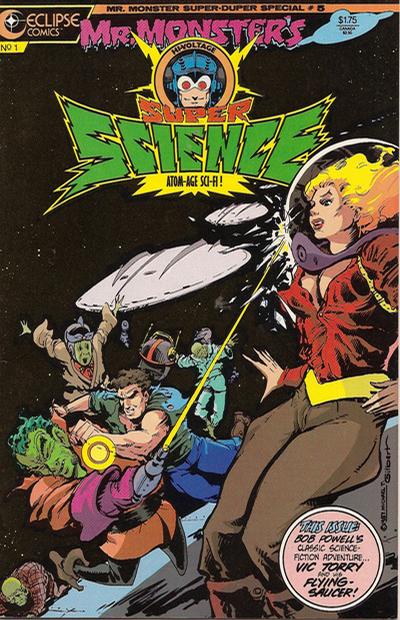
The 40 Years of Comics Project - Day 1304: Mr. Monster's Super-Duper Special #5, January 1987

https://www.comics.org/issue/42360/

A really great pulp science fiction adventure today, featuring a flying saucer, a relatively useless female character, plucky aliens, and, of course, a very manly hero.

I'm being facetious of course, though the story does have many of the classic tropes of early pulp science fiction. What we have is simply a very cool old school sci-fi adventure from an era that predates human exploration of space. These kinds of stories are always interesting as there's just so much speculation as what things will be like, and what we will encounter. While we understand space as infinite, it seems to me it was far more so narratively before we had some idea of what was out there.

Well, not hat we really know, but you know what I mean.

I'm glad to have discovered the art of Bob Powell. His characters are super-dynamic, though given the scarcity of reprint comics like this one, it might be a challenge to track down more of his works. Which, honestly, sounds like a lot of fun.

More to come...

Sep 20, 2018

The 40 Years of Comics Project - Day 1303: Tales Too Terrible to Tell #8, May-June 1993

https://www.comics.org/issue/97729/

A cool reprint title that I've had kicking about since I had my store, though it's apparently quite a bit older than that.

The reprints are all black and white, drawn from original art, and all from pre-Code horror titles. Editor George Suarez has an encyclopedic knowledge and collection of this era of comics, and he's only too happy to share with the readers.

It's kind of a nice irony that the short essay in the comic covering one of the big horror comic publishers of the time was on Harvey Comics. I've just finished reading a collection of their horror comics, so it was cool to get a little bit of background. What the comic also does is make me want to track down more reprints. And it'll have to be reprints as far as these comics go, I think. There's no way I can afford originals.

Well....maybe just one...

More to come...

Oct 21, 2016

The 40 Years of Comics Project - Day 604: DC Silver Age Classics - Action Comics #252, May 1959/1992

http://www.comics.org/issue/277988/

There's a few comics from the Golden and Silver Ages that I would gladly acquire, had I the resources. I've often said that if a ridiculously large lottery win was ever mine, Action Comics #1 would be amongst the first things I'd get. I think I'd have to add #252 to the list - my affection for Supergirl, in all her incarnations, grows as the new TV show continues to knock it out of the park.

Having watched the most recent episode (and ranted, briefly, about how great it was on Facebook), I thought I'd read the Maid of Might's origin story, as presented here in this reprint series. It's likely not a coincidence that this issue of Action also features the first appearance of Metallo, who is the featured villain in the latest Supergirl shows, but now I want to go back to the episodes and see if there's a sly Congorilla reference somewhere.

The lead story in this issue is notable for Metallo's first appearance, but other than that it's a bit lame. Corben is kind of a cardboard cut-out villain, and I'm amazed that as a staple of the Superman comics he's lasted so long. His gimmick (the Kryptonite heart) is a good one for a one-off story, but he's now been a thorn in the Man of Steel's side for more than 50 years. Supergirl's origin story is a good one, introduces the Kryptonian survivors of Argo City, and gives us a moment that was nicely captured in the recent television show of the two Kryptonians realizing their bond and how important it is. It's quite lovely to see that that has been a primary notion in the mythology from very early on - the loneliness that such beings feel, and the relief of connection.

As with Superman, if you want to read some really great Supergirl stories, see if you can track down the issues of Supreme that Alan Moore wrote that feature Suprema, the Girl of Our Dreams. Well worth a look. Onward!

Apr 25, 2016

The 40 Years of Comics Project - Day 426: True Love #1, January 1986 ("Wuv, twue wuv" Week, Day 6)

http://www.comics.org/issue/40975/

As with yesterday's comic, this one is a reprint of old romance stories, though without the re-scripting. A collection of tales from Standard Comics in the 1950s, featuring some of the luminaries of the industry, these stories are a welcome break from the heart-wrenching, angst-filled stories of teenage heartache. These are stories of what comes next, of the "happily ever after," and how it can oftentimes be just as difficult as early romantic entanglements. Which is probably, as someone whose been married for 20 years, why this comic appealed to me more than most I've read this week. As someone who understands the kind of daily work involved in being in love, and loving, it's nice to see such subjects given a good treatment.

Even more, one of the stories in this issue features a woman who can fix a car, and doesn't take shit from a mopey man with whom she has a relationship. There's even a gentle-yet-heavy-handed exploration of PTSD in the wake of the Korean war, which offers an interesting perspective form which to start thinking about these sorts of romance comics. Industry creators have, for a long time, claimed that one can tell grown up stories using a medium that is far too often associated with children's literature, and these stories offer evidence. Instead of relegating the medium to one that is only useful for action stories, we see from this sampling that creators were trying to tell stories about the things that move us, and that we are moved by, in our daily lives - not unlike most serious, literary authors. True Love shows us that there are romance stories for grown-ups, even if the cultural mores of the 1950s leak through a little too prevalently sometimes.

Also as with yesterday's comic, I read the opening text feature, which revealed where these comics had originally appeared. It was nice to see acknowledgement of the fact that most of these stories were written by men for women, and that that opens up the stories to a slew of critical problems, but I found that, by and large, they treated women with far more respect and interest than the teen romances I've been reading this week. True Love was a 2-issue mini-series, and I think I'll be looking for the second issue for another sampling of these thoughtful stories.

One last thing - the cover does not have anything to do with the interior. It's beautiful, as is most of Dave Stevens' work, but it's actually the promotional blurb on the inside front cover that I find amusing. It calls this work "An unmistakable gem of a cover." Noting the pink hair of the lady on the poster, I can only imagine it's a shout-out to Jem and the Holograms, which was first airing around the time this comic came out. Eclipse always was a clever comics publisher.

Last day, tomorrow, and something a little different. See you then.