Pages

Showing posts with label Dave Louapre. Show all posts

May 16, 2019

The 40 Years of Comics Project - Day 1542: American Freak #5, June 1994


I think it's time to take a break from Vertigo. Early Vertigo happened when I wasn't collecting comics. I'd replaced comics with music. When Chris Cornell took his own life, I went back to my Soundgarden albums in memory of a great talent. They're not happy albums. And Vertigo comics, by and large, are not happy comics. Something about that era, about the popular art coming out of the US, and the UK via the US, was just inherently depressed. To me, these were people who were reacting to the noticeable ruptures that have led current cultural mores in a way that previous artistic movements had not. Looking at popular cultural production of the time shows a society starting to feel very uncomfortable with its unspoken truths.

American Freak ends in the only way it really can, given the title. Until this issue, I was unsure as to why it was called that, but the series is drawing on a very strange part of American culture, and one that really makes people very uncomfortable - the freak show. There are two iterations of it in this series, both of them technically performing the same economic function, though the power dynamics of the iterations are quite different. Maybe. I'd have to think about it a lot more than I'm prepared to right now!

Early on in the series, our heroes are captured by a wealthy blueblood who puts on parties for his 1%er friends where they can have their way with "freaks." This is the first iteration of the show, with the power being held solely by those with the money. The second iteration is the press conference and subsequent celebrity we see in today's issue. The power is still bound up in capital, as the Un-Men become celebrities, but the flow of capital is controlled by those whose labour is generating it. By going public the Un-Men have democratized access to their celebrity/strangeness. There's still a lot to be said for the fact that this is a celebrity based on fetishization of the deformed body, but the series shies away from too much social commentary, choosing instead to focus on the internal acceptance at which Damien eventually arrives. Society is a noisy, degraded background to the story of a man accepting who and what he is.

Not my favourite Louapre work, I have to say. I feel like this could have been a shorter series. It wallows. But it wallows like a Soundgarden album, with style and substance.

"My Mom and Dad were alive and well, much to their own chagrin...and mine."

May 15, 2019

The 40 Years of Comics Project - Day 1541: American Freak #4, May 1994


I try to be open-minded about people, giving them the benefit of the doubt until they no longer deserve it, regardless of background. But I have to admit that there really is some satisfying violence done to disgusting 1%ers in this issue.

I'm not sure what kind of conclusion this series is drawing to, but it's going to happen tomorrow. As you can see from the cover, there's some Adam and Eve stuff going on in the series, with Damien seen as some kind of a new beginning for the remaining Un-Men.

I've been talking about the queerness of early Vertigo comics quite a bit lately. This comic certainly fits the bill, though tackles queerness slightly, but only slightly, more metaphorically than other Vertigo series. There's definitely an aspect of body-positivity to the series, of accepting the beauty within rather than concerning oneself overmuch with appearance without. More than that, it's acceptance of aspects of ourselves over which we have no control. None of the Un-Men in the series have any control over their appearance, their origin - all they want is to cease being persecuted.

Okay, so the metaphor's not so subtle, but it's also unfocussed. The metaphoric representation allows us to layer multiple meanings on Un-Men, who could represent anything from actual physical deformity to hair colour. Any instance of a person being disparaged or oppressed due to an uncontrollable physical aspect can be read in this tale of Damien Kane.

"For an instant I thought of not landing at all, but pulling up into the jet stream and staying there forever."

May 14, 2019

The 40 Years of Comics Project - Day 1540: American Freak #3, April 1994


It really is exactly as I feared. American Freak is reading like a very long BSfUC, and it's very uncomfortable. Vince Locke's artwork is fantastic, made all the moreso by Chris Chuckry's colours. The comic isn't just narratively difficult to process, but also visually. The metamorphosis of Damien Kane is not obscured or sanitized. It really does look like his body is breaking down and reforming into something else. The colours are uncomfortably close in their palate to the palate of skin tones, giving the series an unsettlingly organic feel. Intentional, I'm sure.

One thing I love about these kind of underdog stories is that it's always the idle rich who are the real monsters in the story. Kane is captured by a socialite who throws parties for his wealthy friends in which he shows off "freaks" he has acquired. Nice bunch of folks.

"I no longer felt like I was being destroyed...just 'recreated'..."

May 13, 2019

The 40 Years of Comics Project - Day 1539: American Freak #2, March 1994


Things take an odd turn as Damien accepts help from a very strange source. I think the series is as much about psychological transformation as it is physical transformation, though the two happen very differently. As I noted yesterday, the physical change is taking place over a long period. In this issue we see slight markings appear on Damien's back, but nothing more. However, his mind changes almost immediately, in a single panel in yesterday's issue, when the reality of who he is and where he came from asserts itself. So already, within, Damien is willing to accept a certain monstrousness - he is unphased by that which once horrified him, be it physical deformity or questionable moral choice. It's almost as if we're watching his body catch up with his mind.

"The sun was high and hot, and the swamp smelled as though part of the Earth had dies and was rotting in the heat."

May 12, 2019

The 40 Years of Comics Project - Day 1538: American Freak #1, February 1994


I've had most of this series for ages, but I've never got around to reading it. Partially this is because it's based on characters from the Swamp Thing series, which I'm still in the process of reading, and I didn't want the series to give anything away. But according to things I've read online, this continuity diverges somewhat from the Swamp Thing continuity, so whatever. Partially it's because I have read this first issue before, and it's not a happy series. Like, a really not happy series.

But it's Dave Louapre, who I think is one of the great writers to work in comics, though he's without his usual partner in crime Dan Sweetman (whose work we saw recently from a coeval series in The Last One). Unsurprisingly, the comic reads like an extended Beautiful Stories for Ugly Children, and what's chilling about that is that Beautiful Stories for Ugly Children stories work nicely because they're compact, limited by the single issue format. We don't have time to delve into the squishy inner workings of the narratives, nor, in many cases, would we want to. But American Freak gives Mr. Louapre a chance to delve. Damien Kane's transformation is not told in a matter of pages, but issues. It's an uncomfortable series to read.

"My bones feel like they're going to explode."

Apr 25, 2015

The 40 Years of Comics Project - Day 60: Beautiful Stories for Ugly Children volume 6, 1989


For my 2-month anniversary, I present "Happy Birthday to Hell," which I think might be one of my all-time favourite short stories. Ever.

The nice thing about this particular issue of BSFUC is that rather than an illustrated story, this one reads far more like a comic. The text is all in hand-writing, ostensibly Satan's (he likes to be called "Wally"), so not only do the words and the images combine, but the actual form of the text adds a layer. I suppose this is kind of common now with digital lettering giving every character their own distinctive voice, but back in the day such things were not common.

The story is a lovely little tale about Satan's fall from Heaven, and his understanding of how things really are between him and God. I'm honestly loathe to say much more, because I really, really love this story, and I think everyone should read it. The final sentence of the piece is going to eventually be tattooed on my left arm. They're words I've lived by for most of my life now. I'm going to quote the whole last page here, so if you're going to track this one down, or you have it and just haven't read it yet, I urge you to stop reading.

For those who've stayed, this never fails to move me:

"Now when things get out of hand, I take off for the furthest reaches of the smoldering wastelands, that blackened stretch the sinners still haven't found. Out here, the stars ache with just as much quiet desperation as in Heaven, pulsing silently overhead as I search the horizon. For this is a place of fallen angels and benevolent misfits. They plummet from above, the bile of Paradise, twirling like spastic saints who've lost the equilibrium of grace. They crash at my feet and break. They are vulnerable and confused, not yet aware that they are damned. I gather them in, fix their hair, straighten their robes, and try to make them feel comfortably at home. Because in Heaven or in Hell, or in any lonely place that's been forgotten inbetween, the only thing that seems to matter is feeling wanted, like you belong."

Since the day I first read that last sentence to today, that's how I try to live my life.

Back to 2001: A Space Odyssey tomorrow, though I just picked up some super-beat up old comics at a flea market, and I think the newest of them is from 1960. A whole bunch of cool old 50s stuff, so that might find its way into my daily readings. Especially if Kirby continues to tell the same story over and over again.

Apr 2, 2015

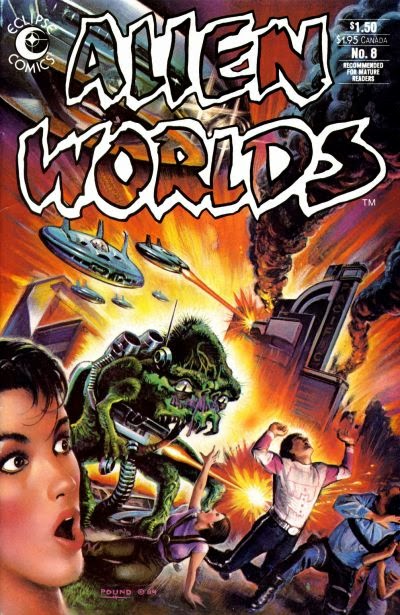
The 40 Years of Comics Project - Day 37: Alien Worlds #8, November 1984

Taking a suggestion from reader , today's comic will be reviewing a comic that was reviewed here by Aaron Kashtan at The Ogre's Feathers. Because my Web-Fu is not strong, I have no idea how to link directly to the place on the page where the review is. It's about a third of the way down the page.

http://www.comics.org/issue/39279/

The comic grabbed me from the moment I opened the cover solely because the title of the lead story is a line from one of my all-time favourite pieces of poetry, Robert Frost's "Stopping By the Woods on a Snowy Evening." The story offers a couple of other interesting things to think about. First, it's set in 2022. Yep. Captain Murdock is diagnosed with a terminal alien disease on some incredible alien planet and (spoiler spoiler spoiler) a mere 7 years from now. Even when the comic was published, which I'm assuming was well after Nolan originally penned the story, 2022 was only 38 years. Ah, the optimism of the speculative fictionist. The other interesting notion is whether or not Nolan himself adapted the story from his short story. The credits list Nolan as the writer, but, from a glance at the original story, it's hard to tell if he adapted it, or if artist Al Williamson handled that chore.

Moving on, I would agree whole-heartedly with Aaron's review that praises the artwork in the stories, though I'd add Ken Steacy's work to the list, because I really like his work, and it captures a particular aesthetic from the 60s and 70s of which I'm particularly fond. I've got a bunch of his stuff spread throughout the collection, much of it from indie comics like this one, and the "ground level" comics represented by titles like Star*Reach and Quack!. Shall I move on to a week of Steacy? Perhaps...

As Aaron's review notes, the stories here are all "shock-ending" stories (and I agree, in 1984, the declaration of love between two men probably was considered shocking), and they get me thinking, as I did before, of the sometimes needed gap of a month or so between issues of a comic. I had mentioned yesterday that Louapre's stories, at least the early ones, read very similarly, so the publication space gives one a bit of breathing room. I imagine, with a title like this, that reading them one after the other would have a wearying effect, always expecting that twist ending.

One last thing is a parallel that might make an interesting comparison: these stories are, in their execution and subject matter, very similar to the "Future Shocks" and "Time Twisters" short stories from 2000 A.D. A comparison of the two would be neat, if only to see it there are intrinsically national qualities to these tiny science fiction stories.

Thanks again to Martin for the suggestion. That was fun. See you tomorrow.

Apr 1, 2015

The 40 Years of Comics Project - Day 36: Beautiful Stories for Ugly Children volume 3, 1989


"Olga Schtump was a tap dancer, and not happy about it in the least." It's a lovely beginning to the "Diary of a Depressed Tap Dancer," though I'd have to say that's the high point of the story. Not to say it's a bad one, but, in contrast to the previous two stories, this one's a bit lacking. Key to this project it recognizing that, even if a comic is ostensibly part of a series I like, or written by people I really admire, not everything I read is going to be stellar.

There's a couple of things that stood out to me about this particular issue that made it a little less enjoyable than its predecessors. First, though the story is called a "Diary," it's actually told in the 3rd person. I know it's a little thing, but this kind of bugged me. Even had there been some indication that Olga talked about herself in the 3rd person, this would have cleared up my nitpicking, but there was nothing. I know, I know. Gotta let these things go sometimes. A larger problem I had was the lack of interaction between words and pictures in this issue. I've noted that in the previous two issues, we have the sort of interaction between these storytelling devices that is indicative of comics, but in this issue there was a decided dearth comics language. The pictures seemed merely (and that's not to say that they are in any way "mere" pictures) to illustrate the action of the words, more like a picture book than a comic. This is a problem for comics that are laid out this way. There's a Grant Morrison Batman that does this, and is more properly an illustrated prose story published in the comics pamphlet than a comic book proper. Whatever, of course, a "comic book proper" might be.

According to my database, I procured this issue relatively recently, which means I've probably never read it, or have read it only once. Perhaps a little bit of my reticence toward it comes from it not having the kind of nostalgic quality that infuses some of the BSFUC that I've had for almost 30 years. I'll have to factor that nostalgia idea into subsequent reviews.

So, there's that. I don't have much more to say about this issue. Tomorrow will be a slight detour as I do a reading of a comic based on my first ever READER SUGGESTION! Which is pretty cool. Taking this detour makes me wonder, though, if perhaps the BSFUC aren't the kind of series that can be read in such rapid succession. Louapre uses a lot of similar rhetorical devices in his prose that I could imagine might start to sound repetitive without the ostensible monthly publishing schedule. I'll have to keep this in mind, and perhaps spread the beauty out over the course of a few months, rather than weeks. Anyway, a detour into 1980s science fiction comics tomorrow. Stay tuned!

Mar 31, 2015

The 40 Years of Comics Project - Day 35: Beautiful Stories for Ugly Children volume 2, 1989


Clyde and Margueritte Deadjohnson are average suburbanites with one important difference: they're dead. But that doesn't stop them from enjoying all the mundane adventures in which the average suburbanite indulges.

This was the first of the BSFUC that I ever read, passed along to me by my dear friend Joel at the tender age of 15. As I mentioned in my post about Morrison's Animal Man, it was around this time that I started to understand that the stories one could read in comics weren't solely relegated to children's comedy (Archie, Richie Rich) and superheroes. Once again, Louapre and Sweetman present a comic in a non-traditional manner. I'm starting to think of these stories as comics in that each double-page spread is one panel. Perhaps I'll scan one of the issues one of these days and see what it looks like set out in a more traditional manner. Because I have time for these things, right?

Piranha Press is a bit of an oddity. And I mean that in the nicest sense possible. As the site says, it's a response to a growing interest in alternative comics, and, coupled with DC's publication of "adult" superhero books (you know, those famous ones that no one will shut up about), I think Piranha demonstrates the movement of the medium, specifically in the mainstream, into a more inclusive space. The stories published in Piranha's catalogue are, categorically, not for kids. It's only one of a number of experiments that mainstream publishers were carrying out at this time. Marvel/Epic's "Shadowline Saga" books (whose characters seem to be on the verge of a resurgence in the upcoming "Secret Wars" series), which took superheroes and put them into dark and complex contemporary stories, happened around the same time that Piranha was publishing Marc Hempel's Gregory series and BSFUC. These experiments, of course, crystalized a few years later in DC's Vertigo imprint, for which Louapre and Sweetman did a couple of pieces, but Piranha, to me at least, is a little more out on the edge of things. The utter weirdness of the Beautiful Stories, or Douglas Michael's The Elvis Mandible, which I'll get to eventually, are never really repeated in the more horror and fantasy-based "grown-up" comics of the Vertigo imprint. Which is probably why Piranha survived, albeit briefly, into Vertigo's nascence.

Something odd occurred to me while I was re-reading this issue. One of the destinations of the Deadjohnsons is "Ant World," a Disneyland-esque theme park based around the behaviours of ants. This section of the story reminded me of the Ant and Bee books I used to read as a child, specifically the Ant and Bee Go Shopping book. I'll have to see if it's still kicking about at my Mum and Dad's place next time I'm back home.

I recently tried to get my hands on the issues of this series that I'm missing, with only partial success. With most of the earlier issues, these are re-reads for the umpteenth time, but the later issues I've never read before, so I'm excited to see what weirdness Louapre and Sweetman have in store for me.

Mar 30, 2015

The 40 Years of Comics Project - Day 34: Beautiful Stories for Ugly Children volume 1, 1989


"It was me, Bingo, Foo Foo, and Joey Punchinello from the start. Foo Foo stole the keys to the Dart while Bingo grabbed Addy the Freaklady and some of our best pups. I got the booze out the ringmaster's trailer when he was watching the big-top burn..."

So begins "A Cotton Candy Autopsy," a brutal cross-country road trip about four clowns and a two-headed lady.

Really, I could just leave it at that, and that would be enough. But I won't, because Beautiful Stories for Ugly Children is the comic you should be going out and tracking down right now. Written by Dave Louapre and illustrated by Dan Sweetman, each month features a bizarre short story from the far edge of madness. In fact, if I'm to be perfectly honest, this story is probably the most normal of the ones I recollect. Next issue features the Deadjohnsons, a normal, everyday family who just happen to be dead. And volume 6 (I think) is the story "Happy Birthday to Hell," in which the fall and the story of Hell are retold by Wally, who really hates that name Lucifer that everyone has saddled him with.

These are wonderful, disturbing, angry, beautiful stories about strange people in strange situations that somehow tell us something about being human. And in this, they resemble the best of contemporary fiction, of the sort you might find in McSweeney's, or a fourth year university English class. Louapre teases out some amazing images, and uses words like a blind man might paint, which is a good thing. Sweetman's art morphs and changes from issue to issue, but always retains some quality that renders it recognizable as being by the same person. It might be madness.

BSFUC (because the full title is a mouthful) also pushes us to consider the boundaries of what we can consider a comic. The stories are not told panel by panel in a sequential way, but more resemble picture books, words accompanied by illustrations. A cursory examination might make one think that the series is a comic solely by virtue of its format. That is, until one realizes that it's only in the last few pages that there are any linguistic markers of Addy having two heads ("...Addy sort of holds him close and rocks back and forth real slow, whispering in both his ears."), but we've known all along because of Sweetman's illustrations. The words and the pictures, though somewhat more separate than in a traditional comic (whatever that may be), still function in tandem, still require the presence of one another for the story to maintain coherence.

Since it's set up more like a story than a comic, I tried reading this one to Tara. We enjoy reading aloud to one another (more me to her than vice versa, admittedly), and this seemed a choice opportunity. Until we got to the bit about the bikers beating up Foo Foo, and Tara asked me if this was a happy story, and I reminded her that the series title was Beautiful Stories for Ugly Children, and they were, in no uncertain terms, not nice stories. I think I'll be reading them silently to myself for the next few weeks.

See you tomorrow. I'll talk a bit about Pirhana Press, DC's proto-Vertigo experiment.