Pages

Showing posts with label television. Show all posts

Jun 30, 2020

Giant Box of Television: Roots of the Doom Patrol

With Season 2 of the best goddamned superhero television series of all time underway (hyperbolic, ain't I?), I thought it would be interesting to have a look at some of the specific comics that have inspired moments, or stories, in the show. I'll stick mostly to the first season, though the already pretty great (though not as great as the first season?) second season might pop up a bit. Most of these early comics are first appearances of characters who have popped up on the show. Adapted storylines are pretty much all from Morrison's run on the title, which I'll cover in the next installment.

I'm going to do this chronologically. We begin in 1963...


This has to come first, of course. The first appearance of Negative Man, Elasti-Girl, The Chief, and Automaton. Who becomes Robotman hereafter. I'm assuming that Automaton was chosen because there was already a Robotman in the DCU (such as it was at the time). I actually think I might like Automaton better, but here we are. We're given their back stories, except the Chief, and introduced to General Immortus, Niles' impetus for searching for an immortality serum in this iteration of the team. You'll note that whatever the substance was that Niles used on Rita, it was named for Immortus.


The first issue after the title switches to The Doom Patrol features a team referred to in the series but never seen, The Brotherhood of Evil. What's significant about this issue is it marks the first, and only, appearance of Mr. Morden, our erstwhile antagonist, and Rog, the giant red robot that makes such an explosive appearance in the final episode of Season 1.


Though he's not featured on the cover, this issue marks the first appearance of Steve Dayton, the superhero known as Mento. Let me be blunt: Steve Dayton in the comics is a piece of garbage. He ends up marrying Rita, and I can't for the life of me figure out why. Steve is given a much nicer treatment in the show.
Seriously. He's such a dick in the comics.


A little hop into Season 2 with the first, and one of only a few, appearance of Dr. Tyme. A more sinister version than the roller-skating madman that we met recently on TV, Dr. Tyme also shows up in the Keith Giffen-scripted version of the show as one of the mad scientists inhabiting Oolong Island.


The Doom Patrol from the television series, though based in the 1950s, took a good deal of inspiration from this version of the team that debuted in the 1970s. You could probably tell that from Tempest's collar in the picture. This marks the first appearances of both Arani Desai and Josh Clay, who are resident and doctor, respectively, at the rest home Niles sets up for the Doom Patrol. In that episode, Larry asks Josh if they know each other, and asks about military service. In the comics, it is revealed that Josh deserted his unit in Vietnam after his powers manifested. He's been on the run as a deserter for years.


The other member of the television Doom Patrol, Rhea Jones, or Lodestone, made her first appearance in the 1980s version of the team, as a younger member brought in by Arani. The problem with this run on the team is that it tries too hard to be a normal superhero comic. The Doom Patrol has never been normal.


One more for today, and my last comic before we hit Grant Morrison's run, which has provided most of the inspiration for the show. This issue marks the first appearance of Dorothy Spinner, the ape-faced girl. In this version of the series, Dorothy has no relation to Niles, and, at this point, no superpowers. She's from Kansas, and her farm happens to be at the center of a battle between the Doom Patrol, assisted by Power Girl, and a Lord of Chaos. What I will say about this issue is that, of all of Paul Kupperberg's run on the team, this is the one that I think is the most "Doom Patrol." It's weird, and not afraid to be.

Next time I'll have a look at some issues from Morrison's run. And, depending on what episode 4 of the new season brings, I might have some more comics to add.

Feb 23, 2020

The 40 Years of Comics Project - Day 1824: Star Trek Year Four #3, September 2007

I will post a picture here when I've got my electronics all figured out - can't make them talk to each other for some reason.

https://www.comics.org/issue/381201/

I really enjoyed this comic, and I think I'm definitely going to have to track down the other three issues of the series. Today's comic gave us a great science fiction story, one where we think one thing is happening, but it's actually something entirely other. As I mentioned when I read the first issue, the format of the comic allows for the Enterprise to really encounter strange new life forms, not just the humans with funny foreheads that tend to dominate in the television series. The viral lifeform encountered by the crew in this story is an excellent idea, and the symbiotic relationship that they have with the crew of the Enterprise, even though the crew don't realize it at the time, is an interesting way of exploring the universe. While perhaps not a completely new idea, the execution of it was great.

Gordon Purcell's art is very good as well, quite different from what I remember from Gammarauders. And not that I want to come down on him again, but I think that the more animated style of art from Steve Conley over the last couple of issues suited the series more so than Purcell's. The series starts out in the aesthetic vein of the animated series, which did for a while continue the 5-year mission, so to have the art jump from the cartoonish to a slightly more realistic depiction throws things off, for me at least. Which I think is almost the same critique I had for his work on Gammarauders. What I really have to do is see if I can find a comic that starts out with Mr. Purcell - then I won't have anything to compare it to and can appreciate it on its own merits.

Well, as much as we can do that with anything, if Derrida is to be believed.

More to follow.

Feb 22, 2020

The 40 Years of Comics Project - Day 1823: Star Trek Year Four #2, August 2007

https://www.comics.org/issue/880199/

Damn, but this is a good series. At first I wasn't on board with the art, but parsing it in terms of the animated series, it's fantastic.

But, oh shit, Kirk is a goddamn sexist bastard. The first page has him referring to one of the female servants on a particular planet as part of the planet's "natural resources." I'm hoping that this is a conscious decision on the part of the writer, David Tischman, demonstrating an understanding of Kirk's character in the original series. I'm hoping it's not, from a 2007 comic, a declaration of sexism on a level that we really ought to have moved past. Again, call me an optimist (those who know me laugh now), but I'm hoping this is narrative sophistication rather than social crudeness on display.

I've got one more issue of this series, and it only ran 6 issues, but I really think I may have to track it down. Perhaps it's the length of time since I've actually seen/read Star Trek, but this comic, and, based on yesterday, this series, really are excellent. Tischman and Conley have managed a really good adaptation of a particular era of the series, one that doesn't simply attempt to be an episode of the television series, but that instead transfers the atmosphere and narrative-style of the series to the two-dimensional medium of comics.

Was supposed to get back to Hard Time tomorrow, but we'll see about maybe reading the next issue of this series. Gordon Purcell is the artist, and the last time I saw him on something, it was Gammarauders, and I wasn't a fan of his style on that series. Interestingly, he's coming in in the next issue to replace an artist whose style is much more stylized that Purcell's, much like he did with Martin King in Gammarauders, so we'll see if that shift affects my enjoyment of the series. I'm so fickle :D.

More to follow.

Feb 21, 2020

The 40 Years of Comics Project - Day 1822: Star Trek Year Four #1, July 2007

https://www.comics.org/issue/880197/

In order that I don't fall into my usual trap of getting jaded and annoyed by a longer run of comics, I'm breaking up Hard Time with some other stuff I stumbled upon as I was revamping my filing system last week. When my brother was downsizing and moving, he bequeathed to me all of his I.D.W.-published Star Trek comics, of which I have only read one. So when I flipped past these, I thought that I'd have a look.

This was a pretty good comic, very much in line with the style of storytelling the original series is known for. We even had a redshirt getting left behind and then killed, with Kirk and the crew showing just as little emotion over the fact as they did in their live action incarnations. And speaking of that incarnation, this comic isn't really going for that particular aesthetic of Star Trek. The art style is much more influenced by the cartoon that followed the last of the live action series, a fact I noticed almost right away from the very rigid construction of many of the characters. At first I wasn't sure if this was the fault of a less-talented artist, until I realized that Mr. Conley was actually going for the aesthetic of the cartoon, which is famously a very poorly-animated show. After that, the comic fell into place for me. I'm hoping that the series, such as it is at only six issues, maintains its "one and done" style - I was rather happy to get a complete story this morning that really did feel like it could have been a 30 - 45-minute episode of a television series. It was also lovely to see some of the non-human characters from the animated series being deployed. While I get that there were budgetary restrictions, I've always felt that the lack of non-humans on board the original Enterprise was one of the aspects of the series that kept from really immersing myself in it. A universe filled with only, or mostly, humanoid creatures just seems very boring to me.

A bit more Star Trek tomorrow, and then back to Ethan and his hard time.

More to follow.

May 24, 2019

On Doom Patrol


            I could not have asked for a better show.

            I’ve loved the Doom Patrol since first seeing them in issue #26 of Grant Morrison’s Animal Man. In that issue [SPOILER ALERT], the writer explains to Animal Man that he also writes the Doom Patrol, though they don’t know it. I had to find them.

Bear in mind, this was well before any of the series had been collected. This was a true comic hunt. I scoured every store I could in southern Ontario, picking up bits and pieces, unwilling to read them until I had the whole story. And then, oh then, it was love. True and pure. These broken and cracked, faded and sad, beautiful and perfect characters touched me in a way that few other stories ever have.

Over the next few years, I managed to track down all but one appearance of the Doom Patrol from their first issue, My Greatest Adventure #80, in 1963 to the end of Keith Giffen’s excellent run of 2009. I missed a bit during DCs very mediocre “New 52”; I’m tracking them down. And Gerard Way’s current run is bonkers and lovely in totally different ways. But in all forms, even the weird 80s superteam version, the story of people cast aside, broken individuals doing wonderful things and staying broken, struggling to heal, speaks to me like no other story ever has. Well, maybe one or two others.
            
I write all this not to claim authority or ownership of these characters. I write this to let you know how much I love these characters, how much I love this story. And it’s best to understand, the Doom Patrol is a single story, as Rita says in the show, told over and over again.

The comic Doom Patrol is unique in the DC Universe, in that their histories, with the slight exception of John Byrne’s take on the team, are never rewritten with the constant universal crises that plague the DCU. This is thanks to the death of Rita Farr. The final issue of the first series, from 1968, features the death of the entire team. Over the years, as superheroes are wont to do, the various members return. Except for poor Rita. Hers is the ghost that haunts the team. She never returns from death, though she keeps them together in death in very much the same way she kept the original team together in life. A version of Rita returns to the team in 2004, though she is a clone of the original, grown from a fragment of the original Rita’s skull, all that Niles could find when he went back to search for her. It is, in fact, only in 2018’s “Milk Wars” crossover that Rita, the original, returns. Gerard Way demonstrates a beautiful understanding of Rita’s place in the team’s history as he has Jane note that Rita’s always been on the team, even though she’s missing from some of their memories. There's a grandeur to the tale, a scope that none of their coeval comics manage.

            Which is also why, when the team was first introduced IN A LIVE ACTION TELEVISION SHOW!!!!! I was curious to see what they’d do with Rita, who’s never really had a proper story of her own, not the way the others have.


            But I’m jumping ahead of myself. Let me start here (after 500 or so words) by saying that Doom Patrol is, without doubt, the best comics to screen adaptation of a mainstream superhero comic. 100%. No other show has captured the spirit of the original, cleaved to the canonical but added something new and perfect to the story, in short, has adapted the original property this well. I knew, the minute that we had the moment before the painting with Cliff and Jane in the first episode, one of the most important and beautiful moments in the team’s entire history, that this series was being made by people who loved this story. Perhaps as much as I did. Over the course of 15 episodes, I felt such joy, such utter joy, that one of my favourite stories of all time had been given a proper and respectful treatment. I said to my son, who loves the team as much as I do, that even if we only ever got this one season, it was one perfect season. Absolutely perfect.

            
And you know what? Other people liked it too. Some, perhaps, loved it. I think it’s because we all feel bruised and broken and damaged by life, but unlike many of the superheroes, whom I also love, we don’t find our strength in our trauma and suddenly become saviours. Instead we fight through our trauma and we find those golden moments of purpose and peace, and sometimes we fall back into our nightmares, and sometimes it’s hard to pull ourselves out. I worry for Jane in the coming season. The Doom Patrol never fully heals, because we never fully heal. We persevere, sometimes into excellence. They’re superheroes who are like us. At the beginning of the first episode, Mr. Nobody’s narration echoes the introduction to the first collected edition, in which writer Peter Milligan tells us that the Doom Patrol isn’t a superhero story, and that that’s a good thing. They’re not superheroes. But they still manage to do amazing things.

I could go on, but I won’t. I live in a world where I see flashes of Danny the Street, in the beautiful, wonderful people I choose as my family. We are all of us broken, but we help each other and we love each other, and sometimes, we excel with each other. Imagine, for a moment, what Danny the World must be like.

You should watch Doom Patrol. It’s really, really good. 

Other things I've written about the Doom Patrol are here.


Apr 5, 2019

Giant Box of Television: The Doom Patrol

SPOILER ALERT for Doom Patrol, y'know, in general. (Seriously, if you've ever read my blog you should know that I'll talk about Doom Patrol and I just don't care. It came out in the 80s and it's on you if you haven't read it yet.)

(Saucy sometimes, aint' I?)

First things first. No, the first season isn't done yet. Yes, I'm watching it illegally, because it's not available in Canada, and it's the fucking Doom Patrol so I'm not going to not watch it.

The latest episode, "Danny Patrol," had me weeping.

I'm doing a project right now with the Calgary Queer Arts Society, one that draws heavily on a remarkable archive of material that the Society has received over the years. It's quite a privilege, I think, to be able to sift through something like this, and I hope our eventual exhibit (the dates of which I'll post here when I can remember them ;D) gives people an idea of not only the history of Calgary's queer communities, but also what an archive like this can do. The idea of deploying this group of objects into a physical space takes what is often a very cerebral experience and makes it tactile. I'm excited to hear peoples' reactions to it.

Here's the thing: a lot of this stuff is really wonderful and fabulous. Calgary's queer culture is amazing, this chaotic collision of fashion, action, and love. But a lot of it is hard to read. Really hard to read.

There is so much death. And so many people who wished death upon us. As much as this archive is an archive of joy, it's also an archive of despair. Of desperate howls into the void, begging only to be allowed to love free of persecution.

It is also an archive of hate, in a literal sense. There is writing in there that can only be called hate literature. I honestly am not sure what to write about that. How people can hate like that is beyond me, well and truly. And I am so grateful that that's the case. It's an important thing to keep close to the rest of the material, though. It offers something that history can often lack: context.

What, you might ask, does this have to do with The Doom Patrol?

I supposed I should put a SPOILER ALERT for both the show and the comic here.

Today's episode showed a place where everyone who ever felt like they didn't belong, or were made to feel like they didn't belong, had a place, a home, a warm embrace, an acceptance. And you know what? It reminded me of the drag shows I go to. It reminded me of the parties and the parades, and the festival at the end of Pride. It reminded me of my chosen family, the people here who I love so much.

And that's when it struck me, when I started crying. I first read of Danny the Street in 1996, as I tracked down Grant Morrison's run on the comic. Danny is genderqueer, uses they/them pronouns, and is, literally, a street. I can only imagine what the comic store on Danny the Street would be like. I knew from the first that that was where I belonged. When Danny became...well, what they become which I won't say just in case there's someone looking for clues, I knew that was where I belonged. 23 years later, I'm so happy to find glimpses of Danny the Street, be it in a bar or a backyard.

End SPOILER, if you want to join us again!

How this also all comes together is that the archive I'm working with is, fundamentally, an archive of resistance, of perseverance in the face of overwhelming adversity. In this way, it is also a living archive, one that expands through time and geography. Today's Doom Patrol episode is also about resistance, about standing up and being proud of who you are, and of never letting anyone else tell you what you can and cannot be. There was even a nice big musical number!

(Honestly, DC television, between Doom Patrol, Legends of Tomorrow, and Supergirl, is kinda killing it with the queer representation. It's honestly one of the best things in my life that we have good, queer superhero shows.)

One other thing occurs to me in the wake of this series: what must Grant Morrison be thinking? To see his work treated so reverently? To see that the world appears to finally be, 30 years after he first told us about being human in The Doom Patrol, catching up. Like the people who wrote in the magazines I've been reading, in the newspapers and comics, and in the letters and coronation guides and zines, I think he'd be happy, proud even, to see how far we've come, but disappointed, too, at how far we still have to go.

I used to end my 40 Years of Comics Project columns with the word "Onward." It seems more appropriate here.

Onward.

May 11, 2017

In Praise of Agents of S.H.I.E.L.D.


I'll admit, first off, that when Netflix gave us Daredevil, when I discovered the Arrowverse through the first season of Flash, I let Agents of S.H.I.E.L.D. fall by the wayside. The show, for me, had hit a high point in its interaction with Captain America: The Winter Soldier, through the remarkable decision to take possibly the most charismatic character on the team and make him a villain. It was a wonderful piece of storytelling, very much in the character of S.H.I.E.L.D.-based comics, and in keeping with the more clandestine style of narrative that the show was going for.

But in the subsequent seasons, with the introduction of Inhumanity, and interdimensional/extra-planetary mind-control creatures, I felt it was getting a bit too much into the superhero realm, rather than living on its periphery where, in the comics, S.H.I.E.L.D. is so effectively utilized. I kept up with the show, but I was far more interested in the other superhero fare that was available.

This continued into the beginning of this season. I would catch up on the show when I had run out of other things to watch, more out of loyalty than necessarily out of a love for the characters and concept. Superhero television series, and, actually, the comics that are their source these days, change all too quickly. The thought seems to be that an audience will grow bored of a particular situation in a series, so that situation has to be changed repeatedly. This is not, obviously, always the case, but since the narrative-twisting practices of genre shows such as Lost or Fringe, it seems to be the fashion. I'm not a fan of this kind of practice. I could have done with a couple of seasons of espionage-esque adventures, like the first season, before the revelation of a traitor. These kinds of paradigm shifts are, I think, far more effective when you have lulled an audience into a sense of security. Genre television is very bad at this lulling nowadays. We go into a series expecting the change, the shock, which is a pity, as the drama of a shift in perspective is so much more powerful from a complacent state.

But, I think, this is beside the point. There's not much that I've written so far that lives up to the title of this post.

The second half of this season of Agents has been divided between two discrete story arcs that are actually one larger story of an artificial person seeking to become real: the Pinocchio myth, if you will. The first half, "LMD," sucked me back in as it drew on one of the best aspects of the new version of Battlestar Galactica, the uncertainty of the affiliation, or of the reality, of any of the characters. Battlestar played it a little better, in that both audience and characters were aware of the problem, but were unaware of who was human and who was Cylon. Agents managed this uncertainty for a few episodes, but let us know who to trust and who not to trust pretty quickly. But what this replacement of major characters set up, for the second half of the story, was an alternate reality within which the "Agents of Hydra" story played out.

Now, I'm a fan of alternate reality superhero stories. It's a wonderful subgenre, and offers remarkable insights into the iconic characters that grow in superhero narratives. So I was absolutely fascinated by this storyline, in which the events of Winter Soldier play out very differently, and Hydra comes out on top. Not only this, but due to the stipulations of the Framework, the virtual reality within which this was happening, and within which one regret of each of the embedded characters was changed, some of our heroes were actually working for, and believing in, the Hydra organization.

And here's where things got very, very interesting.

The writers of the show used this depiction of a world overrun by a blatantly fascist organization to level a series of shots at the treatment of the people, of the media, and of the idea of America itself, by the current U.S. administration. And they weren't even subtle about it. As one of the favourite major characters, Leopold Fitz, now second in command of Hydra, finishes interrogating a former teammate, he notes that in her "lies," "still, she persisted," hearkening back to the silencing of senator Elizabeth Warren by male colleagues as she contested a fellow senator's nomination to Attorney General. The same character, Fitz, as he is briefing his underlings, uses 45's own words while blatantly lying about the intentions of the resistance in this virtual world. He claims that by working together, they'll "make this country great again." The significance of these words issuing from an unapologetically, and unambiguously, fascist character cannot be underplayed. Further, after taking over the Fox News-esque mouthpiece of Hydra, Phil Coulson (probably the MCU's greatest contribution to Marvel's shared universe) exposes the lies of Hyrda, using terms such as "alternative facts," rewritten history, and the silencing of scientific thought. There is absolutely no way that we can read this storyline in any other way: it is a protest. It is the use of a popular medium to demonstrate the ways in which the transmission of free thought, of freedom, is being shackled by a wave of populist, far-right dogma across, sadly, many parts of the world. I was stunned and awed often throughout these episodes. As these words issued from the lips of characters I had come to have affection for, I was moved. Mac, a fantastic character in the show, offers the perspective of a man, a black man, living in fear in this totalitarian world, keeping his head down, saying all the right words, and hoping against hope that he isn't randomly detained or killed. Leo Fitz's father, a brutal man, demonstrates for us the very worst of patriarchal rape culture, articulating the need for men to be detached and emotionless, and brutal. The series writers took the opportunity of this alternate version of their world to show their viewers that this alternative isn't really so alternative. It's just that the things that happen in our reality are a little more pronounced, and little more simply depicted, in theirs. Which, really, has always been the strength of the superhero genre. And, in praise of the writers themselves, they managed all this while still telling a compelling and interesting story, remaining true to the characters, to the premise of the show. This was some expert use of fiction to "teach and delight." Sidney had it so very right all those centuries ago.

So, go watch it. Even if it's just these last five episodes or so. Have a look at a story of a world in which the bad guys (and make no mistake, the "Alt-Right," 45 and his cronies, are the bad guys) won. And let its similarity to what we see in the news everyday wash over you. The storyline concludes, sort of, in revolution, in the people realizing the lies, realizing the hate, and doing something about it. I shudder to think of the chaos, but very often these days I worry that there isn't much other choice except revolution to unseat the hatred that has overcome American (but not just American) politics. I guess we'll have to see if the genre we inhabit, often characterized as dystopian future fiction, can undergo the sort of paradigm shift our fictions find so easy.


May 10, 2017

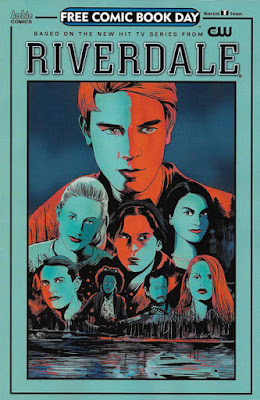
The 40 Years of Comics Project - Day 805: Riverdale One-Shot, FCBD edition, may 2017

https://www.comics.org/issue/1697612/

I think every Free Comic Book Day for the last few years, I've lamented the days when I used to be able to come home with a stack of 20 comics that were all pretty fantastic, and spend a week or so pouring through them for the inevitable treasures. These days, FCBD is little more than another way for comic shops to make money, and not from side-purchases when one goes to get the free stuff.

Anyway, today's comic is really pretty good. I think Riverdale surprised everyone by being not only very, very cheesy, but also very, very compelling. I've been trying to figure out how much of that is based on prior knowledge of the characters and the shock value of seeing them put through this kind of story, but the fact that people who have little or no exposure to the long history of Archie comics also love this show really just means that it's doing something right. With the new Twin Peaks mere days away, and shows like Sense8 telling strange stories that we need to see, there's a new propensity in television for the strange, and Riverdale is giving us our teen-angst dose of that strangeness.

Some nice background bits in today's comic, though nothing that we actually haven't been made aware of from the show. With one possible exception: Hiram Lodge's desire to not have Veronica witness his downfall. It's pretty clear (SPOILER ALERT) that we're going to see Hiram soon in the series, if not in the final episode of the first season then at some point in the second. All we've heard of him in the TV series so far paints a very grim picture. But there's one panel in this issue in which he demonstrates some shame over his predicament, shame associated with his daughter maintaining a particular image of him. That's a very humanizing quality for a character that could have come in and been a stereotypical mustache-twirling villain. And that, I think, is what Riverdale has managed to do which distinguishes it from a lot of the other angst-y shows with which is shares an ostensible genre. It takes the stereotype and adds to it a dash of difference, just enough that we are left guessing, rather than knowing full well what a character is likely to do in a given situation. Further, given that Roberto Aguirre-Sacasa helmed this issue and helms the show, that little aspect of Hiram is very likely to carry over.

Though, honestly, I'd put up with a less well-rendered show if Mr. Aguirre-Sacasa woud just grace us with another issue of Afterlife and Chilling Adventures. Those comics are fucking mad!

To be continued.

Mar 8, 2017

Giant Box of Television: Arrow Season 2


Most of the write-ups of Arrow cite this season as being the high point of the show thus far. Criticisms of seasons 3 and 4 note sloppy storytelling, or trying to pack too much into the show, or mishandling of relationships, but many see season 2 as a near perfect superhero series. Having just finished the whole series (well, up to the current episode), I'm not sure I agree, but I'm also not sure I disagree. I think season 2 is the tightest story arc. The flashbacks to the island impact directly on the contemporary storyline, showing us the descent of Slade Wilson into the Mirakuru-fuelled madness that leads him to put his hands around Starling City's throat. Other flashbacks in other seasons have thematically attempted to follow the main storyline, but this is the only one that has seemed like we were watching one large story told in a non-linear manner. So, for that reason alone, I can understand the privileging that season 2 receives.

It's also where Oliver starts to become a hero, rather than a murderer, the ramifications of which are still being felt on the show. Though the Mike Grell run on Green Arrow that inspired the series shows the character indiscriminately killing, it's hard to reconcile this kind of a "hero" with the larger DCU, which, thankfully, starts to show up a bit more in this season. As I watch the current season (5), I'm conflicted about the character of Oliver Queen. Should he get away with the wholesale slaughter of season 1, simply because he's decided that he's going to be a hero and stop killing? This is obviously what the season 5 villain Prometheus is also asking, which makes us beg the lovely question as to who is really hero and who is really villain in this piece.

But in season 2, Oliver was trying very hard to be a hero, and by the end of the season, he's there, I think. The other great thing about this season is that the supporting cast comes nicely into focus. They spent much of the previous season getting to know one another, but now they're becoming a family. Oliver and John's relationship is one of the nicest homosocial pairings on television, and Felicity Smoak, who for some reason catches a lot of flak from reviewers, is adorably dorky, fiercely intelligent, and super-sexy all at the same time. And don't think Oliver's not noticing.

Villain Slade Wilson is just great. I don't know if it was intentional, but the character bears a lot of similarity to the depiction of Deathstroke in the Teen Titans cartoon from a few years ago. He's brutal and lethal, but also charming and charismatic. He serves as a perfect foil for Oliver in this season, demonstrating the void that remains when someone gives themselves up to despair and death, a lesson that Oliver has to learn in order to emerge on the other side of the season as someone, or something, else.

Feb 15, 2017

Giant Box of Television: Arrow Season 1


I was recently inspired to go back and watch Arrow from beginning to...well, not quite end, but to where it's up to now. I didn't get on board with Arrow right away as I was quite annoyed by the idea that they were going to attempt a superhero television show without superheroes. There had been a clear communication from the creators of the show that this was not going to involve all of the things that make a superhero universe wonderful and weird, but rather would be an action show about a guy with a bow.

Thank goodness they got over that.

Once Flash had started on the CW, and I loved it, I decided I should probably familiarize myself with the characters from Arrow  who were popping up every now and again. I'm very glad I did, for many reasons, not least of which is that Stephen "Oliver Queen" Amell is seriously one of the most attractive people on television.

Season 1 of the series is dark. Very, very dark. But it manages to balance that darkness with some deeply human moments, and some very funny moments. Oliver, at this point, has just returned from what the intro to the show calls "5 years in Hell," the end of which we're just now seeing in the current season. It's probably not a stretch to consider this entire season to be a depiction of a man dealing with PTSD in a very extreme way, but one that channels his demons and pain into something better. It also wonderfully sets up a good deal of the moral greyness that follows the character throughout the series, as even now, in the 5th season, the characters are still dealing with the ramifications of Oliver's indiscriminate killing during his first year back in Starling City.

Green Arrow has never been one of my favourite comic characters. Much like Daredevil, I always saw him as a sort of Batman-lite, and in many ways he's treated that way in this series. In fact, some storylines are lifted directly from Batman's corpus (season 3's conflict with R'as al Ghul, for example), and it's easy to watch the show from the perspective of it really being a Batman show. But Oliver Queen has some very different personality traits to Bruce Wayne. Particularly, in this season, we see his deep loyalty to his family, and his eventual acceding to the opinions of others in his mission. His supporting cast grows and develops over the course of the season too, going from background figures in the series to fully-fleshed out individuals all their own. It strikes me that the creators of the series probably initially envisioned it as simply a Batman story but with a green costume, but the characters surround "The Hood," including Starling City, changed it into something else.

Unlike their filmic counterparts, the Arrowverse television shows understand that superhero comics can vacillate from light to dark literally in the space of a panel. There are still cheesy one-liners, sometimes completely out of place, but that's what a superhero universe is. It's simpler than our own. And vastly more complex (fans of DC's pre-Crisis continuity know what I'm talking about). But it's never one or the other, and Arrow does a wonderful job of representing that.

Jan 16, 2017

The 40 Years of Comics Project - Day 691: Battlestar Galactica #1, March 1979

http://www.comics.org/issue/865477/

We really should all thank our lucky stars for Ronald D. Moore. Though he starts out with a good idea, the original execution of Battlestar Galactica was just bad. Even here, in the comics adaptation, it's bad. Galactica tried too hard to be the next Star Wars when it was so much better suited to the kind of intelligent social commentary the reimagined series gave us in the early 2000s.

But televisual execution isn't all that's damaging this comic. Though drawn by Ernie Colon, an excellent illustrator, the arrangement of panels and speech bubbles, the indistinguishability of some of the main characters, even the colour palate, all work together to make a really uninspiring comic. There are some fine moments. The destruction of the Battlestar Atlantia is well-depicted. But a few nice panels can't save this comic from being confusing and disappointing.

Now, this is not to say that the comics adaptations of the 2000s series were much better. I was never able to get into them, despite loving the show. Perhaps some stories are simply better suited to the medium of their creation.

Onward.

Feb 20, 2016

The 40 Years of Comics Project - Day 361: Welcome Back, Kotter #3, March 1977


I was three years old when this comic was released.

Welcome Back, Kotter, the TV series, is one of those shows that lurks vaguely in the back of my mind. I sort of remember Gabe Kaplan as Kotter, and young John Travolta as Vinnie Barbarino, and the rest of the Sweat Hog stereotypes. I don't remember any specifics, though. Just a general sense of the show. So what I can't tell you is whether or not this comic is even remotely reminiscent of the aesthetic of the show. If it is, then the show was a lot more slapstick than I recall. There's really a lot of dumb humour in this comic, and ridiculous, even by sitcom standards, plot devices. It's an interesting perspective to be taking on an adapted work - reading it without really having a good knowledge of the source material. It's a smaller-scale version of what Frye says about knowledge of the Bible and studying literature - without that knowledge, we're missing a vast amount of the experience.

That said, this comic was amusing, in sort of a mediocre Archie comic kind of way. The art is good, the dialogue is good, and very Seventies-specific. Not my favourite comic ever, but certainly not the worst.

More tomorrow.

Sep 10, 2015

File Under "Miscellaneous"

A couple of comics-related items I came across today:

First, Netflix announces the premiere date for the Jessica Jones series. I had only a passing interest in the Alias and The Pulse comics when they came out, but fell deeply for Jessica during her time on Bendis' New Avengers. I'm excited to see Kristen Ritter's take on the role. And terrified to see what David Tennant does with The Purple Man (note the colour scheme of this teaser trailer).


Next, an article by Michael Chabon from The New Yorker from a few years back about superhero costumes, what they mean, and what they conceal...or fail to conceal, as the case may be.

Secret Skin: An Essay in Unitard Theory

Jul 1, 2015

Giant Box of Television: The Cape


As a part of my comics-collecting mania, I've amassed a fairly substantial Video/DVD/Blu-Ray collection of comic book-based films and television shows, erring mostly on the side of superheroes. Some are quite substantial (i.e., all 10 seasons of Smallville), but some are less so. As I finish a collection, be it season or series, I'll offer a few thoughts on the show, why it works, why it doesn't, and what it does for superheroes in general.

I discovered The Cape through Community. The Community rallying cry of "#SixSeasonsandaMovie" hails from an episode where Abed Nadir, pop culture enthusiast/obsessive, becomes enamoured with The Cape television show, claiming that it'll last for 6 seasons and a movie.

Abed was wrong.

There are 10 extant episodes of The Cape, collected onto a double-DVD collection. I picked it up on a whim, having found it for a good cheap price, and having seen the references to it on Community. It made up a good chunk of my post-exam television-watching, and having completed the series, I cannot for the life of me, especially in the wake of the success of The Flash television show this year, understand why it was not more successful. The Cape offers all the crazy, ridiculous, nonsensical logic of a comic book superhero universe. But more than just that, it recognizes the craziness, the ridiculousness, and embraces it, celebrates it. It's a remarkably self-aware series, something built directly into the fabric of the series as a result of the main character, Vince Faraday, taking on the identity of his son's favourite comic book superhero in order to clear his sullied name. What makes it a remarkable metatext for a superhero series is that there is little to no reference to more well-know superheroes in the series. The Cape, the character, draws strikingly obvious visual hallmarks from Batman. His origin, in some ways, is a reverse, or revamp, of Batman's origin, this time with the father of the family ostensibly dying while the son and wife attempt to continue on.

I shouldn't, perhaps, say that the series doesn't reference its more famous predecessors so quickly, though. Faraday/The Cape's powers and training are provided by a group that call themselves "The Carnival of Crime," hearkening back to Marvel's Ringmaster-led "Circus of Crime." But we're in a world where there are no superpowers to speak of, thus no Princess Pythons, etc. This carnival is composed of people who have become really good at their chosen skill, be it acrobat or hypnotist, and have applied those skills to less-than-altruistic goals. This is one of the really fascinating aspects of the show. The Cape is ostensibly a good guy, a former cop, a devoted father and husband, yet he teams up with a completely morally-ambiguous group of miscreants. And it's not like they hide their activities from him. We see here a prioritizing of crimes that begs deeper investigation. Faraday is attempting to expose the super-villainy of main antagonist Peter Fleming, a.k.a. Chess, a man who not only framed him, but is in the process of taking over the city in order to fund his criminal activities. He bears a striking resemblance to Wilson Fisk, actually, though that may be because I was watching the Netflix Daredevil series at the same time as The Cape. They are very similar series, though Daredevil errs a little more on the dark side than The Cape.


I'm going to revise that statement, actually, and I think the revision might offer a little insight as to why this series wasn't as successful as, in my opinion, it should have been. Let me just jump back to Community for a second. In one of the season finale's, Abed Nadir is transported to "The Darkest Timeline," a version of the show in which all of the main characters have been corrupted almost to the point of super-villainy. The alternate Abed has reformed, however, and, in passing while trying to stop an invasion of the prime timeline, mentions that The Cape was retooled for cable television, and became amazing. Had this actually happened, then the dark superherodom of Daredevil would have been preceded by, maybe even heralded by, The Cape. I noted above that the series embraces the ridiculousness of the superhero genre, but does so affectionately. At the same time, however, it looks to the noir-ish superheroes, Bendis and Maleev's Daredevil being a good example, for inspiration also. I wonder if the problem is that the two don't necessarily mesh particularly well? I've knocked this idea about before, but I'm trying to figure out how a superhero series, be it print or film, can balance itself between the celebratory and the deconstructive. The term I'm starting to bandy about for this process is the notion of an "ironically reconstructionist" viewpoint, in that we're in the celebratory mode, the reconstruction of the myth and fantasy of the superhero, but we're viewing that reconstruction from an ironic vantage, realizing the inherent flaws of these kinds of fictional constructions, but acknowledging that the flaws are an intrinsic part of the myth itself. One of the most common complaints I've heard about Superman is that he is too strong, too perfect. How can there be any suspense, any uncertainty, with a character who is that capable? From an ironic reconstructionist point of view, which I assert is the POV of a work like All-Star Superman, we recognize the flaw of his perfection but accept it as part of the myth. The trick is to tell stories about such a character that embrace this recognition without taking it completely apart.

So what does that have to do with The Cape?

Superhero television/film properties have not been as prominent as the same sorts of properties in comics. Obviously. In comics, we've had almost 80 years of being able to take the superhero apart, place it back together, understand what makes the archetype function, what makes the specific heroes remarkable, what makes them flawed. We've worked through celebratory fervor (think Superman during World War II, or Batman during the 60s television show boom), and, somewhat notoriously, through the deconstructive moment of the late 80s and early 90s (thank you, Alan Moore.) In comics studies, we've had time to assimilate those points of view, and refashion them into what I'm calling ironic reconstructivism. The televisual incarnations of these characters/character-types have not had the same benefit of time. In fact, looking to the DC films and the Marvel films, it's almost like we're working through those two modes at the same time. Nolan's Batman series, and the subsequent DC properties, are deconstructive almost to a fault, whereas the Marvel films are all about spectacle, with, if I'm to be honest, very little substance beneath the flash. Neither of these approaches is wrong, and both have very fruitful applications to the way we can think about superheroes. But a show like The Cape, where the two are being fused, rather expertly, I might add, suffers for the want of time to assimilate these viewpoints. Comic book superhero fans are still working through the ramifications of the Dark Knight/Watchmen treatment of superheroes, and we like to think we've got a handle on what that kind of treatment means for our mythic heroes (we don't, though, just to make things clear). The wider popular audience that a superhero television show is attempting to appeal to hasn't had that luxury of years of discussion and thought to lead us to an ironic reconstructionist text like All-Star Superman. Nolan's version of Batman was revelatory for many people, and so was Whedon's The Avengers, in vastly different ways, and I'm not sure that a film that attempted to fuse, or bridge, the aesthetic/rhetorical visions of the two would have been even remotely as successful as the two films were independently. Though Mad Max: Fury Road comes close. That's a conversation for another time.

Thus, The Cape is cancelled. And not gently, either. Shortened from a 13-episode order to a 10-episode order, we are left at the conclusion of the series with questions that, it seems, will go unanswered forever. The difficult part is that you could see the showrunners getting ready to conclude the storyline, moving us into the endgame that has been coming between The Cape and Chess from the very first episode. Had the series been allowed the last three episodes, had it been allowed to finish the story, or one of the stories, that it had to tell, we might have seen the cable revamp that Dark Abed hints at. The Cape concealed within itself the potential for a superhero series that allowed us to question what makes a hero, what are the lengths to which one might go in order to serve justice, as opposed to law? At the same time, it allowed us to embrace wonder, to see that the superhero really does reside within us, and that it's function is not simply the vengeful path of Batman or Wolverine, but the ascending path of Superman, the celebration of the powers we carry within us and the ways they can benefit the world. It's a wonderful conversation to be having, but perhaps The Cape just started the discussion slightly before it should have.

One note to anyone who might check the series out: there is a comic book called The Cape, published by IDW, that has nothing to do with the television series. I was so excited to see that it had been continued in the medium of its genesis, and to see that I might actually have a chance to at least see the conclusion to the story being told in season 1. Alas, such was not the case. I still hold out hope, though. This series deserves a look from superhero fans. It's speaking to our beloved genre in some interesting ways. It also deserves a second chance, especially now, during the superheroic media golden age within which we find ourselves. Vince Faraday, Peter Fleming, the Carnival of Crime, they are wonderful creations. And once created, it's hard to keep a good superhero narrative down.

Here's an interview with Creator Tom Wheeler, in which he is quite optimistic about the show's future. Someday, perhaps.

Jun 28, 2015

Live-Post: Sunday Afternoon Comics - Steven Universe: Greg Universe Special

Are you watching Steven Universe? You probably should be.


Greg Universe is an enigmatic character, for all that he's portrayed, sometimes, as a simpleton. I'm not sure this comic answers much of the enigma, but it does do a lovely job of representing what is wonderful about this "semi-background-but-really-actually-pretty-fundamental" character in the show.

Also, I had no idea that there were Steven Universe comics. So. Excited.

Jun 5, 2015

The 40 Years of Comics Project - Day 101: The Flash v.1 #311, July 1982


A caveat: I only read the Flash story in this issue to post here today. There's a Dr. Fate story in the comic as well, but I'm going to be doing a piece for Sequart about Steve Gerber's Dr. Fate-related comics, so I'll hold off commenting on that here.

A number of the first volume Flash comics I have are from this period in the very early eighties, slightly before Barry Allen made himself the martyr par excellence of the DCU in Crisis On Infinite Earths. The villain of this issue is one that I've encountered in this era of Flash before, Colonel Computron. While I applaud Bates and Infantino for trying to stay current with their new rogues, Computron's dialogue and aesthetic make this a sadly very dated read. He tries to electrocute someone by attaching him to a Missile Command-style video game. Yep. That's the big plan.

What this does illustrate nicely is the ridiculousness that is inherent in these Flash comics, the element of play that is even evident in the actually heinous crimes his rogues attempt. This is an aesthetic that the show-runners of the new Flash TV series have picked up on nicely, this almost friendly relationship The Flash has with his nemeses. (Have I mentioned that The Flash TV show is hands down the best superhero TV series I've watched yet? Do yourself a favour and watch it.) Because I love the Wally West incarnation of The Flash so much, I am already kindly-disposed to Barry Allen's run (see what I did there?) in the yellow boots. I don't always find the stories as gripping as Mark Waid and Brian Augustyn's masterful take on the character, but he's The Flash, and I love him. I guess I'm just a big softie for men in tight red costumes.

I know, I know, that was all very silly. I'll see you tomorrow.