For information on stopping the spread of COVID-19, and on what to do if you are quarantined, have a look at the World Health Organization site.
I read a little bit of Avengelyne a while back, and noted the fact that, like Chaos!, Avatar seems to publish it's characters ongoing adventures as a series of discrete series, rather than as a single, continuing piece. I think that it must be a marketing thing, though I suppose it also gives a chance for creators to keep on schedule with breaks between each series.
Today's issue throws a bit of a wrench in the works, though. Set between the events of the Alive and Last Rites series, Lady Death has an adventure involving Sarah, the young woman she rescues in Alive, and who returns to her everyday life in the Last Rites series. According to today's issue, Sarah manifests an entity called Shriek who attempts to spread and/or quell fear - it was a bit unclear. However, in the first issue of Last Rites, there's absolutely no mention of this event, only that Sarah needs to return to her family. Both were written by John Ostrander, and both were published not too distantly from one another, so it just seems to be sloppy writing to not mention the previous/subsequent adventure (chronologically versus publication, that is.)
That said, I quite liked today's story. As Sarah is a teenager, when she turns into Shriek she is, unlike every other Chaos! lady, actually completely clad in a costume and her breasts aren't the size of her head. It was a nice change. There was some interesting philosophical stuff about death being the source of all fear that I really think could have been addressed a bit more fully, but as this was meant as a holiday-themed one-shot I can understand why it wouldn't have gone that route. I'm curious to see if the earlier Lady Death stuff deals with that fear, or if it's only after the main character becomes mortal again that we start to see some consideration of what death, and Lady Death, mean to finite creatures like ourselves.
More to follow.
Further Reading and Related Posts
I really ought to go back and tag the rest, but here's some other holiday-themed comics I've reviewed. Surely there must be more out there than just Christmas stuff, though.
And another take on Death, famously, appears in Star*Reach #1.
For information on stopping the spread of COVID-19, and on what to do if you are quarantined, have a look at the World Health Organization site.
Well.
Here we are 12 days later, and I've found myself chest-deep in Lady Death comics from Chaos!.
(The exclamation point is part of the publisher name, hence a period after the exclamation.)
(Nerd.)
We get here because once I'd finished the "Onslaught" crossover, I needed a break from superheroes, and decided to read comics that I consider to have some of the sexiest covers in the collection. I'll be doing a different article on those. I'm still in the process of reading them. But Lady Death: Last Rites #2, with a cover by today's artist Carlos Mota, is on the list. But I obviously couldn't read the second issue without reading the first, and by the time I was done, I'd come to understand that despite the giant, giant boobs on display on every single female character in the publisher's wheelhouse, there were some really interesting stories being told.
I've looked at Lady Death stuff before, mainly in connection with the character's original artist, the late Steven Hughes. (Though having just gone back and re-read them, I see that I contradict myself. Which I'm happy to see. I'd hate to think I was consistent.) But when I had my comic store in the early 2000s, Chaos! was entering its heyday, and I definitely wanted popular stuff on the shelves of The Magic Mirror. It didn't help much, but at least I now have a really great comic collection. The nice thing is that I have a not-quite-but-almost complete view of what Lady Death's story was like for that year or so that I was in business. Hence today's comic, following reading Last Rites #1&2 and the Lady Death/Medieval Witchblade crossover preview.
To facilitate this, I went looking for a reading order, as Chaos! was using the new storyline = new series publishing format at this point. The most exhaustive I found opens with the same thing I've said a couple of times: despite the fact that the lead characters are virtually naked all the time, there's a really interesting plot going on.
And, I suppose, in the end, in and of themselves, there's nothing wrong with huge breasts. It'd just be really great if there wasn't such a preponderance of them in mainstream comics.
More, probably, to follow.
Further Reading and Related Posts
London Night Studios offered the grittier side of bad girl art, though I'm not as big a fan of their story.
And then there's the swimsuit issues, that take the girl out of "bad girl" and throw a swimsuit on her...leaving just "bad," really.
For information on stopping the spread of COVID-19, and on what to do if you are quarantined, have a look at the World Health Organization site.
Back to a little bad girl action from the early 90s. I read another issue of Lady Death the last time I did a series highlighting Black creators, also illustrated by today's featured artist Steven Hughes. That wiki article is quite sparse, but here's a really lovely obituary that lays out Mr. Hughes' importance to comics in the early 90s, and highlights his position as founder of Chaos! Comics and as one of the most successful Black comics creators around. They're not really my thing, though the last time I did have some stuff to say about the page layouts (still amazing - Mr. Hughes' panel borders verge on the invisible) and the myth-building that was going on. A couple of issues later, and I'm not really sure what's happened, but this one is pretty much a 20ish page battle between first Lady Demon (Death) and Purgatori, and then Lady Death and Satan. Not really much of the myth-building, though I guess the ending, with LD taking over Hell, is pretty mythic. I will admit to a morbid curiosity as to how her story eventually plays out.
But on the other hand, though Mr. Hughes' command of it is expert, the big boobs skinny waists bad girl look is just far too distracting. I always come back to Kill la Kill, one of my favourite animes when I'm considering the overabundance of exposed female flesh in a comic. In the anime, the characters dress in costumes every bit as revealing as Lady Death's. But at some point in the series we realize that we've stopped paying attention to the sexualized bodies because the story is so engrossing. At least, that has been the experience of myself and others I know. I think the trouble is that this doesn't happen in most of the Chaos! comics I've read. The physicality of the character is just so..there that it's never not impacting the story. And I won't bother with the why question. We all know why the characters are presented that way.
But the thing is that, as I mentioned last time, there's something intriguing about the story of Lady Death. She's a badass female character, takes no shit from Satan himself, and seems to actually have a well-wrought backstory. And Mr. Hughes' art is just wonderful. His characters all look different physically (with the exception of every lead female character), they all move through their environments in different ways (I noticed in this issue the different way Satan moves through the battle as compared to Lady Death - each character has their own way of expressing physicality), and his layouts are interesting without sacrificing logic.
So I remain torn about the series itself, though it appears to have all the ingredients for something quite cool. It's just difficult to see past the boobs.
Note: While I am focussing very heavily on only one creator, generally, in these posts, I never want to lose sight of the fact that comics are a collaborative medium. While the Black creators are taking necessary precedence right now, you'll always be able to find any other primary creators' names in the tags. In fact, in a lot of ways it's this spirit of collaboration that we ought to be taking away from comics at the moment and figuring out how we can apply it to our broken society.
Eek! Sorry, the day got away from me and I think Omega will have to wait til tomorrow. Here's a contingency comic instead!
I know literally nothing about this character. Thank goodness there's a little recap thing at the beginning explaining that she's an ancient Chinese vampire working to restore glory to her country. As ancient Chinese vampires do, I guess.
The comic's a pretty standard Chaos! offering, with stylized hyper-violence, buxom and scantily-clad women, and supernatural goings on going on. What Jade appears to be adding to the shared universe (if indeed she's a part of it) is a definite Eastern animation sensibility. The anti-vampire armour that plays a large role in this issue looks like it could have stepped straight from an anime. Betraying my ignorance of mecha anime, I'm going to say it looks like something from Robotech: The New Generation, an Invid-style suit, or whatever that look was before it was North Americanized.
It's a first issue, so there's a lot of set-up, and I'm assuming that the action we're dropped into is somehow a continuation from Jade's previous series. And, sadly, it's the only issue I have in my collection, so it'll have to stand totally on it's own merits. The art is nice and manga-esque, which is a bit odd given that Jade is Chinese. There's perhaps a little of the manhua in it, but in my (admittedly slight) experience of the difference between manga and manhua, manga is a little more stylized, erring more toward anime, where manhua tends to be a little less stylized. But, as I say, my experience of the two is not great. Another of the reasons for a project like this one.
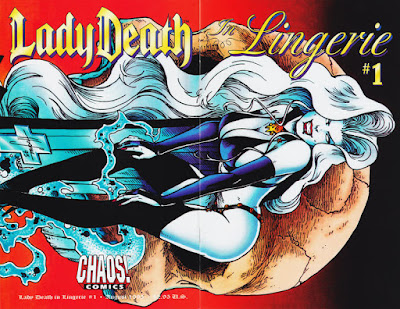
I have, at last count, 22 Lady Death comics in my collection, but aside from the lingerie special I wrote about a few weeks back, I've never read any of them. Most of what I do have comes straight from the shelves of my now defunct comic shop, and, I'll admit, I've based my assessment of them purely on the covers. Big breasts, quasi-bondage costumes, lots of scowls. Today, however, marks the first time I've actually read one.
I'm quite glad I did. I was worried that I made a claim in the opening of my look at Black creators that these were great and important comics, but the first couple I read weren't actually that great and important. This isn't a huge problem. Comics, and especially mainstream comics, are a medium founded on mediocrity - to appeal to the widest range of people, you need the widest common denominators. That's why the more literary comics only appeal to a certain subset of readers. And, given my thoughts on Chaos! Comics in general, I was not holding out hope (which is a pun Lady Death readers will get!).
Today's featured creator is Steven Hughes, who passed away after succumbing to cancer in 2000. Aside from a handful of other appearances, Hughes' career has been tightly bound to Chaos! Comics. He created the looks of many of the company's signature characters, and shepherded them through their various adventures. Hughes' style is fairly standard, building off superhero art of the decades prior, but his page layout is really interesting. There are occasional moments where the panels are a bit out of sequence, or it's hard to tell which one to read next, but these are only occasional. For the most part, his page layouts are fantastic. We get a peek into Lady Death's past, both real and illusory, in this issue, and the flashback panels are drawn as curling scrolls sitting over top of the contemporary action. This mixture of temporality and dimensionality is really quite lovely, and leaves the reader in no way confused as to the time periods (and there are 3) being explored throughout the tale. Page construction is not an easy thing to master, so to see it coming so wonderfully from an artist working at the height of the car crash that was early Image Comics is great.
So let me briefly meditate on that last point. I think the reason I avoided Chaos! was that they are contemporaneous with early Image, so I just assumed they were pretty much more of that mess. But the story within these buxom covers is actually quite intriguing, and there's an element of myth here that I hadn't expected. In fact, the appearances of the characters vanish into the story in this comic, so rather than being the softcore porn that much early Image seems to have embraced, the scantily-clad ladies are actual characters that just happen to be mostly unclothed. Now, don't get me wrong. I'm well aware that this is objectification of a particular variety of the female form in order to sell comics. But that we actually have a decent story within that doesn't revolve around showcasing those forms is both surprising and gratifying. I'm actually looking forward to reading more from Chaos!, and from Hughes, as the project goes on.
I delved into the formal and structural links between specific pairings of comics and music here, where I started theorizing primary versus secondary aesthetic experiences based on how well album cover art in comics form meshed with the music for which the album is primarily a vehicle. Let's have a look at some other kinds of comics/music combinations to see if they help us understand the combination of a primarily audio medium with a primarily visual one.
We're going to look today at two variations on a theme: the packaging of music with comics.
Big Joe Krash - Who Am I?
1994's Break the Chain is a hip-hop comic in numerous senses of the words. Co-written by the inimitable Kyle Baker and Kris "KRS-One" Parker, the comic is packaged with a "cass-single" containing three short songs ostensibly produced by Big Joe Krash, one of the characters in the comic. The music is catchy and anthemic, and surprisingly, for a 90s hip-hop record, not completely foul-mouthed. The comic itself takes place in a stereotypically urban environment, though one that is unidentifiable as any one particular city. Thematically, the album and the comic tackle the problem of urban youth, specifically young African-American youth, being ignorant of their cultural history, of the vast empires that once covered the African continent, of the heritage that has been obscured by the spectre of slavery that haunts American culture. The comic and its musical companion, then, are pieces of protest literature, of the kind that hip-hop, in what we might call its truest form, emblematizes.
Big Joe Krash - Break the Chain!
But how does it hold up with regard to my thoughts on primary and secondary aesthetic experiences? Break the Chain is an interesting case study, and I must admit that I assumed that the comic would be the primary vehicle and the music a secondary, complementary one. This turns out to not be the case at all. While the comic is vibrantly constructed, demonstrating the remarkable creative flourishes for which Baker is known, the most moving moments in the narrative come when Big Joe Krash sings his songs and the words are transcribed, verbatim, from the album. As such, the sections between songs act more as bridges between these musical moments than they do fundamental narrative moments in and of themselves. Put more plainly, these bridging moments bring very little to the overt message of Big Joe Krash/KRS-One's message in the music, that is, the importance of Black culture, of education, and of standing up and grasping both of those things.
Big Joe Krash - So Much Greater
Had this story/album been packaged as a record (and there's some evidence that it was released as a 12" album), I would have decisively said that the primary aesthetic vehicle and experience was the music, about which Baker's narrative and art is wrapped. It's only because the comic was sold as a comic with a cassette included that I would even think about calling the comic the primary vehicle. What we can conclude from this particular comic is that the comic was marketed as the primary vehicle, by dint of its actual form, but once experienced, both visually and aurally, it becomes quite clear that it is the music, the audio element of the hybrid package, that carries the primary thrust of aesthetic experience and performance. Much like the comics that adorn the album covers in my previous column, Baker's work here is secondary. While nice to look at, its overall contribution to the aesthetic experience is negligible.
The case of 2002's Static-X, published by Chaos! Comics, is a little more difficult to parse. The comic comes with a CD containing audio and video music and interviews with this unfortunate (an appellation I'll address shortly) band. But where the primary and secondary aesthetic experiences fall is a difficult question to answer.
Static-X - This Is Not
Static-X tells what is ostensibly an origin story for a group of freedom fighters, modelled on the band themselves, in the totalitarian society of 2072 A.D. The science fiction and thoroughly mechanized setting jibe nicely with the industrial sound of the band (even though they are more often associated with the "nu-metal" movement), though the comic suffers from something I'm coming to understand as the Chaos! Comics style.
(Chaos! is a bit of a conundrum for me. Their production values are very high, and they attracted some fairly large names in the industry, but their comics were always mediocre. I begin to wonder if they set out to be mediocre, and thus succeeded spectacularly, or if they wanted to be great, and failed. I'll ponder on that a bit more when I get to their oeuvre in the 40 Years of Comics Project.)
The plot hangs somewhat around the lyrics to the song "This is Not," and actually holds some promise of an interesting revolutionary narrative, one that has the potential to lift Static-X's music out of the depths of nu-metal and into consideration as protest music. Unfortunately, Chaos! folded shortly after the publication of this issue, so the second volume, advertised both within and on the back cover, never appeared. All this aside, this package offers a further consideration with regard to primary and secondary aesthetic vehicle and experience. As I come at the package from the point of view of a comics fan, it is the comic, its words, pictures, and overall narrative, that I privilege over the CD and the music that comes with it. However, I can imagine that from the point of view of a fan of the band, the comic would be secondary to the experience of the songs, videos, and interviews on the disc. Thus, here, we can propose a primacy of aesthetic vehicle and experience based upon the point of view from which one approaches the package. Such a claim cannot be made for the album covers from my last column, as their aesthetic value is markedly secondary to the music they accompany. Similarly, for Break the Chain, there is a decided primacy to the music, regardless of the perspective from which one approaches the package. Having read and listened to Break the Chain, one is able to see the primacy of the music. Having read and listened to Static-X, the hierarchy is far less clear.
Let me elaborate now on my characterization of the band as "unfortunate." I felt it behooved me to do a bit of research about the band before writing about this comic based upon them, and what I found was not happy. The band went through a prodigious amount of personnel changes, all revolving around frontman Wayne Static. Tripp Eisen, who is featured in this comic, and was lead guitarist when the comic was published, was arrested 3 years later on charges of sexual relations with a minor. He was subsequently booted from the band. And then last year, Static himself was found dead at the age of 48. So while I am still of the opinion that this comic was, at best, mediocre, there is a perspective from which it stands as a testament to a group of artists just before things went very badly wrong for them.
I was going to feature one more comic/CD package in this column, the Students of the Unusual Giant-Sized Music Special, but it's somewhat different from the two works I've addressed here, so I'll leave it until next time. In contrast to the previously discussed record albums, the works I've looked at here require deeper consideration before we can make any claims as the primary and secondary aesthetic vehicles/experiences that each provides. The albums use comics solely as art to enhance the primary experience of the music,even in the case that the one has little or nothing to do with the other. The comic/music packages I've looked at today require both media to be experienced before we can make the distinction. In the case of Break the Chain, I'd go so far as to say that even if the comic was read without the benefit of the music, it is the transcriptions of the music in the comic that would be the most influential portion of the experience, so even in absentia the music is the primary aesthetic vehicle and experience. In the case of Static-X, despite my misgivings about the quality of both the comic and the music, I think that the two complement each other quite well, and incorporate one another quite well. That the band existed prior to the comic might skew our decision as to the primary aesthetic vehicle/experience in favour of the music, but as I stated earlier, the perspective from which one approaches this package is more likely to inform that decision. The revolutionary message is inherent in both media equally, whereas in Break the Chain, it is predominantly encapsulated in the music and its transcription.
My next look at the combination of music and comics will address the aforementioned Students of the Unusual comic, which is packaged with a CD of music composed in tribute to the comic. This is a thoroughly interesting phenomenon, and I'm looking forward to seeing where it takes me.