Saw it.
Loved it.
More when I am not tired.
Mar 10, 2009

Mar 6, 2009
Medieval Literature, Modern Comics
(Note: This piece was originally a presentation for a Medieval Literature class. After the year was over, I revised it, replacing the Middle English with a modern translation, for the sake of ease.)
(Further note: In November of 2010, a proposal to present this paper at the Pop Culture Association of America's annual conference was accepted. Pending a complete re-write and begging for funding, it will be presented at the conference in Texas in April of 2011.)
Introduction
When I started thinking about this project, I was concerned that I wouldn't find nearly enough material to make it worthwhile. There are definitely a large quantity of comics that feature knights and kings and peasants and fairies. I wondered if they would necessarily have much to do with their 12th - 14th century precedents, or would it just be a matter of a particular thing looking cool in a comic book story? Luckily, the answer fell somewhere in the middle, and the discoveries I made not only carry forward many elements from the medieval period, but they also look really cool! Some pieces I looked at were so dense that I probably could have focussed solely on them. Grant Morrison and Simone Bianchi's "Seven Soldiers: Shining Knight" is deserving of a paper all its own, but my purpose is to give a broad view of the medieval in comic books, and so a broad selection of comics is necessary. I'm going to break my discussion up into three sections: Stories, Forms, and Themes. Within each section I'll give specific visual examples, and discuss how each example is related to a text from the medieval period.
Note: All the images within the text can be enlarged by clicking on them.
1. Stories
Stories are perhaps the easiest aspect to address in adapting medieval literature to modern comics. Indeed, almost since the beginning of the form, and definitely pre-dating Superman, comics' most recognizable hero, medieval stories have figured prominently. Hal Foster began "Prince Valiant in the Days of King Arthur" in 1937, and it has continued, in some form, right up to present day (Torregrossa 244). In the modern age of comics, the most recognizable revival of the medieval story is DC Comics' Camelot 3000, originally published between 1982 and 1985. It is an example of what Jason Tondro calls an "Arthur Transformed" tale, "stories which pick up after the death of Arthur" (170). Camelot 3000 bears out Malory's prophetic "some men say...that King Arthur is not dead...that he shall come again" (Malory 713). Arthur returns in the year 3000, as do the best of his knights, and they battle against Morgan Le Fay to
  save the Earth. The treasonous love between Guenivere and Lancelot also makes a return. There is much emphasis throughout the story on the cyclical nature of the tale. Arthur's, it seems, is a story that will go ever on.
Another story of time-travelling knights is Morrison and Bianchi's "Seven Soldiers: Shining Knight." While the greater part of the tale is about a time-displaced knight, the opening pages give an interpretation of the fall of Camelot. The illustration to the left is an example of Tondro's "Traditional Tale," ones that are "adaptations of...tales in the Arthurian 'canon'" (171). This bloody depiction of the Camelot's defeat (the violence of which will be addressed in the "Themes" section) could easily be compared to the "[g]reat carnage...suffered on both sides, [the] countless groans issued from the dying men" (Geoffrey 155). The balance of the tale, however, falls into the "Arthurian Toybox," where a writer grounds "an original character in an Arthurian setting, from which he soon departs to carry on modern superheroic adventures" (172). This is certainly the case for Sir Justin, the hero of "Shining Knight," who finds himself in New York, 2005, very shortly into the story.
The stories of the medieval period have survived in many forms through the ages, from poem to pamphlet, song to cinema. Their use in modern comics is not unusual, and is likely only the latest iteration of the tales. It could be that soon there will be online "webisodes" on YouTube, or some other video sharing site, depicting Gawain's struggles with the Green Knight, or the ribald humour of "The Miller's Tale." These stories will continue to be told in many different media for many years to come.
2. Forms
Aside from the stories that lend themselves to the comic book, the forms those stories take also make an appearance. The use of these forms varies quite widely. An implicit reference to one form, Chaucer's "Canterbury Tales," is also the most recent example we will be looking at. Neil Gaiman's story "Whatever Happened to the Caped Crusader?" in "Batman" #686, published in February of 2009, and its second part in "Detective Comics" #853, as yet unpublished, tells a vaguely surreal tale of the funeral of The Batman. Various people, friends and enemies, stand to recount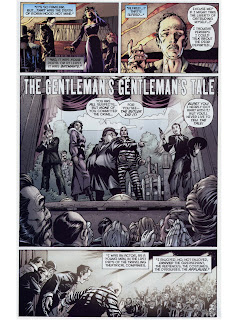 their stories of his last days. Each story is sub-titled, much as each section of Chaucer's work is. The example to the right is the introduction to Alfred's (Bruce "Batman" Wayne's butler) tale. The archaic way of referring to a butler accentuates the connection to Chaucer's text. The other story sub-titled in this comic is simply called "The Catwoman's Tale." The pun is likely very intentional. Jason Tondro writes about "the depth to which Arthurian legend has permeated our culture" (174), such that elements from that legend can be used in comics without explicitly making reference to the legend. I believe that this is the case with "The Canterbury Tales," that it has become so much a part of the culture that a reference such as Gaiman's is implicit.

Where the previous example uses a form specific to one work, Grant Morrison and John J. Muth's The Mystery Play uses the literary form of the mystery play as a jumping-off point for a surreal murder mystery. The setting is a small village in England with a "tradition...of participation in the Yorkshire cycles" (Morrison 6). The Mayor of the town goes on to talk about the involvement of the whole community in the staging of the medieval plays, and in contrast the action of the graphic novel involves many members of the close-knit community. The basic premise is that the actor playing God is murdered, and the actor playing the Devil is the main suspect. Assigned to the murder is one Detective Carpenter (symbolism utterly intentional), who's investigation leads to some profound moral questions and lessons. In this manner, the graphic novel mimics not only the form of the mystery play, but its meditational purpose too. In the illustration to the left, the play is taking place on a flat-bed truck, a fair update of the "system of movable wagons that was common...in England" (Klaus, Gilbert, and Field 118), upon which the play would have taken place on in its original context.
There are other aspects of medieval form that appear in comic books. In issue #4 of "Seven Soldiers: Shining Knight," the villains, a race called the Sheeda, a fairy analogue that will be dealt with in the next section, speak in a runic script. The script is Ogham, an "Early Medieval alphabet used primarily to represent the Old Irish language" ("Ogham" Wikipedia).
These uses of medieval forms serve a number of purposes. They link the modern work with a medieval predecessor, lending an air of authenticity, especially in a medium so marginalized through its history. There is also an aspect of tribute in the works, an acknowledgement that these forms were used in some of the greatest works of English literature and that they should be respected and remembered. Building on this idea is the notion that these forms can be adapted for a modern audience, that they are not just forms that were useful in the medieval period, but ones that can be useful in our modern one.
3. Themes
Thematic elements are somewhat harder to pinpoint. The use of the Sheeda in "Shining Knight" can be interpreted as a "Toybox" approach, as Tondro suggests with Arthurian comics. The fairies are an element of medieval stories (Lanval and Sir Orpheo spring immediately to mind), but their involvement in "Shining Knight" is not specific to one particular tale. In this way they become a thematic element, specifically that of an outside presence, of a magical or unknown nature, intruding upon reality and causing chaos.
Another theme shared by the comic and medieval tales is one that has landed the comic book in trouble quite often over its history: violence. Fredric Wertham's attack on comic books in the 1950s was based almost entirely around depictions of violence on the printed page, and it was an attack that nearly shut down the comic book industry. In the early 2000s, Steven Seagle and Kelley Jones investigated this aspect of medieval literature in their series "The Crusades." The series chronicles, as the back cover of The Crusades: Urban Decree graphic novel claims, the exploits of "an enigmatic 11th-century crusader...come to render a terrible justice on the citizens of 21st-century San Francisco". As can be seen from the picture to the right, the "terrible justice" is quite brutal. However, if we contrast this with Gawain's exploits in the wilds, where "[s]ometimes he fights dragons, and wolves as well,/Sometimes with wild men who dwelt among the crags" ("Gawain" 255;l.720-21) and on to the declaration that "fighting troubled him less than the rigorous winter" (255;l.726), we see that the violence, the terrible justice, is less troublesome to a character from the medieval period. How, then, can this attitude toward violence be reconciled in the modern day? While the man the knight attacks is a mugger, as are many of his victims throughout the series, his vigilante-style of justice does not sit well with modern people.
It is on the topic of themes that the greatest disparity between medieval literature and modern comics can be seen. The cultural norms of the two periods are so different that transposing into one what is acceptable in the other becomes problematic. However, consideration of such cultural clashes is often the point of superimposing one period over another. In examining the differences between cultural perceptions, a common point of reference can sometimes be distinguished. In such a case, lessons can be learned about both time periods.
Conclusion
The comics I've highlighted here are just a sampling. They are only indicative of medieval elements in comics that I have in my personal collection, and are therefore subject to the whims of my tastes. I have purposefully left out much of the specifics of the stories, purely in the interest of people who might be intrigued and want to go out and find these books. Some among you will perhaps want to find out how Arthur manages to defeat the alien invaders and Morgan Le Fay in Camelot 3000, or just what happens to Sir Justin after he finds himself in New York, circa 2005, in "Seven Soldiers: Shining Knight." What these glimpses may prove, or support at least, is that there is a reason that the great works of the medieval period continue to be studied and read: they are great stories, with great characters, and they deal with themes common to human experience, whether you are a peasant listening to a storyteller in the 13th century, or a person sitting on your couch reading a comic in the 21st.
(Further note: In November of 2010, a proposal to present this paper at the Pop Culture Association of America's annual conference was accepted. Pending a complete re-write and begging for funding, it will be presented at the conference in Texas in April of 2011.)
Introduction
When I started thinking about this project, I was concerned that I wouldn't find
 nearly enough material to make it worthwhile. There are definitely a large quantity of comics that feature knights and kings and peasants and fairies. I wondered if they would necessarily have much to do with their 12th - 14th century precedents, or would it just be a matter of a particular thing looking cool in a comic book story? Luckily, the answer fell somewhere in the middle, and the discoveries I made not only carry forward many elements from the medieval period, but they also look really cool! Some pieces I looked at were so dense that I probably could have focussed solely on them. Grant Morrison and Simone Bianchi's "Seven Soldiers: Shining Knight" is deserving of a paper all its own, but my purpose is to give a broad view of the medieval in comic books, and so a broad selection of comics is necessary. I'm going to break my discussion up into three sections: Stories, Forms, and Themes. Within each section I'll give specific visual examples, and discuss how each example is related to a text from the medieval period.
 Note: All the images within the text can be enlarged by clicking on them.
1. Stories
Stories are perhaps the easiest aspect to address in adapting medieval literature to modern comics. Indeed, almost since the beginning of the form, and definitely pre-dating Superman, comics' most recognizable hero, medieval stories have figured
 prominently. Hal Foster began "Prince Valiant in the Days of King Arthur" in 1937, and it has continued, in some form, right up to present day (Torregrossa 244). In the modern age of comics, the most recognizable revival of the medieval story is DC Comics' Camelot 3000, originally published between 1982 and 1985. It is an example of what Jason Tondro calls an "Arthur Transformed" tale, "stories which pick up after the death of Arthur" (170). Camelot 3000 bears out Malory's prophetic "some men say...that King Arthur is not dead...that he shall come again" (Malory 713). Arthur returns in the year 3000, as do the best of his knights, and they battle against Morgan Le Fay to
  save the Earth. The treasonous love between Guenivere and Lancelot also makes a return. There is much emphasis throughout the story on the cyclical nature of the tale. Arthur's, it seems, is a story that will go ever on.
 Another story of time-travelling knights is Morrison and Bianchi's "Seven Soldiers: Shining Knight." While the greater part of the tale is about a time-displaced knight, the opening pages give an interpretation of the fall of Camelot. The illustration to the left is an example of Tondro's "Traditional Tale," ones that are "adaptations of...tales in the Arthurian 'canon'" (171). This bloody depiction of the Camelot's defeat (the violence of which will be addressed in the "Themes" section) could easily be compared to the "[g]reat carnage...suffered on both sides, [the] countless groans issued from the dying men" (Geoffrey 155). The balance of the tale, however, falls into the "Arthurian Toybox," where a writer grounds "an original character in an Arthurian setting, from which he soon departs to carry on modern superheroic adventures" (172). This is certainly the case for Sir Justin, the hero of "Shining Knight," who finds himself in New York, 2005, very shortly into the story.
The stories of the medieval period have survived in many forms through the ages, from poem to pamphlet, song to cinema. Their use in modern comics is not unusual, and is likely only the latest iteration of the tales. It could be that soon there will be online "webisodes" on YouTube, or some other video sharing site, depicting Gawain's struggles with the Green Knight, or the ribald humour of "The Miller's Tale." These stories will continue to be told in many different media for many years to come.
2. Forms
Aside from the stories that lend themselves to the comic book, the forms those stories take also make an appearance. The use of these forms varies quite widely. An implicit reference to one form, Chaucer's "Canterbury Tales," is also the most recent example we will be looking at. Neil Gaiman's story "Whatever Happened to the Caped Crusader?" in "Batman" #686, published in February of 2009, and its second part in "Detective Comics" #853, as yet unpublished, tells a vaguely surreal tale of the funeral of The Batman. Various people, friends and enemies, stand to recount
 their stories of his last days. Each story is sub-titled, much as each section of Chaucer's work is. The example to the right is the introduction to Alfred's (Bruce "Batman" Wayne's butler) tale. The archaic way of referring to a butler accentuates the connection to Chaucer's text. The other story sub-titled in this comic is simply called "The Catwoman's Tale." The pun is likely very intentional. Jason Tondro writes about "the depth to which Arthurian legend has permeated our culture" (174), such that elements from that legend can be used in comics without explicitly making reference to the legend. I believe that this is the case with "The Canterbury Tales," that it has become so much a part of the culture that a reference such as Gaiman's is implicit.
Where the previous example uses a form specific to one work, Grant Morrison and John J. Muth's The Mystery Play uses the literary form of the mystery play as a jumping-off point for a surreal murder mystery. The setting is a small village in England with a "tradition...of participation in the Yorkshire cycles" (Morrison 6). The Mayor of the town goes on to talk about the involvement of the whole community in the staging of the medieval plays, and in contrast the action of the graphic novel involves many members of the close-knit community. The basic premise is that the actor playing God is murdered, and the actor playing the Devil is the main suspect. Assigned to the murder is one Detective Carpenter (symbolism utterly intentional), who's investigation leads to some profound moral questions and lessons. In this manner, the graphic novel mimics not only the form of the mystery play, but its meditational purpose too. In the illustration to the left, the play is taking place on a flat-bed truck, a fair update of the "system of movable wagons that was common...in England" (Klaus, Gilbert, and Field 118), upon which the play would have taken place on in its original context.
There are other aspects of medieval form that appear in comic books. In issue #4 of "Seven Soldiers: Shining Knight," the villains, a race called the Sheeda, a fairy analogue that will be dealt with in the next section, speak in a runic script. The script is Ogham, an "Early Medieval alphabet used primarily to represent the Old Irish language" ("Ogham" Wikipedia).
These uses of medieval forms serve a number of purposes. They link the modern work with a medieval predecessor, lending an air of authenticity, especially in a medium so marginalized through its history. There is also an aspect of tribute in the works, an acknowledgement that these forms were used in some of the greatest works of English literature and that they should be respected and remembered. Building on this idea is the notion that these forms can be adapted for a modern audience, that they are not just forms that were useful in the medieval period, but ones that can be useful in our modern one.
3. Themes
Thematic elements are somewhat harder to pinpoint. The use of the Sheeda in "Shining Knight" can be interpreted as a "Toybox" approach, as Tondro suggests with Arthurian comics. The fairies are an element of medieval stories (Lanval and Sir Orpheo spring immediately to mind), but their involvement in "Shining Knight" is not specific to one particular tale. In this way they become a thematic element, specifically that of an outside presence, of a magical or unknown nature, intruding upon reality and causing chaos.
Another theme shared by the comic and medieval tales is one that has landed the comic book in trouble quite often over its history: violence. Fredric Wertham's attack on comic books in the 1950s was based almost entirely around depictions of
 violence on the printed page, and it was an attack that nearly shut down the comic book industry. In the early 2000s, Steven Seagle and Kelley Jones investigated this aspect of medieval literature in their series "The Crusades." The series chronicles, as the back cover of The Crusades: Urban Decree graphic novel claims, the exploits of "an enigmatic 11th-century crusader...come to render a terrible justice on the citizens of 21st-century San Francisco". As can be seen from the picture to the right, the "terrible justice" is quite brutal. However, if we contrast this with Gawain's exploits in the wilds, where "[s]ometimes he fights dragons, and wolves as well,/Sometimes with wild men who dwelt among the crags" ("Gawain" 255;l.720-21) and on to the declaration that "fighting troubled him less than the rigorous winter" (255;l.726), we see that the violence, the terrible justice, is less troublesome to a character from the medieval period. How, then, can this attitude toward violence be reconciled in the modern day? While the man the knight attacks is a mugger, as are many of his victims throughout the series, his vigilante-style of justice does not sit well with modern people.
 It is on the topic of themes that the greatest disparity between medieval literature and modern comics can be seen. The cultural norms of the two periods are so different that transposing into one what is acceptable in the other becomes problematic. However, consideration of such cultural clashes is often the point of superimposing one period over another. In examining the differences between cultural perceptions, a common point of reference can sometimes be distinguished. In such a case, lessons can be learned about both time periods.
Conclusion
The comics I've highlighted here are just a sampling. They are only indicative of medieval elements in comics that I have in my personal collection, and are therefore subject to the whims of my tastes. I have purposefully left out much of the specifics of the stories, purely in the interest of people who might be intrigued and want to go out and find these books. Some among you will perhaps want to find out how Arthur manages to defeat the alien invaders and Morgan Le Fay in Camelot 3000, or just what happens to Sir Justin after he finds himself in New York, circa 2005, in "Seven Soldiers: Shining Knight." What these glimpses may prove, or support at least, is that there is a reason that the great works of the medieval period continue to be studied and read: they are great stories, with great characters, and they deal with themes common to human experience, whether you are a peasant listening to a storyteller in the 13th century, or a person sitting on your couch reading a comic in the 21st.
Works Cited
Barr, Mike W. (w), and Brian Bolland (a). Camelot 3000. New York: DC Comics, 1988.
Gaiman, Neil (w), Andy Kubert (p), and Scott Williams (i). "Whatever Happened to the Caped Crusader part 1 of 2: The Beginning of the End." Batman #686 (April 2009), DC Comics.
Geoffrey of Monmouth. "A History of the Kings of Britain." The Broadview Anthology of British Literature volume 1: The Medieval Period. Ed. Joseph Black, et al. Peterborough: Broadview Press, 2006. 136-57.
Klaus, Carl H., Miriam Gilbert, and Bradford S. Field, Jr. "Medieval Theater." Stages of Drama. Ed. Carl H. Klaus, Miriam Gilbert, and Bradford S. Field, Jr. 2nd Ed. New York: St. Martin's Press, 1991. 117-121.
Malory, Sir Thomas. "Morte Darthur." The Broadview Anthology of British Literature volume 1: The Medieval Period. Ed. Joseph Black, et al. Peterborough: Broadview Press, 2006. 679-719.
Morrison, Grant (w), and John J. Muth (a). The Mystery Play. New York: DC Comics, 1994.
Morrison, Grant (w), and Simone Bianchi (a). "The Last of Lancelot." Seven Soldiers: Shining Knight #1 (May 2005), DC Comics.
---. "The Last Stand of Don Vincenzo." Seven Soldiers: Shining Knight #4 (October 2005), DC Comics.
"Ogham." Wikipedia. 28 February 2009.
Seagle, Steven T. (w), Kelley Jones (p), and Jason Moore (i). "The First Crusade A.D. 2001." The
Crusades #1 (May 2001), DC Comics.
---. The Crusades: Urban Decree. New York: DC Comics, 2001.
Torregrossa, Michael A. "Once and Future Kings: The Return of King Arthur in the Comics." Adapting the Arthurian Legends for Children. Ed. Barbara Tepa Lupack. New York: Palgrave Macmillan, 2004. 243-62.
Tondro, Jason. "Camelot in Comics." King Arthur in Popular Culture. Ed. Elizabeth S. Sklar and Donald L. Hoffman. Jefferson: McFarland & Company, 2002. 169-81.
Barr, Mike W. (w), and Brian Bolland (a). Camelot 3000. New York: DC Comics, 1988.
Gaiman, Neil (w), Andy Kubert (p), and Scott Williams (i). "Whatever Happened to the Caped Crusader part 1 of 2: The Beginning of the End." Batman #686 (April 2009), DC Comics.
Geoffrey of Monmouth. "A History of the Kings of Britain." The Broadview Anthology of British Literature volume 1: The Medieval Period. Ed. Joseph Black, et al. Peterborough: Broadview Press, 2006. 136-57.
Klaus, Carl H., Miriam Gilbert, and Bradford S. Field, Jr. "Medieval Theater." Stages of Drama. Ed. Carl H. Klaus, Miriam Gilbert, and Bradford S. Field, Jr. 2nd Ed. New York: St. Martin's Press, 1991. 117-121.
Malory, Sir Thomas. "Morte Darthur." The Broadview Anthology of British Literature volume 1: The Medieval Period. Ed. Joseph Black, et al. Peterborough: Broadview Press, 2006. 679-719.
Morrison, Grant (w), and John J. Muth (a). The Mystery Play. New York: DC Comics, 1994.
Morrison, Grant (w), and Simone Bianchi (a). "The Last of Lancelot." Seven Soldiers: Shining Knight #1 (May 2005), DC Comics.
---. "The Last Stand of Don Vincenzo." Seven Soldiers: Shining Knight #4 (October 2005), DC Comics.
"Ogham." Wikipedia. 28 February 2009
Seagle, Steven T. (w), Kelley Jones (p), and Jason Moore (i). "The First Crusade A.D. 2001." The
Crusades #1 (May 2001), DC Comics.
---. The Crusades: Urban Decree. New York: DC Comics, 2001.
Torregrossa, Michael A. "Once and Future Kings: The Return of King Arthur in the Comics." Adapting the Arthurian Legends for Children. Ed. Barbara Tepa Lupack. New York: Palgrave Macmillan, 2004. 243-62.
Tondro, Jason. "Camelot in Comics." King Arthur in Popular Culture. Ed. Elizabeth S. Sklar and Donald L. Hoffman. Jefferson: McFarland & Company, 2002. 169-81.
Jan 22, 2009
Batman vs. Mighty Wing
This is an essay I wrote for my course "Concepts of Culture" last term. I got an A+ on it, and it constitutes my first actual piece of comic book scholarship. This is the essay exactly as it was handed in for the class. I am planning on revising it later on this year, perhaps once I've got a bit of time in the summer.
(Note, Mar.7/09: This essay won 2nd place in the first term 2nd year Humanities Essay Writing awards at McMaster University.)
Batman vs. Mighty Wing
In Dreamworld and Catastrophe, Susan Buck-Morrs references a pair of strikingly similar pictures from strikingly different cultures. The Gulf Refining Company ad and the Magnitogorsk newspaper illustration (Buck-Morrs 191) each portray a man staring from his window at the factory that defines his life, though these definitions could not be more dissimilar. In considering how two opposed cultural viewpoints, the individualist and the collectivist, can make use of near-identical artworks to propagate their disparate views, it is useful to look at the doctrinal tools each culture uses. The North American comic book Batman and the North Korean comic Great General Mighty Wing, through many practices common to comic books, disseminate vastly different viewpoints on the individual and his or her role in society. More specifically, the shared use of animal motifs in these comics concretely demonstrates the difference of ideology through the sameness of form.
Batman, first published in 1939 (Giordano 7), and Great General Mighty Wing, first published in 1994 (Fenkl), are both comics aimed at the youth of their particular nation and era. Both are examples of what Scott McCloud calls “iconic abstraction”(46). This is a cartooning technique that is a process of “not so much eliminating details...as focusing on specific details”(30). McCloud further elucidates this point by saying that a photo, or a realistic drawing, will make one think of an “other,” where a cartoon will make one think of the self (36). In Great General Mighty Wing, all the bees, including the main character, have incredibly simplistic facial features, wide-eyed, innocent, and somewhat child-like. Batman too, in his first appearances, is greatly abstracted by the bat cowl he dons. McCloud goes on to posit that the reason for this abstraction is that if one were viewing realistic images, one would be “far too aware of the messenger to fully receive the message”(37). The respective icons in the two comics are facially abstracted so much that a reader can place him- or herself in the hero's place, and thus receive the cultural message embedded in the piece.
The physical depictions of hero as animal in Great General Mighty Wing and Batman serve very different cultural functions. Mighty Wing is a bee, anthropomorphic and abstracted, but still a bee. His physical depiction is identical to that of the other bees he inspires. This is, in many ways, similar to the depiction of Aleksi Stakhanov who, while described as a hero and leader, blends in completely when pictured with a group of “Stakhanovites”(Buck-Morrs 183). The hero is not physically set apart. He is one of the people, thus showing that any person can be a hero, or indeed that service to the state makes heroes of all people. Batman is not an anthropomorphic animal. He is a man dressed up as an animal, which immediately causes the reader to separate him out from the general population. Underneath his mask he is a man, but by donning the mantle of the bat, he sets himself apart from society. He no longer looks like everyone else. Rather than the image of the hero as belonging to society, the image of the bat makes the hero into a “weird figure of the shadows”(Kane 70). Batman does not lead an army of like-minded, like-costumed heroes in service to the state. His animal depiction separates him from society in exactly the same way that Mighty Wing's inextricably links him to society.
The physicality of each hero aside, even the shared use of animalistic behaviours shows the differing cultural foci. The hive-mind, the collective mentality, as portrayed by the bees in Great General Mighty Wing is a familiar one. Indeed, the perception of the bee as constantly working toward the betterment of its society gives even a Western individualist culture an aphorism such as “busy as a bee.” In remarking that “Mighty Wing's squad worked through the night” and that “they're fast as lightning”(Cho), coupled with the aforementioned iconic abstraction, a reader is invited to identify with the homogeneous, industrious citizen of the state. Batman springs from a cultural idea that is completely antithetical to Great General Mighty Wing's, but that can still be illustrated by an animal behaviour. By picking a creature that is nocturnal, rather than diurnal, one that will “strike terror into [people's] hearts”(Kane 70), Batman is again set outside of the society that he protects. Where Mighty Wing's peers regard him with awe and gratitude, Batman's peers think that “real cops shouldn't have [their] pride stripped away...by some vigilante who's twice the criminal as” those he tackles (Moench 6). In much the same way that his bat mask physically sets him apart from his peers, his propensity for acting in darkness and for using the bat image to instill fear, behaviourally sets him apart. However, individual or collective, bat or bee, an animal behaviour is used to illustrate both.
The animal motif, as used to portray behaviour, physicality, and abstraction, allows Batman and Great General Mighty Wing to elucidate the ideals of two very different cultures. Like the captain of industry in the Gulf Refining Company ad, Batman shows the betterment of society through the actions of the exceptional individual. In contrast, both Mighty Wing and the factory worker in the Magnitogorsk picture better society by being one of many. The use of such similar forms to portray such different ideas not only speaks to the universality of the comic book format, but hints that there are tools that can manipulate people, regardless of the cultural ideology that uses them.
Works Cited
Buck-Morrs, Susan. Dreamworld and Catastrophe. M.I.T. Press, 2000.
Cho Pyong Kwon. “Great General Mighty Wing.” Trans. Heinz Insu Fenkl. Words Without Borders. February 2008. November 3, 2008. http://www.wordswithoutborders.org/?front=FEBRUARY%202008
Fenkl, Heinz Insu. “Translator's Introduction.” Words Without Borders. February 2008. November 3, 2008. http://www.wordswithoutborders.org/?front=FEBRUARY%202008
Giordano, Dick. “Growing Up With The Greatest.” The Greatest Batman Stories Ever Told. Ed. Mike Gold. New York: DC Comics, 1988. 6-11.
Kane, Bob. “The Origin of the Batman.” The Greatest Batman Stories Ever Told. Ed.
Mike Gold. New York: DC Comics, 1988. 66-78.
McCloud, Scott. Understanding Comics. New York: DC Comics, 2000.
Moench, Doug. “Prey part 1.” Batman: Legends of the Dark Knight 11 (1990): 6.
(Note, Mar.7/09: This essay won 2nd place in the first term 2nd year Humanities Essay Writing awards at McMaster University.)
Batman vs. Mighty Wing
In Dreamworld and Catastrophe, Susan Buck-Morrs references a pair of strikingly similar pictures from strikingly different cultures. The Gulf Refining Company ad and the Magnitogorsk newspaper illustration (Buck-Morrs 191) each portray a man staring from his window at the factory that defines his life, though these definitions could not be more dissimilar. In considering how two opposed cultural viewpoints, the individualist and the collectivist, can make use of near-identical artworks to propagate their disparate views, it is useful to look at the doctrinal tools each culture uses. The North American comic book Batman and the North Korean comic Great General Mighty Wing, through many practices common to comic books, disseminate vastly different viewpoints on the individual and his or her role in society. More specifically, the shared use of animal motifs in these comics concretely demonstrates the difference of ideology through the sameness of form.
Batman, first published in 1939 (Giordano 7), and Great General Mighty Wing, first published in 1994 (Fenkl), are both comics aimed at the youth of their particular nation and era. Both are examples of what Scott McCloud calls “iconic abstraction”(46). This is a cartooning technique that is a process of “not so much eliminating details...as focusing on specific details”(30). McCloud further elucidates this point by saying that a photo, or a realistic drawing, will make one think of an “other,” where a cartoon will make one think of the self (36). In Great General Mighty Wing, all the bees, including the main character, have incredibly simplistic facial features, wide-eyed, innocent, and somewhat child-like. Batman too, in his first appearances, is greatly abstracted by the bat cowl he dons. McCloud goes on to posit that the reason for this abstraction is that if one were viewing realistic images, one would be “far too aware of the messenger to fully receive the message”(37). The respective icons in the two comics are facially abstracted so much that a reader can place him- or herself in the hero's place, and thus receive the cultural message embedded in the piece.
The physical depictions of hero as animal in Great General Mighty Wing and Batman serve very different cultural functions. Mighty Wing is a bee, anthropomorphic and abstracted, but still a bee. His physical depiction is identical to that of the other bees he inspires. This is, in many ways, similar to the depiction of Aleksi Stakhanov who, while described as a hero and leader, blends in completely when pictured with a group of “Stakhanovites”(Buck-Morrs 183). The hero is not physically set apart. He is one of the people, thus showing that any person can be a hero, or indeed that service to the state makes heroes of all people. Batman is not an anthropomorphic animal. He is a man dressed up as an animal, which immediately causes the reader to separate him out from the general population. Underneath his mask he is a man, but by donning the mantle of the bat, he sets himself apart from society. He no longer looks like everyone else. Rather than the image of the hero as belonging to society, the image of the bat makes the hero into a “weird figure of the shadows”(Kane 70). Batman does not lead an army of like-minded, like-costumed heroes in service to the state. His animal depiction separates him from society in exactly the same way that Mighty Wing's inextricably links him to society.
The physicality of each hero aside, even the shared use of animalistic behaviours shows the differing cultural foci. The hive-mind, the collective mentality, as portrayed by the bees in Great General Mighty Wing is a familiar one. Indeed, the perception of the bee as constantly working toward the betterment of its society gives even a Western individualist culture an aphorism such as “busy as a bee.” In remarking that “Mighty Wing's squad worked through the night” and that “they're fast as lightning”(Cho), coupled with the aforementioned iconic abstraction, a reader is invited to identify with the homogeneous, industrious citizen of the state. Batman springs from a cultural idea that is completely antithetical to Great General Mighty Wing's, but that can still be illustrated by an animal behaviour. By picking a creature that is nocturnal, rather than diurnal, one that will “strike terror into [people's] hearts”(Kane 70), Batman is again set outside of the society that he protects. Where Mighty Wing's peers regard him with awe and gratitude, Batman's peers think that “real cops shouldn't have [their] pride stripped away...by some vigilante who's twice the criminal as” those he tackles (Moench 6). In much the same way that his bat mask physically sets him apart from his peers, his propensity for acting in darkness and for using the bat image to instill fear, behaviourally sets him apart. However, individual or collective, bat or bee, an animal behaviour is used to illustrate both.
The animal motif, as used to portray behaviour, physicality, and abstraction, allows Batman and Great General Mighty Wing to elucidate the ideals of two very different cultures. Like the captain of industry in the Gulf Refining Company ad, Batman shows the betterment of society through the actions of the exceptional individual. In contrast, both Mighty Wing and the factory worker in the Magnitogorsk picture better society by being one of many. The use of such similar forms to portray such different ideas not only speaks to the universality of the comic book format, but hints that there are tools that can manipulate people, regardless of the cultural ideology that uses them.
Works Cited
Buck-Morrs, Susan. Dreamworld and Catastrophe. M.I.T. Press, 2000.
Cho Pyong Kwon. “Great General Mighty Wing.” Trans. Heinz Insu Fenkl. Words Without Borders. February 2008. November 3, 2008. http://www.wordswithoutborders.org/?front=FEBRUARY%202008
Fenkl, Heinz Insu. “Translator's Introduction.” Words Without Borders. February 2008. November 3, 2008. http://www.wordswithoutborders.org/?front=FEBRUARY%202008
Giordano, Dick. “Growing Up With The Greatest.” The Greatest Batman Stories Ever Told. Ed. Mike Gold. New York: DC Comics, 1988. 6-11.
Kane, Bob. “The Origin of the Batman.” The Greatest Batman Stories Ever Told. Ed.
Mike Gold. New York: DC Comics, 1988. 66-78.
McCloud, Scott. Understanding Comics. New York: DC Comics, 2000.
Moench, Doug. “Prey part 1.” Batman: Legends of the Dark Knight 11 (1990): 6.
Dec 6, 2008
Crossovers, Mega-Crossovers, and the Fools Who Love Them part 2
An open letter to Marvel Comics:
Guys, seriously, it has to stop eventually. I've been faithful. I've been good. I've followed the stories, from New Avengers' "Breakout", to House of M, to Civil War, right through to the Secret Invasion. I waited and read patiently, savouring each little tidbit, each revelatory moment that recast the last few years of Marvel U history into this rather ornate and well-orchestrated whole. That aside, I've actually enjoyed all those stories individually, as well as the whole tapestry. But the end of Secret Invasion? Did we get and epilogue of any kind? Did we get reactions from the public? Did we get Skrulls in the streets? Did we, at least, get a satisfying conclusion to the story? No. We got the teaser for the next big crossover. What a let down. I'm glad that you seem to have grand stories you'd like to tell, and writers willing to put in the years and effort. But here's the thing. While the Marvel U is undergoing crisis after crisis, and just picks itself back up and shakes off the dust, the real world is undergoing a couple of crises simultaneously that we can't just get back up and keep going from. As a result of these crises, I can't afford to buy your over-extended, constantly bigger and better stories. I have to put gas in my car. I can't afford to buy three or four books to understand what's going on in one title I enjoy. I have to deal with the increasing price of food. I can't even imagine what a let down the last few issues of New Avengers would have been if I hadn't been reading Secret Invasion. I really hope that the stories in your separate comics will actually be separate for a while, because I can't buy Dark Reign. I can't buy Dark Avengers. You have a substantial portion of my income directed to your company already, but it seems you just want more and more. Sadly, should the titles I enjoy no longer be able to stand on their own (as New Avengers and Mighty Avengers over the last 6 months have not), then that portion of my income will be put towards something else. I'm not even threatening to leave you for the competition, because that would be childish. I just want you to think about the people who are buying your comics, who likely put money aside especially for your comics, and who cannot afford in these trying times, to put much more aside. Is it fair to expect them to do so in order to enjoy the products you produce? I don't think so. I've been buying Marvel comics for almost 25 years. I have a lot invested in your characters. I've enjoyed their stories for almost as long as I can remember, and I would love to be able to continue to do so. I therefore ask that you allow me to continue enjoying the stories you produce, that you make it feasible for someone, for everyone, who can't find the money to collect five or six different titles, to still get a satisfying experience from collecting a single series. Maybe you will. Maybe Dark Reign will play out in the background of the titles I read. Maybe I'll be pleasantly surprised. But if the last couple of years is anything to go by, I'll be wrong.
Yours,
A fan.
Guys, seriously, it has to stop eventually. I've been faithful. I've been good. I've followed the stories, from New Avengers' "Breakout", to House of M, to Civil War, right through to the Secret Invasion. I waited and read patiently, savouring each little tidbit, each revelatory moment that recast the last few years of Marvel U history into this rather ornate and well-orchestrated whole. That aside, I've actually enjoyed all those stories individually, as well as the whole tapestry. But the end of Secret Invasion? Did we get and epilogue of any kind? Did we get reactions from the public? Did we get Skrulls in the streets? Did we, at least, get a satisfying conclusion to the story? No. We got the teaser for the next big crossover. What a let down. I'm glad that you seem to have grand stories you'd like to tell, and writers willing to put in the years and effort. But here's the thing. While the Marvel U is undergoing crisis after crisis, and just picks itself back up and shakes off the dust, the real world is undergoing a couple of crises simultaneously that we can't just get back up and keep going from. As a result of these crises, I can't afford to buy your over-extended, constantly bigger and better stories. I have to put gas in my car. I can't afford to buy three or four books to understand what's going on in one title I enjoy. I have to deal with the increasing price of food. I can't even imagine what a let down the last few issues of New Avengers would have been if I hadn't been reading Secret Invasion. I really hope that the stories in your separate comics will actually be separate for a while, because I can't buy Dark Reign. I can't buy Dark Avengers. You have a substantial portion of my income directed to your company already, but it seems you just want more and more. Sadly, should the titles I enjoy no longer be able to stand on their own (as New Avengers and Mighty Avengers over the last 6 months have not), then that portion of my income will be put towards something else. I'm not even threatening to leave you for the competition, because that would be childish. I just want you to think about the people who are buying your comics, who likely put money aside especially for your comics, and who cannot afford in these trying times, to put much more aside. Is it fair to expect them to do so in order to enjoy the products you produce? I don't think so. I've been buying Marvel comics for almost 25 years. I have a lot invested in your characters. I've enjoyed their stories for almost as long as I can remember, and I would love to be able to continue to do so. I therefore ask that you allow me to continue enjoying the stories you produce, that you make it feasible for someone, for everyone, who can't find the money to collect five or six different titles, to still get a satisfying experience from collecting a single series. Maybe you will. Maybe Dark Reign will play out in the background of the titles I read. Maybe I'll be pleasantly surprised. But if the last couple of years is anything to go by, I'll be wrong.
Yours,
A fan.
Oct 31, 2008
Interviews and Annotations on All-Star Superman
So, Newsarama has a 10-part series on the genesis and production of Grant Morrison and Frank Quitely's "All-Star Superman". If you've read the series, this is brilliant background, and a wonderful insight into Morrison's creative process.
If you haven't read it, what the hell are you waiting for? This is likely going to be one the definitive Superman texts for years to come. Read it. Go. Now!
Part 1
Part 2
Part 3
Part 4
Part 5
Part 6
Part 7
Part 8
Part 9
Part 10
If you haven't read it, what the hell are you waiting for? This is likely going to be one the definitive Superman texts for years to come. Read it. Go. Now!
Part 1
Part 2
Part 3
Part 4
Part 5
Part 6
Part 7
Part 8
Part 9
Part 10
Oct 16, 2008
Learning to Read Comics, part 1
I figured that this might be a useful thing to write about. There have to be hundreds, if not thousands, of you out there who love comics passionately. You think they are the perfect art form; It's not a bad thing, I'm right there with you. The combination of words and pictures, the giant tapestry of history, that follows not only the fictional characters but the real-life ones, too. Think of Jack Kirby's story. Or Siegel and Schuster's story. We love to hear tales of our comic book heroes. Grant Morrison on Disinfo.com. Alan Moore on The Simpsons. We have our own entertainment culture within a culture that we thrive on. The little snippets of gossip from the conventions, announcements of exclusive contracts for this writer, or that artist. Again, I'm not saying it's bad. But have you ever tried explaining it to anyone who's not like you?
(This article appears with many thanks to Peter.)
I have.
I am 34 years old. With a brief break in my late teen years, I've read comics for about 25 years. I know this because the first comic I bought that I kept, that I collected, was the first issue of Marvel's The Transformers. I still have it. I love comics unabashedly. I have a wife, a 9 year old son, and a 58 year-old father. Let me just state for the record that I also have a Mum, 2 brothers, a gaggle of in-laws, friends and the like. But I picked those specific three out because they are the ones I've tried to convince of the brilliance of comics. This is what I have learned. I set it down because of our shared joy in this hobby, because I worry that it'll die out, and I think that would be a shame. Time to make some converts, eh comrades?
Part 1. The Dad
together, even went on a bit of a holiday together with the families last year. He's a brilliant Grandad, and, if my Mum sticking around is any indicator, a great husband. But right from the start, from the very start, he wasn't okay with the hording that went on at the beginning of my collection. It's not even that he had a problem with comics in general. It was just the collecting of them. To him, they were like magazines. They came out every week and you read them, maybe kept them in a stack next to your bed for a bit, and then you chucked them. I'm really not sure if he got comics as a kid. I don't recall him ever saying anything about it. There's a part of me that thinks maybe he didn't, and that's why the huge amount I've got is a problem for him. But perhaps I read too much into that. I don't bring him downstairs into my basement any more. I think the sheer volume of comics down there might just kill him.
So, over the years that dislike for the collecting kind of spread out to the medium in general. Comics were for kids. They weren't to be put in plastic bags with little boards behind; they weren't to be kept in boxes in alphabetical order; they weren't to be entered into a database with separate folders for each of your favourite writers. Nope.
My Dad is a work in progress for me. He has to be reintroduced to comics very slowly and in a way that makes him think it's his doing. To date, since the year 2002, when I decided, behind the counter of my short-lived comic store, that there was a comic out there for every single human being, and I could find it, I have given him 3 graphic novels to read. That's patience right there. If anyone ever accuses me of not having any (as we will see in part : The Wife), that's my proof. I have begun re-introducing my Dad to comics at the rate of one every two years. It takes research. That's all.
 Back in 2002, that whole Jane Austen revival thing was not nearly as cheesy as it is now. It was okay to like all that period drama. I love the old BBC Pride and Prejudice. It's great. I only admit that here because I know you'll keep my secret. But my Mum loved it. Still does. Looooovvvveeeeddd it. And my Dad, being the excellent dude that he is, took an interest too. He's okay with the dancing and the teas and the scandals and stuff, but if you want the real stories, the ones that the period dramas are the safe, friendly, sit-com versions of, you read the gritty stuff. For my Dad, it was Charles Dickens. But,hey, why even read fiction when one of the greatest stories ever, one of the creepiest and most conspiracy-laden, happened right there in Victorian London: Jack the Ripper. So this is where I found my Dad's comic nerve, all those years ago.
If you're a reader in the know, you'll have figured out that it was Alan Moore and Eddie Campbell's From Hell that was my weapon of choice. It was followed (or maybe preceded, now that I think about it), by Rick Geary's A Treasury of Victorian Murder: Jack the Ripper volume, which is really good. If you're less familiar with the Geary book, I'll elucidate. It's a graphic novel setting down the known facts of the Ripper case. He does delve slightly into the speculation and conspiracy that may or may not have been present, but in general relies on witness reports, police documents, and the like. Really well done, and quite valuable when you're about to send someone upon the journey that is From Hell.
The approach had to be sly. I'd recently given him a book that was a collection of all the official documents of the case. I got one for myself. Yep, there are people out there who buy that kind of stuff all the time. We live amongst you. Anyway, he enjoyed it. There were a couple of others of the same ilk. I had used books at my store and I came upon a collection of prison records of a Victorian jail, published in paperback format. That creeped me out a bit. But when my Dad really thought it was cool, I decided to take the plunge. I wish I could remember how I brought the topic up. For about 20 years up to that point, any discussion of comics with my Dad was met with some amount of derision. It may have been the fact that the film version of From Hell had recently come out, and he'd enjoyed that, so I scoffed at him and told him that the book was a whole other creature that would blow his mind. Whatever those magic words were, they must have worked. I must have believed in them just enough for them to work because my Dad agreed to read the book. He would pick up and actually read this giant graphic novel.
Looking back, that's quite something. Here's a guy who, to my knowledge, hasn't read a comic for the vast majority of my lifetime, and I give him From Hell to start off with. Imagine someone had done that to you. However, the fact of the matter is it worked. He read the entire book.
So there's the first lesson. If you want someone to give comics a shot, you're going to have to know them pretty well. You can't just do it for someone you hang out with occasionally. You've got to know the nuances of someone's personality, so you can know when something will be too  violent, or when there's too much of a suspension of disbelief required. I knew that my Dad would get that book. Regardless of how complex a work it's considered within the medium, someone outside the medium will see it in a completely different way. It was within an area of his interest and expertise, so he accepted it as a legitimate piece of work.
And that's the way it's progressed, slowly but surely. There are indeed comics out there that I know, utterly know, that my Dad will like. There's not a lot of them, to be sure, but they exist. I mentioned that he and I play folk music together (please, don't tell my 16 year-old self. I don't think he could take it!), so there was my next in. Enter Charles Vess' The Book of Ballads. Not only do you have illustrated retellings of these traditional songs, but commentary, discographies. I actually can't believe, given the interests of my Father and I, that we didn't think of it first. Ah, well. Again, it was a success, he really enjoyed it. This past christmas I gave him the collection of Scott Chantler's Northwest Passage, a tale set on the Canadian frontier, a time period referenced often in Canadian folk music. So it's out there. That person you know, there is definitely something out there for them. But you're going to have to search hard. I suppose, though, that someone you know that well, you don't generally mind putting in a little hard work for them.
Coming soon, part 2: The Wife
(This article appears with many thanks to Peter.)
Sep 3, 2008
Crossovers, Mega-Crossovers, and the Fools Who Love Them interlude
So, as I'm considering the massive marketing machine that has for so many years been the multi-part crossover, Marvel and DC are in the midst of their BIGGEST CROSSOVERS EVER!!!!
I am, of course, talking about Marvel's "Secret Invasion" and DC's "Final Crisis". The two have taken decidedly different approaches to the crossovers, and the effect is quite interesting.
Marvel have apparently been building the secret invasion for years. Or rather, Brian Bendis, the evil genius mastermind behind the crossover, has. Years back, when he started up New Avengers, Bendis alluded to a sinister force within S.H.I.E.L.D. Little or nothing was ever mentioned of it again, the House of M came and went, as did the Civil War, and all of a sudden the Skrulls invaded and everything made sense. The main series, Secret Invasion, is a surprisingly stand-alone story. We have invasions of Skrulls, and heroes doing their best to repel them. The really interesting bit is when you follow not only this title, but Bendis' two Avengers titles as well. In these, he travels back to various events he set up all those years ago, and shows how they were actually pieces of the invasion. One likes to think he set it all up. I really believe he did, because that makes the last few years of Avengers comics even better than they already were. And they were pretty amazing. Of course, Marvel has the invasion spreading out into all of their titles, which really does give the feeling that this event is impacting all the of the heroes and forging changes in the shared universe.

DC, on the other hand, have gone a different route. As far as I can tell, the Crisis is not impacting any of the currently published titles. Instead, we have a number of mini-series branching out of the main one. I have to admit to having a soft spot for Final Crisis, as it is written by my favourite comics writer, Grant Morrison. But it just doesn't seem to have the impact that Marvel's invasion is having. I feel a little hypocritical writing that, as one of my biggest problems with the previous Infinite Crisis series was that you have to have read 5 or 6 other series for it to make any sense whatsoever. Final Crisis seems to mostly stem from Morrison's mega-crossover (which will be discussed in greater detail in a later column) "Seven Soldiers", most specifically Jack Kirby's New Gods and their fall to Earth. Perhaps I'm jumping the gun, and once the series, which is only 3 issues strong so far, gets more steam, it'll bleed into the other series. However, as my fellow comic fans will atest, an important part of following one hero or another is trying to keep straight just when in the hero's life a particular even happens. If Batman is undergoing a mental breakdown in his own title, when are we supposed to assume that he was captured by the Apokaliptan gods in Final Crisis?
(Try geeking out more than that. I dare you.)
So, the verdict, so far, is that the "Secret Invasion" event seems to be hitting more emotional highs than "Final Crisis". The action is faster, the consequences more far-reaching. "Final Crisis" seems to be a self-contained story, rather than the crossover it was advertised (or assumed, perhaps) to be. Morrison has said that if DC hadn't allowed him to do the story in official continuity, he would have done it as an All-Star title, which perhaps explains why it doesn't seem to be having any affect on the DC universe. Again, with "Secret Invasion" more than half done, and "Final Crisis" not quite to the halfway point, it may be too early to tell which is the better story.
But don't take my word for it. Go read them. They're both excellent.
I am, of course, talking about Marvel's "Secret Invasion" and DC's "Final Crisis". The two have taken decidedly different approaches to the crossovers, and the effect is quite interesting.
Marvel have apparently been building the secret invasion for years. Or rather, Brian Bendis, the evil genius mastermind behind the crossover, has. Years back, when he started up New Avengers, Bendis alluded to a sinister force within S.H.I.E.L.D. Little or nothing was ever mentioned of it again, the House of M came and went, as did the Civil War, and all of a sudden the Skrulls invaded and everything made sense. The main series, Secret Invasion, is a surprisingly stand-alone story. We have invasions of Skrulls, and heroes doing their best to repel them. The really interesting bit is when you follow not only this title, but Bendis' two Avengers titles as well. In these, he travels back to various events he set up all those years ago, and shows how they were actually pieces of the invasion. One likes to think he set it all up. I really believe he did, because that makes the last few years of Avengers comics even better than they already were. And they were pretty amazing. Of course, Marvel has the invasion spreading out into all of their titles, which really does give the feeling that this event is impacting all the of the heroes and forging changes in the shared universe.

DC, on the other hand, have gone a different route. As far as I can tell, the Crisis is not impacting any of the currently published titles. Instead, we have a number of mini-series branching out of the main one. I have to admit to having a soft spot for Final Crisis, as it is written by my favourite comics writer, Grant Morrison. But it just doesn't seem to have the impact that Marvel's invasion is having. I feel a little hypocritical writing that, as one of my biggest problems with the previous Infinite Crisis series was that you have to have read 5 or 6 other series for it to make any sense whatsoever. Final Crisis seems to mostly stem from Morrison's mega-crossover (which will be discussed in greater detail in a later column) "Seven Soldiers", most specifically Jack Kirby's New Gods and their fall to Earth. Perhaps I'm jumping the gun, and once the series, which is only 3 issues strong so far, gets more steam, it'll bleed into the other series. However, as my fellow comic fans will atest, an important part of following one hero or another is trying to keep straight just when in the hero's life a particular even happens. If Batman is undergoing a mental breakdown in his own title, when are we supposed to assume that he was captured by the Apokaliptan gods in Final Crisis?
(Try geeking out more than that. I dare you.)
So, the verdict, so far, is that the "Secret Invasion" event seems to be hitting more emotional highs than "Final Crisis". The action is faster, the consequences more far-reaching. "Final Crisis" seems to be a self-contained story, rather than the crossover it was advertised (or assumed, perhaps) to be. Morrison has said that if DC hadn't allowed him to do the story in official continuity, he would have done it as an All-Star title, which perhaps explains why it doesn't seem to be having any affect on the DC universe. Again, with "Secret Invasion" more than half done, and "Final Crisis" not quite to the halfway point, it may be too early to tell which is the better story.
But don't take my word for it. Go read them. They're both excellent.
Subscribe to:
Posts (Atom)