Thoughts, reviews, rants, laments, and general chatting about the wonderful world(s) of comic books.
Showing posts with label Iron Man. Show all posts
Jan 18, 2018
Road to Infinity War - Re-Watching the Marvel Cinematic Universe part 1: Iron Man
In anticipation of the coming Avengers: Infinity War, I thought I'd refresh my memory and re-watch the films leading up to what is looking to be an amazing superhero movie. I've also recently got back into Agents of S.H.I.E.L.D., one of the more under-rated superhero shows, I think. I am loving this season's arc thus far. Classic, full-on, superhero time-travel shenanigans. What more could we want? Sadly, though I'd love to do it some day, I won't be watching the television shows that intersect with the movies. One day I will, but probably only after I retire. Who has time for that otherwise?
And, of course, Iron Man is where it all starts. It had even slipped my mind that this film is the first time we meet Phil Coulson.
While watching it last night, I was struck by what a great movie it really is. It might be traditional to leave such a summation until the end of my assessment/review/blog post (whatever we want to call this), but I think it's an important thing to put out there up front: this is a really good movie. Even if it hadn't spawned what is ostensibly the first shared universe in film, it would still have stood on its own merits as an entertaining and pleasing piece of cinema. A good story arc, likeable characters, bad-ass special effects. It does everything an action movie needs to do. But it's more than an action movie, isn't it?
I should interject here and say that that's not a derogatory statement about action movies. Please don't misunderstand. I like a good action movie as much as the next person.
But a superhero movie is slightly different. It's getting, or has long been, cliche to talk about superheroes and myth. Any reader of my blog knows that, for me, it's a foregone conclusion that these stories are attempting to serve the same purpose in our culture as the major religious texts did, and do, in their own cultures. Isn't it the perfect embodiment of the post-modern deity that we're all completely aware of its artificial nature? And what better embodiment of that artificiality than Tony Stark and Iron Man? The classic reversal of Iron Man is the man of flesh with the iron heart becomes the man of iron with the living heart. He takes the grossest of our contemporary material productions, weapons, and, as the second film (which I'll get to in a couple of weeks) says, turns them into a shield. This is the lesson that Tony Stark's story tries to teach us, the kerygmatic aspect of this particular myth.
All that aside, though, it's also the film that kicks off the MCU, and it's blatantly designed to do so. The tiny stroke of genius that is the final scene of this film, combined with the final scene in The Incredible Hulk (next week's feature) did the one thing that superhero fans have been waiting for for so, so long. They told us that these two movies existed in the same place. That while Iron Man was having his scuffle with the Iron Monger, Bruce Banner was on the run from the U.S. government, sometimes as himself, and sometimes as "the other guy." And off on a different plane we'd come to realize that Thor was getting himself in trouble. Or that somewhere in the Arctic there was a plane buried in the ice containing a hero who would rise again in the hour of our greatest need (you never thought about Captain America as North American-ized Arthurian myth? Me neither til just now!). Finally, we had the Marvel Universe we knew and loved, and it seemed that movies had figured out what kind of a vehicle they needed to be for the tenor of the genre.
Well, at least until DC came along and managed to bungle it supremely. But perhaps that's fodder for another post.
Iron Man is a great place to start because it's a great movie. The MCU hits the ground running and never stops, really. Though the next film, The Incredible Hulk, is perhaps the slowest spot. We'll talk about why that might be next week.
Nov 27, 2017
The 40 Years of Comics Project - Day 1006: Iron Man v.1 #231, June 1988
Can I be honest? I picked today's comic because I went into my storage room and pulled a comic from the most easily accessible box. Interestingly, it comes from an era of the title that is coeval with the Avengers stuff I've just finished reading. That was not planned.
I was never a big fan of Iron Man, or of Iron Man. I kind of got how he worked in a team book, but all the secondary story stuff with his company and all that just never interested me at all, and that's all that the book seemed to be about - either someone had stolen Stark's tech, or someone was trying to take over his company. I'm sure there's more to it, and I'm sure I'll discover that when I get to reading more of the title, but the one's I've read to this point aren't doing a great job of changing my mind.
I will say I like the armour revamp that happens in this issue. It's not quite back to the classic design, but it's a design that pays tribute to it while remaining quite modern. I like it. I'm not sure how long it lasts, but I wonder if it's the last of the more organic looking suits before the armour actually starts to look like armour.
Anyway, not a bad comic, not a great comic, but a comic, nonetheless. As soon as I'm finished typing this up, I'll try to figure out what my next slate of reads will be!
To be continued.
Jul 25, 2017
May 27, 2017
The 40 Years of Comics Project - Day 822: Iron Man #203, February 1986
Our last issue of Iron Man for now sees Stark trying to regain control of his life after the suicide of Obadiah Stane. Stane is so evil, he's actually set up a system whereby if he doesn't enter a particular code every so often, Tony's fortune will be electronically erased. So, like any good former multi-millionaire industrialist superhero, Stark shrinks himself to minute size, flies into the computer, and stops the erasure of his fortune.
These things just happen. It's one of the parts of the MCU that irks me a good deal. Something crazy will happen in one of the television shows, and everyone acts like it's the weirdest thing they've ever seen. When aliens have actually invaded New York through a hole in the sky, and an entire city started floating off into the air, you'd think that no one would be particularly surprised by the other strangeness.
I have to say that this last week of Iron Man has not made me any more of a fan of the character. Granted, I didn't get into much, but, as I noted in an earlier post, I enjoy him much more as part of a team than as a solo hero.
And, I think, that's all I have to say about him. For now, anyway. I'll of course get back into the vast amount of Iron Man comics in the collection eventually. I think that I must have bought a collection when I had my store from someone who actually was a fan. I can't think of any other reason I'd have so many of them. Tomorrow we're going to start a week of another character I've never really taken to: The Incredible Hulk.
To be continued.
May 26, 2017
The 40 Years of Comics Project - Day 821: Iron Man #202, January 1986
First things first: I am always a fan of taking two completely disparate superheroes and putting them together in a buddy-cop-style story. And you can't get much more disparate than Iron Man and Ka-Zar. Well, sort of, but I'll get to that in a moment. Having a high tech knight and a Tarzan homage team up to take down The Fixer (who is, actually, one of my favourite Marvel villains) is a treat. While Stark is very much Stark in this issue, though there is some lovely self-awareness as he compares his addiction to being Iron Man to his addiction to alcohol, Ka-Zar is beset by comparisons to Tarzan, and seeing this C-list character take it all in stride, and seeing how it actually affects his sense of self-worth is really quite a nice bit of nuanced writing.
So, yes, in many ways, they are very, very different characters. Well, except for the fact that they're both privileged, powerful white guys. Let's bear in mind that the identity of Iron Man has, literally 3 issues prior, been taken back by Tony Stark from Jim Rhodes, an African-American man who was in the suit for just over 2 years publication time. Rhodey is not relegated to helping Tony test the new armour. This is a few years before the advent of War Machine (I think), and this complete acquiescence to Stark taking back the armour speaks to the assumption that Rhodey was always nothing more than a fill-in, until Tony could pull himself together and take over again.
*sigh*
But wait! I'm not done yet. Do you know what blond-haired, blue-eyed Ka-Zar's real name is?
Lord. Kevin. PLUNDER.
Without even a trace of irony present. And did I mention that he's hero/ruler of a jungle realm that, as of this issue, was recently completely destroyed, and he's one of the few people who escaped?
Don't get me wrong, or too wrong, here. I actually like Ka-Zar. Seeing him struggle with being compared to a fictional character here speaks volumes about superhero comics and their relationship to our world. And he struggles, again in this issue, with feelings of displacement, of aimlessness, that I find all too familiar. But he's still a white, conquering hero in the mold the white jungle men that were de rigueur in the early 20th century, which I could even accept, if there were any hint of the creators being conscious of the problems of that heroic stereotype. But as I say, no irony present. And that just makes the comic, 30 years old, seem dated and more than a little insulting.
To be continued.
May 25, 2017
The 40 Years of Comics Project - Day 820: Iron Man #200, November 1985
Skipping ahead a little further, and we hit a milestone comic. The 200th issue of any series is really something to celebrate, especially in our current climate where, while a series or character might reach this milestone, they've likely undergone numerous numbering changes and reboots by that time, so keeping track of when the 200th arrives is problematic at best. Such was not the case in the earlier years of the medium.
From what I can tell from the previous issues, Tony gives up the Iron Man armour because he's worried that getting back into the suit will drive him back to drink. But he realizes, in today's issue, that abdicating the armour doesn't mean abdicating the people who hold grudges against him and the armour, nor does it mean that the people he is close to aren't still in danger. A death close to him drives this point home, and in response, we see the new Iron Man rise from the West Coast Avengers compound.
What's actually quite cool about this comic is that much of the final battle between Tony and the Iron Monger serves as the basis for the plot of the first Iron Man film. Obadiah Stane is a much more long-haul villain in the comics, taking away Tony's company and his designs, and seeing himself much more explicitly as a Lex Luthor-type villain, with pretensions to world domination, than the Jeff Bridges version of the character who seems to just want the company. That said, had the Iron Monger escaped at the end of the first movie, we might actually have see this villainous evolution. It's one of the definite advantages the comic book versions of the stories have over the films: space to grow, not just for the heroes but for the villains as well. We get continuity of character through the MCU output, but really only with the main heroes. Take, for example, Zemo, the villain of Civil War. In the comics, he's a legacy villain, his father having fought Captain America in the Second World War, and he's perhaps one of the most fully realized villains the Marvel Universe has produced. Check out Roger Stern's Avengers: Under Siege collection, or Zemo's leading role in Thunderbolts. He's fascinating and compelling, though thoroughly fascistic and evil. In the film, he's a Sokovian soldier who wants revenge, and there's a good chance we'll never see him again. Though I'm a fan of the televisual Marvel U, I think that this is one way in which we can talk about the transition to film being unsuccessful. Comics, and superhero comics particularly, work really well because the antagonists of the stories are, in the best cases, just as well-realized as the protagonists. We understand the nuance of personality in the villains, rather than simply their stereotyped motivations.
This is why the confrontation with Obadiah Stane in today's comic is so dramatic (or would be, I suppose, for those who followed the series) - even simply according to the notes, the Stane storyline goes back 40 issues, which is almost 4 years of story. That's a lot of time and space to flesh out a villain, and make his defeat in this issue affecting.
Can such a thing happen with the MCU? Absolutely. The recent re-introduction of Grant Ward in Agents of S.H.I.E.L.D. speaks to this. The character was built up and fleshed out over the course of a few seasons, so to see him return, and to fulfill many of the hopes viewers might have had for the character initially, creates a wonderful sense of drama and involvement. What the films lack, unfortunately, is their seriality, an intrinsic factor in superhero narratives.
To be continued.
May 24, 2017
The 40 Years of Comics Project - Day 819: Iron Man #188, November 1984
One of the really cool things about reading stories from this particular era of Iron Man is getting to see Jim Rhodes learning the ins and outs of being a super-powered adventurer. At one point in the comic, Stark notes that Rhodey might have the potential to be a better Iron Man than he ever was, as Rhodey has piloting skills that make him more at home in the air than Tony might once have been. Rhodey might be technically better, but the story being told is demonstrating how much of being a superhero is a very specific skill set that allows one to deal with the unforseeable without having it throw you for a loop.
Rhodey's not great at this. Yet.
I think the part of the comic I found most interesting was the letter column. Comics fans don't change much, it seems - they just get more venues in which to give their opinions. At least here there is editorial oversight that keeps the vitriol to a minimum. Fans are fairly united in their desire to see Stark back in the armour. Comics fans have this need, sometimes, for something original, in that there's a belief that the first version of something, particularly a superhero, is somehow intrinsically the best version. I think this betrays an odd propensity for superheroes to take on a reality that's more significant than most fictional characters. But this undercuts the ability of the creative team to propel a character to greatness. A number of the letters claim that Tony Stark is Iron Man, but I think this betrays a misrecognition about where the vitality of a character comes from. It would be more suitable to credit a creative team with being Iron Man, as they are the ones who take the iconic assemblage that is a superhero and turn it into stories that we enjoy and cleave to.
History has shown that Rhodey is every bit as good in the armour as Stark. This is a result not of anything intrinsic to the character, but to the characterization he is given by the people writing the comic. As long as the story is well-told, the inhabitant of the armour doesn't matter that much.
Not to me, anyway.
To be continued.
May 23, 2017
The 40 Years of Comics Project - Day 818: Iron Man #187, October 1984
So we jump 70 issues, in to the 80s, and all of a sudden James Rhodes is Iron Man. This is the Iron Man I was originally introduced to. The first West Coast Avengers series was one of the first series I ever collected, and Rhodey had just become Iron Man at that point. As I noted yesterday, the reason for this is that Tony Stark has accepted, and started dealing with, his drinking problem. There's a nice two or three panel sequence in this issue of Stark musing on "being thirsty," and then walking away from a bar that he's strolling past. It's a small moment, but one that speaks to the daily struggle that is very often the life of an addict.
Story-wise, this is a relatively straight forward tale - villain escapes from prison and threatens a small town if Iron Man doesn't present himself for vengeance. Of course, IM and his team figure out the source of the villain's powers and defeat him. It's the last part of the story about Vibro (an unfortunate villain name if ever there was one, and probably a future Scourge victim), and it has about it the feel of an epilogue. The art by Luke McDonnell is...well, it's a bit awkward, actually. There's one or two shots of Iron Man flying away and he really seems like he doesn't know what to do with his body. This could be a narrative choice, I suppose, but Rhodey simply doesn't seem like the kind of character that would hold himself awkwardly, whether flying through the air or standing on the ground, so these moments where the red and gold body looks somewhat askew are quite off-putting.
I'll keep on trucking through Iron Man this week. I've got a short run of the Michelinie-penned stuff coming up, so perhaps I'll draw our look at the golden Avenger out a little longer than a week. But I'm kind of hoping to spend at least a week over the next little while on iconic characters. The Hulk, John Constantine, some others that have become more available to me since my rearrangement of the collection.
To be continued.
May 22, 2017
The 40 Years of Comics Project - Day 817: Iron Man #117, December 1978
Writing this post is actually the first time I've see this cover. The copy of this comic that I have is missing the cover, so my first experience of it is seeing Tony Stark, mustachio'd and smoking jacketed (it's the 70s) getting his brain splattered all over a curtain.
Don't worry. It's an LMD. Which kind of makes Aida's behaviour in Agents of S.H.I.E.L.D. seem a bit more justified.
Not a bad comic today, though, with a very brief flashback exception, this comic, like yesterday's, features Stark encased in the Iron Man armour constantly. I'm feeling a little adrift due to my severe lack of exposure to Iron Man comics, and whether or not this was a regular thing with the title through the 70s. In the Avengers titles I've read with Iron Man in them, he doesn't spend quite an equal amount of time as Stark, but there's definitely moments where it's important for him to be out of his armour. You have to have this for superhero comics - the secret identity doesn't just work to protect the fictional loved ones, but also to link the superhuman to the human. Stark needs to step out of the armour occasionally, or we just begin to see him as a robot, not a person.
There's going to be quite a leap in time for tomorrow's issue, and I think it may actually skip right over the famous "Demon in a Bottle" storyline. I noticed in today's issue, Tony has a couple of drinks, so this is definitely pre-alcoholism. The next issue is from 1984, probably post. But I'll be interested to see if the influence of a story that so very fundamentally revolves around the man, rather than the iron man, has placed the man a little more in the spotlight of the title.
To be continued.
May 21, 2017
The 40 Years of Comics Project - Day 816: Iron Man Annual #4, 1977
Today's comic (actually, like a couple of the BnV ones from last week) is part of a subset of the collection that belongs to my lovely wife. For a long while these comics were kept separately in a cute little comic box that her parents must have made for her, but they've since found their way into the larger Giant Box of Comics collection. Though, they're still under her name in my database.
Iron Man has never been one of my favourite Marvel characters. The recent films have been pretty good, and whenever Stark is on the Avengers, I've enjoyed his presence, but for me he's a bit like Batman. I like Bruce when he's in JLA adventures, but his solo stuff, Morrison's run aside, leaves me a bit cold. There are definitely characters in both the Marvel and DC universes that function better when they're held in juxtaposition to other heroes, or that blossom when part of a team. Iron Man, in my opinion, is one of these characters.
Though the comic doesn't explicitly state it, I think this story comes in part way through a longer tale. Iron Man is tracking M.O.D.O.K. and A.I.M., and recruits new superhero team The Champions to help him. We don't actually see Tony Stark's face in this issue, as he spends the entire story encased in his armour. And The Champions are a weird mixed bag of a super-team. I don't really know all that much about them, but I don't think they lasted much past the end of the Seventies.
I don't really know what to say about this story. It was a strange amalgamation of little stories, with the team splitting up to investigate three possible M.O.D.O.K. locations, only to be called back to Iron Man's original point of investigation, where the invisible enemy had been hiding all along. There is one sequence that struck me. It was amusing, but not in a way that the creators were intending, I think. Part of the action takes place in the giant Redwood forests along the Californian coast. Hercules and the Black Widow are struck by the beauty of the place, Herc even claiming that the forest is blessed by the gods. They're then attacked, and what's the first thing Hercules does? He tears an entire, probably 500-year old Redwood out of the ground and starts pounding on the bad guys with it.
*sigh*
It is, I suppose, in keeping with the character, but the immediate switch from reverence to destruction was kind of darkly funny.
I'll get into some of the regular series over the next week. Iron Man Week. Sounds good.
To be continued.
Apr 10, 2017
The 40 Years of Comics Project - Day 775: Iron Man v.1 #241, April 1989
The late 80s at Marvel were a strange time. Or, my understanding is that they were. I'd stopped collecting comics at this point, so I missed much of the hullaballoo that led to the forming of Image Comics. It seems to me, though, that the stories were very much retreading waters that had only recently been trod (?). Today's comic is a good example.
I was recently talking with a friend about Blues music. My contention had been that, much like Shakespeare, it wasn't necessarily the originality of a Blues song that was paramount, but the way in which an artist took the form and made something novel out of it. Comics, I think, are very similar. Especially superhero comics. There's really only so many stories you can tell, and so many things you can do with a character, so it's not always the originality of plot we readers want to see, but originality of execution.
Anyway. Today's featured creator is breakdown artist Denys Cowan. Cowan's work is very much in the 80s Marvel style, similar to the John Buscema Avengers that was my bread and butter a little earlier in the decade. Marvel's art had moved from the more stylized look of Kirby and Ditko into a parodic style through the 70s (see Howard the Duck), and then into a more realistic style in the 80s. I can only assume this is a response to Dave Gibbons' work on Watchmen. There's not a lot to distinguish Cowan's art from most of his contemporaries at this time, but that's entirely the point. A "house style" develops at a publisher in order that readers might have some idea of a baseline level of quality they'll be receiving in buying a comic from that publisher. And while there's definitely something to be said for novelty, sometimes one simply wants a good, old-fashioned superhero comic. Whatever that may be.
From the looks of his Wikipedia bibliography, Mr. Cowan has mostly moved on from comics, though he's fundamental in the formation of Milestone Comics at DC later into the 90s, and which we'll be having a look at some time in the next couple of weeks. Milestone was an imprint designed to highlight Persons of Colour in comics, and was, for a little while, mildly successful. In today's issue, as I've intimated, his art is very much in keeping with the look of Marvel in the 80s. I don't want this to seem like I'm down-playing his art. The creation of a brand, of a standard of production, is very important in a publishing endeavour, so that an artist can cop to this house style, even though his own personal style might be quite different (I'm thinking of Cowan's very different art on The Question), speaks well of that artist. Of course, it's likely that inker Bob Layton had a lot to do with this as well.
More tomorrow. To be continued.
Nov 18, 2015
The 40 Years of Comics Project - Day 267: Tales of Suspense #67, July 1965
I really am going to have to start doing these posts earlier in the day. I'm very tired right now, and, unfortunately, Stan Lee's dialogue is not exactly the sort of thing to keep one awake.
There's some really great moments in both of the stories in this issue. Don Heck and Jack Kirby are obviously very talented artists, so there's a dynamism to the art that simply isn't reflected in the prose attached to it. It makes for a bit of a jarring read.
That said, it's cool to see a period piece for Captain America, and to get to see Bucky in action. Having just finished reading The Amazing Adventures of Kavalier & Clay, it was lovely to see a crazed Hitler in the issue, and lots of beating on Nazis. Bucky's even a bit bloodthirsty, in that he kills a remarkable amount of soldiers in this issue. The influence on Chabon's novel of these comics is undeniable.
Sorry, that's it for today. I'm beat and I'm going to bed. I'll try to get to the comic earlier tomorrow, and actually have something interesting to say. Sweet dreams!
Apr 29, 2015
Toy Stories
Let's call this one an irregular feature.
I used to be far more into toys than I am now. Moving across the country has taught me exactly how transportable all your stuff needs to be, and toys are not.
I do have one weakness when it comes to toys, though, and that's Lego's BIONICLE series.
I love this stuff.
I've been getting it since it debuted in 2001, hitting up garage sales and thrift shops after the line ended in 2010. The line made a return in 2015, which is wonderful.
I've only just (well, in the last year or so) taken the step of really using it creatively though. For a long while it was about collecting the official models in the series (it still is to a certain extent), or about building pieces that were basically just variations on those official models. But in the last little while I've come to see it not just as a building toy, but an artistic outlet. There are insane BIONICLE-based figures all over the Internet.
I also started trying to maintain a semi-critical look at the line at my collecting blog, but this one is taking up a lot of time lately (and, y'know, school). I'll get back to the BIONICLE blogging one of these days.
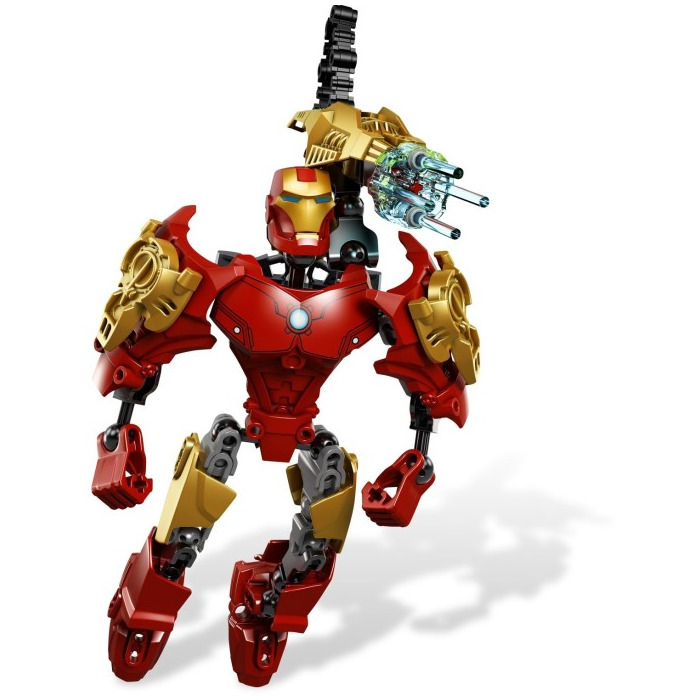
Now, when BIONICLE ended, and just as the Marvel Cinematic Universe was becoming a force to be reckoned with, Lego released a series of superheroes using simpler versions of the BIONICLE elements:
Lego released Iron Man, Captain America, and the Hulk from the Marvel U, and Batman, the Joker, and Green Lantern from the DCU (I've got pics of IM and GL here because they're the only two of the sets that I own).
I managed to snag a double of the Iron Man set, and began to wonder, with the myriad pieces I have, what kinds of Iron Men I could build. Eventually, I settled on an Iron Man with a kind of samurai aesthetic. As I've said, I'm seeing the BIONICLE elements as artistic medium now, so here's some of my superhero inspired art:
It's not immediately obvious in that last picture, but his jets at the back swing up into guns.
Here's a clearer picture of them, though the picture's less clear, if you see what I mean.
So, that's one of my other passions. I'm currently working on a Green Lantern one, and furiously searching for the other characters.
I'll do other, sporadic "Toy Stories." My supervisor, Bart, wrote a book called Comics vs. Art, and in parts of it he considers what we consider the limits of comics scholarship. Should it solely be about 2-dimensional sequential art strips, or can it be about the vast culture, material and otherwise, that has grown up around them too? What are "comics?"
Subscribe to:
Posts (Atom)