This is another comic book-based essay I did for school this year. No word on what I got on it yet.
“...That Hates And Fears Them”: The X-Men and South African Apartheid
The X-Men are most familiar to the general public as the leather-clad freedom-fighters of the early-2000s movie trilogy. While these films undoubtedly did wonders for the franchise, they did not do justice to the important thematic elements of the comic book series. The social critique took a back seat to the action movie. Over the course of their almost 50-year history, the X-Men have been used by numerous writers and artists to discuss a variety of social woes. They have acted as black civil rights analogues in the 1960s and have been commentary on the gay rights movement of the modern era. All of this under the guise of spandex-clad superheroes fighting for a finer world. For the comic book reading community in the late 1980s, the X-Men became a symbol of a struggle that engaged the consciousness of the Western world: the anti-apartheid movement in South Africa. By examining various aspects of the comic, political, social, and personal, the X-Men of the 1980s can be read as commentary on, and explication of, the struggle of black South Africans against apartheid.
There is always a danger inherent in making a comparison such as this one. The struggle against apartheid was not just politically-charged, but emotionally-charged too. A comparison between fictional superheroes and factual freedom fighters can run the risk of being labelled with belittling a significant, and damaging, historical period. The comic book, for the longest time, has been thought of as a throw-away medium, at least by those outside the community. Such an opinion is helped by the quality of materials involved in producing the comic book, especially the ones of the era being considered. The pages are cheap newsprint, the art is slightly blurry, and the colours relatively dull. This, of course, has to be taken in the context of the time, and modern comics prove that printing technology has advanced a great deal in the last 25 years. Regardless, the average comic in the 1980s cost about 75¢, so was not a treasured repository of social commentary. However, if one looks back at the history of the medium, the comic book has always been an outlet for such commentary.
In the 1940s, not long after the first appearance of the superhero, American comics “reflected...the American public's reaction to the horrors of war in general” (Thomas 6), with figures such as Captain America and the Sub-Mariner joining the struggle against Fascism in World War II. The 1950s brought E.C. Comics with their bleak and graphically violent commentary on the hypocrisy of contemporary American society. This social criticism ended with Dr. Frederic Wertham's call for the U.S. Senate to form “a subcommittee to investigate comics and potential ties to juvenile delinquency” (Ro 52). Even into the 1960s, when the institution of the Comics Code Authority had “cleaned up” the industry, Marvel Comics introduced the X-Men, who became “a fantastical allegory to the then-growing American civil rights movement” (Mallory 47). The 1970s brought the even-more biting social satire and criticism of Steve Gerber's Man-Thing and Howard the Duck. In this light, the supposition that The Uncanny X-Men could be a commentary on the situation in South Africa seems far more plausible, and far less frivolous, than a surface reading might suggest.
Through the early Eighties the stories of the X-Men started to deal with a government that was increasingly hostile to their kind. In The Uncanny X-Men #181, a fictional U.S. Senator named Robert Kelly introduces Federal Bill “S-1 – The Mutant Affairs Control Act” (Claremont, “Tokyo Story” 22). The bill, described by detractors as not “far removed from legalized slavery” (21), sets out the mandate of “licensing [mutants] by the government” (“Dark” 5). Senator Kelly's impetus for the act, which at a later point in the comic book universe's chronology actually passes into law, is that “as a nation and, perhaps, a species -- [we have] to defend ourselves!” (“Tokyo Story” 21). This fictional bill parallels a whole slew of laws undertaken by the governing National Party of South Africa, “laws which define the population as consisting of separate 'races'” (International Defense 15). This distinction of race is interesting in considering the X-Men. While the South African government's proclamation of racial difference is patently ridiculous, such is not the case in the world of the X-Men. The mutants are a different species, one that, while descended from homo sapiens, has specific genetic differences that set them apart. To circumvent the prejudices that can be associated with this biological difference, mutants are depicted in the Marvel universe much the same way that humans are: there are good ones and bad ones, they eat, they sleep, they fall in love, they make mistakes. They are just like the humans who share their world and the people reading their adventures. If a people who are genetically different from humans can be, if not heroes, decent ordinary citizens, then it is ridiculous to separate other humans based solely on the colour of their skin. Such a notion may be obvious to the modern reader, but the point of the depiction in the X-Men comics is to highlight that ridiculousness. It must be remembered that it wasn't until 1985, the year after these stories in The Uncanny X-Men were published, that the United States government started imposing sanctions against South Africa (Thompson 234). The specific parallel for the Mutant Affairs Control Act (M.A.C.A.) are the Pass Laws. While the details of the M.A.C.A. are left nebulous, likely so as not to stifle various writers' interpretation and use of it, the Pass Laws give a chilling idea of what those specifics might be: “they show at a glance whether they [the Africans] have any right to be in a particular area; whether or where they are employed; whether they have paid their taxes” (International Defense 43). Later into the comics' history, the M.A.C.A. is renamed “The Mutant Registration Act,” echoing bluntly the “Population Registration Act” of 1950, that instituted “a register of the population and the issuing of racial identity cards” (16). There is a very specific statement being made by creating this sort of tension in the X-Men's universe. Surely it would be easier for superheroes to act in a world free of hatred and bigotry toward their kind, a world that accepts them as the decent people that they are. It would be easier to function in a society without a prejudicial government constantly checking up on, and limiting the freedoms of, its people, a statement that applies every bit as much to apartheid-era South Africa as it does to the X-Men's United States.
Four years later, in The Uncanny X-Men #235, the team and its readership are introduced to the ultra-modern island country of Genosha. “Located off the East African coast, midway between Madagascar and the Seychelles” (Claremont, “Who's Human” 6), this seemingly idyllic nation harbours the dark secret of being maintained by an oppressed class of servile mutants. At this point in the comic, the parallels between the X-Men's fiction and South Africa's reality become quite blatant. By placing the island nation geographically outside the United States, and close to South Africa, the attention of the readers is drawn away from a “what if?” scenario in their own country, to a depiction of what is happening elsewhere in the world. There is further reference to draconian law in the case of a young Genoshan human who finds out his fiancée is “gene-positive.” She is condemned as a mutant and, “know[ing] the law,” he is informed that there will be “no engagement” (“Busting Loose” 25). This references the Mixed Marriages Act and the Immorality Act in South Africa that outlawed “[m]arriage between whites and members of any of the black groups, [as well as] sexual intercourse between them” (International Defense 16). A further legal reflection is the establishment of the “Mutant Settlement Zone” (Claremont, “Revolution” 13). This mutant homeland in the barren north, an enforced geographical segregation, parallels the Group Areas Act of 1980, that forced the labouring class into a substantially smaller amount of land than the ruling whites (International Defense 18). Aside from legal analogues, there are also comparisons to the South African law-makers. Leonard Thompson describes apartheid architect Hendrik Verwoerd thus: “In private life he was charming; in public affairs, dogmatic, intolerant, domineering, and xenophobic” (189). Dr. Moreau (an ironic moniker, to say the least) is the Genegineer on Genosha. He is the man responsible for the control and maintenance of the country's apartheid-like state. When introduced, he is shown as a kind older man working in his garden, and he expresses regret for being pulled away from his son by work (Claremont, “Busting Loose” 7-8). Later, his true colours fly as he describes the oppressed mutants as “our most valuable resource, to be husbanded and utilized for the good of us all” (“Revolution” 19). The kindly facade crumbles even further as Moreau chooses the secrecy and safety of his corrupt regime over the life of his own son (20). Dogmatic, intolerant, domineering, and xenophobic indeed. The comparisons continue apace. Each mutant is forced to wear a uniform that is bonded to their skin, one that, as Rogue of the X-Men points out, “[m]akes the slaves easily identifiable, then guarantees a social environment wherein they're almost totally isolated” (14). This practice takes a society that is predominantly white and creates visual separateness that echoes the separateness of skin colour in South Africa. The marking of mutants also includes the tattooing of a number, somewhat ridiculously, emblazoned across their foreheads. This dehumanizing practice brings the commentary on South Africa in line with that most atrocious of 20th century evils: Nazi Germany. If nothing else had before, this comparison, this link of unthinkably cruel regimes, neatly sums up the opinion of apartheid expressed in the X-Men comics over the years between the introduction of the M.A.C.A. and the fall of Genosha, not long after the real-life fall of apartheid in South Africa .
Political and social themes aside, it is also pertinent to consider the more personal parallels between the X-Men and the anti-apartheid movement. This connection is best explored through fictionalized reflections on apartheid, as fiction can be seen as an emotional reaction to a historical event. The comparison is less concrete, more an implicit connection, but there is a specific theme that links these two disparate fictions: enclosure. Gcina Mhlope's “The Toilet” explores the forced enclosure a black woman in South Africa must endure in order to work and support herself. To escape detection by the white ruling class, she is “locked in [her] sister's room so that the Madam” (Mhlope 117) will not discover her presence. Once employed, the narrator finds herself needing to hide out in a public toilet until she can “sneak into the house again without the white people seeing [her]” (118). This picture of enclosure and hiding has been a staple of the X-Men stories since their inception. In the 1980s, the main X-Men series had a companion comic called The New Mutants. This series traced the adventures of a teen-aged group of mutants, dealing not only with the rights issues of the elder X-Men, but also the problems of puberty and growing up. Issue #45 tells the tale of Larry Bodine who, as a result of being a mutant, ends up killing himself rather than risking discovery. Prior to his suicide, it is revealed that the boy practices his power (the ability to create sculptures out of light, a non-combative and beautiful power) only in his room, locked away from the outside world (Claremont, “Foolin'” 14). At the story's end Kitty Pryde, one of the X-Men, wonders about being accepted by humans and asks, “how can we [be accepted] if we keep hiding.../...behind masks and secret identities and the walls of our school?” (23). Both in the fictional universe and in the real one, enclosure becomes a survival mechanism, perhaps one that all oppressed peoples adopt in one way or another.
The Uncanny X-Men joins a long tradition of social commentary and protest comics with its treatment of apartheid in the 1980s. The deliberate social and political critiques, coupled with the perhaps coincidental thematic similarities with apartheid fiction, give the series a far greater depth than has historically been attributed to the mainstream comic book medium. Of course, having presented such an argument, one is always left with the question of why this reading of this text is an important one, the question of “So what?” To step briefly out of the academic tone, while I was researching this paper, I was struck by the dearth of information pertaining to the reaction of the West to the apartheid state in South Africa. At the time, it was a “cause célèbre” engendering movie star outcries and protest concerts, as well as the myriad political boycotts and sanctions levied against the government. There is certainly plenty of information about what happened, but as I stated in the previous section, fiction can be utilized to discuss how people react emotionally to what happened. Perhaps it is not only important to remember what occurred in history in order to not repeat it, but to remember how that period of history made us feel. This essay demonstrates the anger and revulsion that one small segment of the population felt over South African apartheid.
Works Cited
Note: The citations for individual comic books are based on an article online found at http://www.comicsresearch.org/CAC/cite.html. It is a work in progress, as there is no official MLA guide for citing comic books.
Claremont, Chris (w), Jackson Guice (p), and Kyle Baker (i). “We Were Only Foolin'.” The New Mutants #45 (Nov. 1986), Marvel Comics.
---, Rick Leonardi (p), and Terry Austin (i). “Who's Human?” The Uncanny X-Men #237 (Early Nov. 1988), Marvel Comics.
---, John Romita, jr. (p), and Dan Green (i). “Tokyo Story.” The Uncanny X-Men #181 (May 1984), Marvel Comics.
---, Marc Silvestri (p), and Dan Green (i). “Busting Loose!” The Uncanny X-Men #236 (Late October 1986), Marvel Comics.
---,---,---. “Gonna Be A Revolution.” The Uncanny X-Men #238 (Late Nov. 1988), Marvel Comics.
---, ---, and Bob Wiacek (i). “The Dark before the Dawn.” The Uncanny X-Men #224 ( December 1987), Marvel Comics.
International Defense and Aid Fund for Southern Africa. Apartheid: The Facts. Kent: A.G. Bishop & Sons, 1983.
Mallory, Michael. X-Men: The Characters and Their Universe. Hugh Lauter Levin Associates, 2006.
Mhlope, Gcina. “The Toilet.” Being Here: Modern Short Stories from Southern Africa. Comp. R. Malan. David Phillips Publishers, 1996. 117-23.
Ro, Ronin. Tales to Astonish. New York: Bloomsbury, 2004.
Thomas, Roy. “Marvel's Most Timely Heroes.” The Golden Age of Marvel Comics. Ed. Tom Brevoort. New York: Marvel Comics, 1997. 4-8.
Thompson, Leonard. A History of South Africa. New Haven: Yale University Press, 1990.

Mar 10, 2009
Mar 6, 2009
Medieval Literature, Modern Comics
(Note: This piece was originally a presentation for a Medieval Literature class. After the year was over, I revised it, replacing the Middle English with a modern translation, for the sake of ease.)
(Further note: In November of 2010, a proposal to present this paper at the Pop Culture Association of America's annual conference was accepted. Pending a complete re-write and begging for funding, it will be presented at the conference in Texas in April of 2011.)
Introduction
When I started thinking about this project, I was concerned that I wouldn't find nearly enough material to make it worthwhile. There are definitely a large quantity of comics that feature knights and kings and peasants and fairies. I wondered if they would necessarily have much to do with their 12th - 14th century precedents, or would it just be a matter of a particular thing looking cool in a comic book story? Luckily, the answer fell somewhere in the middle, and the discoveries I made not only carry forward many elements from the medieval period, but they also look really cool! Some pieces I looked at were so dense that I probably could have focussed solely on them. Grant Morrison and Simone Bianchi's "Seven Soldiers: Shining Knight" is deserving of a paper all its own, but my purpose is to give a broad view of the medieval in comic books, and so a broad selection of comics is necessary. I'm going to break my discussion up into three sections: Stories, Forms, and Themes. Within each section I'll give specific visual examples, and discuss how each example is related to a text from the medieval period.
Note: All the images within the text can be enlarged by clicking on them.
1. Stories
Stories are perhaps the easiest aspect to address in adapting medieval literature to modern comics. Indeed, almost since the beginning of the form, and definitely pre-dating Superman, comics' most recognizable hero, medieval stories have figured prominently. Hal Foster began "Prince Valiant in the Days of King Arthur" in 1937, and it has continued, in some form, right up to present day (Torregrossa 244). In the modern age of comics, the most recognizable revival of the medieval story is DC Comics' Camelot 3000, originally published between 1982 and 1985. It is an example of what Jason Tondro calls an "Arthur Transformed" tale, "stories which pick up after the death of Arthur" (170). Camelot 3000 bears out Malory's prophetic "some men say...that King Arthur is not dead...that he shall come again" (Malory 713). Arthur returns in the year 3000, as do the best of his knights, and they battle against Morgan Le Fay to
  save the Earth. The treasonous love between Guenivere and Lancelot also makes a return. There is much emphasis throughout the story on the cyclical nature of the tale. Arthur's, it seems, is a story that will go ever on.
Another story of time-travelling knights is Morrison and Bianchi's "Seven Soldiers: Shining Knight." While the greater part of the tale is about a time-displaced knight, the opening pages give an interpretation of the fall of Camelot. The illustration to the left is an example of Tondro's "Traditional Tale," ones that are "adaptations of...tales in the Arthurian 'canon'" (171). This bloody depiction of the Camelot's defeat (the violence of which will be addressed in the "Themes" section) could easily be compared to the "[g]reat carnage...suffered on both sides, [the] countless groans issued from the dying men" (Geoffrey 155). The balance of the tale, however, falls into the "Arthurian Toybox," where a writer grounds "an original character in an Arthurian setting, from which he soon departs to carry on modern superheroic adventures" (172). This is certainly the case for Sir Justin, the hero of "Shining Knight," who finds himself in New York, 2005, very shortly into the story.
The stories of the medieval period have survived in many forms through the ages, from poem to pamphlet, song to cinema. Their use in modern comics is not unusual, and is likely only the latest iteration of the tales. It could be that soon there will be online "webisodes" on YouTube, or some other video sharing site, depicting Gawain's struggles with the Green Knight, or the ribald humour of "The Miller's Tale." These stories will continue to be told in many different media for many years to come.
2. Forms
Aside from the stories that lend themselves to the comic book, the forms those stories take also make an appearance. The use of these forms varies quite widely. An implicit reference to one form, Chaucer's "Canterbury Tales," is also the most recent example we will be looking at. Neil Gaiman's story "Whatever Happened to the Caped Crusader?" in "Batman" #686, published in February of 2009, and its second part in "Detective Comics" #853, as yet unpublished, tells a vaguely surreal tale of the funeral of The Batman. Various people, friends and enemies, stand to recount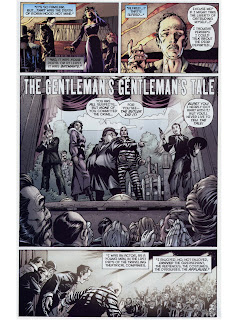 their stories of his last days. Each story is sub-titled, much as each section of Chaucer's work is. The example to the right is the introduction to Alfred's (Bruce "Batman" Wayne's butler) tale. The archaic way of referring to a butler accentuates the connection to Chaucer's text. The other story sub-titled in this comic is simply called "The Catwoman's Tale." The pun is likely very intentional. Jason Tondro writes about "the depth to which Arthurian legend has permeated our culture" (174), such that elements from that legend can be used in comics without explicitly making reference to the legend. I believe that this is the case with "The Canterbury Tales," that it has become so much a part of the culture that a reference such as Gaiman's is implicit.

Where the previous example uses a form specific to one work, Grant Morrison and John J. Muth's The Mystery Play uses the literary form of the mystery play as a jumping-off point for a surreal murder mystery. The setting is a small village in England with a "tradition...of participation in the Yorkshire cycles" (Morrison 6). The Mayor of the town goes on to talk about the involvement of the whole community in the staging of the medieval plays, and in contrast the action of the graphic novel involves many members of the close-knit community. The basic premise is that the actor playing God is murdered, and the actor playing the Devil is the main suspect. Assigned to the murder is one Detective Carpenter (symbolism utterly intentional), who's investigation leads to some profound moral questions and lessons. In this manner, the graphic novel mimics not only the form of the mystery play, but its meditational purpose too. In the illustration to the left, the play is taking place on a flat-bed truck, a fair update of the "system of movable wagons that was common...in England" (Klaus, Gilbert, and Field 118), upon which the play would have taken place on in its original context.
There are other aspects of medieval form that appear in comic books. In issue #4 of "Seven Soldiers: Shining Knight," the villains, a race called the Sheeda, a fairy analogue that will be dealt with in the next section, speak in a runic script. The script is Ogham, an "Early Medieval alphabet used primarily to represent the Old Irish language" ("Ogham" Wikipedia).
These uses of medieval forms serve a number of purposes. They link the modern work with a medieval predecessor, lending an air of authenticity, especially in a medium so marginalized through its history. There is also an aspect of tribute in the works, an acknowledgement that these forms were used in some of the greatest works of English literature and that they should be respected and remembered. Building on this idea is the notion that these forms can be adapted for a modern audience, that they are not just forms that were useful in the medieval period, but ones that can be useful in our modern one.
3. Themes
Thematic elements are somewhat harder to pinpoint. The use of the Sheeda in "Shining Knight" can be interpreted as a "Toybox" approach, as Tondro suggests with Arthurian comics. The fairies are an element of medieval stories (Lanval and Sir Orpheo spring immediately to mind), but their involvement in "Shining Knight" is not specific to one particular tale. In this way they become a thematic element, specifically that of an outside presence, of a magical or unknown nature, intruding upon reality and causing chaos.
Another theme shared by the comic and medieval tales is one that has landed the comic book in trouble quite often over its history: violence. Fredric Wertham's attack on comic books in the 1950s was based almost entirely around depictions of violence on the printed page, and it was an attack that nearly shut down the comic book industry. In the early 2000s, Steven Seagle and Kelley Jones investigated this aspect of medieval literature in their series "The Crusades." The series chronicles, as the back cover of The Crusades: Urban Decree graphic novel claims, the exploits of "an enigmatic 11th-century crusader...come to render a terrible justice on the citizens of 21st-century San Francisco". As can be seen from the picture to the right, the "terrible justice" is quite brutal. However, if we contrast this with Gawain's exploits in the wilds, where "[s]ometimes he fights dragons, and wolves as well,/Sometimes with wild men who dwelt among the crags" ("Gawain" 255;l.720-21) and on to the declaration that "fighting troubled him less than the rigorous winter" (255;l.726), we see that the violence, the terrible justice, is less troublesome to a character from the medieval period. How, then, can this attitude toward violence be reconciled in the modern day? While the man the knight attacks is a mugger, as are many of his victims throughout the series, his vigilante-style of justice does not sit well with modern people.
It is on the topic of themes that the greatest disparity between medieval literature and modern comics can be seen. The cultural norms of the two periods are so different that transposing into one what is acceptable in the other becomes problematic. However, consideration of such cultural clashes is often the point of superimposing one period over another. In examining the differences between cultural perceptions, a common point of reference can sometimes be distinguished. In such a case, lessons can be learned about both time periods.
Conclusion
The comics I've highlighted here are just a sampling. They are only indicative of medieval elements in comics that I have in my personal collection, and are therefore subject to the whims of my tastes. I have purposefully left out much of the specifics of the stories, purely in the interest of people who might be intrigued and want to go out and find these books. Some among you will perhaps want to find out how Arthur manages to defeat the alien invaders and Morgan Le Fay in Camelot 3000, or just what happens to Sir Justin after he finds himself in New York, circa 2005, in "Seven Soldiers: Shining Knight." What these glimpses may prove, or support at least, is that there is a reason that the great works of the medieval period continue to be studied and read: they are great stories, with great characters, and they deal with themes common to human experience, whether you are a peasant listening to a storyteller in the 13th century, or a person sitting on your couch reading a comic in the 21st.
(Further note: In November of 2010, a proposal to present this paper at the Pop Culture Association of America's annual conference was accepted. Pending a complete re-write and begging for funding, it will be presented at the conference in Texas in April of 2011.)
Introduction
When I started thinking about this project, I was concerned that I wouldn't find
 nearly enough material to make it worthwhile. There are definitely a large quantity of comics that feature knights and kings and peasants and fairies. I wondered if they would necessarily have much to do with their 12th - 14th century precedents, or would it just be a matter of a particular thing looking cool in a comic book story? Luckily, the answer fell somewhere in the middle, and the discoveries I made not only carry forward many elements from the medieval period, but they also look really cool! Some pieces I looked at were so dense that I probably could have focussed solely on them. Grant Morrison and Simone Bianchi's "Seven Soldiers: Shining Knight" is deserving of a paper all its own, but my purpose is to give a broad view of the medieval in comic books, and so a broad selection of comics is necessary. I'm going to break my discussion up into three sections: Stories, Forms, and Themes. Within each section I'll give specific visual examples, and discuss how each example is related to a text from the medieval period.
 Note: All the images within the text can be enlarged by clicking on them.
1. Stories
Stories are perhaps the easiest aspect to address in adapting medieval literature to modern comics. Indeed, almost since the beginning of the form, and definitely pre-dating Superman, comics' most recognizable hero, medieval stories have figured
 prominently. Hal Foster began "Prince Valiant in the Days of King Arthur" in 1937, and it has continued, in some form, right up to present day (Torregrossa 244). In the modern age of comics, the most recognizable revival of the medieval story is DC Comics' Camelot 3000, originally published between 1982 and 1985. It is an example of what Jason Tondro calls an "Arthur Transformed" tale, "stories which pick up after the death of Arthur" (170). Camelot 3000 bears out Malory's prophetic "some men say...that King Arthur is not dead...that he shall come again" (Malory 713). Arthur returns in the year 3000, as do the best of his knights, and they battle against Morgan Le Fay to
  save the Earth. The treasonous love between Guenivere and Lancelot also makes a return. There is much emphasis throughout the story on the cyclical nature of the tale. Arthur's, it seems, is a story that will go ever on.
 Another story of time-travelling knights is Morrison and Bianchi's "Seven Soldiers: Shining Knight." While the greater part of the tale is about a time-displaced knight, the opening pages give an interpretation of the fall of Camelot. The illustration to the left is an example of Tondro's "Traditional Tale," ones that are "adaptations of...tales in the Arthurian 'canon'" (171). This bloody depiction of the Camelot's defeat (the violence of which will be addressed in the "Themes" section) could easily be compared to the "[g]reat carnage...suffered on both sides, [the] countless groans issued from the dying men" (Geoffrey 155). The balance of the tale, however, falls into the "Arthurian Toybox," where a writer grounds "an original character in an Arthurian setting, from which he soon departs to carry on modern superheroic adventures" (172). This is certainly the case for Sir Justin, the hero of "Shining Knight," who finds himself in New York, 2005, very shortly into the story.
The stories of the medieval period have survived in many forms through the ages, from poem to pamphlet, song to cinema. Their use in modern comics is not unusual, and is likely only the latest iteration of the tales. It could be that soon there will be online "webisodes" on YouTube, or some other video sharing site, depicting Gawain's struggles with the Green Knight, or the ribald humour of "The Miller's Tale." These stories will continue to be told in many different media for many years to come.
2. Forms
Aside from the stories that lend themselves to the comic book, the forms those stories take also make an appearance. The use of these forms varies quite widely. An implicit reference to one form, Chaucer's "Canterbury Tales," is also the most recent example we will be looking at. Neil Gaiman's story "Whatever Happened to the Caped Crusader?" in "Batman" #686, published in February of 2009, and its second part in "Detective Comics" #853, as yet unpublished, tells a vaguely surreal tale of the funeral of The Batman. Various people, friends and enemies, stand to recount
 their stories of his last days. Each story is sub-titled, much as each section of Chaucer's work is. The example to the right is the introduction to Alfred's (Bruce "Batman" Wayne's butler) tale. The archaic way of referring to a butler accentuates the connection to Chaucer's text. The other story sub-titled in this comic is simply called "The Catwoman's Tale." The pun is likely very intentional. Jason Tondro writes about "the depth to which Arthurian legend has permeated our culture" (174), such that elements from that legend can be used in comics without explicitly making reference to the legend. I believe that this is the case with "The Canterbury Tales," that it has become so much a part of the culture that a reference such as Gaiman's is implicit.
Where the previous example uses a form specific to one work, Grant Morrison and John J. Muth's The Mystery Play uses the literary form of the mystery play as a jumping-off point for a surreal murder mystery. The setting is a small village in England with a "tradition...of participation in the Yorkshire cycles" (Morrison 6). The Mayor of the town goes on to talk about the involvement of the whole community in the staging of the medieval plays, and in contrast the action of the graphic novel involves many members of the close-knit community. The basic premise is that the actor playing God is murdered, and the actor playing the Devil is the main suspect. Assigned to the murder is one Detective Carpenter (symbolism utterly intentional), who's investigation leads to some profound moral questions and lessons. In this manner, the graphic novel mimics not only the form of the mystery play, but its meditational purpose too. In the illustration to the left, the play is taking place on a flat-bed truck, a fair update of the "system of movable wagons that was common...in England" (Klaus, Gilbert, and Field 118), upon which the play would have taken place on in its original context.
There are other aspects of medieval form that appear in comic books. In issue #4 of "Seven Soldiers: Shining Knight," the villains, a race called the Sheeda, a fairy analogue that will be dealt with in the next section, speak in a runic script. The script is Ogham, an "Early Medieval alphabet used primarily to represent the Old Irish language" ("Ogham" Wikipedia).
These uses of medieval forms serve a number of purposes. They link the modern work with a medieval predecessor, lending an air of authenticity, especially in a medium so marginalized through its history. There is also an aspect of tribute in the works, an acknowledgement that these forms were used in some of the greatest works of English literature and that they should be respected and remembered. Building on this idea is the notion that these forms can be adapted for a modern audience, that they are not just forms that were useful in the medieval period, but ones that can be useful in our modern one.
3. Themes
Thematic elements are somewhat harder to pinpoint. The use of the Sheeda in "Shining Knight" can be interpreted as a "Toybox" approach, as Tondro suggests with Arthurian comics. The fairies are an element of medieval stories (Lanval and Sir Orpheo spring immediately to mind), but their involvement in "Shining Knight" is not specific to one particular tale. In this way they become a thematic element, specifically that of an outside presence, of a magical or unknown nature, intruding upon reality and causing chaos.
Another theme shared by the comic and medieval tales is one that has landed the comic book in trouble quite often over its history: violence. Fredric Wertham's attack on comic books in the 1950s was based almost entirely around depictions of
 violence on the printed page, and it was an attack that nearly shut down the comic book industry. In the early 2000s, Steven Seagle and Kelley Jones investigated this aspect of medieval literature in their series "The Crusades." The series chronicles, as the back cover of The Crusades: Urban Decree graphic novel claims, the exploits of "an enigmatic 11th-century crusader...come to render a terrible justice on the citizens of 21st-century San Francisco". As can be seen from the picture to the right, the "terrible justice" is quite brutal. However, if we contrast this with Gawain's exploits in the wilds, where "[s]ometimes he fights dragons, and wolves as well,/Sometimes with wild men who dwelt among the crags" ("Gawain" 255;l.720-21) and on to the declaration that "fighting troubled him less than the rigorous winter" (255;l.726), we see that the violence, the terrible justice, is less troublesome to a character from the medieval period. How, then, can this attitude toward violence be reconciled in the modern day? While the man the knight attacks is a mugger, as are many of his victims throughout the series, his vigilante-style of justice does not sit well with modern people.
 It is on the topic of themes that the greatest disparity between medieval literature and modern comics can be seen. The cultural norms of the two periods are so different that transposing into one what is acceptable in the other becomes problematic. However, consideration of such cultural clashes is often the point of superimposing one period over another. In examining the differences between cultural perceptions, a common point of reference can sometimes be distinguished. In such a case, lessons can be learned about both time periods.
Conclusion
The comics I've highlighted here are just a sampling. They are only indicative of medieval elements in comics that I have in my personal collection, and are therefore subject to the whims of my tastes. I have purposefully left out much of the specifics of the stories, purely in the interest of people who might be intrigued and want to go out and find these books. Some among you will perhaps want to find out how Arthur manages to defeat the alien invaders and Morgan Le Fay in Camelot 3000, or just what happens to Sir Justin after he finds himself in New York, circa 2005, in "Seven Soldiers: Shining Knight." What these glimpses may prove, or support at least, is that there is a reason that the great works of the medieval period continue to be studied and read: they are great stories, with great characters, and they deal with themes common to human experience, whether you are a peasant listening to a storyteller in the 13th century, or a person sitting on your couch reading a comic in the 21st.
Works Cited
Barr, Mike W. (w), and Brian Bolland (a). Camelot 3000. New York: DC Comics, 1988.
Gaiman, Neil (w), Andy Kubert (p), and Scott Williams (i). "Whatever Happened to the Caped Crusader part 1 of 2: The Beginning of the End." Batman #686 (April 2009), DC Comics.
Geoffrey of Monmouth. "A History of the Kings of Britain." The Broadview Anthology of British Literature volume 1: The Medieval Period. Ed. Joseph Black, et al. Peterborough: Broadview Press, 2006. 136-57.
Klaus, Carl H., Miriam Gilbert, and Bradford S. Field, Jr. "Medieval Theater." Stages of Drama. Ed. Carl H. Klaus, Miriam Gilbert, and Bradford S. Field, Jr. 2nd Ed. New York: St. Martin's Press, 1991. 117-121.
Malory, Sir Thomas. "Morte Darthur." The Broadview Anthology of British Literature volume 1: The Medieval Period. Ed. Joseph Black, et al. Peterborough: Broadview Press, 2006. 679-719.
Morrison, Grant (w), and John J. Muth (a). The Mystery Play. New York: DC Comics, 1994.
Morrison, Grant (w), and Simone Bianchi (a). "The Last of Lancelot." Seven Soldiers: Shining Knight #1 (May 2005), DC Comics.
---. "The Last Stand of Don Vincenzo." Seven Soldiers: Shining Knight #4 (October 2005), DC Comics.
"Ogham." Wikipedia. 28 February 2009.
Seagle, Steven T. (w), Kelley Jones (p), and Jason Moore (i). "The First Crusade A.D. 2001." The
Crusades #1 (May 2001), DC Comics.
---. The Crusades: Urban Decree. New York: DC Comics, 2001.
Torregrossa, Michael A. "Once and Future Kings: The Return of King Arthur in the Comics." Adapting the Arthurian Legends for Children. Ed. Barbara Tepa Lupack. New York: Palgrave Macmillan, 2004. 243-62.
Tondro, Jason. "Camelot in Comics." King Arthur in Popular Culture. Ed. Elizabeth S. Sklar and Donald L. Hoffman. Jefferson: McFarland & Company, 2002. 169-81.
Barr, Mike W. (w), and Brian Bolland (a). Camelot 3000. New York: DC Comics, 1988.
Gaiman, Neil (w), Andy Kubert (p), and Scott Williams (i). "Whatever Happened to the Caped Crusader part 1 of 2: The Beginning of the End." Batman #686 (April 2009), DC Comics.
Geoffrey of Monmouth. "A History of the Kings of Britain." The Broadview Anthology of British Literature volume 1: The Medieval Period. Ed. Joseph Black, et al. Peterborough: Broadview Press, 2006. 136-57.
Klaus, Carl H., Miriam Gilbert, and Bradford S. Field, Jr. "Medieval Theater." Stages of Drama. Ed. Carl H. Klaus, Miriam Gilbert, and Bradford S. Field, Jr. 2nd Ed. New York: St. Martin's Press, 1991. 117-121.
Malory, Sir Thomas. "Morte Darthur." The Broadview Anthology of British Literature volume 1: The Medieval Period. Ed. Joseph Black, et al. Peterborough: Broadview Press, 2006. 679-719.
Morrison, Grant (w), and John J. Muth (a). The Mystery Play. New York: DC Comics, 1994.
Morrison, Grant (w), and Simone Bianchi (a). "The Last of Lancelot." Seven Soldiers: Shining Knight #1 (May 2005), DC Comics.
---. "The Last Stand of Don Vincenzo." Seven Soldiers: Shining Knight #4 (October 2005), DC Comics.
"Ogham." Wikipedia. 28 February 2009
Seagle, Steven T. (w), Kelley Jones (p), and Jason Moore (i). "The First Crusade A.D. 2001." The
Crusades #1 (May 2001), DC Comics.
---. The Crusades: Urban Decree. New York: DC Comics, 2001.
Torregrossa, Michael A. "Once and Future Kings: The Return of King Arthur in the Comics." Adapting the Arthurian Legends for Children. Ed. Barbara Tepa Lupack. New York: Palgrave Macmillan, 2004. 243-62.
Tondro, Jason. "Camelot in Comics." King Arthur in Popular Culture. Ed. Elizabeth S. Sklar and Donald L. Hoffman. Jefferson: McFarland & Company, 2002. 169-81.
Subscribe to:
Posts (Atom)